
Mass Tort Lawsuits 2026: Complete MDL, Claims & Settlement Guide
Mass tort lawsuits involve many people alleging similar injuries from the same or related drug, medical device, product, exposure, platform or course of conduct. Federal cases may be coordinated through multidistrict litigation (MDL) while individual claimants generally keep separate injury, causation and damages issues.
What happens after you submit
- A case advisor reviews your detailsThey look at the injury, product or incident, and dates you share. This is not legal advice.
- A matching firm may contact youIf your claim fits, an independent law firm or legal intake partner that handles this type of case may reach out.
- You decide what happens nextThere is no fee to submit and no obligation to move forward.
Current Mass Tort MDLs to Watch in 2026
These mass tort lawsuits and MDLs were checked against official federal court or JPML sources. They are not a complete list of every pending mass tort case, and litigation status can change after publication.
The dockets below show where mass tort lawsuits are currently pending. A pending count describes caseload at a point in time, not the number of claims that will recover anything.
Depo-Provera — MDL 3140
Among current mass tort lawsuits, the Northern District of Florida continues to manage the Depo-Provera products-liability litigation. The court lists additional 2026 case-management activity, including an August 21 conference and a September Rule 702 hearing.
Suboxone Dental Injury — MDL 3092
These mass tort lawsuits allege that Suboxone buprenorphine/naloxone film contributed to dental erosion and decay, with claims coordinated in the Northern District of Ohio. The allegations remain disputed.
Uber MDL 3084 & Lyft MDL 3171
Uber passenger sexual-assault cases are coordinated in MDL 3084 before Judge Charles R. Breyer. Lyft passenger sexual-assault cases are coordinated separately in MDL 3171 before Judge Rita F. Lin, both in the Northern District of California. Centralization does not establish liability.
AFFF / PFAS — MDL 2873
The District of South Carolina continues to oversee AFFF mass tort lawsuits involving PFAS-related personal-injury, property and other claims.
Roblox Child Exploitation & Assault — MDL 3166
The Northern District of California lists MDL 3166, In re: Roblox Corporation Child Sexual Exploitation and Assault Litigation, before Judge Richard Seeborg. The docket continued to show August 2026 activity. Centralization does not establish liability.
JPML Pending MDL Reports
The U.S. Judicial Panel on Multidistrict Litigation publishes monthly reports identifying pending federal MDLs. TortAdvisor uses these reports as a primary status check for coordinated federal litigation.
Mass Tort Lawsuit & Claim Guides for 2026
Use the categories below to research mass tort lawsuits and closely related coordinated litigation. Mass tort lawsuits can involve pharmaceuticals, devices, toxic exposures, consumer products, rideshare claims and online-platform allegations. A listed topic may involve a federal MDL, consolidated state litigation, large-scale civil claims or another coordinated proceeding. Inclusion does not establish liability, guarantee a settlement or mean every claimant qualifies.
Dangerous Drugs & Product Liability
8 guides
Depo-Provera Lawsuit
Mass tort lawsuits involving Depo-Provera include meningioma allegations, use history, medical proof, MDL 3140 and filing considerations.
Suboxone Lawsuit
Mass tort lawsuits involving Suboxone include dental injury allegations, treatment history and MDL 3092.
Ozempic Lawsuit
Gastroparesis, intestinal-injury allegations, medication history, warnings and litigation updates.
Talcum Powder Lawsuit
Ovarian-cancer and mesothelioma allegations, product-use evidence and litigation developments.
Hair Relaxer Lawsuit
Chemical-straightener use, cancer allegations, diagnosis evidence and claim considerations.
NEC Baby Formula Lawsuit
Claims involving premature infants, cow’s-milk-based formula, NEC, surgery and long-term harm.
Tylenol Autism Lawsuit
Claims alleging prenatal acetaminophen exposure is linked to autism and ADHD diagnoses in children.
Oxbryta Lawsuit
Claims involving Oxbryta (voxelotor) use linked to increased vaso-occlusive crises, stroke and wrongful death risk.
Medical Devices & Surgical Products
5 guides
Medical Device Lawsuits
Medical-device mass tort lawsuits can involve FDA recalls, device identification, implants, surgical products, evidence, MDLs and filing issues.
Hernia Mesh Lawsuit
Mesh failure, migration, infection, chronic pain, revision surgery and product identification.
Bair Hugger Lawsuit
Surgical infection allegations, device use, treatment records and litigation developments.
Breast Implant Lawsuit
BIA-ALCL, rupture, systemic symptoms, revision surgery and implant documentation.
Hip Replacement Lawsuit
Claims over metal-on-metal and defective hip implants causing metallosis, early failure and revision surgery.
Toxic Exposure, Chemicals & Asbestos
9 guides
PFAS Cancer Lawsuit
PFAS mass tort lawsuits can involve forever-chemical exposure, cancer allegations, contaminated water and occupational evidence.
AFFF Firefighting Foam Lawsuit
AFFF mass tort lawsuits can involve PFAS foam exposure affecting firefighters, military sites, airports and communities.
Roundup Lawsuit
Glyphosate exposure, non-Hodgkin lymphoma allegations and product-use history.
Paraquat Lawsuit
Parkinson’s disease allegations, agricultural exposure and evidence considerations.
Mesothelioma Lawsuit
Asbestos exposure, worksite and product identification, trust funds and wrongful-death options.
World Trade Center Claims
Resources for responders, workers, residents, survivors and eligible family members.
Asbestos Lawsuit
Claims for workers and families exposed to asbestos in construction, shipyards, manufacturing and older buildings.
Asbestos Lung Cancer Lawsuit
Claims for asbestos-related lung cancer diagnoses, eligibility criteria and trust fund compensation.
California Wildfire Lawsuit
Claims for property loss, injury and wrongful death tied to utility-caused California wildfires.
Sexual Abuse Lawsuit
Civil claims involving individuals, schools, churches, facilities and other institutions.
Uber & Lyft Sexual Assault Lawsuit
Trip records, platform evidence, medical and therapy documentation, and federal MDL context.
Roblox Sexual Abuse Lawsuit
Grooming and exploitation allegations, digital evidence, MDL 3166 and child-safety issues.
Snapchat Lawsuit
Exploitation, mental-health harm, platform-design allegations and account evidence.
Social Media Addiction Lawsuit
These mass tort lawsuits involve allegations of addictive platform design and youth mental-health harms.
Video Game Addiction Lawsuit
Claims involving alleged addictive design, youth-targeted mechanics and behavioral harms.
How Mass Tort Lawsuits & MDL Claims Work
Mass tort lawsuits may involve hundreds or thousands of individual plaintiffs alleging similar harm. Unlike a single ordinary injury case, mass tort lawsuits often require coordinated discovery and rulings on issues shared across many claims. When federal cases share common factual questions, the Judicial Panel on Multidistrict Litigation can transfer them to one district for coordinated pretrial proceedings under 28 U.S.C. § 1407.
Identify the Common Harm
Mass tort claims often involve the same drug, medical device, chemical exposure, platform or course of conduct, but each plaintiff’s injury and damages remain individual.
Centralization May Be Requested
The JPML can decide whether federal cases sharing common factual questions should be coordinated in an MDL and select the transferee court.
Coordinated Pretrial Proceedings
The MDL court may manage discovery, motions, expert issues, bellwether preparation and other common pretrial matters.
Individual Claims Remain
MDL centralization does not itself create a class action. Individual causation, damages, defenses and settlement decisions may still differ from claimant to claimant.
Why mass tort lawsuits are not class actions, and why it changes everything
- A class actionOne representative case under Rule 23. A single judgment binds class members who do not opt out.
- A mass tortThousands of separate claims that stay individual. Each still has to prove its own injury and causation.
- What an MDL isUnder 28 U.S.C. § 1407 the JPML transfers related federal cases to one judge for pretrial work only.
- Why cases go backIn Lexecon the Supreme Court held the transferee judge cannot keep cases for trial. Unresolved cases are remanded.
- What bellwethers doA handful of representative trials that inform settlement discussions. They do not bind the others.
- What centralization is notCreating an MDL proves nothing about liability and guarantees no payment to anyone.
TortAdvisor · Educational information, not legal advice or a case valuation
What Can Affect Mass Tort Settlements & Claim Value?
There is no universal payout for mass tort lawsuits. Even when mass tort lawsuits are resolved through a common settlement program, individual compensation can differ substantially. Mass tort settlements can depend on injury severity, medical causation, product or exposure proof, claimant-specific damages, litigation stage, defenses, available settlement funds and the terms of any negotiated resolution.
There is no published per-claim figure for mass tort lawsuits as a category, and there cannot be one. Mass tort lawsuits keep each claim individual, so a number that averages across an entire docket describes the docket rather than any claim in it.
Injury Severity
Diagnosis, surgery, hospitalization, permanent impairment, future treatment and prognosis can materially affect individual damages.
Causation Evidence
Medical records, expert evidence, exposure history or product-use documentation may be central to proving that the alleged mass tort caused the claimed injury.
Product or Exposure Proof
Prescription history, device identity, purchase records, worksite evidence, trip data or account records can be essential in different mass tort cases.
Economic Damages
Medical expenses, lost wages, reduced earning capacity and future care can provide measurable damages evidence.
Non-Economic Harm
Pain, trauma, disability, loss of enjoyment and other non-economic damages depend on applicable law and individual facts.
Settlement Matrix or Tiers
Some mass tort settlements use matrices, point systems or injury tiers, but the structure varies by litigation and should never be assumed before official terms exist.
Venue & Filing Status
Jurisdiction, statutes of limitation, MDL orders, filing status and claimant compliance can affect eligibility and leverage.
Defenses & Litigation Stage
Expert rulings, bellwether results, appellate decisions and available defenses can affect settlement negotiations without guaranteeing an outcome.
What actually drives value in mass tort lawsuits
- The injury itselfSeverity, permanence and whether treatment is finished or continuing.
- Strength of the recordWhether use, exposure and diagnosis are documented or reconstructed from memory.
- Where the case sitsThe state whose law applies, and whether it is in an MDL, a state consolidation or standing alone.
- Timing in the litigationAn early bellwether and a late inventory claim are not valued the same way.
- Who is left to paySolvency, insurance limits and whether a defendant has reorganized through bankruptcy.
- Competing explanationsOther plausible causes of the same condition, which the defense will raise individually.
TortAdvisor · Educational information, not legal advice or a case valuation
Evidence That May Support Mass Tort Claims
Mass tort lawsuits usually require both common litigation evidence and claimant-specific proof. Strong mass tort claims connect the individual claimant to the product, exposure or conduct at issue. Preserving records early can help identify the product, exposure, injury, timing and damages that distinguish an individual claim.
- Medical records, diagnoses, imaging, pathology, prescriptions, surgery records and therapy notes
- Drug use, prescription history, pharmacy records or product identification
- Medical-device model, lot, serial, implant stickers or operative records when relevant
- Exposure history, jobsite records, military records, water data or environmental documentation
- Photos, videos, screenshots, messages, app records, trip data and other digital evidence
- Employment records, wage loss, disability documentation and out-of-pocket expenses
- Witness information and a dated timeline of use, exposure, symptoms, diagnosis and treatment
- Any prior claim form, release, settlement communication or attorney representation agreement
What mass tort lawsuits have to establish before value is discussed
- The product or conductThe specific drug, device, chemical, platform or course of conduct at issue.
- Personal exposure or usePrescription records, purchase history, employment files or account data tying the person to it.
- A recognized injuryA diagnosis or harm of the kind the litigation is actually about, documented in records.
- General causationPublished science showing the product can cause that harm. This is often decided once for all cases.
- Specific causationThat it did cause this person’s harm, given their own history. This is decided case by case.
- A live filing windowA limitation period that has not run, judged under the law of the relevant state.
TortAdvisor · Educational information, not legal advice or a case valuation
Mass Tort Settlement Calculators & Amount Guides
For mass tort lawsuits, TortAdvisor calculators organize claim-specific facts that may influence mass tort compensation. They are educational tools, not legal opinions, settlement offers or guarantees.
Settlement Calculators
Browse drug, medical-device, toxic-exposure, abuse and other mass-tort-related educational claim-factor tools.
Lawsuit Settlement Amounts
Research claim-specific damages factors, settlement structures and payout considerations without treating projections as confirmed values.
Depo-Provera Settlement Calculator
Organize injection history, meningioma diagnosis, treatment, neurological effects and damages factors.
Bair Hugger Settlement Calculator
Review infection, surgical treatment, revision procedures, evidence and damages factors.
PFAS Settlement Calculator
Organize PFAS exposure history, diagnosis, medical evidence, treatment and damages information.
Sexual Abuse Settlement Calculator
Confidentially organize harm, evidence, treatment, institutional factors and damages for abuse-related civil claims.
Rideshare Sexual Assault Settlement Calculator
Organize trip evidence, incident severity, treatment, economic loss and other rideshare-specific claim factors.
Roblox Sexual Abuse Settlement Calculator
Organize exploitation allegations, digital evidence, treatment, reporting history and child-safety claim factors.
How TortAdvisor Reviews Mass Tort Litigation
Mass tort lawsuits and MDL proceedings can change quickly. For mass tort lawsuits, TortAdvisor separates confirmed procedural facts from allegations, settlement estimates and predictions, and prioritizes JPML, federal courts, regulators and other primary sources whenever they are reasonably available.
Every status and figure published here about mass tort lawsuits is traced back to a primary source before it appears on the page.
Court, Regulatory & Mass Tort Sources
These primary sources support the mass-tort procedure and current litigation examples discussed on this page. Individual claim guides should still cite the most specific court, agency, statute, label, order, transfer document, or scientific source relevant to that claim.
JPML Pending MDL Reports
Monthly federal multidistrict-litigation status reports.
JPML — MDL Procedure
Official explanation of 28 U.S.C. § 1407 centralization.
Depo-Provera — MDL 3140
Northern District of Florida case page and 2026 hearing schedule.
Suboxone — MDL 3092
Northern District of Ohio case page for Suboxone film dental-injury litigation.
AFFF / PFAS — MDL 2873
District of South Carolina case page for AFFF products-liability litigation.
Uber — MDL 3084
Northern District of California Uber passenger sexual-assault MDL page.
Lyft — MDL 3171
Northern District of California Lyft passenger sexual-assault MDL page.
Roblox — MDL 3166
Northern District of California Roblox child-exploitation and assault MDL page.
Source access/review date: August 20, 2026. Court schedules, dockets, case counts, filing standards and agency guidance can change after publication. TortAdvisor links material procedural claims to the closest available primary source.
The order TortAdvisor trusts sources in when researching mass tort lawsuits
- 1. The controlling courtOrders, dockets and opinions from the judge actually deciding the litigation.
- 2. The JPMLMonthly pending-case reports and the transfer orders that created each MDL.
- 3. Company filingsForm 10-Q, 10-K and 8-K disclosures where a defendant states its own reserves and agreements.
- 4. Federal agenciesFDA, EPA, OSHA, ATSDR and comparable regulators for recalls, labels and exposure guidance.
- 5. Peer-reviewed sciencePublished studies on whether the product or conduct can cause the harm alleged.
- 6. Everything elseSecondary coverage is used only as support, never as the basis for a figure.
TortAdvisor · Educational information, not legal advice or a case valuation
Mass Tort Lawsuits 2026 FAQ
Use these answers as a starting point. Claim-specific lawsuit guides provide the more detailed eligibility, evidence, deadline and litigation information for each mass tort.
What mass tort lawsuits are active in 2026?
Current mass tort litigation includes coordinated federal and state cases involving drugs, medical devices, toxic exposures, products, rideshare sexual-assault claims and online-platform allegations. The exact status varies by lawsuit, court and jurisdiction.
SourceJPML1 Sep 2026
What is a mass tort?
A mass tort involves many people alleging similar injuries from the same or related products, exposures or conduct. Federal mass tort lawsuits may be coordinated in an MDL, but individual plaintiffs generally retain individual claims for damages.
Source28 U.S.C.Sec. 1407
Does an MDL mean the defendant is liable?
No. In mass tort lawsuits, MDL centralization is a procedural mechanism for coordinating common pretrial issues. It does not establish that a defendant is liable or that any claimant will recover compensation.
Source28 U.S.C.Sec. 1407(a)
How do I know whether I may qualify?
Eligibility depends on the specific product or exposure, diagnosis, evidence, timing, jurisdiction and legal requirements. Start with the matching lawsuit guide, then compare evidence, deadlines, settlement research and calculator tools where available.
How much can a mass tort lawsuit be worth?
There is no universal value. Injury severity, causation, liability evidence, economic losses, future care, applicable law, available recovery sources and other claim-specific facts can affect potential compensation.
SourceJPML1 Sep 2026
How long do I have to file?
Deadlines vary by state and claim type. Some matters involve discovery rules, survivor filing windows, administrative deadlines or court orders, so claim-specific review should happen promptly.
SourceN.Y. CPLRSec. 214
What is a bellwether trial?
Short answer: A bellwether trial is an early test case tried in front of a jury inside a mass tort. The Federal Judicial Center describes bellwethers as individual trials held by the MDL judge to produce reliable information about the other cases in the same MDL.
The parties and the court pick a small group of cases meant to represent the wider pool, prepare them for trial, and try a few. The verdicts, and how the evidence holds up, give both sides a realistic sense of what other claims are worth, which is why bellwethers often promote a global settlement. The FJC guide also notes their limits: a handful of verdicts may not represent every claim, and many bellwether cases settle or are dismissed before trial.
- A bellwether verdict is not your verdict. It does not decide or pay other cases.
- Dates move: bellwether trials are often vacated when a settlement is reached, as in the Depo-Provera MDL in 2026.
- Where they stand now: the GLP-1 MDL has no bellwether date set; the hair relaxer MDL’s first trial is set for September 7, 2027.
SourcesBellwether Trials in MDL ProceedingsFederal Judicial Center, 201928 U.S.C. § 1407Cornell LIIJPML report2 Nov 2026
What is an MDL (multidistrict litigation)?
Short answer: An MDL, or multidistrict litigation, is a federal procedure that sends similar lawsuits filed across the country to one judge for shared pretrial work such as discovery and expert rulings. It is set up by the Judicial Panel on Multidistrict Litigation under 28 U.S.C. § 1407. On November 2, 2026, 204,987 actions were pending in 164 MDLs.
Each case stays an individual lawsuit. The statute allows transfer only for pretrial proceedings, and any case not resolved is to be sent back (remanded) to the court where it was filed for trial. In practice most product cases resolve in the MDL through rulings, bellwether trials or a settlement program.
- Examples now: talc MDL 2738 (69,376 pending), AFFF MDL 2873 (15,270), hair relaxer MDL 3060 (12,743), Depo-Provera MDL 3140 (6,413), GLP-1 MDL 3094 (4,082).
- Not a class action: no one represents you automatically; you file your own case.
- State courts often run parallel coordinated proceedings for the same products.
How are mass tort settlements paid out?
Short answer: Usually through a settlement administrator that scores each claim against a matrix of tiers based on injury and proof, then pays in stages. In the Paraquat MDL, for example, the court required each plaintiff’s matrix tier and offer to be reported to a special master.
The usual steps
- Registration and records review.
- Tier placement and an offer.
- Accept or opt out.
- Payment, after fees, costs and medical liens are deducted.
How does a mass tort lawsuit work, step by step?
Short answer: Individual lawsuits are filed against the same company, often consolidated before one federal judge in a multidistrict litigation (MDL), tested in early bellwether trials, and then frequently resolved through a settlement program. Each person keeps an individual claim.
The usual stages
- Filing and consolidation (JPML transfer).
- Shared discovery and expert rulings.
- Bellwether trials.
- Settlement or remand for trial.
What is the difference between a class action and a mass tort?
Short answer: A class action is one lawsuit on behalf of a whole group, and one result binds every class member. In a mass tort, each person files an individual case; cases are grouped for pretrial work, but each claim is valued separately.
| Class action | Mass tort | |
|---|---|---|
| Your case | Part of one group case | Your own lawsuit |
| Payout | Shared by formula | Based on your injuries |
| Typical use | Similar small harms | Serious, different injuries |
SourcesFed. R. Civ. P. 23Cornell LII28 U.S.C. § 1407Cornell LII

Uber & Lyft Sexual Assault Lawsuit Update
Follow the separate Uber MDL 3084 and Lyft MDL 3171 proceedings and current federal litigation context.
Depo-Provera Settlement 2026 Update
Review current Depo-Provera settlement and MDL developments before comparing claim-value factors.
Roblox Lawsuit Update: MDL 3166
Review current federal Roblox child-exploitation litigation and MDL 3166 procedural developments.
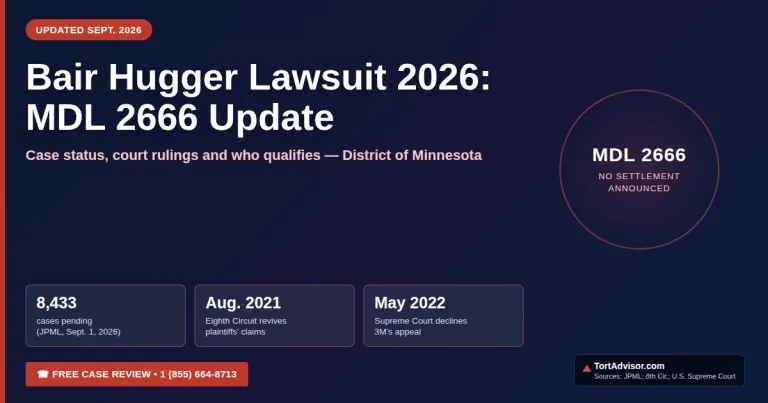
Bair Hugger Lawsuit 2026 Update
Follow current Bair Hugger MDL 2666 litigation and settlement-related developments.
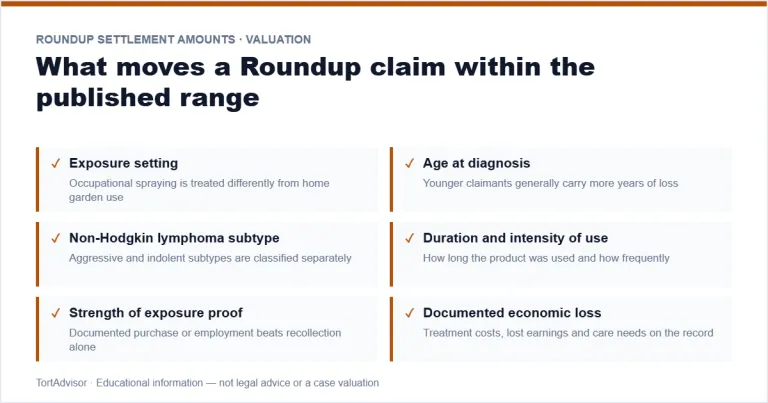
Roundup Settlement Amounts
The $7.25 billion class settlement, its $6,000 to $165,000 payout range, and the 2026 Supreme Court preemption ruling.
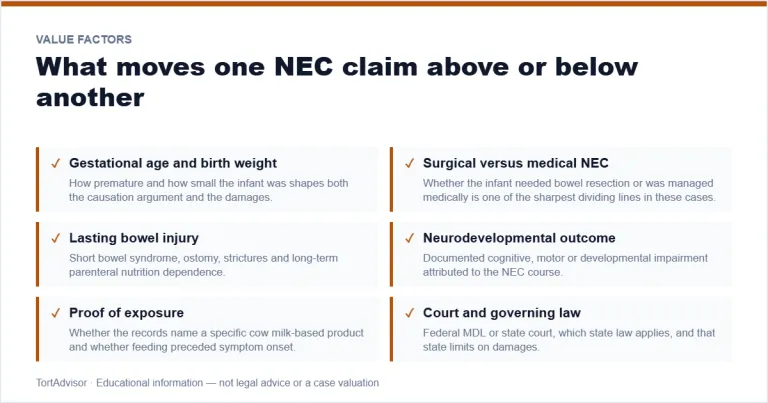
NEC Settlement Amounts
What Abbott’s approximately $670 million settlement covers, and why the widely quoted per-infant arithmetic does not work.
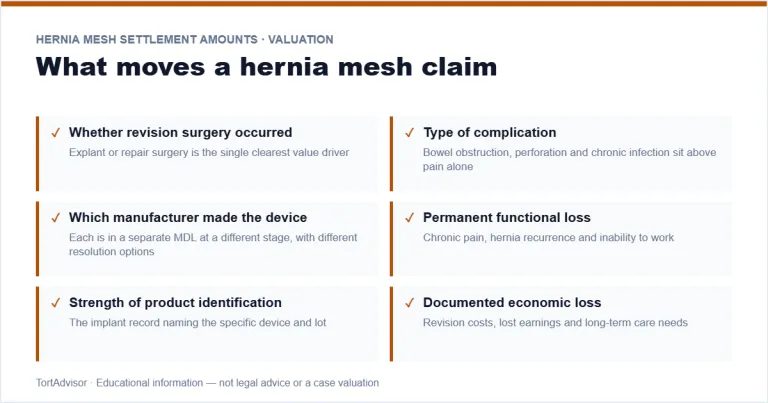
Hernia Mesh Settlement Amounts
Three separate device litigations at three different stages, only one of which has settled.
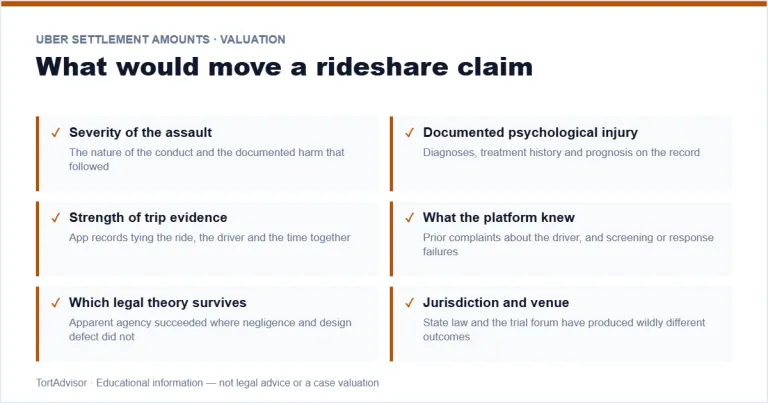
Uber Sexual Assault Settlement Amounts
Two federal juries have returned verdicts in MDL 3084 — $8.5 million and $5,000. What that gap means for claim value.
All Settlement Amount Guides
Sourced payout research across every case type we cover, with clear labelling of what is confirmed and what is only projected.
Request a Free, Confidential Mass Tort Case Review
Share what happened and a trained case advisor will review it. There is no fee to submit and no obligation.