Talcum Powder Settlement Amounts 2026: J&J’s $5.5B Proposal
After a decade of litigation and two failed bankruptcy manoeuvres, Johnson & Johnson has proposed paying $5.5 billion to resolve the ovarian talc cases. It is a proposal, not a programme — and it only takes effect if almost every remaining claimant agrees.
Latest Talcum Powder Settlement Amounts and MDL 2738 Status
The talcum powder litigation is the largest mass tort in the United States by pending case count, and the only one in this library where the defendant has twice tried to route it through bankruptcy and twice been turned back.
J&J moves the claims into a subsidiary and files for Chapter 11 twice under the so-called Texas two-step. Both attempts are dismissed, and the claims return to the tort system.
A third attempt through Red River Talc LLC, structured as a consensual prepackaged reorganisation, is denied. J&J announces it will return to the tort system and defend the cases individually.
J&J reports having settled approximately 95% of the mesothelioma lawsuits, along with consumer protection claims and disputes with talc suppliers. The mesothelioma claims are a different track with different science and different values.
J&J announces an agreement with plaintiff firms leading the MDL and state proceedings, structured as per-claim payments and conditioned on 95% participation.
No more than $3 billion would be paid in 2027, with no additional payments due before 2028 — so even a successful resolution pays over several years.
The docket has not shrunk. Until the participation threshold is met, every case remains live and the litigation continues on its normal track.
Talcum Powder Settlement Amounts: Confirmed Facts vs. Projections
A $5.5 billion headline invites a simple division of the talcum powder money. The arithmetic is easy; whether it means anything is the harder question.
What Is Confirmed
- J&J announced a $5.5 billion commitment on July 27, 2026.
- The first payment is no more than $3 billion in 2027, with no additional payments due before 2028.
- It is structured as per-claim payments, not a lump sum.
- It requires express participation of at least 95% of remaining claims.
- Roughly 76,000 ovarian talc claims are pending across all courts.
- MDL 2738 held 69,340 pending actions of 72,024 filed as of the Oct. 1, 2026 JPML report, before Judge Michael A. Shipp.
- J&J reports having already resolved approximately 95% of mesothelioma talc lawsuits on a separate track.
What Is Not Known
- Whether the 95% participation threshold will be met.
- The per-claim matrix — no allocation criteria or tier values have been published.
- What any individual claimant would receive under it.
- What happens to claims that opt out, or to all claims if the proposal fails.
- Whether the payment schedule extends beyond 2028 and on what terms.
- How claims filed after the announcement are treated.
What the Talcum Powder Settlement Arithmetic Actually Implies
Because the talcum powder money is earmarked for per-claim payments to a known population, division is at least meaningful here — unlike a state enforcement fund. But it produces an average, and an average is not an offer.
Advanced ovarian cancer, long documented use, strong product proof
- Later-stage diagnosis with intensive treatment or recurrence
- Many years of documented regular perineal use
- Purchase records or consistent corroborated household use
- Younger age at diagnosis and substantial economic loss
- No strong alternative-cause evidence such as a BRCA mutation
Confirmed diagnosis, moderate use history
- Ovarian cancer diagnosis with completed treatment
- Regular use over a sustained but shorter period
- Partial documentary proof supported by testimony
- Mid-life diagnosis with moderate documented loss
Shorter use, weaker proof, or competing causes
- Limited or intermittent use history
- Product identification resting on recollection alone
- Older age at diagnosis with limited economic loss
- Documented genetic or family-history risk factors
How a talcum powder settlement payment would be calculated
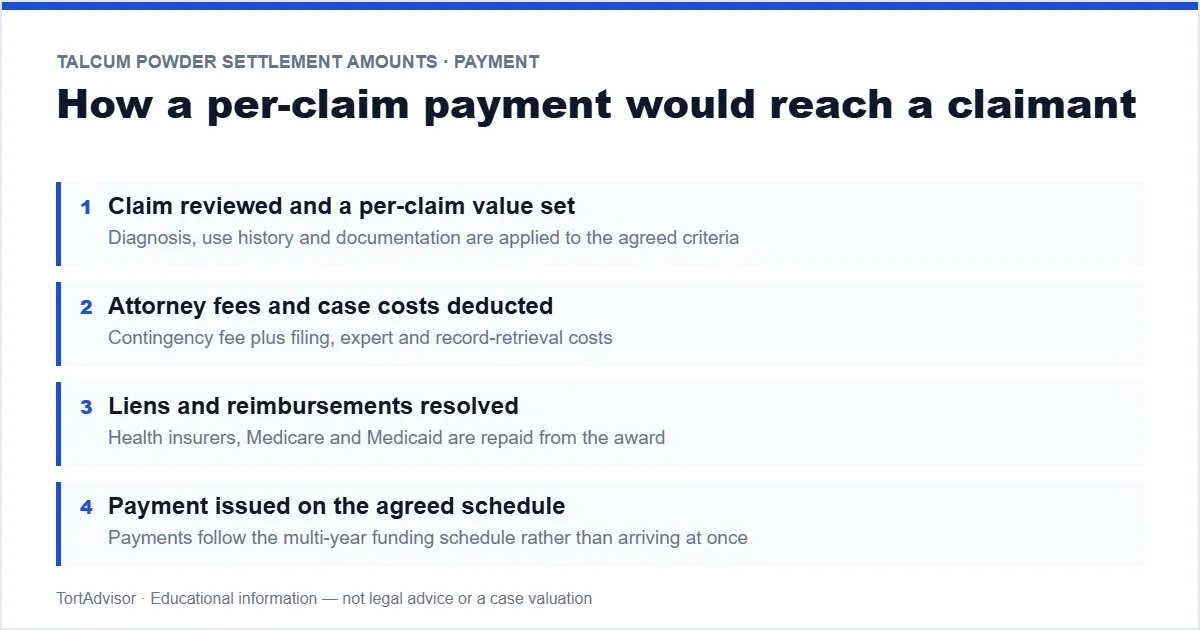
The announced structure is per-claim payments over several years. This is the sequence between an assigned value and money received.
Claim reviewed and valued
Diagnosis, stage, use history and documentation are applied to whatever criteria the parties agree.
Participation elected
A claimant decides whether to accept the resolution. The programme only funds if 95% of remaining claims participate.
Fees and costs deducted
Contingency fee plus filing, expert and record-retrieval costs come out of the gross figure first.
Liens resolved
Health insurers, Medicare and Medicaid assert reimbursement rights against the recovery.
Net payment issued on schedule
Payments follow the multi-year funding timetable, beginning no earlier than 2027.
Illustrative sequence only. No talcum powder settlement fund has been created and no claim has been paid under this proposal as of Sept. 1, 2026.
How TortAdvisor Handles Talcum Powder Settlement Amounts
The talcum powder litigation has produced enormous verdicts, most of them reduced or reversed. Reporting those as though they were settlement values is the standard error.
Separate verdicts from settlements
Headline talc verdicts are jury awards in individual trials, frequently cut on appeal. They tell you almost nothing about what a settled claim pays.
Label arithmetic as arithmetic
Dividing a committed total by a claim count produces an average. We say so plainly rather than presenting it as an expected payment.
Keep the two tracks apart
Ovarian and mesothelioma talc claims have different science, different defendants’ positions and very different values. They are never blended here.
Track conditions, not just totals
A commitment with a 95% participation condition is not the same as money in escrow. The condition is reported alongside the figure every time.
Talcum Powder Settlement Amounts by Claim Profile
The same proposal would treat these profiles very differently, because the factors that drive talcum powder claim value are not evenly distributed.
| Claim profile | Use history | Diagnosis | Position relative to the average | What moves it |
|---|---|---|---|---|
| Long-term user, advanced disease | Decades of regular perineal use with corroboration | Advanced-stage ovarian cancer, recurrence or death | Upper | |
| Long-term user, earlier-stage disease | Decades of use, well documented | Earlier-stage ovarian cancer, treatment completed | Upper to middle | |
| Moderate user, confirmed diagnosis | Sustained use over a shorter period | Ovarian cancer diagnosis | Middle | |
| User with genetic risk factors | Any | Ovarian cancer with a documented BRCA mutation or family history | Lower | |
| Mesothelioma claimant | Any talc exposure | Mesothelioma rather than ovarian cancer | Separate track entirely |
Positions in this table are TortAdvisor modelling, not a published matrix. No allocation criteria have been released, and the parties may adopt a structure that weights these factors differently.
Free Talcum Powder Case Review
Wondering how the figures on this page relate to your own situation? Share a few details below — a trained case advisor reviews every submission FREE and with no obligation, and your information stays confidential.
- Free — no cost, no obligation
- About a minute to complete
- Reviewed by a trained case advisor
- Nothing you submit is published
Your details are sent over a secure connection and reviewed confidentially.
Who May Qualify for Talcum Powder Settlement Amounts
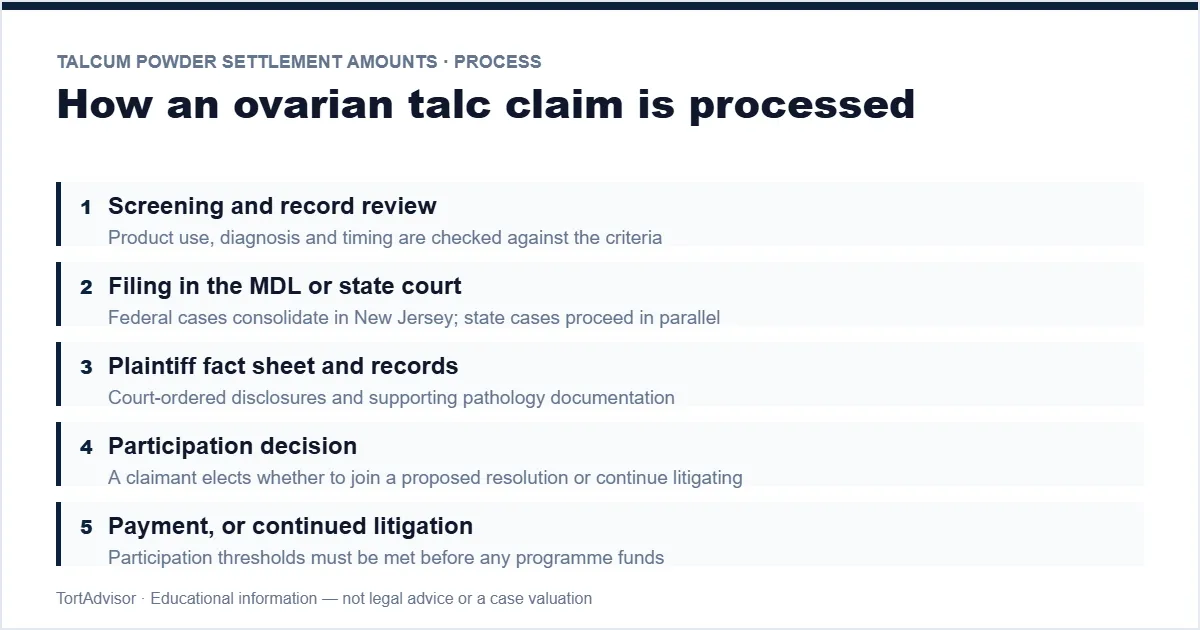
Eligibility for the proposed talcum powder resolution turns on diagnosis and on having a claim already in the system.
Common Screening Factors
- An ovarian cancer diagnosis — the proposed resolution covers the ovarian track
- Regular perineal use of a talc-based body powder before diagnosis
- Use over a sustained period, typically years rather than months
- Some means of identifying the product, from receipts to consistent household testimony
- Claims brought by a personal representative where the claimant has died
- A claim already pending in the MDL or a related state proceeding
Factors Requiring Closer Review
- Mesothelioma rather than ovarian cancer — a different track, not covered here
- Documented BRCA mutation or strong family history, which defendants raise as alternative causation
- Short or intermittent use that weakens the exposure argument
- Product identification resting on recollection alone
- State limitation periods for anyone who has not yet filed
- Whether to participate in the resolution or opt out — a decision with consequences either way
Our ovarian cancer talc lawsuit guide covers eligibility in more depth, and the separate talc mesothelioma track is covered on its own page.
Factors That May Increase or Reduce Talcum Powder Settlement Amounts
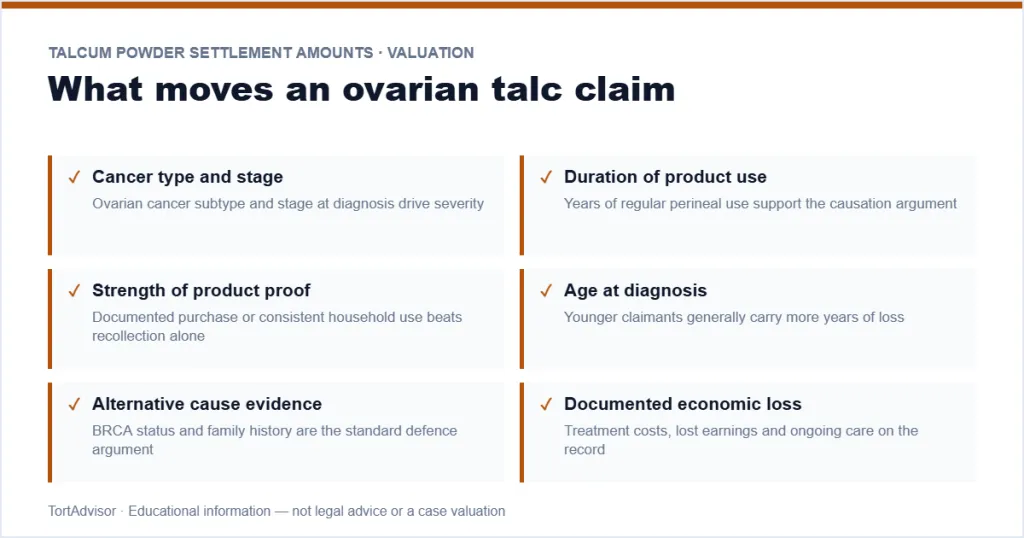
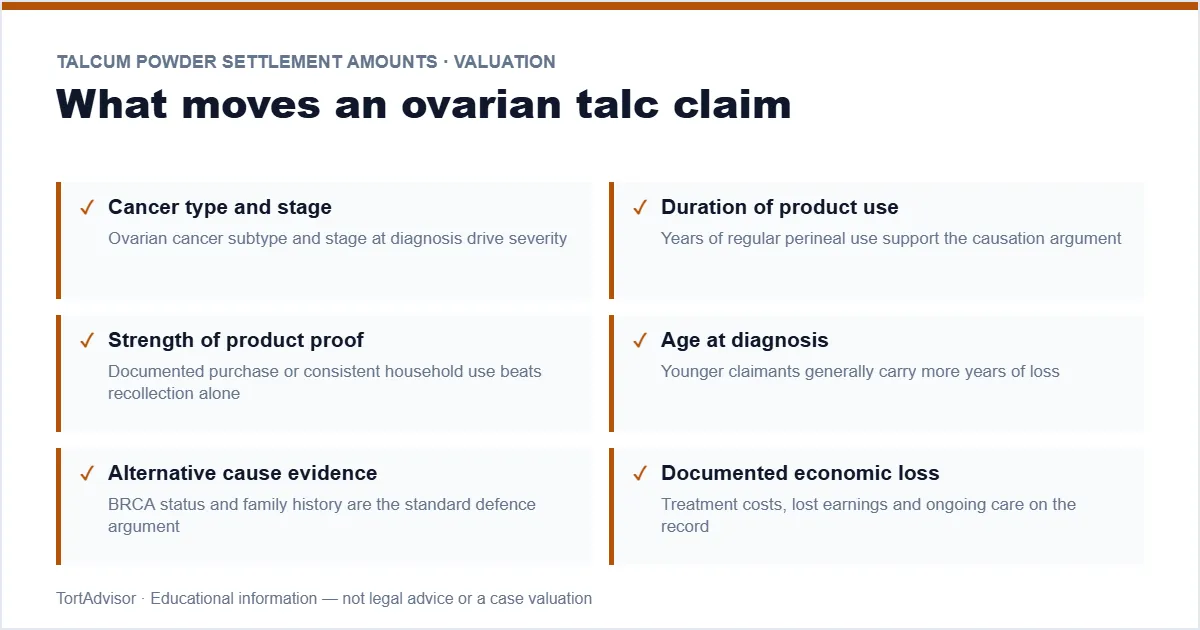
Whatever allocation criteria are ultimately adopted, these are the factors that decide whether a talcum powder claim is strong.
Cancer type and stage
Ovarian cancer subtype and stage at diagnosis are the primary severity measure. Recurrence, metastasis and death claims sit above single-episode treated disease.
Duration and regularity of use
Years of routine perineal application support the exposure argument far more strongly than occasional use, and duration is the factor most often contested.
Strength of product identification
Purchase records, photographs, consistent household testimony or supply evidence. Weak product proof is a recurring reason claims are discounted.
Age at diagnosis
A younger claimant generally carries more years of lost earning capacity and future care need, which raises the economic component.
Alternative-cause evidence
A documented BRCA mutation or strong family history is the standard defence argument. It does not defeat a claim but it reliably reduces its assessed value.
Documented economic loss
Surgery, chemotherapy, hospitalisation, ongoing surveillance, lost earnings and care costs need to be on the record to count toward any award.
Evidence Supporting Talcum Powder Settlement Amounts
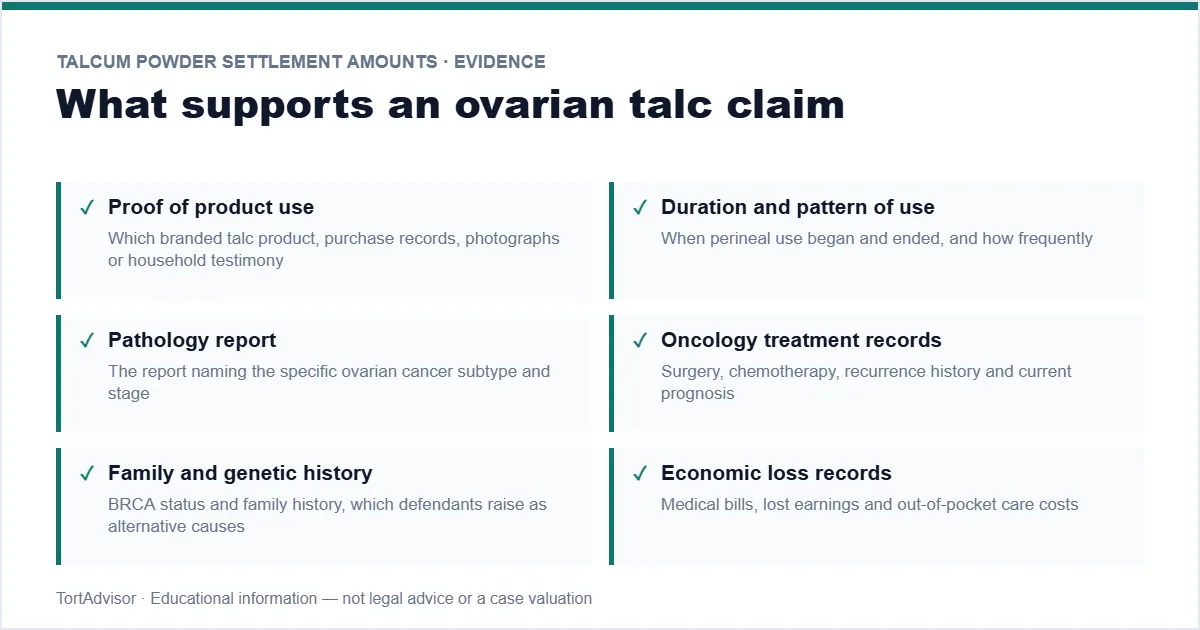
Two evidence problems dominate talcum powder claims: proving which product was used and for how long, and meeting the causation argument on genetics.
Proof of product use
Purchase receipts, loyalty or pharmacy records, photographs of product in the home, and testimony from family members who can confirm the routine.
Duration and pattern
When perineal use began and ended, and how regularly. A coherent timeline spanning years is what supports the exposure argument.
Pathology report
The report naming the specific ovarian cancer subtype and stage. Subtype matters to both causation and severity.
Oncology treatment records
Surgery, chemotherapy regimens, hospitalisations, recurrence history, current prognosis and ongoing surveillance.
Genetic and family history
BRCA testing results and family cancer history. Gathering this early lets a claim address the defence argument rather than be surprised by it.
Economic loss records
Medical bills and explanations of benefits, payroll or tax records showing lost earnings, and out-of-pocket costs for travel and care.
Filing Deadlines for Talcum Powder Claims
Two clocks matter for talcum powder claims: the state limitation period for anyone not yet filed, and the participation election for anyone already in.
If you already have a claim
- The participation election is the live decision, and it has consequences either way
- Opting out means continuing to litigate individually against a well-resourced defendant
- Even a successful resolution pays over several years, beginning no earlier than 2027
If you have not filed
- Your state’s limitation period governs and may be as short as one or two years from diagnosis
- Discovery rules vary by state and change when the clock starts
- Wrongful death claims usually run from the date of death, on a separate clock
- The announcement of a resolution does not pause any of this
Take the Talcum Powder Settlement Calculator Below
The calculator organises what you know about product use, diagnosis, treatment, records and financial loss into an educational range, and shows which factors carry the most weight in a talcum powder claim. It takes a few minutes and asks for no documents.
The result is educational and is not a guaranteed case value or settlement offer.
Before You Start
- Roughly when talc use began and ended
- How regularly the product was used
- The ovarian cancer subtype and stage from the pathology report
- Age at diagnosis
- Treatment received, including any recurrence
- Whether BRCA testing has been done
Answer what you know. You do not need every record or an exact timeline to get started.
Primary Sources for Talcum Powder Settlement Amounts
Every time-sensitive figure on this page traces to one of these. Each was checked on Oct. 1, 2026.
JPML pending-actions report
The JPML report dated Oct. 1, 2026 lists 69,340 actions pending in MDL 2738 of 72,024 filed, before Judge Michael A. Shipp in the District of New Jersey — the largest pending mass tort docket in the country.
J&J proposed resolution announcement
Johnson & Johnson’s July 27, 2026 announcement sets out the $5.5 billion commitment, the first payment of no more than $3 billion in 2027, the per-claim structure, the roughly 76,000 pending ovarian claims and the 95% participation condition.
Prepackaged reorganisation attempt
J&J’s own account of the prepackaged plan documents the bankruptcy route the company attempted before the current proposal.
Return to the tort system
J&J’s statement on returning to the tort system followed the denial of that plan and set the posture that led to the July 2026 proposal.
Company position on the science
J&J’s talc information site sets out the company’s position that its talc products are safe and do not cause cancer. That position is contested by plaintiffs and has not been resolved by the proposed settlement, which J&J has not framed as an admission.
Mesothelioma track
J&J states it has resolved approximately 95% of the mesothelioma talc lawsuits separately, along with consumer protection claims and talc supplier disputes. Those claims are not covered by the ovarian resolution.
Frequently Asked Questions About Talcum Powder Settlement Amounts
What is the average talcum powder settlement amount?
No talcum powder average exists, because no claim has been paid under the proposed resolution. Dividing the $5.5 billion commitment by roughly 76,000 pending claims produces about $72,000, but that is arithmetic on a headline figure — not an allocation, not an offer, and before attorney fees and liens.
Is the $5.5 billion talc settlement final?
No. It was announced on July 27, 2026 as a proposed resolution and requires the express participation of at least 95% of remaining claims. If that threshold is not met the proposal can fail, as previous attempts to resolve these claims have.
When would talc settlement payments begin?
No earlier than 2027. J&J stated a first payment of no more than $3 billion would be made in 2027, with no additional payments due before 2028, so even a successful resolution pays over several years.
How many talcum powder lawsuits are pending?
The JPML report dated Oct. 1, 2026 lists 69,340 actions pending in federal MDL 2738. J&J puts the total ovarian talc claim count across all courts at roughly 76,000, the difference being state-court cases.
Does the settlement cover mesothelioma claims?
No. The proposed resolution addresses the ovarian talc litigation. J&J reports having separately resolved approximately 95% of the mesothelioma lawsuits, which involve different science and different claim values.
Does a BRCA mutation stop a talc claim?
No, but it is the standard defence argument. Defendants point to genetic and family-history risk factors as an alternative cause. It does not defeat a claim on its own, though it reliably reduces the value assigned to one.
Can I still file a talcum powder lawsuit?
Whether a new talcum powder claim can be brought depends on your state’s limitation period, which continues to run and is unaffected by the announcement. Whether a newly filed claim would be covered by the proposed resolution has not been published.
Is the talcum powder settlement calculator legally binding?
No. It is an educational tool that organises claim factors into an illustrative range. It is not a case valuation, not an offer, and produces nothing that binds Johnson & Johnson, any court or any law firm.
See Which Factors May Affect a Talcum Powder Ovarian Cancer Settlement
Answer the questions you can about talc product use, an ovarian cancer diagnosis, treatment, records, expenses and long-term impact. The calculator organizes those inputs into an educational settlement range and highlights the factors that may matter most when a claim is reviewed.
The result is educational and is not a guaranteed case value or settlement offer.
Helpful Information to Have Ready
You do not need every record in hand. Answer what you know; these details can make the estimate more useful.
Reading this page is separate from any request to be contacted. The consent boxes on this form are unchecked unless you tick them yourself.