Paraquat Litigation in 2026: What Monsanto v. Durnell Changed
Paraquat litigation changed materially on June 25, 2026. In Monsanto Co. v. Durnell, the U.S. Supreme Court held that FIFRA can preempt a state failure-to-warn claim when the warning sought under state law was never required by the EPA. Although Durnell involved glyphosate rather than paraquat, the ruling directly affects a central legal theory used in many paraquat cases.
As of October 2026: 6,602 actions are pending in federal Paraquat MDL 3004; a global settlement has been agreed in principle but no fund size, tier schedule, average payment, or claimant allocation has been publicly disclosed; and EPA's paraquat registration review remains open. This page separates those verified facts from projections and explains what Durnell changed, what it did not decide, and what to watch next.
Primary sources checked: U.S. Supreme Court, JPML, Southern District of Illinois, EPA and Federal Register.
Find out if you may have a claim
Answer a few questions and a trained case advisor will review your situation — most people finish in about a minute.
- Free — no cost, no obligation
- About a minute to complete
- Reviewed by a trained case advisor
- Nothing you submit is published
Your details are sent over a secure connection and reviewed confidentially.
What changed in one sentence?
Monsanto v. Durnell makes many paraquat failure-to-warn claims harder to sustain because a state-law warning theory may be preempted when EPA never required the warning plaintiffs say should have appeared on the federally regulated pesticide label.
What it did not decide: Durnell did not itself decide paraquat-specific design-defect, negligent-testing or failure-to-report claims.
Paraquat litigation at a glance
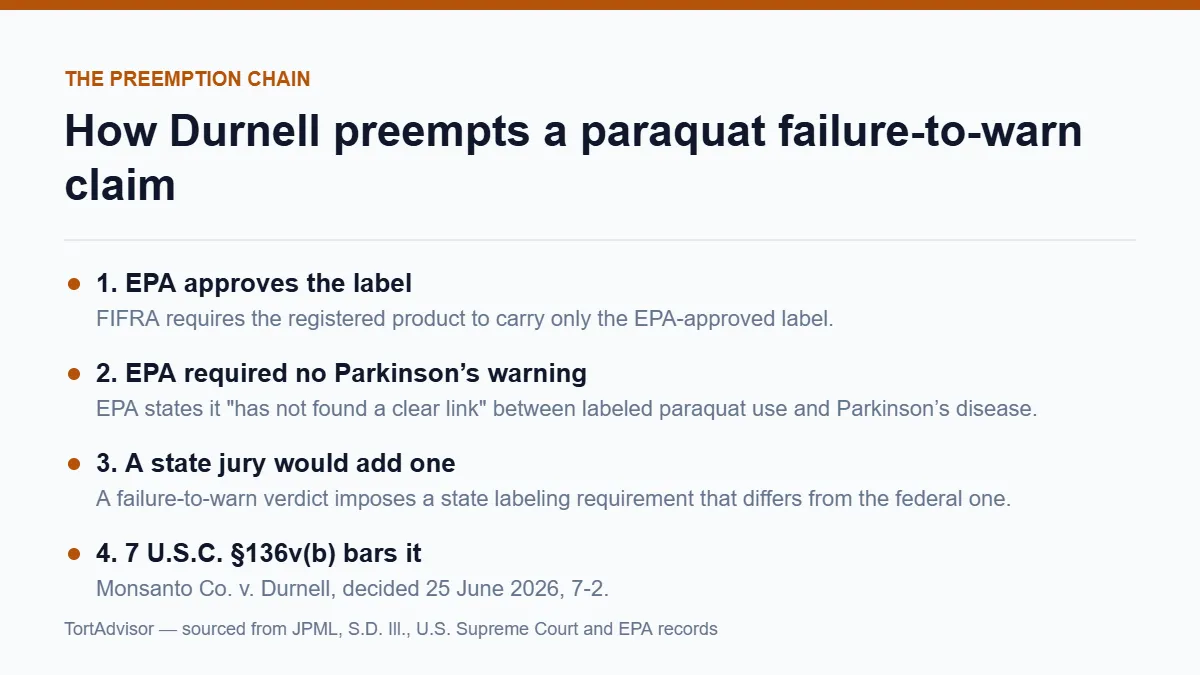
- 6,602 actions pending in MDL 3004 as of the JPML's October 1, 2026 report.
- Chief Judge Nancy J. Rosenstengel, Southern District of Illinois, case 3:21-md-3004-NJR.
- A global settlement has been agreed in principle — but its terms, fund size and per-claimant allocation have never been disclosed.
- Monsanto Co. v. Durnell was decided June 25, 2026, 7-2. The Court held that FIFRA can preempt state failure-to-warn claims when the warning sought was not required by EPA; the ruling now has to be applied to paraquat claims by the courts handling them.
- The EPA says it has not found a clear link between labeled paraquat use and Parkinson's disease. EPA also says the underlying studies vary in quality and have produced conflicting results.
What the Supreme Court decided in Monsanto v. Durnell
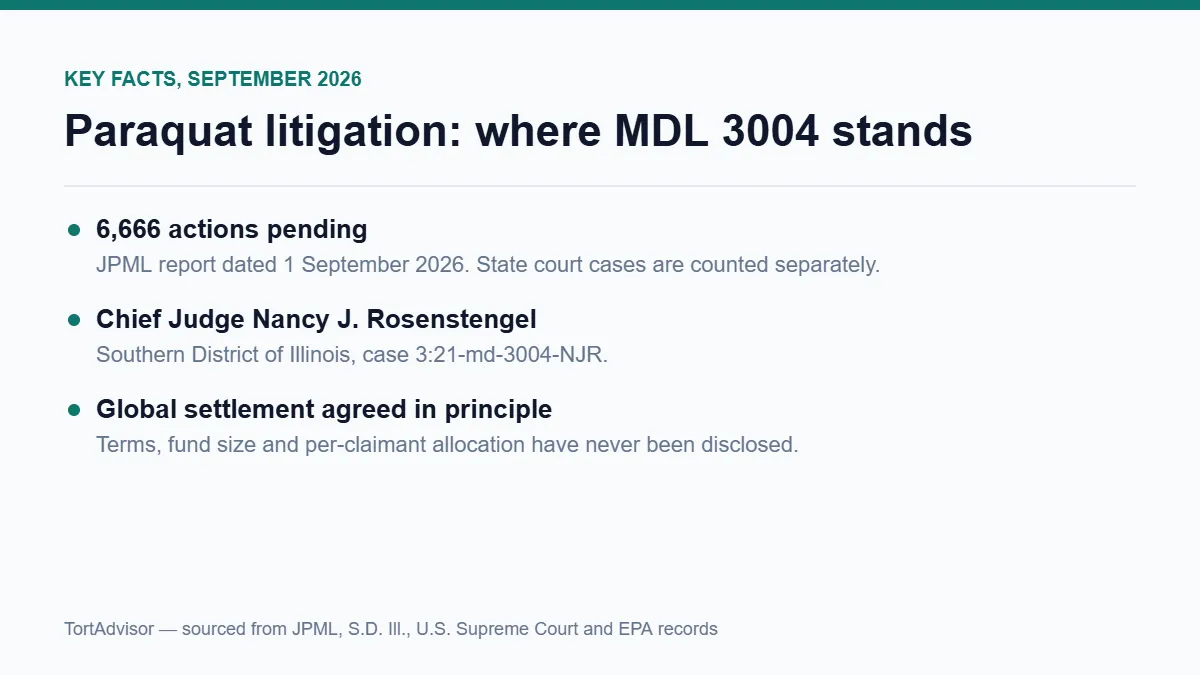
In Monsanto Co. v. Durnell, No. 24-1068, decided 25 June 2026, the Court held that the Federal Insecticide, Fungicide, and Rodenticide Act expressly preempts a state-law failure-to-warn claim when that claim would require adding a warning the EPA never required on the product's approved label.
The vote was 7-2. Justice Kavanaugh wrote for the majority, joined by Chief Justice Roberts and Justices Thomas, Alito, Sotomayor, Kagan and Barrett. Justice Thomas filed a concurrence. Justice Jackson dissented, joined by Justice Gorsuch. The decision reversed the Missouri Court of Appeals. The vote breakdown and authorship are confirmed in the Cornell Legal Information Institute record.
The reasoning matters more than the result. The Court treated state tort duties as labeling requirements within the meaning of FIFRA. Once state tort law is a labeling requirement, FIFRA's uniformity provision at 7 U.S.C. §136v(b) bars any state requirement that differs from the federal one. A jury verdict saying "you should have warned" is, in the Court's framing, a state requirement to carry a label the EPA did not approve.
Why Durnell lands directly on paraquat litigation
Durnell was a glyphosate case — Roundup, not paraquat. Its preemption analysis, however, turns on FIFRA's treatment of federally regulated pesticide labeling rather than on glyphosate alone. That is why the decision is relevant to paraquat failure-to-warn claims even though the Court did not decide a paraquat case.
Paraquat claims allege that Syngenta and Chevron failed to warn users that exposure could cause Parkinson's disease. For a state failure-to-warn duty to survive Durnell, there would need to be an EPA-required Parkinson's warning that the manufacturers omitted. There is not one. The EPA's position, in its own words, is the opposite:
"After a thorough review of the best available science, as required under FIFRA, EPA has not found a clear link between paraquat exposure from labeled uses and adverse health outcomes such as Parkinson's disease and cancer."
That statement appears on the EPA's own paraquat dichloride page. Read alongside Durnell, it creates a significant preemption issue for a state-law theory that would require a Parkinson's warning not required on the federal label. The application of that rule to particular paraquat claims remains for the relevant courts to decide.
This does not mean every paraquat claim is extinguished. Claims pleaded as design defect, negligent testing, or failure to report adverse data to the EPA are analytically different from failure-to-warn, and Durnell did not decide those. But the theory that carried the most weight is now materially weaker, and anyone assessing paraquat litigation without accounting for that is working from a 2025 picture.
Where MDL 3004 actually stands
Federal paraquat litigation is consolidated before Chief Judge Nancy J. Rosenstengel in the Southern District of Illinois as MDL No. 3004, case number 3:21-md-3004-NJR. The JPML's report dated October 1, 2026 records 6,602 actions pending. That federal MDL count does not include separate state-court cases.
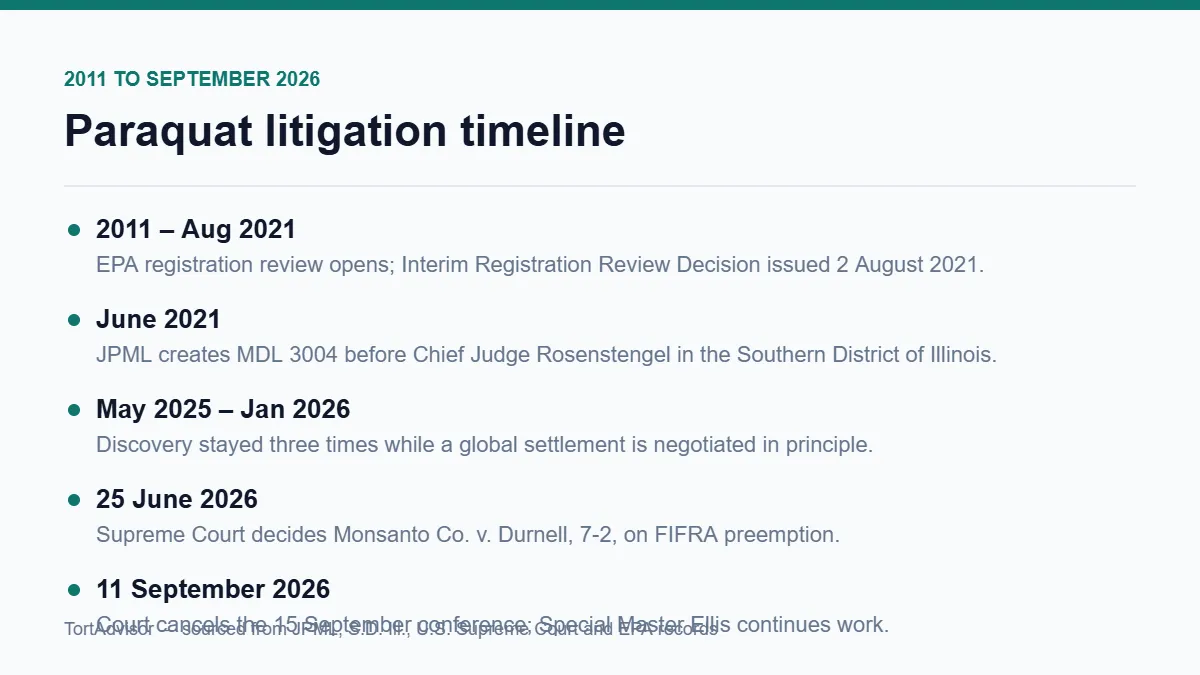
The court's most recent public order is dated 11 September 2026. It cancelled a status conference set for 15 September on the strength of progress reported by Special Master Ellis, directed the Special Master to "continue working with the DiCello Firm on these issues and to provide periodic updates," and restated the court's commitment to the "just, speedy, and efficient resolution of each of the cases pending in this MDL." The court's public MDL page currently lists no upcoming proceedings and no upcoming deadlines.
Recent case management orders include CMO 23 of 11 February 2026, dealing with voluntary dismissals, and CMO 24 of 8 April 2026, dealing with settlement access.
The global settlement: agreed in principle, terms never disclosed
A global settlement in the paraquat litigation has been agreed in principle. That phrase is doing real work and should not be read as "settled."
The court's order of 6 October 2025 records that discovery deadlines were stayed into January 2026 to allow the settlement to be finalised — the third such extension since May 2025 — and states that the court would "not permit any counsel in these proceedings to undermine this judicially supervised process."
What has never been published: the size of any fund, the allocation method, tier values, average payments, or what a given diagnosis is worth. No court order, no securities filing and no press release discloses them.
Why this page publishes no paraquat settlement figure
Search for paraquat settlement amounts and you will find confident numbers — averages, per-claimant ranges, tier tables. None of them traces to a disclosed settlement term. They are projections, and where a source is offered it is usually another marketing page.
Our rule is simple and we apply it site-wide: a dollar figure appears only if it is paid, announced, or awarded and stated on appeal, with a link to the primary record. For paraquat, no figure meets that test, so none is published. You can read the standard in our settlement data methodology and our editorial policy.
If you want to understand the factors a paraquat claim actually turns on — diagnosis, documented exposure, timing, and jurisdiction — our paraquat settlement amounts guide works through them without inventing a number, and the paraquat compensation calculator walks the same factors interactively.
What the EPA has and has not said
The EPA's regulatory record is the single most important document set in paraquat litigation, because Durnell makes the federal label the reference point.
Paraquat has been under registration review since 2011. The EPA issued an Interim Registration Review Decision on 2 August 2021. It is interim: registration review is not finished. That decision imposed mitigations that are still in force, described on the EPA's safety measures page:
- Aerial application limited to 350 acres per applicator per 24 hours, cotton desiccation excepted
- Residential drift buffers for aerial application
- Prohibition of human flaggers and of pressurized handgun and backpack sprayer application
- A 48-hour restricted entry interval for most crops, and 7 days for cotton desiccation
- Enclosed cabs or respirators depending on acreage treated
- Mandatory spray-drift management labeling and closed-system packaging
- Specialized training for certified applicators
Every paraquat product is a Restricted Use Pesticide. Only certified applicators may use it, and supervised applicators are expressly prohibited from using it at all. That restriction shapes who is realistically exposed: licensed applicators, farm workers, and people living or working near treated fields.
The science, stated honestly
The EPA acknowledges that studies on paraquat and Parkinson's "range in quality and provide conflicting results." It notes that a 2020 update of the Agricultural Health Study found no association, failing to replicate earlier findings from 2011 that had suggested a link.
Plaintiffs rely on other scientific evidence, including epidemiologic and mechanistic research offered to support an association between paraquat exposure and Parkinson's disease. The important distinction is that evidence of an association and EPA's current regulatory conclusion are not the same thing. EPA continues to state that it has not found a clear link from labeled uses, while its registration review remains open.
EPA's review is still open
Two developments keep the regulatory question live inside paraquat litigation, and both post-date most published paraquat content.
On 1 February 2024, the EPA published a preliminary supplemental reconsideration of certain issues supporting its interim decision, prompted by a Ninth Circuit petition for review brought by the California Rural Legal Assistance Foundation and others (No. 21-71287). The Federal Register notice confirms the Parkinson's question is among the issues under reconsideration.
On 13 November 2025, the EPA released an updated review of paraquat's potential to volatilize from treated fields and announced plans to issue a Data Call-In to manufacturers, stating that "there is greater uncertainty regarding the potential for paraquat to volatilize than previously considered." The agency will complete Endangered Species Act and endocrine disruption assessments before any final registration review decision.
Volatilization matters legally as well as scientifically. If paraquat moves off-target more than previously assumed, the population with a plausible exposure history is larger than the applicator-only picture suggests.
How paraquat litigation reached this point
The federal paraquat litigation was centralised in June 2021, when the Judicial Panel on Multidistrict Litigation created MDL 3004 and assigned it to Chief Judge Rosenstengel. Case management orders through 2021 established leadership, a plaintiff assessment questionnaire, a common benefit fund and a trial case selection protocol.
The years that followed were dominated by expert admissibility. The central question in paraquat litigation has always been whether plaintiffs' causation experts can survive a Daubert challenge, because without admissible general causation evidence the claims cannot reach a jury. That fight, rather than any trial, consumed most of the docket's active life.
From May 2025 the posture changed. Discovery deadlines were stayed repeatedly to let a global settlement be finalised, and the stay was extended three times. By October 2025 the court was actively defending the settlement process against counsel it viewed as undermining it. Then, in June 2026, the Supreme Court decided Durnell — and the legal foundation under paraquat litigation shifted while the settlement was still unfinished.
That sequence is the thing to hold on to. The settlement was negotiated under one set of legal assumptions; Durnell arrived afterwards. Any honest account of paraquat litigation has to set those two facts against each other rather than reporting the settlement as though nothing had changed.
Paraquat litigation outside the federal MDL
The 6,602 figure covers federal cases only. A substantial volume of paraquat litigation sits in state courts, principally in California, Illinois and Pennsylvania, and those cases are not counted in the JPML's monthly report.
State paraquat litigation matters for a practical reason: preemption is a federal defence, but it is raised in state court too, and state appellate courts will now be applying Durnell independently. Different jurisdictions may reach different conclusions about which paraquat claims survive, and how quickly.
How paraquat litigation compares with Roundup
The two are constantly conflated and should not be. Roundup involves glyphosate and alleges non-Hodgkin lymphoma; paraquat litigation involves a different chemical and alleges Parkinson's disease. The manufacturers differ — Syngenta and Chevron rather than Monsanto and Bayer.
What they now share is the preemption ruling. Durnell was a Roundup case, decided on a principle that applies to any EPA-registered pesticide. Roundup claims also reached large public verdicts and a disclosed settlement programme, whereas paraquat litigation has produced neither a public verdict figure nor disclosed settlement terms. That asymmetry is why so much paraquat content resorts to invented numbers: there is nothing real to report.
Who paraquat litigation covers
If you are weighing a claim of your own rather than following the litigation, our paraquat lawsuit guide covers who may qualify, what evidence matters and the filing deadlines.
Paraquat litigation claims generally involve a Parkinson's disease diagnosis together with a documented exposure history. In practice the strongest exposure records belong to licensed applicators, farm and agricultural workers, commercial groundskeepers, and people who lived or worked close to treated fields during application seasons.
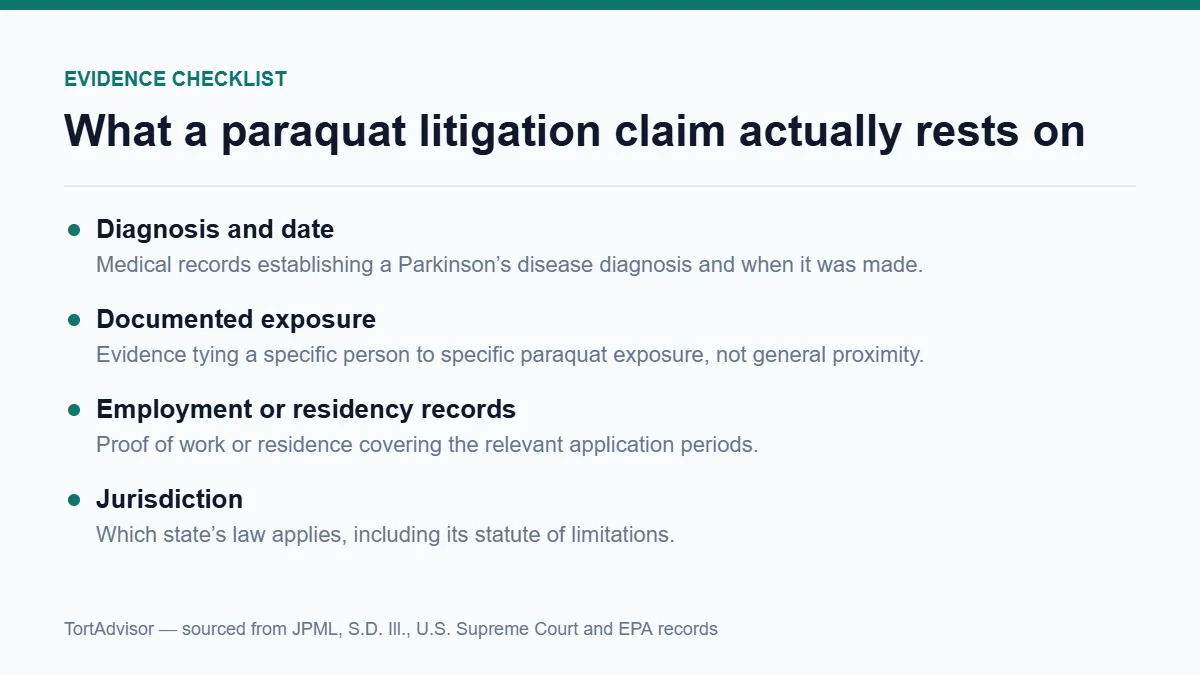
What actually drives a paraquat litigation claim's strength is unglamorous: medical records establishing diagnosis and date, evidence tying a specific person to specific exposure, employment or residency records covering the relevant period, and the jurisdiction whose law applies. No page can assess those from a distance, and any page that assigns a dollar value to them without seeing them is guessing.
Filing deadlines
Paraquat claims are governed by state statutes of limitation. They differ from state to state and can permanently bar a claim once they expire, whatever its merits. Checking costs nothing.
What to watch next
- How courts apply Durnell to paraquat. The first paraquat litigation rulings testing whether design-defect and failure-to-report theories survive will shape everything downstream.
- Whether settlement terms ever become public. They may not. Confidential resolution is common, and no rule requires disclosure.
- The EPA's final registration review decision, which is still pending behind the volatilization data call-in and the ESA and endocrine assessments.
- The Ninth Circuit petition and what the EPA's supplemental reconsideration concludes on the Parkinson's question.
Still unsure where you stand?
Have a trained case advisor review your own facts — free, confidential, and with no obligation.
- Free — no cost, no obligation
- About a minute to complete
- Reviewed by a trained case advisor
- Nothing you submit is published
Your details are sent over a secure connection and reviewed confidentially.
Frequently asked questions about paraquat litigation
Has the paraquat lawsuit settled?
A global settlement has been agreed in principle, but it has not been finalised on the public record and its terms have never been disclosed. The court's 2026 orders show a settlement being administered plaintiff by plaintiff, not a completed resolution: Case Management Order No. 24 (8 April 2026) directed the settlement administrator to report each plaintiff's status to Special Master Randi Ellis and required her to meet every plaintiff who had opted out or not yet decided, and in June the court selected opt-out cases for limited discovery.
SourceS.D. Ill. CMO 248 Apr 2026S.D. Ill. order3 Jun 2026
How much is a paraquat claim worth?
There is no public answer. No paraquat settlement amount, tier table or average payment has ever been disclosed in a court order, regulatory filing or company statement. Any specific figure you encounter is a projection, not a reported outcome.
Does Monsanto v. Durnell end paraquat litigation?
No. It preempts state-law failure-to-warn claims where the EPA required no such warning, which is the theory most paraquat claims lead with. Other theories — design defect, negligent testing, failure to report adverse data — were not decided in Durnell.
SourceU.S. Supreme Court25 Jun 2026
How many paraquat litigation cases are pending?
6,602 actions were pending in MDL 3004 as of the JPML's 1 October 2026 report, plus additional cases in state courts that the federal figure does not count.
SourceJPML1 Sep 2026
Does the EPA say paraquat causes Parkinson's disease?
No. The EPA states it "has not found a clear link between paraquat exposure from labeled uses and adverse health outcomes such as Parkinson's disease and cancer," while acknowledging the underlying studies conflict. Its registration review remains open.
SourceEPA13 Nov 2025
Related paraquat and toxic exposure research
Paraquat litigation sits within our wider coverage of toxic exposure lawsuits. Because Durnell was itself a glyphosate case, our Monsanto Roundup lawsuit guide covers the decision from the other direction. Figures for other torts are collected in our settlement amounts library, and the broader landscape is mapped in our mass tort lawsuits hub.
Editorial note: This page reports public litigation and regulatory records for educational purposes. It does not predict the outcome or value of any individual claim and is not legal advice. Case status, court orders and agency positions can change; the dated primary sources below control.
Primary sources
- Monsanto Co. v. Durnell, No. 24-1068 (U.S. 25 June 2026), slip opinion
- Cornell LII record for Monsanto Co. v. Durnell
- JPML, Pending MDL Dockets by Actions Pending, 1 October 2026
- S.D. Illinois, Paraquat Products Liability Litigation, case management orders
- EPA, Paraquat Dichloride
- EPA, Finalizes New, Stronger Safety Measures for Paraquat
- EPA, Updated Review on Potential Paraquat Volatilization, 13 November 2025
- Federal Register, EPA Document in Support of the Paraquat Interim Registration Review Decision
Related Posts

How VCF registration works: who should register, the two-year deadline and when it starts, how to register online or by phone, and how it fits with the WTC Health Program.
Paraquat exposure explained from EPA, CDC and court records: how it happens, who is most at risk, drift and vapor, the safety rules since 2016, Parkinson’s research, and the records that help show exposure.

Quick Answer: The Suboxone dental injury lawsuit update for August 2026 centers on MDL 3092, the federal litigation involving claims [...]