
How TortAdvisor Sources Settlement and Verdict Figures
This page explains where our settlement ranges, fault-rule summaries, and statute-of-limitations data come from, how we verify them, and what these figures are — and are not — intended to tell you.
Table of Contents: Our Data Methodology
Overview
TortAdvisor publishes free reference material on settled and reported case figures, state fault rules, and filing deadlines for personal injury and mass tort claims. Because a reader may decide what to do about their own injury partly on the strength of what they read here, the site follows a documented, repeatable process for sourcing, verifying and updating every figure and every legal rule it publishes. This page is that process in plain language, and it governs every page on this site that carries a number or states a rule of law.
Where Our Data Comes From
We draw on four categories of sources, in order of preference:
| Category | Examples |
|---|---|
| Government & regulatory data | NHTSA (crash statistics), FMCSA (trucking regulations), U.S. Coast Guard (recreational boating statistics), state departments of insurance |
| Primary legal sources | State statutes and codes, read directly rather than relied on secondhand, using official state legislature or code publisher sites |
| Legal-research aggregators | Casefleet, Justia, Nolo, and Matthiesen, Wickert & Lehrer, S.C. — used to cross-check primary statutes and catch recent amendments |
| Industry & insurance data | Insurance Information Institute, Insurance Institute for Highway Safety, and current-year consumer insurance guides (e.g., WalletHub, Kiplinger, Liberty Mutual) for no-fault state classifications |
Every external source we cite is linked directly from the relevant page’s “Sources & Citations” section so you can verify it yourself.
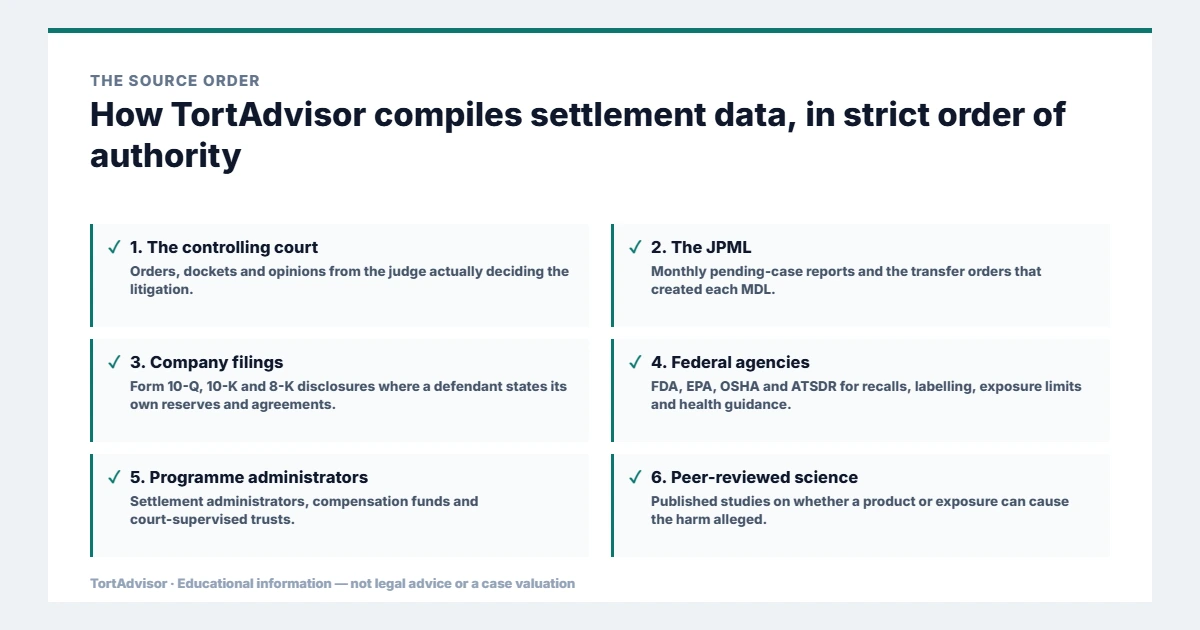
How We Handle Settlement and Verdict Figures
TortAdvisor does not operate a case database and has no access to confidential settlement terms. That limitation decides what this site will and will not publish.
Every dollar figure on TortAdvisor is a specific amount that a specific document has actually reported: a court order or judgment, a notice published by a court-appointed settlement administrator, a government enforcement action, or a company’s own filing. Each figure is published alongside the record it came from, linked, so that a reader can open the source and check it rather than take our word for it.
What this site does not publish is a compiled range. TortAdvisor does not average reported settlements into a low-to-high band, does not publish an estimated or projected claim value, and does not publish a per-claim average for any litigation. Those numbers fail in a way that matters: they average together claims with different injuries, different evidence and different state law, and a reader understandably reads them as a prediction of what their own claim is worth. No public dataset supports that prediction.
Where the public record supports no figure at all, the page says so and gives the date the check was made, instead of filling the gap with an estimate. Where a litigation has produced no settlement — the AFFF and PFAS litigation is the clearest current example — no settlement amount appears on the page, because there is none to report. Every figure links to its record, and every settlement-amounts page links back to this one.
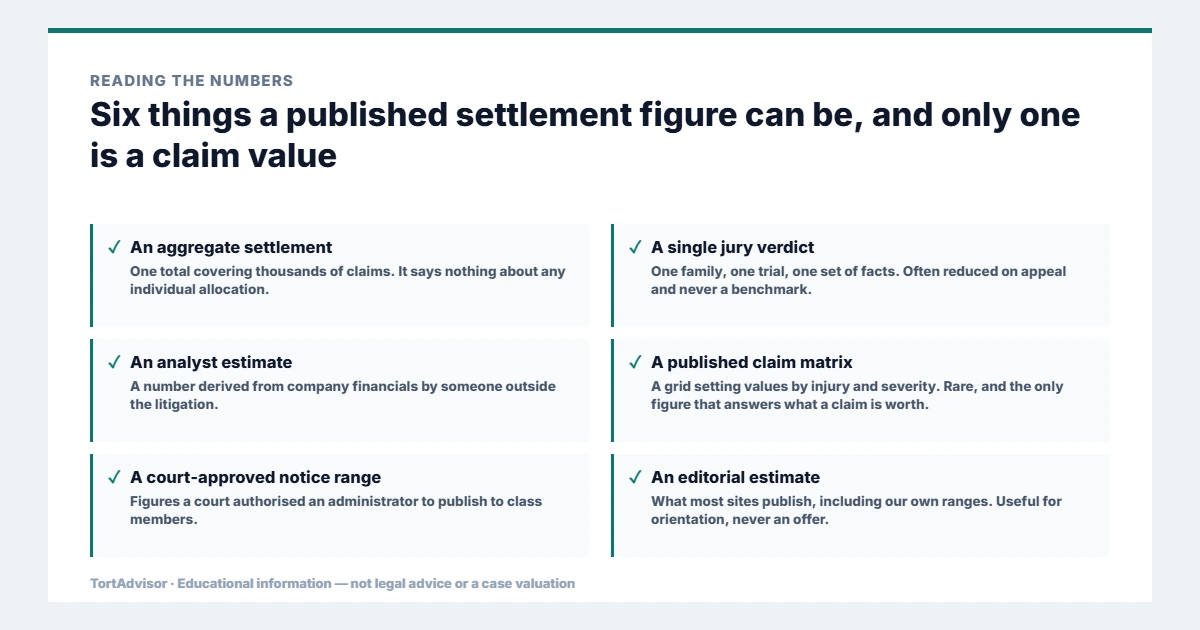
How We Verify Legal & Statutory Information
Statutes of limitations, fault systems, and negligence rules change: legislatures amend them, and secondary sources are not always current. Before publishing a state-by-state legal chart, our process is to check the current statute text directly (or a source that links directly to it), then cross-reference that reading against at least one independent aggregator.
This process is not theoretical — it has caught real, recent changes. For example, Florida’s personal-injury statute of limitations was shortened from four years to two years by HB 837, effective March 24, 2023, and Louisiana’s general delictual prescription period was extended from one year to two years by Act 423, effective July 1, 2024. Older articles across the web (including on some competitor sites) still cite the pre-amendment figures. We check for changes like these before publishing and again during scheduled reviews.
Update Cadence & Corrections
Pages with state-by-state legal data display a “Last Updated” date in the meta bar near the top of the page. We review these pages on an ongoing basis and immediately when we become aware of a relevant law change. If you are an attorney, paralegal, or reader who believes a figure on this site is outdated or incorrect, please tell us using the contact form on our About & Editorial Policy page — we review every submission and correct confirmed errors promptly.
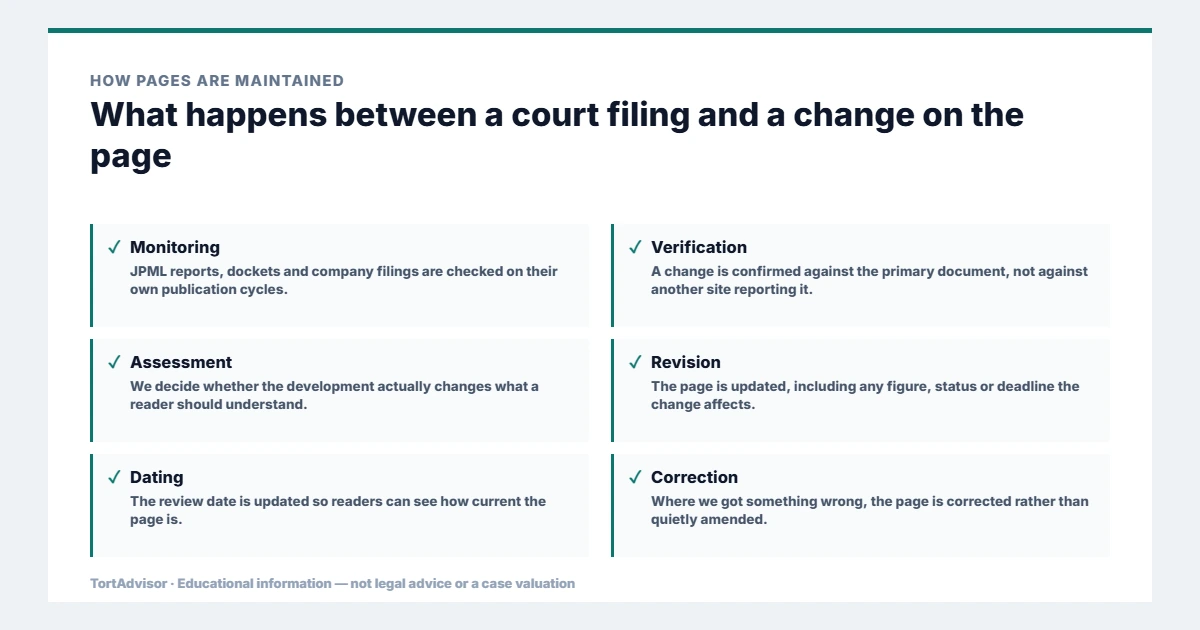
What This Data Is Not
- It is not legal advice, and reading it does not create an attorney-client relationship.
- It is not a guarantee or prediction of the outcome or value of any specific case.
- It is not a substitute for reading the current text of the statute that applies to your situation.
- It is not a live, continuously updated case database, and it publishes no compiled settlement ranges or estimated claim values.
Always confirm current law and case-specific guidance with a licensed attorney in your jurisdiction before making a legal decision.
Frequently Asked Questions
Is the data on TortAdvisor a substitute for legal advice?
No. Everything on this site, including settlement ranges and state-law summaries, is general information for educational purposes. It is not legal advice, and you should consult a licensed attorney in your state before making any decision about a legal claim.
How often is settlement and legal data updated?
Pages display a “Last Updated” date in the meta bar. We review data-heavy pages on an ongoing basis and update them promptly when we identify a relevant law change or new publicly reported settlement data.
How do I report an error or suggest a correction?
Use the contact form on our About & Editorial Policy page and select “Editorial Job” or describe the issue in the comments field. Every submission is reviewed.
Have Questions About Your Case?
If you’ve been injured and want to understand your options, tell us about your situation. There’s no cost and no obligation to find out if you have a claim.
This page describes TortAdvisor’s editorial methodology for general informational purposes only and does not constitute legal advice. TortAdvisor is not a law firm and does not provide legal representation. Confirm current legal requirements with a licensed attorney in your jurisdiction before making any legal decision.