
Accident Injury Claims 2026: Car, Work & Disability Guide
Accident injury claims can involve very different legal and benefit systems. Car, truck, motorcycle, pedestrian and rideshare crashes may involve negligence and insurance claims, while workplace injuries can involve state workers’ compensation systems and serious long-term conditions may also lead to Social Security Disability Insurance (SSDI) claims. Start by choosing the event or benefit system that applies, then continue to the matching claim guide, evidence resource, calculator or benefit information.
Key Facts About Accident, Work Injury & Disability Claims
These national figures come from current federal sources and provide context only. They do not establish liability, eligibility, a filing deadline or the value of an individual claim.
The figures below give national context for accident injury claims. They describe how common these events are, not how any individual claim will be assessed.
NHTSA’s final 2024 data report 39,254 people killed in motor vehicle traffic crashes.
BLS reports 2,488,400 total recordable nonfatal workplace injury and illness cases in private industry for 2024.
SSA generally gives a claimant 60 days after receiving a decision to request the next appeal step.
SSA’s 2024 statistical report says the initial-level award share ranged from about 18% to 21% for application cohorts from 2014 through 2023.
Most private-sector and state/local government workers use the workers’ compensation system for the state governing the claim.
Limitation periods, insurance requirements and government-notice rules depend on jurisdiction, defendant type and claim facts.
Accident Injury Claims: Car, Work & Disability Directory
Each case type below has its own eligibility rules, deadlines and evidence. Select a guide to continue.
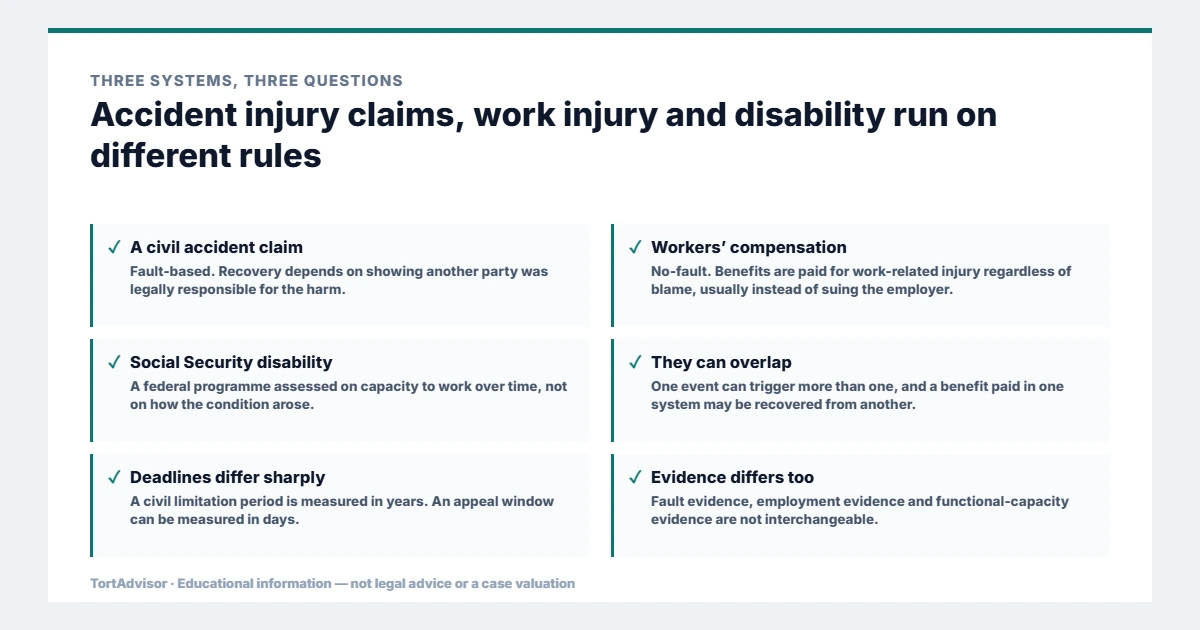
The distinction that matters most in accident injury claims is who bears the burden. In a civil claim the injured person must show another party was at fault. In workers’ compensation they generally do not, but what can be recovered is limited to defined benefits. In a disability application fault is irrelevant altogether, and the question is what work a person can still do.
Car Accident Lawsuit
Injury claims, settlement ranges and case review for car accident victims.
View Guide →Use the Car Accident Settlement Calculator →Review car accident settlement research →
Rideshare Accident Lawsuit
Uber and Lyft accident claims, insurance layers and settlement guidance.
Motorcycle Accident Lawsuit
Injury claims and settlement factors specific to motorcycle crashes.
Truck Accident Lawsuit
FMCSA claims, commercial carrier liability and settlement case review.
Workers’ Compensation Claims
State workers’ compensation benefits, reporting, medical evidence, denied claims and possible third-party injury actions.
SSDI Benefits Guide
Eligibility, payment amounts and the SSDI approval process explained.

How Accident, Work Injury & SSDI Claims Differ
Accident injury claims, workers’ compensation and SSDI are different systems. The steps below show common preparation themes without suggesting that the same liability, benefit or filing rules apply to all three.
Prompt action can help preserve evidence and identify the correct reporting, insurance, administrative or court deadline for the specific claim.
The steps below are common to accident injury claims across all three systems. They are not a single procedure, because accident injury claims, workers’ compensation and disability applications each follow their own route once started.
Document diagnoses, treatment, restrictions and symptoms. Medical evidence is important across injury and disability claims, although each system applies different legal standards.
That may mean a crash or incident report, employer notice, insurance claim, workers’ compensation filing, or an SSA disability application or appeal.
Accident claims focus on legal responsibility and damages; workers’ compensation and SSDI use separate benefit eligibility standards.
The next stage may involve insurance negotiation, litigation, a workers’ compensation proceeding or an SSA administrative appeal.
Evidence That May Support Accident, Work Injury & SSDI Claims
The relevant evidence depends on the legal or benefit system. Preserve records early, but avoid assuming that evidence important in one type of claim proves another.
Keep copies of everything and avoid discarding records, even ones that seem minor at the time.
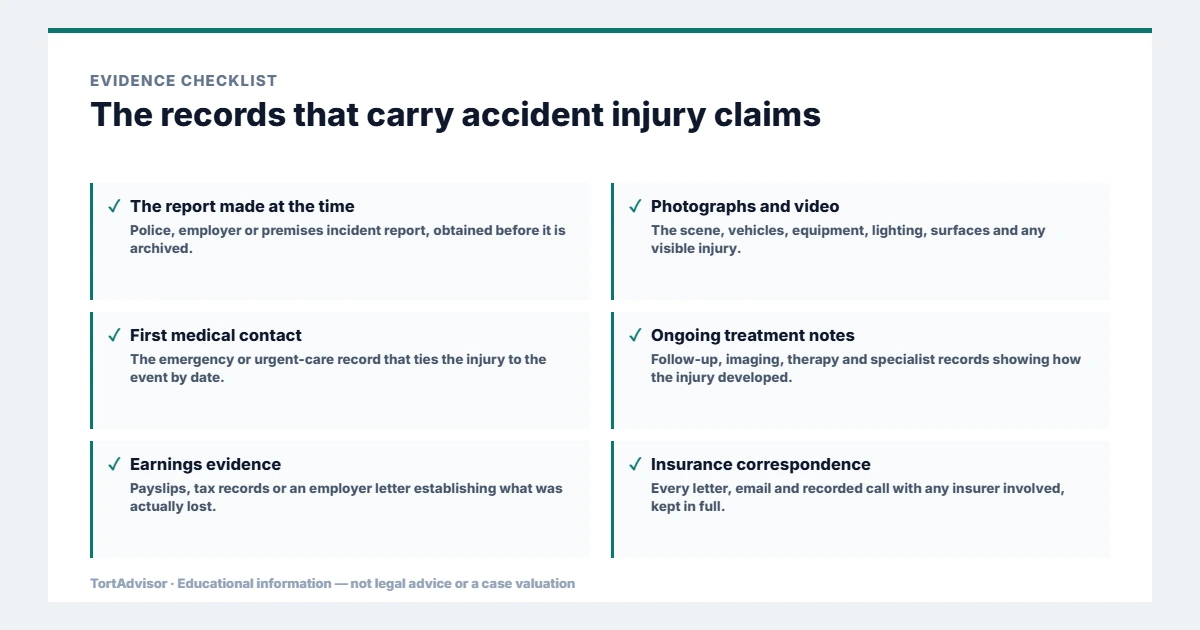
Evidence gathered in the first days is worth disproportionately more in accident injury claims, because the scene changes, reports are archived and memories fade well before a claim is assessed.
Two records decide more accident injury claims than any others: the report made at the time of the event, and the first medical note that follows it. A delay between the two is the single most common argument an insurer raises, because it invites the suggestion that something else caused the injury.
Accident & Injury Evidence
- Police or incident report
- Photos and video of the scene and injuries
- Complete medical records and bills
- Witness names and statements
- Lost-wage and income documentation
- Insurance company correspondence
- Vehicle or property damage estimates
Workers’ Comp & Disability Evidence
- Employer incident report
- Treating physician records and notes
- Work-restriction and disability documentation
- SSA medical evidence and function reports
- Denial or determination letters
- Employment and earnings history
What Can Affect Accident Compensation & Disability Benefits?
Accident damages, workers’ compensation benefits and SSDI payments are determined under different rules. The factors below explain common issues without combining those systems into one settlement formula.
These are general patterns from publicly available case data, not guarantees for any specific claim.
There is no published average for accident injury claims as a category. What a claim is worth turns on the injury, the treatment record, the applicable state law and the insurance actually available, so any single figure quoted for accident injury claims as a whole averages unlike things.
Insurance limits are the quiet ceiling on many accident injury claims. Where a driver carries only a state-minimum policy, the available cover can be far smaller than the documented loss, and the practical question becomes whether any other party or policy can be reached.
Accident Claim Value Factors
- Severe or permanent injury
- Clear liability against the other party
- Documented lost income and future earning loss
- Strong, well-organized medical documentation
- Low comparative fault on your part
Benefit & Recovery Limits
- Comparative negligence reductions
- Insurance policy limits
- Workers’ compensation benefit caps
- SSDI offset rules for other benefits
- Disputes over pre-existing conditions
Use Our Car Accident Settlement Calculator → See Real Settlement Amounts by Case Type →

Primary Sources for Accident, Work Injury & Disability Claims
TortAdvisor prioritizes the government source closest to each statement. State negligence, insurance, workers’ compensation and filing rules still require the authority that governs the individual claim.
Every statement on this page about accident injury claims is traced to a court, agency or programme source before it is published.
Accident & Disability Claim FAQs
Answers to common questions about accident, injury and disability claims.
These answers describe how accident injury claims are generally assessed. They are not advice about any particular claim, and state law varies enough that the same facts can produce different answers in different places.
How long do I have to file a car accident claim?
There is no single national deadline. The limitation period depends on the state, defendant, injury, discovery rules and whether special notice requirements apply. Confirm the law governing the claim promptly rather than relying on a general nationwide estimate.
SourceN.Y. CPLRSec. 214
What’s the difference between an accident injury claim and workers’ compensation?
An accident injury claim generally requires a legally responsible defendant and can include damages allowed by state law. Workers’ compensation is a separate state benefit system for qualifying job-related injuries and illnesses and follows different fault, benefit and dispute rules. A third-party injury claim may sometimes exist alongside workers’ compensation.
Can I receive SSDI and workers’ compensation at the same time?
In some cases yes, but combined benefits may be subject to an SSDI offset that reduces your monthly disability payment. Rules vary by state and case.
SourceSSAPub. 05-10018
What happens if my SSDI claim is denied?
SSA generally gives you 60 days after you receive the determination or decision to request an appeal. The notice explains the appeal method and deadline. A denial does not guarantee that a later appeal will succeed, so preserve the notice and follow SSA instructions promptly.
Source20 C.F.R.Sec. 404.909
Do I need a lawyer for a car accident claim?
Simple, low-damage claims may not require an attorney, but cases involving serious injury, disputed liability or lowball insurance offers often benefit from legal representation.
How is an accident injury settlement evaluated?
Potential settlement value can depend on medical causation, injury severity, treatment, future care, lost income, liability evidence, comparative fault, insurance or defendant resources, jurisdiction and other damages allowed by law. Workers’ compensation and SSDI benefits use different statutory or administrative formulas.
What if the accident was partly my fault?
Fault rules vary by jurisdiction. Some states use pure comparative fault, others use modified comparative-fault thresholds, and a small number still apply contributory-negligence rules. The effect of partial fault must be evaluated under the law governing the claim.
SourceN.Y. CPLRSec. 1411
Request a Free Accident or Injury Claim Review
If you are researching accident injury claims because of a car, truck, motorcycle, rideshare or workplace injury, you can submit the incident, injuries, treatment, timing and available evidence you know now for review. SSDI and workers’ compensation follow different legal and benefit systems, so the intake should identify which path applies.
- No fee to submit information
- Claim-specific accident and injury intake questions
- Attorney representation or benefits eligibility is not guaranteed
- Submitting information does not create an attorney-client relationship
See Which Claim Path May Fit Your Situation
Answer what you know. Avoid submitting unnecessary sensitive information.