
Medical Device Lawsuits 2026: Recalls, Claims & Settlements
Medical device lawsuits may involve implants, surgical products, warming systems and other devices alleged to have caused injury because of product defects, inadequate warnings, contamination, premature failure or another product-liability issue. Start with the device-specific guide, then continue to evidence, FDA safety information, settlement research or a matching calculator.
What Is a Medical Device Lawsuit?
A medical device lawsuit is generally an individual civil claim alleging that an implanted or non-implanted device caused injury because of a design defect, manufacturing defect, inadequate warning, contamination, premature failure, misleading promotion, negligent recall conduct or another legally recognized product-liability theory. The exact elements vary by state and by the legal theory asserted.
Medical device lawsuits differ from drug cases in one practical way: the product is usually still inside the patient, or has been removed and kept. That physical evidence is why medical device lawsuits often turn on records the hospital holds rather than on the patient’s own account.
Design Defect
The product’s design allegedly created an unreasonable risk even when the device was manufactured as intended.
Manufacturing Defect
A particular unit, lot or component allegedly departed from design specifications or was contaminated or improperly packaged.
Failure to Warn
Instructions, labeling, safety information or physician warnings allegedly failed to disclose material risks under applicable law.
Medical Device Lawsuits: Active Device & Implant Claims
This directory combines current independent TortAdvisor claim guides with frequently researched medical-device topics. A topic is linked to a standalone guide only when a current independent canonical page is available. Inclusion does not mean every product has been recalled, every allegation has been proven, or every patient qualifies for a claim.
The dockets below show where medical device lawsuits are currently pending. A pending count describes caseload, not the number of claims that will recover.
Bair Hugger Lawsuit
Review MDL 2666, surgical-site and prosthetic-joint infection allegations, device-use evidence and revision procedures.
Read the Bair Hugger lawsuit guide → Use the Bair Hugger Settlement Calculator → Read the latest Bair Hugger litigation update →
Breast Implant Lawsuit
Research BIA-ALCL, rupture, capsular contracture, systemic symptoms, product records and revision surgery.
Read the breast implant lawsuit guide → Use the Breast Implant Settlement Calculator →
Hernia Mesh Lawsuit
Review mesh failure, migration, infection, chronic pain, bowel injury, revision surgery and product identification.
Read the hernia mesh lawsuit guide → Use the Hernia Mesh Settlement Calculator →
Exactech Implant Claims
Research recalled knee, ankle and hip components, premature wear, bone loss, device failure, revision surgery and FDA recall records. TortAdvisor currently covers this topic inside the Medical Device Lawsuits pillar rather than linking through a legacy redirect.
IVC Filter Injury Claims
Review fracture, migration, perforation, embolization, retrieval complications, device identification and long-term monitoring. TortAdvisor currently covers this topic inside the Medical Device Lawsuits pillar rather than linking through a legacy redirect.
Hip Replacement Lawsuit
Research implant loosening, metallosis, premature failure, fracture, dislocation and revision procedures.
Medical Device Recalls, Early Alerts and Safety Communications
For medical device lawsuits, FDA safety information can provide important regulatory context without independently proving causation or liability. The FDA maintains current pages for medical device recalls and early alerts and separate medical device safety communications. FDA recall communications can involve product removal, correction, updated instructions, software changes, monitoring or other risk-reduction actions.
Recalls and Early Alerts
FDA listings identify serious recalls and early alerts involving corrective actions while the agency gathers or confirms information.
Safety Communications
FDA communications may explain identified risks, affected populations, recommended actions and ongoing agency review.
Adverse-Event Reports
The FDA’s MAUDE system contains reports involving device malfunctions, injuries and deaths, but the FDA cautions that the database alone cannot establish incidence, prevalence or causation.
Primary sources: FDA Medical Device Recalls & Early Alerts • FDA — About the MAUDE Database
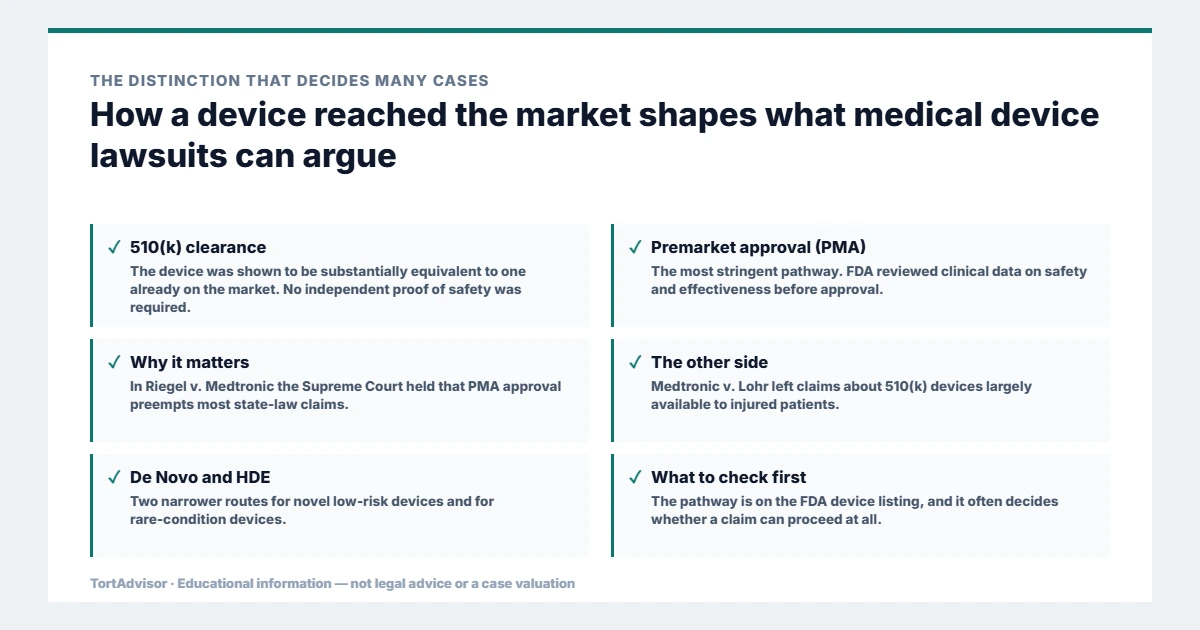
Medical Device Lawsuit Eligibility: Who May Qualify?
Medical device lawsuits are evaluated individually. Product identification, documented injury, medical causation, damages, filing deadlines and any prior release or settlement can affect whether a claim is potentially reviewable.
Eligibility for medical device lawsuits is assessed device by device. Two patients with the same implant and the same complication can reach different answers if one has the implant card and the other does not.
Identifiable Device
The product, manufacturer, model, component, lot or serial number can be identified through records, implant labels or other reliable documentation.
Documented Injury
Medical records document failure, infection, migration, fracture, erosion, toxicity, revision surgery or another alleged complication.
Connection to the Device
The injury followed implantation or device use and qualified reviewers can evaluate timing, medical causation and alternative causes.
Meaningful Damages
The patient experienced medical costs, lost income, disability, pain, revision procedures or other legally compensable harm.
Timely Filing
The claim remains within the applicable statute of limitations, repose period or another recognized filing window.
No Prior Release
The claimant has not already settled the same injury or signed a release that bars further claims against the relevant defendant.
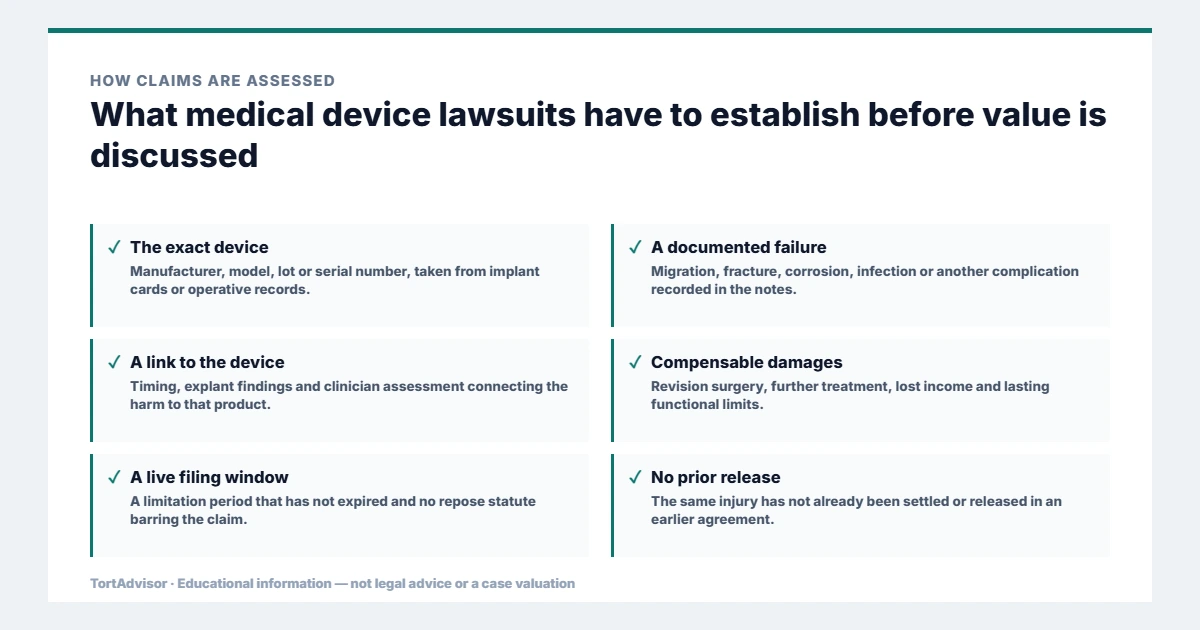
Medical Device Claim Evidence That May Support a Lawsuit
Medical device lawsuits are highly record-dependent. Product identification, operative reports, revision findings, recall history, treatment records and damages evidence can all affect whether the claim can be evaluated.
| Evidence Category | Examples | Why It May Matter |
|---|---|---|
| Device identification | Implant sticker, model, serial number, lot number, operative report and product card. | Links the patient to a specific manufacturer and product. |
| Medical records | Diagnosis, imaging, pathology, cultures, hospitalizations and specialist notes. | Documents injury, timing, treatment and possible alternative causes. |
| Revision records | Removal, replacement, debridement, corrective surgery and explant analysis. | May document failure mode and treatment burden. |
| Recall and safety records | FDA communications, recall letters, manufacturer notices and physician warnings. | May provide regulatory and notice context; a recall alone does not establish individual causation. |
| Damages evidence | Bills, wage loss, disability records, travel costs and future-care estimates. | Supports economic and non-economic damage evaluation. |
| Preserved product | Explanted device, packaging, photographs and chain-of-custody information. | May allow inspection or expert analysis when preservation is possible. |
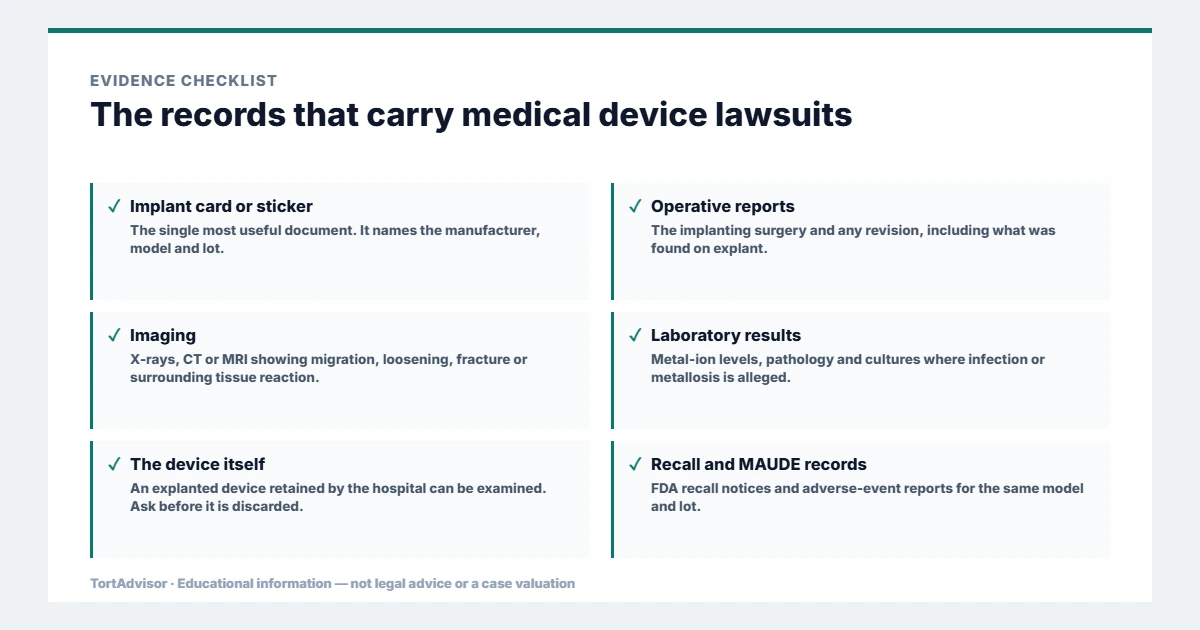
Common Legal Theories in Medical Device Lawsuits
The available causes of action and required proof depend on state law, federal preemption issues, the device, the manufacturer and the facts of the individual claim.
Most medical device lawsuits are pleaded on more than one of these theories at once, because it is rarely clear at filing which one the evidence will best support.
Strict Product Liability
Claims may allege defective design, manufacturing or warnings where recognized under applicable state law.
Negligence
A manufacturer may be accused of unreasonable testing, design, manufacturing, monitoring, labeling or recall conduct.
Failure to Warn
Warnings to physicians or patients may allegedly omit material risks or fail to communicate risk information adequately.
Breach of Warranty
Express or implied warranty theories may be alleged when legally available and supported by the facts.
Misrepresentation
Marketing or safety representations may be challenged when plaintiffs allege material omissions or misleading statements.
Wrongful Death
Eligible family members or estate representatives may pursue damages when an alleged device injury contributes to death and applicable law permits the claim.
Medical Device Lawsuit Compensation & Claim-Value Factors
There is no universal settlement amount for medical device lawsuits. Potential damages depend on the device, injury, medical causation, evidence, jurisdiction, defendants, filing status and how the claim resolves.
There is no published per-claim figure for medical device lawsuits as a category. What a claim is worth depends on the device, the revision history and the jurisdiction, so any single number quoted for medical device lawsuits as a whole averages unlike things.
Medical Costs
Hospital care, revision surgery, device removal, rehabilitation, medication and future treatment.
Income Loss
Past wages, reduced earning capacity, disability and loss of employment benefits when recoverable.
Pain and Suffering
Physical pain, emotional distress, disfigurement, impaired mobility and reduced quality of life where compensable.
Permanent Injury
Organ damage, chronic infection, neurological injury or long-term functional limitation.
Replacement and Monitoring
Future imaging, device surveillance, repeat procedures and specialized medical care.
Wrongful Death
Funeral costs, loss of support and other damages authorized by applicable state law.
Medical Device MDL Proceedings vs. Class Actions
Some medical device lawsuits are coordinated through federal multidistrict litigation when cases share common factual questions. Under 28 U.S.C. § 1407, the U.S. Judicial Panel on Multidistrict Litigation can transfer federal civil actions involving common factual questions to one district for coordinated or consolidated pretrial proceedings. The Panel explains that centralization is intended to reduce duplicative discovery, inconsistent pretrial rulings and unnecessary resource use.
An MDL is not the same as a traditional class action. In product-liability MDLs, plaintiffs generally retain individual claims and still must establish claim-specific injury, causation and damages.
Primary source: U.S. Judicial Panel on Multidistrict Litigation — About the Panel
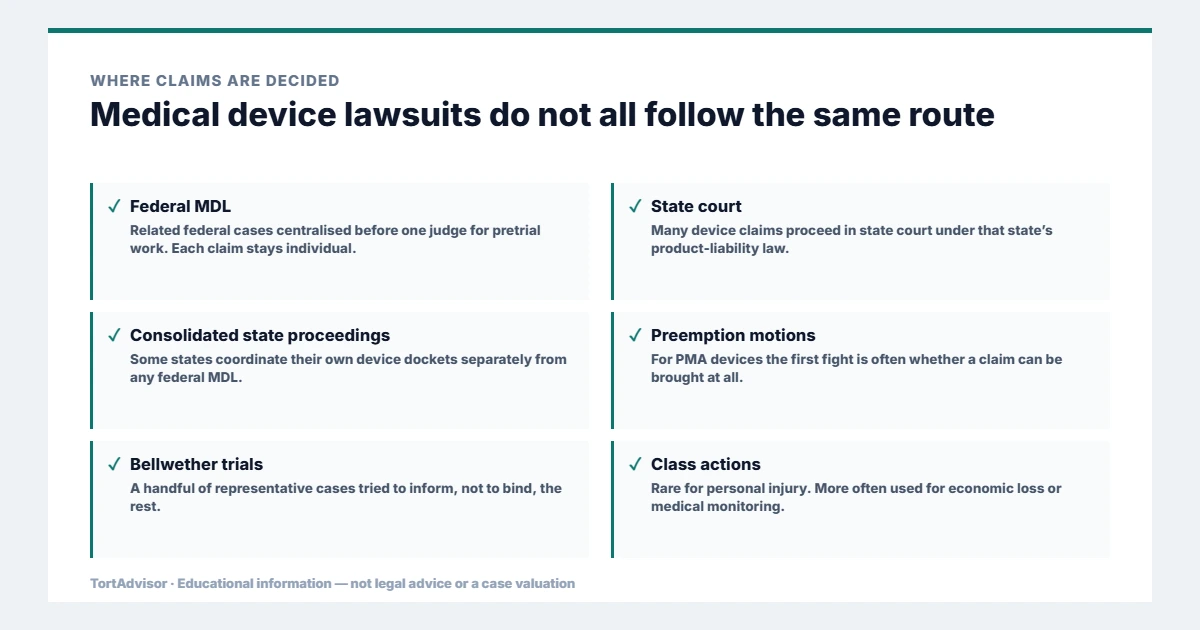
How to File a Medical Device Lawsuit
Medical device lawsuits are highly dependent on records and timing. Before filing, identify the product, preserve medical and device evidence, document the injury timeline and confirm the applicable deadline and forum.
Filing deadlines for medical device lawsuits run from different starting points in different states, and some states also apply a statute of repose that can bar a claim regardless of when the harm was discovered.
- Identify the device. Gather the product name, manufacturer, model, lot or serial number, procedure date and hospital.
- Preserve records. Request operative reports, implant stickers, imaging, pathology, revision records and recall notices.
- Document the injury. Create a timeline of symptoms, diagnosis, treatment, device failure and economic losses.
- Confirm deadlines. Do not assume that an FDA recall, adverse-event report or MDL automatically pauses the applicable state filing period.
- Review legal theories. A licensed attorney can evaluate defendants, state-law claims, preemption issues, causation, jurisdiction and available damages.
- File in the proper court if appropriate. A claim may proceed individually in state or federal court or become part of coordinated federal MDL proceedings.
Medical Device Lawsuit FAQs
What is a medical device lawsuit?
It is generally a product-liability claim alleging that a medical device caused injury because of defective design, manufacturing problems, inadequate warnings or another legally recognized theory. The exact legal requirements vary by jurisdiction.
SourceFDAMAUDE
Does an FDA recall automatically prove my medical device case?
No. A recall may provide relevant safety or notice context, but an individual claimant generally still must establish product identification, injury, causation, damages and timely filing.
SourceFDADevice recalls
What if I do not know the device model or serial number?
Operative reports, implant stickers, hospital records, billing codes, product cards and other medical records may help identify the device and manufacturer. Once a device identifier is known, the FDA’s public AccessGUDID database can be searched for the device name, company and related identification information.
SourceFDAAccessGUDID
Is multidistrict litigation the same as a class action?
No. An MDL coordinates federal lawsuits that share common factual issues for pretrial proceedings. Individual plaintiffs generally retain their own claims.
Can I report a medical device problem to the FDA?
Yes. The FDA provides medical-device reporting information for patients, caregivers and health professionals. Reporting a device problem is separate from filing a civil lawsuit.
SourceFDADevice reporting
How long do I have to file a medical device lawsuit?
Filing deadlines vary by state, claim, injury and sometimes discovery date. Statutes of repose or other rules may also apply. A claim-specific deadline review is important.
SourceN.Y. CPLRSec. 214-c
How much is a medical device lawsuit worth?
There is no standard payout. Potential value can depend on injury severity, revision surgery, medical causation, permanent impairment, lost income, evidence, jurisdiction, defenses and other case-specific factors.
SourceJPML1 Sep 2026
FDA reporting resource: How to Report Medical Device Problems to the FDA
Continue With the Most Relevant Medical Device Resource
Use the direct device guides, settlement tools and parent hubs below to continue research without mixing medical-device search intent with unrelated drug, toxic-exposure or general personal-injury topics.
TortAdvisor uses descriptive, crawlable HTTPS links so readers and search engines can understand the relationship between this medical-device pillar, its device-specific children and broader site hubs.
Active Personal Injury Lawsuits
Browse TortAdvisor’s main directory of active lawsuit categories, evidence requirements, filing issues and case-review resources.
Mass Tort Lawsuits
Research coordinated drug, device, toxic-exposure and product-liability litigation and current mass-tort updates.
Dangerous Drugs & Product Liability
Use the drug and product-liability pillar for pharmaceutical injuries and non-device product claims.
Settlement Calculators
Compare device-specific and broader claim-value tools based on injury, treatment, evidence and damages factors.
Lawsuit Settlement Amounts
Review damages categories, settlement-value factors and case-specific payout research without treating estimates as guarantees.
Legal Insights
Read TortAdvisor lawsuit updates, evidence explainers, filing guidance and legal research articles.
Reviewed by Mason Arnao
This page was reviewed for factual accuracy, source quality, readability, legal-advertising clarity, medical-device terminology and consistency with current FDA and JPML materials. TortAdvisor separates recalls, adverse-event reports and allegations from established causation and does not present eligibility, representation, settlement or results as guaranteed.
Official Medical Device Sources and Citations
Primary regulatory and federal court sources are linked both near the relevant claims above and in this consolidated source directory for verification.
Every status and figure published on this page about medical device lawsuits comes from the sources listed below, in the order shown.
FDA Medical Device Recalls & Early Alerts
Current serious recalls, corrective actions and early alerts. Accessed August 20, 2026.
FDA Medical Device Safety Communications
Official safety communications, risk information and recommendations. Accessed August 20, 2026.
FDA Medical Device Reporting
Official reporting information for patients, caregivers and health professionals. Accessed August 20, 2026.
FDA — About the MAUDE Database
Official description and limitations of the MAUDE adverse-event database. Accessed August 20, 2026.
JPML Pending MDLs
Official monthly federal multidistrict-litigation reports and pending MDL information. Accessed August 20, 2026.
U.S. JPML — About the Panel
Official explanation of federal MDL centralization and coordinated pretrial proceedings. Accessed August 20, 2026.
Request a Free Medical Device Case Review
A medical-device claim may depend on product identification, operative records, revision findings, medical causation, FDA safety information, filing deadlines and the law that applies to the individual claim.
- Identify the device, manufacturer, procedure and injury.
- Organize implant cards, operative reports, revision records and FDA safety context.
- Flag deadline, jurisdiction, damages and evidence questions for claim-specific review.