
Hip Replacement Lawsuit 2026: Implant Failures, MDLs & Revision Claims
Hip replacement lawsuit claims allege that specific hip implants or components failed prematurely, released metal debris, loosened, fractured, dislocated or otherwise caused injuries requiring revision surgery. Current litigation is divided among manufacturer- and product-specific proceedings involving companies such as DePuy, Stryker, Zimmer, Smith & Nephew and Exactech rather than one nationwide class action.
From here you can browse the settlement calculators for every tort we cover, compare reported settlement amounts across torts, and see how we source and check every figure.
Choose the Hip Replacement Lawsuit Information You Need
Start with potential eligibility or current MDLs, then review metal-on-metal risks, recalled products, revision evidence and settlement factors.
What Is a Hip Replacement Lawsuit?
A hip replacement lawsuit is usually an individual product-liability claim alleging that a specific implant or component was defectively designed, manufactured or labeled and caused compensable injury. Some hip-surgery injuries instead involve medical-malpractice or informed-consent theories against healthcare providers. Those are separate legal paths with different proof and filing rules.
Defective Implant
Claims may allege premature loosening, corrosion, fracture, wear, dislocation or another product-specific failure.
Additional Surgery
Revision surgery can document the failure mode, tissue damage, component wear, corrosion, fracture, metallosis or other operative findings.
Medical Malpractice
Improper placement, surgical injury or negligent postoperative care may involve a healthcare-provider claim rather than a product-liability MDL.
Who May Qualify for a Hip Replacement Lawsuit?
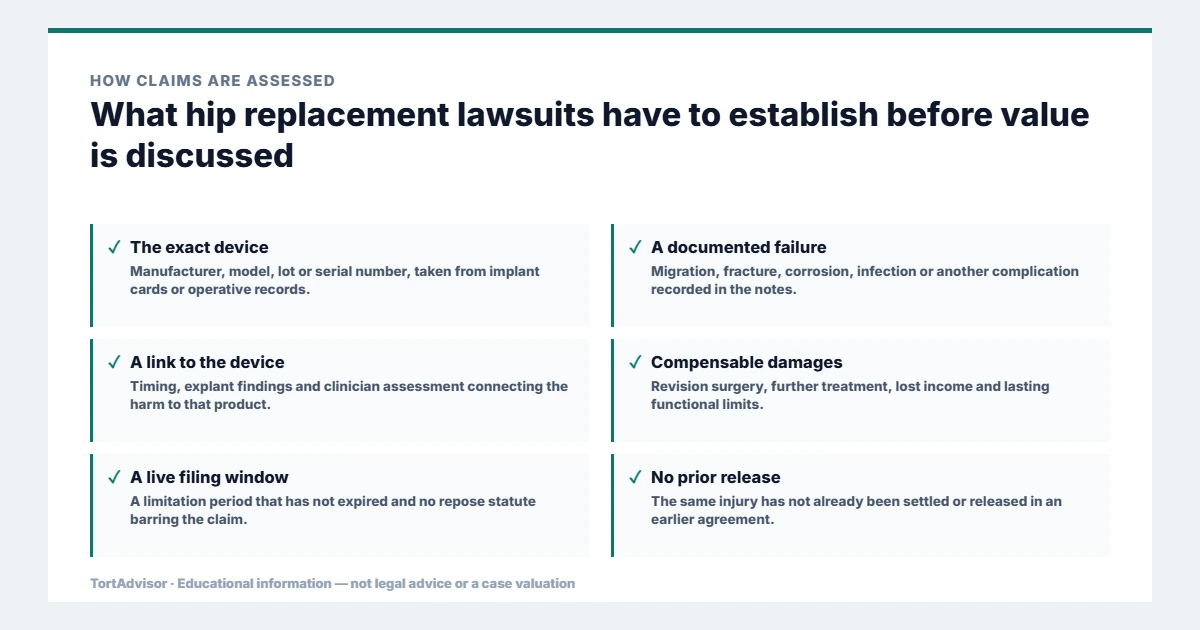
There is no universal nationwide qualification rule. Product-liability screening generally starts with an identifiable implant or component and a documented serious complication—often one that required revision surgery or produced significant tissue damage, elevated metal ions or permanent impairment.
Identifiable Hip Implant
- Manufacturer and product line can be confirmed through records.
- Implant date, hospital and surgeon are known.
- Operative report, implant sticker or device card identifies components.
Serious Documented Complication
- Premature loosening, fracture, corrosion or failure.
- Metallosis or adverse local tissue reaction.
- Dislocation, osteolysis, bone loss or severe persistent pain.
- Revision, explant or major corrective surgery.
Causation Evidence
Review may include implant position, wear pattern, infection testing, metal-ion results, imaging, pathology, revision findings, trauma history and alternative medical explanations.
Timely, Unreleased Claim
Prior settlements, releases, MDL participation, state statutes of limitation and statutes of repose can affect whether a claim remains available.
Hip Replacement Lawsuit MDLs in September 2026
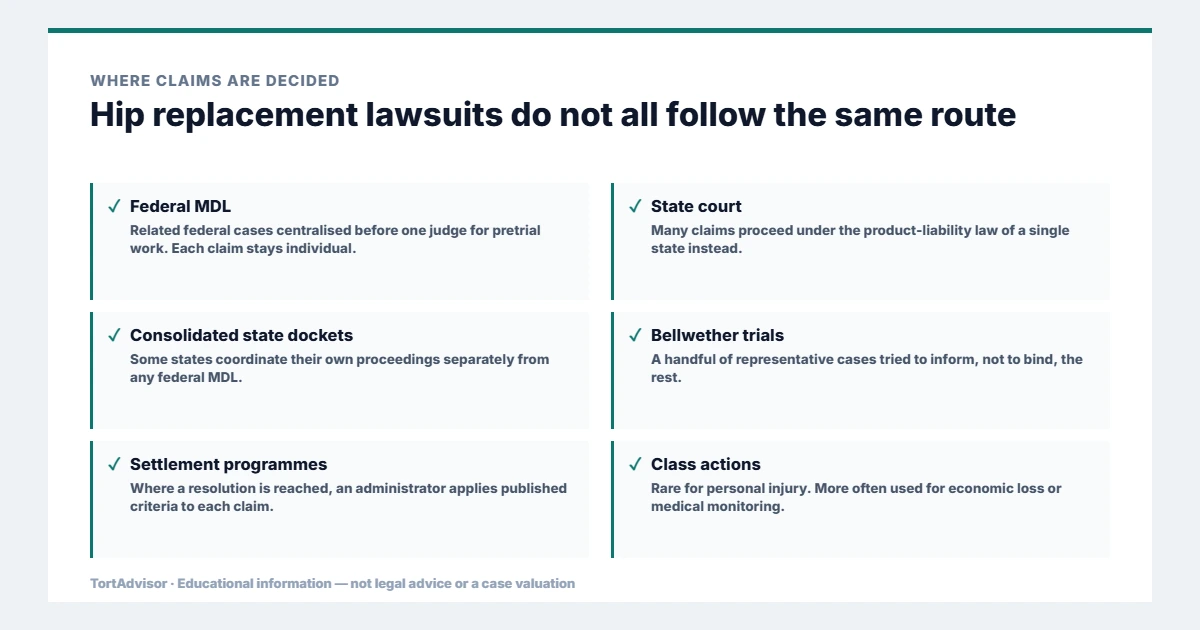
Hip implant litigation has developed through multiple manufacturer-specific federal MDLs over more than a decade. Some are nearly resolved; others remain open with a limited number of cases; and Exactech MDL 3044 is a broader orthopedic-product litigation that includes recalled hip liners along with knee and ankle products.
| Manufacturer / Device | Federal MDL | October 2026 Context |
|---|---|---|
| DePuy ASR | MDL 2197 — N.D. Ohio | 113 pending actions; historical settlement programs resolved many prior claims. |
| Stryker LFIT V40 | MDL 2768 — D. Massachusetts | 47 pending actions; court page includes an order aiding private settlement. |
| Stryker Rejuvenate / ABG II | MDL 2441 — D. Minnesota | 6 pending actions; most historical claims resolved through settlement programs. |
| Zimmer M/L Taper / Kinectiv | MDL 2859 — S.D.N.Y. | 1 pending action reported in August; a July 2026 opinion addressed expert evidence in one of the final cases. |
| Smith & Nephew BHR | MDL 2775 — D. Maryland | 0 pending / 1,089 historical actions in the Aug. 3 JPML report. |
| Exactech polyethylene products | MDL 3044 — E.D.N.Y. | 1,838 pending mixed orthopedic actions; includes hip-liner cases but is not a hip-only MDL. |
Hip Replacement Manufacturers and Devices Commonly Researched
The specific implanted components control the legal analysis. Hip systems are modular, so a patient may have a cup, liner, femoral head, taper, neck and stem from one system—or, in some circumstances, different components with separate recall or litigation histories.
ASR & Pinnacle
DePuy’s ASR metal-on-metal systems generated MDL 2197 and major historical settlement programs. Pinnacle litigation was separately coordinated in MDL 2244 and is largely historical.
LFIT V40, Rejuvenate & ABG II
Current or historically active MDLs involve modular components associated with corrosion, metal debris, pain, failure and revision allegations.
M/L Taper / Kinectiv
MDL 2859 involves M/L Taper components and Versys femoral heads, including fracture and corrosion allegations.
Birmingham Hip Resurfacing
MDL 2775 involved BHR cobalt-chromium resurfacing and related total-hip configurations.
Connexion GXL & Other Liners
Exactech recalled certain hip liners because of premature wear concerns; hip claims are part of the broader MDL 3044 orthopedic litigation.
Product-Specific Review
Not every hip implant is part of an MDL. A recalled or allegedly defective component may still require individual product-liability analysis.
Metal-on-Metal Hip Implants, Cobalt and Chromium
FDA explains that metal-on-metal hip implants can release metal particles through wear and corrosion. Cobalt and chromium ions can enter the bloodstream, and local metal debris may contribute to adverse local tissue reaction, bone or soft-tissue damage, loosening and device failure.
FDA also cautions that metal-ion levels alone do not reliably predict which patient will develop an adverse reaction. Some patients may have elevated levels without symptoms, while others can have clinically important tissue reactions at lower levels. Testing should therefore be interpreted together with symptoms, examination and imaging by qualified clinicians.
ALTR / ARMD
Metal debris can trigger local tissue reactions that may damage bone, muscle or other tissue and contribute to loosening or revision surgery.
Cobalt & Chromium
Metal-ion testing may help clinical evaluation in appropriate cases, but FDA does not endorse one blood level as a stand-alone proof of implant failure.
No FDA-Approved MoM Total Hips Marketed
FDA states that no metal-on-metal total hip replacement devices are currently FDA-approved and marketed in the United States; two metal-on-metal resurfacing devices remain approved.
Exactech Hip Liner Recall and MDL 3044
Exactech’s orthopedic recall history includes hip components. Federal court records state that Exactech initiated a voluntary recall for certain hip implants in June 2021 because of premature wear and expanded the hip recall in August 2022 to additional polyethylene liners. FDA’s recall database identifies GXL acetabular liners among affected hip components.
Exactech MDL 3044 is broader than hip replacement: it coordinates claims involving recalled polyethylene orthopedic products used in knees, ankles and hips. JPML lists 1,838 pending actions in October 2026. Exactech’s Chapter 11 bankruptcy process has also affected the litigation path, so Exactech claimants may face bankruptcy-specific procedures in addition to ordinary product-liability analysis.
Hip Replacement Complications Commonly Reviewed in Lawsuits
Premature Loosening
Failure of fixation can cause pain, instability, bone loss and the need for revision.
Metallosis / ALTR
Metal debris may be associated with tissue inflammation, necrosis, pseudotumor formation or component loosening.
Fracture or Component Failure
Stem, neck, taper, head or liner failure may require urgent or complex revision surgery.
Dislocation / Instability
Recurrent dislocation can require reduction, bracing, rehabilitation or revision depending on the cause.
Osteolysis / Bone Loss
Wear debris and inflammatory responses can contribute to bone loss around an implant.
Infection
Periprosthetic joint infection may arise independently of product defect and can require staged revision, IV antibiotics or explantation.
Chronic Pain & Mobility Loss
Persistent pain, weakness, limp and impaired function can materially affect damages when medically documented.
Revision Surgery
Replacement or removal of failed components can create additional surgical risk, recovery time and future-care needs.
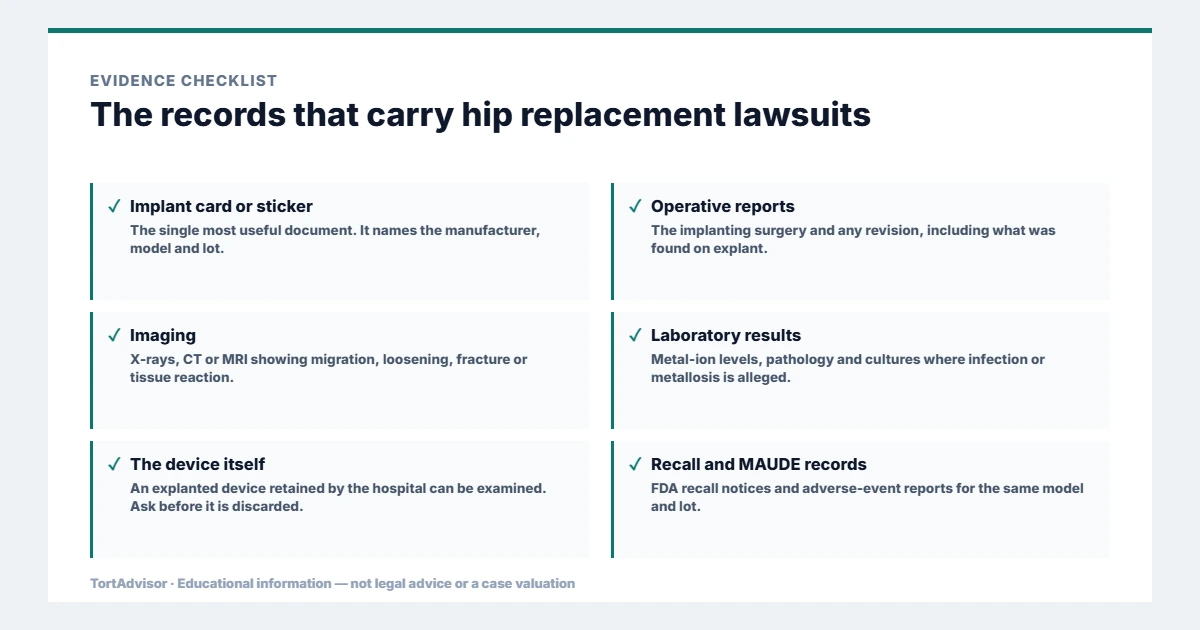
Evidence That Can Strengthen a Hip Implant Claim Review
Implant Stickers / Device Card
Manufacturer, model, size, lot, serial and component information can identify the litigation track.
Original Operative Report
Documents implantation date, surgical approach, component sizes and sometimes product labels.
Metal-Ion Testing
Cobalt and chromium results may support clinical evaluation in metal-bearing systems when interpreted with other evidence.
Imaging
X-rays, CT, ultrasound or metal-artifact-reduction MRI may document loosening, fracture, fluid collections or tissue reaction.
Revision Operative Findings
Corrosion, taper damage, metallosis, tissue necrosis, loosening, fracture or liner wear may be documented during revision.
Pathology / Explant Analysis
Tissue pathology, photographs and preserved implant components may provide additional failure-mode evidence.
Recall / Warning Records
Manufacturer notices, FDA recall records and physician communications can provide product-specific regulatory context.
Damages Records
Medical expenses, wage loss, disability, rehabilitation, mobility aids and future-care needs support damages analysis.
Hip Replacement Lawsuit Settlement Status and Value Factors
Hip implant litigation has produced major historical settlement programs involving DePuy and Stryker products, while some current MDLs remain open with small residual case inventories. Those prior programs should not be treated as a current universal “average hip replacement settlement.” Exactech claims have a different procedural posture because the broader MDL includes multiple orthopedic products and the manufacturer’s bankruptcy proceedings affect the path to recovery.
Revision Surgery
Revision, explant or reimplantation can materially increase treatment burden and may provide direct evidence of the failure mode.
Metallosis / Tissue Damage
Documented adverse local tissue reaction, necrosis, pseudotumor or substantial metal-debris injury can affect damages.
Fracture / Catastrophic Failure
Component fracture, sudden failure or complex reconstruction can increase medical and functional damages.
Product Identification
A precise manufacturer and component match can be critical to identifying available claims, settlements or defenses.
Permanent Impairment
Mobility loss, chronic pain, nerve or muscle damage and future revision risk can materially affect value.
State Law & Prior Settlement
Limitation periods, statutes of repose, prior releases, settlement-program participation and jurisdiction can change outcomes.
Hip Implant Product Liability vs. Medical Malpractice
A failed hip replacement can involve a device claim, a medical-malpractice claim, both, or neither. Product-liability claims focus on the implant manufacturer and alleged design, manufacturing or warning defects. Medical-malpractice claims focus on whether a surgeon, hospital or other provider departed from the applicable professional standard of care.
TortAdvisor publishes research on hip replacement lawsuits and does not represent claimants. Nothing on this page is a prediction about the outcome of a particular claim.
Product-Liability Examples
- Premature component fracture or corrosion.
- Recalled liner or implant component.
- Allegedly inadequate device warnings.
- Metal-debris reaction tied to a product design.
Malpractice Examples
- Improper component positioning.
- Intraoperative injury unrelated to device defect.
- Failure to timely diagnose infection or dislocation.
- Other provider conduct falling below the applicable standard of care.
Hip Replacement Lawsuit Statute of Limitations
There is no single nationwide deadline. State law can make timing depend on the implant date, onset of symptoms, diagnosis, recall notice, revision surgery, when a claimant discovered or reasonably should have discovered a possible product connection, and whether a statute of repose applies.
Hip Replacement Lawsuit FAQ
Are hip replacement lawsuits still active in 2026?
Yes, but activity is product-specific. DePuy ASR, Stryker LFIT V40, Stryker Rejuvenate/ABG II and Zimmer M/L Taper MDLs still appear on the October 1, 2026 active-MDL list, while some older hip MDLs have zero pending actions or have largely resolved.
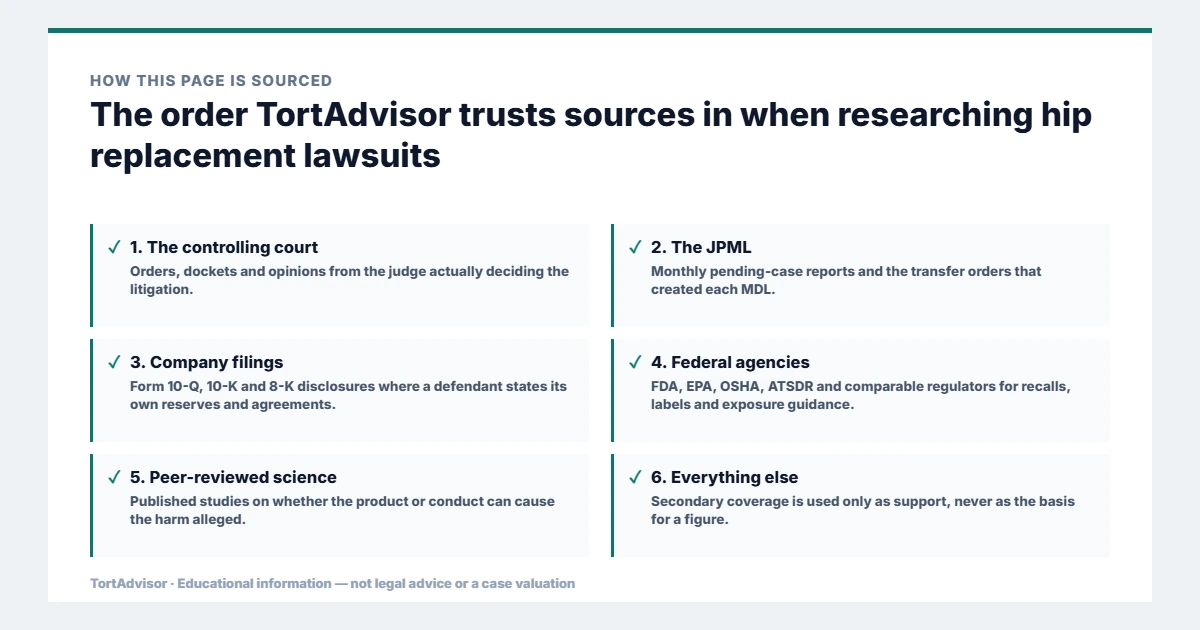
Every status, deadline and figure published on this page about hip replacement lawsuits is traced to a primary source before it appears.
SourceJPML1 Sep 2026
How many DePuy ASR cases are pending?
The October 1, 2026 JPML figures list 113 pending actions in DePuy ASR MDL 2197 in the Northern District of Ohio.
SourceJPML1 Sep 2026
How many Stryker hip cases are pending?
JPML’s October 2026 figures list 47 pending actions in Stryker LFIT V40 MDL 2768 and 6 pending actions in Stryker Rejuvenate/ABG II MDL 2441.
SourceJPML1 Sep 2026
Are all 1,838 Exactech MDL cases hip replacements?
No. Exactech MDL 3044 includes polyethylene orthopedic products used in knee, ankle and hip replacements. The 1,838 pending count is for the mixed MDL, not hip-only claims.
SourceJPML7 Oct 2022
What is metallosis after hip replacement?
Metal wear or corrosion can release cobalt, chromium or other debris. FDA explains that some patients may develop local tissue reactions, bone or soft-tissue damage, loosening or implant failure.
SourceFDA15 Mar 2019
Does a high cobalt level prove a defective hip implant?
No. FDA says metal-ion results should not be interpreted as a stand-alone test for failure. Symptoms, imaging, implant type, examination and other clinical evidence matter.
SourceFDA15 Mar 2019
Does revision surgery strengthen a hip implant lawsuit?
Revision surgery can provide important evidence about component failure, corrosion, wear, fracture or tissue damage, but it does not automatically prove manufacturer liability.
SourceFDA15 Mar 2019
What is the average hip replacement settlement?
There is no reliable universal average. Product, settlement-program history, revision surgery, injury severity, causation evidence, permanent impairment, economic losses, state law and prior releases can all materially affect value.
SourceJPML1 Sep 2026
Hip Replacement Lawsuit Sources and Official References
- Judicial Panel on Multidistrict Litigation — Pending MDL Reports. October 1, 2026 source for current federal MDL counts.
- Northern District of Ohio — DePuy ASR MDL 2197. Official court page describing the ASR XL and ASR Hip Resurfacing litigation.
- District of Massachusetts — Stryker LFIT V40 MDL 2768. Official MDL page and settlement-related orders.
- District of Minnesota — Stryker Rejuvenate/ABG II MDL 2441. Official court page for the dual-modular hip implant litigation.
- District of Maryland — Smith & Nephew BHR MDL 2775. Official court description of the BHR litigation.
- McMillian v. Zimmer — July 2026 Opinion. Current expert-evidence ruling in one of the final MDL 2859 cases.
- FDA — Concerns About Metal-on-Metal Hip Implants. Metal wear, cobalt/chromium and adverse local tissue reaction context.
- FDA — Metal-on-Metal Hip Implant Activities. U.S. market and postmarket-surveillance context.
- FDA Recall Database — Exactech GXL Acetabular Liners. Official recall entry for affected hip-liner components.
Request a Confidential Hip Replacement Case Review
If your hip implant failed prematurely, caused metallosis or severe tissue injury, fractured or required revision surgery, submit the implant, complication, testing and revision information you know now for review.