
Hernia Mesh Lawsuit 2026: Bard Settlement Process, MDLs & Revision Claims
Hernia mesh lawsuit claims allege that specific implanted mesh products were defectively designed, manufactured or labeled and caused complications such as recurrence, migration, infection, adhesions, bowel obstruction, perforation or chronic pain. Federal litigation is divided by manufacturer and product family rather than handled as one class action, with Bard/Davol MDL 2846 and Covidien MDL 3029 among the largest active proceedings in August 2026.
From here you can work through the hernia mesh settlement calculator, read the hernia mesh settlement amounts already on the public record, and see how we source and check every figure.
Choose the Hernia Mesh Lawsuit Information You Need
Start with potential eligibility or the current MDL status, then review revision surgery, mesh complications, settlement factors or the calculator.
What Is a Hernia Mesh Lawsuit?
A hernia mesh lawsuit is an individual product-liability claim alleging that a particular surgical mesh product was defective or carried inadequate warnings and caused injury. Claims may involve design defect, manufacturing defect, failure to warn, negligence, breach of warranty or wrongful death depending on the product, state law and facts.
Manufacturer Matters
Bard/Davol, Covidien, Atrium and Ethicon cases have been coordinated in separate federal proceedings involving different product families and litigation histories.
Revision Findings Matter
Operative findings during revision or removal surgery may help document migration, recurrence, adhesions, erosion, infection, bowel involvement or other alleged problems.
Not One Class Action
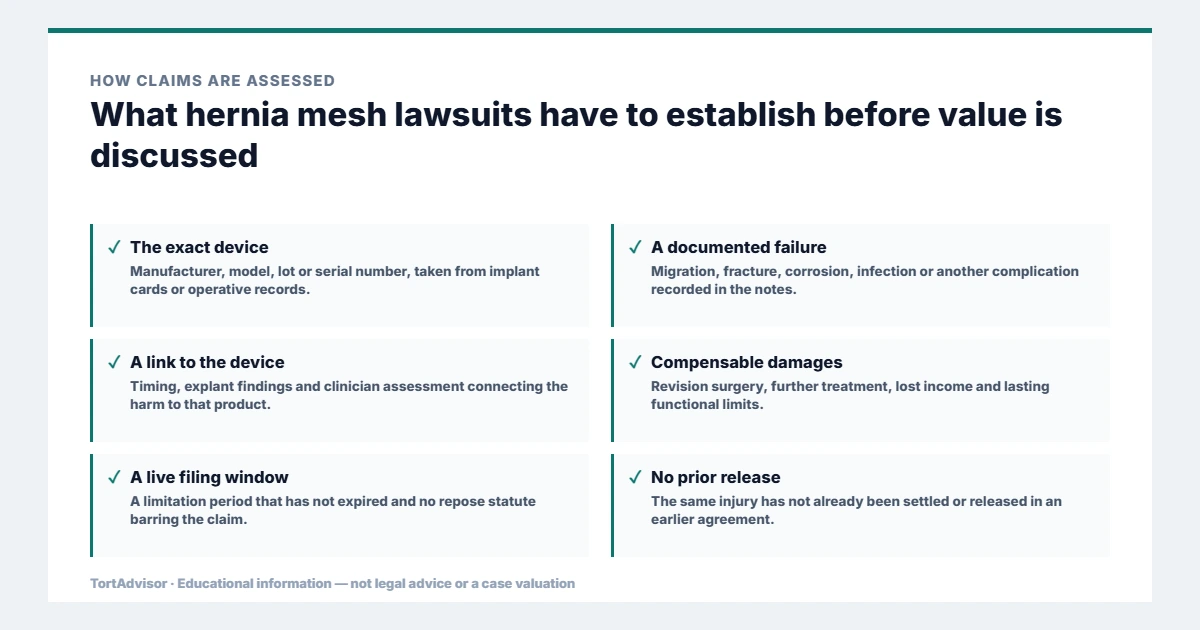
MDL centralization coordinates common pretrial issues. Each claimant still has an individual case and must establish product identity, causation, damages and timely filing.
Who May Qualify for a Hernia Mesh Lawsuit?
There is no single nationwide eligibility rule. Claim screening commonly focuses on whether the mesh manufacturer and product can be identified, whether a significant complication occurred, whether revision or removal surgery was required and whether medical records support a plausible connection between the implant and the injury.
Identifiable Hernia Mesh Implant
- Operative report, implant sticker or hospital device log identifies the manufacturer or product.
- Implant date, hospital and surgeon are known or can be obtained.
- Product belongs to a currently actionable manufacturer/product category under applicable law.
Serious Mesh-Related Complication
- Hernia recurrence, migration or contraction.
- Infection, abscess or inflammatory complication.
- Adhesions, bowel obstruction, perforation or fistula.
- Persistent chronic pain or other documented dysfunction.
Revision or Removal Surgery
Additional surgery can provide important evidence because the revision surgeon may document the mesh condition, migration, folding, erosion, adhesions, infection, bowel involvement or the reason for explantation.
Causation, State Law & Deadlines
Alternative causes, prior hernias, surgical technique, smoking, obesity, infection risk, the governing product-liability law and statutes of limitation can affect claim viability.
Hernia Mesh Lawsuit MDL Status in August 2026
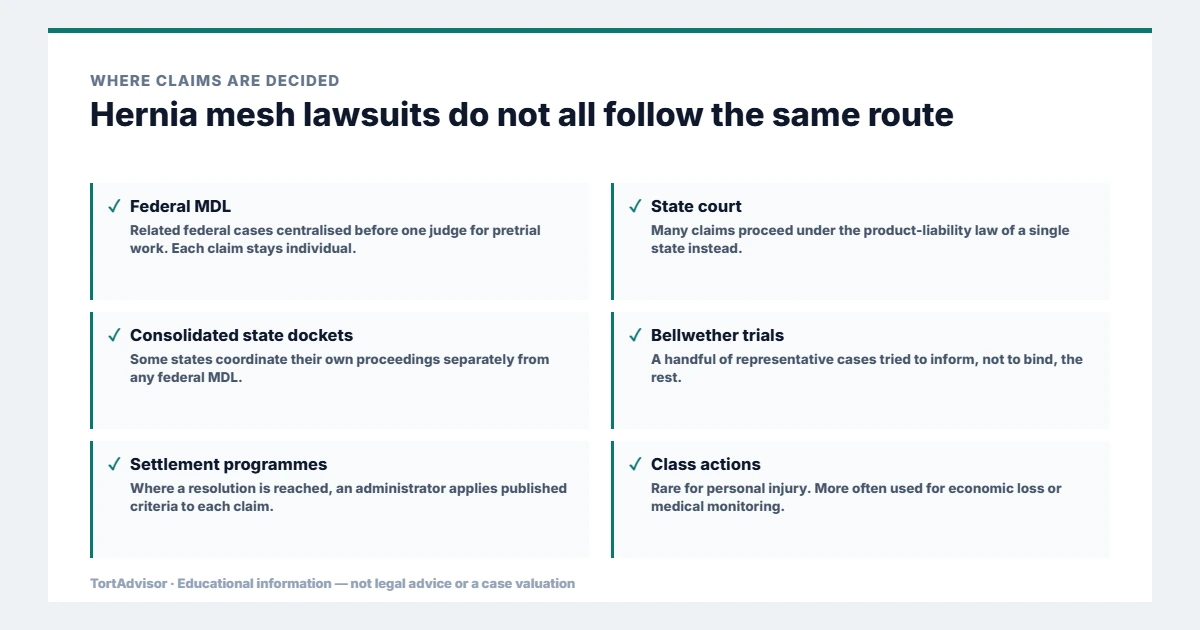
Hernia mesh litigation is divided among manufacturer-specific federal proceedings. JPML’s October 1, 2026 report shows four notable active or historically active hernia-mesh MDLs with very different case counts and settlement stages.
August 2, 2018 — Bard/Davol MDL 2846 Created
JPML centralized federal cases alleging defects in Bard/Davol polypropylene hernia mesh products in the Southern District of Ohio before Judge Edmund A. Sargus Jr.
June 6, 2022 — Covidien MDL 3029 Created
JPML centralized the second Covidien hernia-mesh products-liability litigation in the District of Massachusetts.
November–December 2024 — Bard Settlement Infrastructure
The Southern District of Ohio entered orders establishing an intensive settlement process, appointing special masters and creating the Bard 2024 Hernia Mesh Global Qualified Settlement Fund.
October 31, 2025 — Bard Payment / Common Benefit Order
The court entered CMO No. 58 addressing the mechanism and timing of payments into common-benefit accounts from settlement payments under the agreed payment schedule.
March 2026 — Bard Case-Management Orders Continue
The court entered additional case-management orders in MDL 2846, confirming ongoing administration while settlement implementation continued.
October 1, 2026 — Current JPML Counts
JPML reported 23,324 Bard/Davol actions, 2,479 Covidien actions and 127 Atrium C-QUR actions pending.
Major Manufacturers in Hernia Mesh Litigation
The proper litigation track depends on the exact implant—not merely the fact that “mesh” was used. Hospital implant records, UDI information and operative reports are often the best starting point for manufacturer identification.
| Manufacturer / Product Family | Federal Litigation | October 1, 2026 Context |
|---|---|---|
| Bard / Davol Polypropylene hernia repair products |
MDL 2846 — Southern District of Ohio | 23,324 pending; intensive settlement process and QSF established. |
| Covidien / Medtronic Covidien hernia mesh products |
MDL 3029 — District of Massachusetts | 2,479 pending actions. |
| Atrium Medical C-QUR mesh products |
MDL 2753 — District of New Hampshire | 101 pending; prior court orders implemented a global settlement process. |
| Ethicon / Johnson & Johnson Physiomesh Flexible Composite |
MDL 2782 — Northern District of Georgia | 0 pending, 4,054 historical actions in JPML’s active-litigation report. |
Hernia Mesh Complications Commonly Reviewed in Lawsuits
FDA states that common adverse events after hernia repair—with or without mesh—include pain, infection, recurrence, adhesions, obstruction, bleeding, fistula, seroma and perforation. For mesh repairs, FDA also identifies mesh migration and contraction as additional adverse events. These complications are medically important but do not by themselves prove a defective product.
Recurrence / Mesh Failure
A recurrent hernia may lead to repeat repair. Revision records can help determine whether failure, position, contraction or another factor was involved.
Infection
Mesh infection or abscess may require antibiotics, drainage, hospitalization, debridement or mesh removal.
Migration / Contraction
Movement or shrinkage may be documented by imaging or operative findings and can be evaluated alongside symptoms and alternative causes.
Adhesions / Obstruction
Scar tissue or bowel involvement may cause pain, obstruction or the need for additional surgery.
Perforation / Fistula
Injury or abnormal connections involving bowel or nearby tissue can create serious complications and may require complex surgery.
Chronic Pain
Persistent pain can involve fixation, nerves, scar tissue, recurrence, inflammation, infection or other causes requiring individualized evaluation.
Seroma / Inflammation
Fluid collections and inflammatory reactions can occur after repair and may require drainage, observation or further intervention.
Revision / Explant
Mesh removal or partial removal may generate important operative evidence but can itself be medically complex and should be discussed with a surgeon.
What FDA Says About Hernia Surgical Mesh
FDA notes that mesh can reduce the likelihood of hernia recurrence and that most U.S. hernia repairs use mesh, while also identifying important complications and continuing postmarket surveillance. FDA’s review of adverse-event reports containing hernia-mesh or similar terms identified more than 55,000 reports over a 22-year period.
FDA cautions that adverse-event reporting is a passive surveillance system and that individual reports may be incomplete, inaccurate, unverified or biased. FDA states that adverse-event reports alone are rarely able to confirm direct cause and effect between a medical device and an event.
Lower Recurrence Risk
FDA says medical literature consistently demonstrates a reduced likelihood of hernia recurrence with mesh compared with some non-mesh repairs.
Mesh-Specific Events
FDA lists migration and contraction among additional adverse events associated with mesh repairs.
55,000+ Reports Reviewed
FDA uses adverse-event reports together with research, inspections, registries and other data sources rather than treating reports alone as proof of causation.
Evidence That Can Strengthen a Hernia Mesh Claim Review
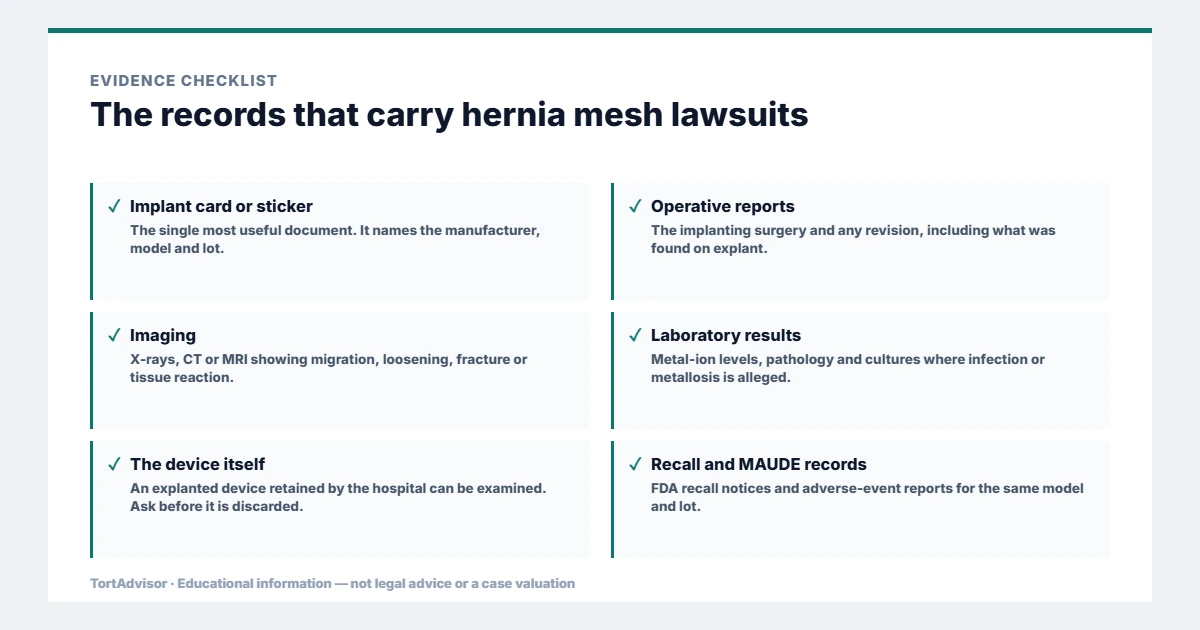
Original Operative Report
May identify the surgical approach, implant date, facility and sometimes the manufacturer or product.
Implant Sticker / UDI
Can provide manufacturer, brand, catalog number, lot number, size or Unique Device Identifier.
Revision Operative Report
May document recurrence, migration, folding, adhesions, infection, bowel involvement, mesh removal or other findings.
Imaging & Diagnostic Records
CT scans, ultrasound, endoscopy, cultures, pathology and other tests may support the complication timeline.
Hospital & Specialist Records
Emergency visits, surgical consultations, infectious-disease care, pain management and postoperative follow-up can document severity and treatment.
Explant / Pathology Evidence
Where available, pathology, photographs, explant records or preserved device information may provide additional product and injury evidence.
Economic Damages
Medical bills, insurance records, wage loss, disability documentation, travel costs and future-care estimates may support damages.
Timeline Evidence
Implant date, onset of symptoms, diagnosis, revision dates and discovery of the product connection can also affect legal deadlines.
Hernia Mesh Lawsuit Settlement Status and Value Factors
The most significant confirmed settlement development in the large Bard/Davol litigation is the Southern District of Ohio’s formal settlement infrastructure. In November 2024, the court appointed special masters and established an intensive settlement process. In December 2024, the court created the Bard 2024 Hernia Mesh Global Qualified Settlement Fund, and another order stated that settling claimants had resolved claims pursuant to an agreement between Plaintiffs’ Lead Counsel and Bard. A 2025 order addressed payments under the agreed schedule and common-benefit assessments.
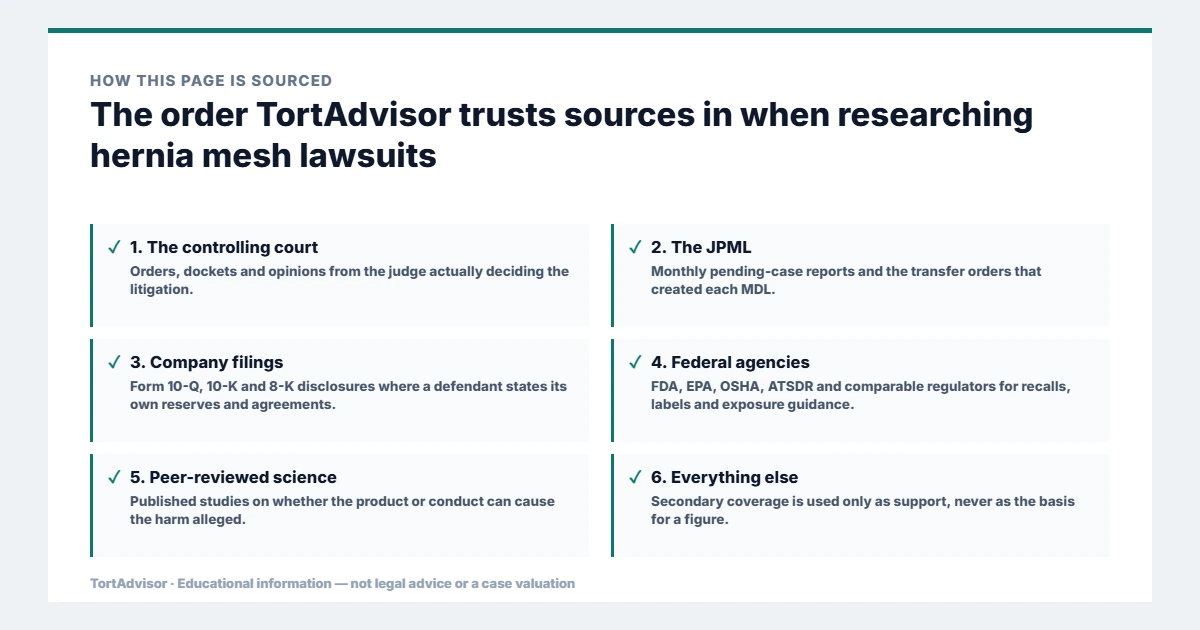
Every status, deadline and figure published on this page about hernia mesh lawsuits is traced to a primary source before it appears.
Revision or Removal Surgery
Additional operations, explantation and operative findings often increase documented medical losses and may strengthen product-specific evidence.
Bowel or Organ Injury
Obstruction, perforation, fistula or organ involvement can create significant medical treatment and future-care damages.
Persistent Infection
Hospitalization, drainage, antibiotics, mesh removal and repeated treatment can materially affect claimed damages.
Product Identification
A case tied to a specific manufacturer and device usually has a clearer litigation path than a claim where the implant cannot be identified.
Permanent Impairment
Chronic pain, mobility limits, recurrent hernias, nutritional problems or other lasting effects can affect damages when medically documented.
State Law & Defenses
Statutes of limitation, repose, learned-intermediary rules, causation standards and prior settlements can materially affect both viability and value.
How a Hernia Mesh Lawsuit May Be Evaluated
Identify the Implant
Obtain the operative report, implant sticker, UDI or hospital device log.
Document the Complication
Gather imaging, infection records, recurrence diagnosis, bowel records or pain-treatment documentation.
Review Revision Surgery
Collect revision operative findings, pathology and records showing whether mesh was removed or replaced.
Match Manufacturer & Litigation
Determine whether Bard, Covidien, Atrium, Ethicon or another manufacturer/product is involved.
Check Causation & Deadlines
Review alternative causes, governing state law, discovery rules, statutes of limitation and repose.
Document Damages
Preserve medical expenses, wage loss, disability, future treatment and other legally recoverable losses.
Hernia Mesh Lawsuit Statute of Limitations
There is no single nationwide filing deadline for every hernia mesh claim. Timing can depend on state statutes of limitation and repose, the implant date, onset of symptoms, diagnosis, revision surgery, when the claimant discovered or should have discovered a potential product connection, residence and other facts.
TortAdvisor publishes research on hernia mesh lawsuits and does not represent claimants. Nothing on this page is a prediction about the outcome of a particular claim.
Hernia Mesh Lawsuit FAQ
How many Bard hernia mesh lawsuits are pending?
JPML’s October 1, 2026 report lists 23,324 actions pending and 25,217 historical actions in Bard/Davol MDL 2846.
SourceJPML1 Sep 2026
How many Covidien hernia mesh cases are pending?
JPML lists 2,479 actions pending and 2,489 historical actions in Covidien Hernia Mesh MDL 3029 as of October 1, 2026.
SourceJPML1 Sep 2026
Is the hernia mesh litigation a class action?
No. Major federal proceedings are MDLs coordinating individual lawsuits for common pretrial issues. Each claimant keeps an individual claim and must establish product identity, injury, causation and damages.
Source28 U.S.C.Sec. 1407(a)
Has Bard created a hernia mesh settlement fund?
The Southern District of Ohio established a qualified settlement fund and intensive settlement process. Court orders also refer to settling claimants who resolved claims under an agreement with Bard. The public orders do not create a universal payout amount for all mesh claimants.
SourceS.D. OhioCMO 56
Does revision surgery make a hernia mesh case stronger?
Revision surgery can provide important medical and product evidence, but it does not automatically establish liability. FDA lists the most common adverse events as occurring in hernia repair with or without mesh, so a revision on its own does not identify the mesh as the cause. The reason for revision, operative findings, product identity, causation and state law still matter.
SourceFDAHernia mesh
What complications does FDA associate with hernia repair?
FDA lists pain, infection, recurrence, adhesions, obstruction, bleeding, fistula, seroma and perforation among common adverse events for hernia repair. For mesh repairs, FDA also identifies mesh migration and contraction.
SourceFDA13 Jul 2023
How do I find out what mesh was implanted?
The details sit in your medical record. Under FDA’s Unique Device Identification system a UDI appears on the device label and package: the device identifier names the labeler and the specific model, and the production identifier carries the lot or batch number, serial number and manufacturing date. Requesting the operative report and implant record from the hospital or surgeon’s office is the usual way to obtain the manufacturer, brand, UDI, catalog and lot number, size and implant date.
SourceFDAUDI Basics
What is an average hernia mesh settlement?
There is no reliable universal average that predicts an individual result. Manufacturer, product, revision surgery, injury severity, evidence, causation, damages, liens, state law and settlement terms can all materially change value.
SourceS.D. OhioCMO 56
Hernia Mesh Lawsuit Sources and Official References
- JPML — Pending MDLs by Actions Pending, October 1, 2026. Official counts for Bard/Davol MDL 2846, Covidien MDL 3029, Atrium C-QUR MDL 2753 and Ethicon Physiomesh MDL 2782.
- Southern District of Ohio — MDL 2846. Official Bard/Davol hernia-mesh MDL page and presiding-judge information.
- Southern District of Ohio — Selected Orders by Date. Includes the intensive settlement process, qualified settlement fund and 2026 case-management orders.
- Bard MDL CMO No. 57. States that settling claimants resolved claims pursuant to an agreement between Plaintiffs’ Lead Counsel and Bard.
- Bard MDL CMO No. 58. Addresses settlement payments and common-benefit accounts under the agreed payment schedule.
- District of Massachusetts — MDL 3029. Official Covidien Hernia Mesh Products Liability Litigation No. II page.
- District of New Hampshire — Atrium C-QUR Settlement Hearing Order. Official order describing implementation of the Atrium global settlement process.
- FDA — Surgical Mesh Used for Hernia Repair. Benefits, risks and recognized complications.
- FDA — Hernia Mesh Safety Activities. Postmarket surveillance and review of more than 55,000 adverse-event reports.
Request a Confidential Hernia Mesh Case Review
If you experienced serious complications or required revision or removal surgery after a hernia mesh implant, submit the implant, complication, treatment and revision information you know now for review.
See Hernia Mesh Settlement Amounts 2026 for reported payout ranges, the factors that move claim value, and what the court record actually shows as of August 2026.