
Short answer: This article explains the key facts, eligibility issues, settlement factors, deadlines, and source-backed updates related to this legal topic. Results vary by case facts, evidence, jurisdiction, and representation.
A Rochester car accident lawsuit can involve no-fault insurance benefits, a statutory serious-injury threshold, medical causation, available coverage, and fault rules that changed in 2026. This guide separates verified Rochester crash data from the legal and insurance issues that determine an individual claim.
Rochester Collision Risk in Allstate’s 2026 Report
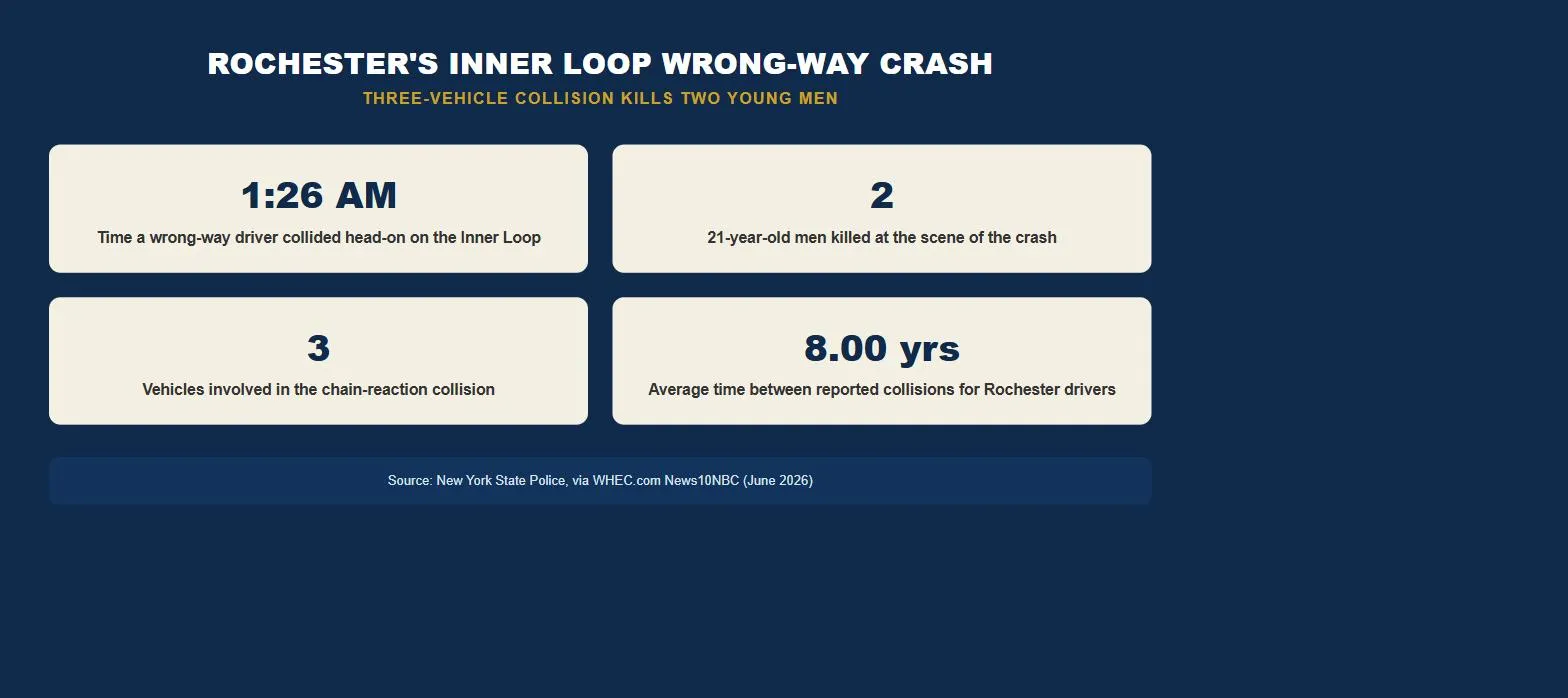
The 2026 Allstate America’s Best Drivers Report ranks Rochester 152nd out of 200 large U.S. cities. The report lists an average of 8.0 years between collisions and a relative collision likelihood 35.8% above the national benchmark.
Allstate’s ranking is based on property-damage claim frequency from January 2023 through December 2024. Its phone-use, speeding, hard-braking and nighttime-driving information supplies behavioral context but is not used to determine the city ranking. The figures are not police crash totals and do not predict when a specific Rochester driver will be involved in a collision.
Rochester’s position among the 200 large U.S. cities included in Allstate’s comparison.
Estimated average interval between property-damage collision claims.
Relative collision likelihood reported above Allstate’s national baseline.
June 2026 Rochester Inner Loop Wrong-Way Crash
According to the New York State Police, a Honda CR-V traveled westbound in the eastbound lanes of Rochester’s Inner Loop at approximately 1:26 a.m. on June 26, 2026. The Honda collided head-on with an eastbound Ford Fusion, and the Ford then entered the path of a Jeep Liberty.
The Ford’s 21-year-old driver and 21-year-old front-seat passenger were pronounced dead at the scene. The Honda driver became unresponsive and was transported to Strong Memorial Hospital. The Jeep driver was treated for injuries that State Police described as non-life-threatening.
A Honda CR-V reportedly traveled west in the eastbound lanes.
The Honda collided with an eastbound Ford Fusion.
The Ford then entered the path of a Jeep Liberty.
Two Ford occupants died, and the two other drivers were transported for treatment.
New York Car Accident Law Changed in 2026
The former page described New York as a pure comparative-negligence state for car accident injury claims. That statement is no longer accurate for covered motor-vehicle personal-injury actions commenced on or after May 26, 2026.
Modified Comparative Negligence
Under current CPLR § 1411(b), culpable conduct attributable to a claimant bars recovery in a covered motor-vehicle personal-injury action when the claimant’s fault is greater than the defendant’s fault or the defendants’ combined fault.
When the claimant’s fault does not exceed that threshold, damages may still be reduced according to the assigned percentage of fault.
First-Party Benefits
New York’s no-fault system generally directs an eligible injured driver, passenger or pedestrian to the applicable no-fault insurer for covered basic economic losses without first proving another driver’s negligence.
The New York Department of Financial Services identifies general notice and proof deadlines that begin soon after the crash.
Serious-Injury Requirement
Under Insurance Law § 5104, a covered person generally must establish a qualifying serious injury before recovering non-economic damages from another covered person.
The 2026 amendments removed the former temporary 90-out-of-180-day impairment category for actions and proceedings commenced on or after May 26, 2026.
Special Non-Economic Damage Cap
Current Insurance Law § 5104(d) imposes a $100,000 non-economic-damage cap in specified cases involving an at-fault injured driver who was uninsured, convicted of impaired operation, or convicted of using the vehicle during a felony or immediate flight.
The provision contains statutory conditions and does not apply to injuries resulting in death.
Rochester Car Accident Insurance and Filing Deadlines
The commonly cited three-year personal-injury period is not the only deadline. No-fault notice, medical bills, wage-loss proof, wrongful-death actions and claims involving a city or public authority can have much shorter requirements.
| Requirement | General period | Why it matters | Primary source |
|---|---|---|---|
| No-fault accident notice | Generally within 30 days after the accident, subject to limited justification for delay. | Late notice may jeopardize first-party no-fault benefits. | NY DFS no-fault FAQs |
| Medical bills | Generally within 45 days after treatment. | Providers and claimants must comply with proof-of-claim requirements. | NY DFS Regulation 68 FAQs |
| Lost earnings | Generally within 90 days. | Late wage-loss proof may affect reimbursement. | NY DFS Regulation 68 FAQs |
| Personal-injury lawsuit | Generally three years. | Exceptions and special defendants can change the deadline. | CPLR § 214 |
| Wrongful-death action | Generally two years after death. | An estate representative and separate survival issues may be involved. | EPTL § 5-4.1 |
| Municipal Notice of Claim | Often 90 days when General Municipal Law § 50-e applies. | City vehicles, public employees or dangerous-road claims may trigger special procedures. | GML § 50-e |
Common Rochester Car Accident Claims
Wrong-Way and Head-On Crashes
These claims may require reconstruction, toxicology, roadway video, electronic vehicle data and investigation of additional contributing parties.
Multi-Vehicle Collisions
Chain-reaction crashes can involve multiple fault percentages, insurers, policy limits and disputes over which impact caused each injury.
Winter Weather Accidents
Snow and ice do not automatically excuse unsafe driving. Speed, following distance, visibility, tire condition and road-treatment evidence may matter.
Pedestrian and Bicycle Injuries
Crosswalks, signals, lighting, right-of-way rules, visibility and surveillance footage can become central evidence.
Impaired or Distracted Driving
Police records, toxicology, phone evidence, criminal proceedings and negligent-entrustment issues may affect liability and damages.
Government and Roadway Claims
Public vehicles, road design, signs, signals, snow removal or maintenance may create special notice and immunity questions.
Evidence That Can Strengthen a Rochester Car Accident Claim
Fault Evidence
- Police report and incident number
- Scene, roadway and vehicle photographs
- Dashcam, traffic-camera and business video
- Witness contact information
- Vehicle event-data-recorder information
- Phone, toxicology or driving records when legally available
Medical Evidence
- Emergency and hospital records
- Imaging reports and specialist notes
- Surgery, therapy and rehabilitation records
- Prior records addressing pre-existing conditions
- Prognosis and future-care evidence
- Proof relevant to the serious-injury threshold
Financial and Insurance Evidence
- No-fault forms and insurer correspondence
- Medical bills and receipts
- Pay records and employer statements
- Repair estimates and total-loss records
- Liability, SUM and UM/UIM information
- Future earnings or household-service evidence
Compensation Potentially Available After a Rochester Crash
Potential recovery depends on no-fault benefits, the serious-injury threshold, fault allocation, available coverage, responsible parties, liens and documented damages.
Economic Losses
- Medical treatment and rehabilitation
- Future medical and life-care expenses
- Lost earnings and reduced earning capacity
- Vehicle damage and replacement loss
- Transportation and out-of-pocket costs
Non-Economic and Death-Related Losses
- Pain and suffering when legally recoverable
- Disability, disfigurement and loss of function
- Loss of enjoyment of life and consortium
- Survival damages accruing before death
- Wrongful-death pecuniary loss and funeral expenses
What May Increase or Reduce a Rochester Car Accident Settlement?
| Value factor | Potentially stronger evidence | Potential challenge |
|---|---|---|
| Fault | Video, witnesses, admissions, reconstruction and consistent physical evidence. | Conflicting accounts, missing evidence or fault placing the claimant above New York’s 2026 threshold. |
| Injury severity | Surgery, fracture, brain injury, spinal injury, permanent impairment or wrongful death. | Temporary symptoms, full recovery or failure to satisfy the serious-injury threshold. |
| Medical documentation | Prompt care, objective testing, consistent treatment and credible prognosis evidence. | Treatment gaps, inconsistent history or unsupported future care. |
| Economic damages | Documented bills, wage loss, reduced capacity and future costs. | Unverified amounts or speculative projections. |
| Insurance and defendants | Adequate liability limits, SUM coverage, commercial policies or additional responsible parties. | Minimum limits, uninsured driver, exclusions or competing claims. |
| Deadline compliance | Timely no-fault notice, bills, wage proof, municipal notice and lawsuit filing. | Late notice, expired limitations period or missing public-entity requirements. |
What to Do After a Rochester Car Accident
- Call 911 and address urgent medical needs. Request police and emergency assistance and move to safety when possible.
- Preserve the scene. Photograph vehicle positions, damage, road conditions, signs, signals, debris and visible injuries.
- Collect identifying information. Obtain driver, owner, insurance and witness details without debating fault.
- Seek appropriate medical evaluation. Describe symptoms accurately and retain records and discharge instructions.
- Address no-fault notice promptly. Written notice is generally due within 30 days, with other proof deadlines following.
- Preserve video and electronic evidence. Business footage, dashcams and vehicle data can be overwritten or lost.
- Do not sign a release before understanding future losses. A release can end further recovery even when additional treatment is later needed.
Frequently Asked Questions About Rochester Car Accident Lawsuits
Is New York still a pure comparative-negligence state for car accident claims?
No—not for covered motor-vehicle personal-injury actions commenced on or after May 26, 2026. CPLR § 1411(b) now bars recovery when the claimant’s fault is greater than the fault of the defendant or the defendants’ combined fault.
How long do I have to file a Rochester car accident lawsuit?
New York generally provides three years for personal-injury actions. Wrongful-death, public-entity, public-authority, insurance and contractual deadlines may be shorter.
How soon must I provide New York no-fault notice?
Written notice is generally required within 30 days after the accident unless clear and reasonable justification supports a delay. Medical bills and lost-earnings proof have additional deadlines.
Can I recover pain-and-suffering damages?
A covered person generally must establish a serious injury under New York’s no-fault law before recovering non-economic loss from another covered person.
Who may be liable for a wrong-way crash?
The wrong-way driver may be a primary defendant, but vehicle ownership, negligent entrustment, alcohol service, employment, roadway conditions and other contributing factors may also be investigated.
Does the Allstate ranking prove a Rochester road was dangerous?
No. The ranking is a city-level insurance-claims comparison. It does not prove that a particular road was defective or establish fault in an individual collision.
What happens when a claimant is more at fault than the defendants?
In covered actions subject to the 2026 rule, recovery is barred when the claimant’s fault is greater than the fault of the defendant or the defendants’ combined fault.
Is the settlement calculator a guaranteed claim value?
No. It is an educational estimate based on limited inputs. Actual results depend on current law, evidence, injury severity, insurance, liens, deadlines and professional review.
Primary Sources and External Citations
Allstate 2026 America’s Best Drivers Report
Rochester ranking and report methodology
Official source for Rochester’s rank, years between collisions, relative likelihood and claims-data methodology.
New York State Police
June 26, 2026 Rochester Inner Loop crash release
Official description of the wrong-way vehicle, sequence of impacts and reported injuries.
New York DFS 2026 Reforms
Insurance Circular Letter No. 3 (2026)
Official explanation of the modified comparative-negligence rule, serious-injury changes, damage cap and effective dates.
New York Statutes and No-Fault Guidance
CPLR § 1411, Insurance Law § 5104, CPLR § 214, and NY DFS no-fault FAQs.
Estimate a Rochester Car Accident Claim
Organize the crash facts, medical treatment, wage loss, fault evidence and insurance information before accepting an offer or signing a release.
Have These Details Ready
- Accident date and Rochester location
- Police report or incident number
- Injuries and medical treatment
- No-fault and liability insurer information
- Lost earnings and expenses
- Photos, video and witnesses
About the Reviewer
TortAdvisor Editorial Team reviews legal content for clarity, source quality, mobile readability, internal-link structure and usefulness. This page was corrected after New York’s May 2026 motor-vehicle reforms changed the comparative-fault and serious-injury rules applicable to newly commenced covered actions.
What to Know About Your Rochester Car Accident Lawsuit
Understanding your rochester car accident lawsuit options early can make the difference between a lowball settlement offer and full compensation for medical bills, lost wages, and pain and suffering.
An experienced attorney handling a rochester car accident lawsuit case will gather police reports, medical records, and witness statements while negotiating directly with insurance adjusters on your behalf.
If you or a loved one need guidance on a rochester car accident lawsuit, a free, no-obligation consultation can help clarify your legal options and next steps.
An experienced attorney handling a rochester car accident lawsuit case will gather police reports, medical records, and witness statements while negotiating directly with insurance adjusters on your behalf.
If you or a loved one need guidance on a rochester car accident lawsuit, a free, no-obligation consultation can help clarify your legal options and next steps.
Related Posts

This social media addiction lawsuit negligence verdict 2026 update explains exactly what changed, who qualifies, and how to file a [...]
Anyone comparing settlement outcomes for a rear-end collision lawsuit needs to understand how fault is decided, what similar claims have [...]

Learn how accident claim lawyers evaluate cases, handle insurance tactics, and maximize your compensation under California law.


