Social Media Abuse Lawsuit 2026: Landmark Negligence Verdict, Who Qualifies & How to File
This 2026 update supports TortAdvisor’s
Social Media Addiction Lawsuit Guide.
You can also browse
Active Lawsuits,
Settlement Calculators,
Social Media Settlement Amounts,
and
Legal Insights.
Social media addiction lawsuit 2026 update: Federal claims alleging that major platforms used addictive design features that harmed children and adolescents continue in MDL No. 3047, In re: Social Media Adolescent Addiction/Personal Injury Products Liability Litigation, in the U.S. District Court for the Northern District of California. The litigation involves allegations against companies associated with Instagram, Facebook, YouTube, TikTok, Snapchat, and other platforms. The defendants dispute liability, and an MDL does not determine that every user has a valid claim.
Key Social Media Addiction Lawsuit Developments — August 2026
- Federal proceeding: MDL 3047 remains centralized in the Northern District of California.
- March 25, 2026 verdict: A Los Angeles County state-court jury found Meta and Google/YouTube liable in the K.G.M. social media addiction trial and awarded $6 million in combined compensatory and punitive damages. That verdict was not a verdict in MDL 3047 and does not automatically determine other cases.
- August 10, 2026 appellate development: The Ninth Circuit declined to halt more than 3,000 social-media addiction lawsuits at that procedural stage, allowing the litigation to continue while leaving defendants able to raise Section 230 and other defenses later.
- August 12, 2026: Jury selection is scheduled to begin in Oakland in the multistate attorneys general case against Meta, with opening statements scheduled for August 18.
- Settlement status: No global settlement resolving the individual social-media addiction MDL has been announced.
What Is the Social Media Addiction Lawsuit?
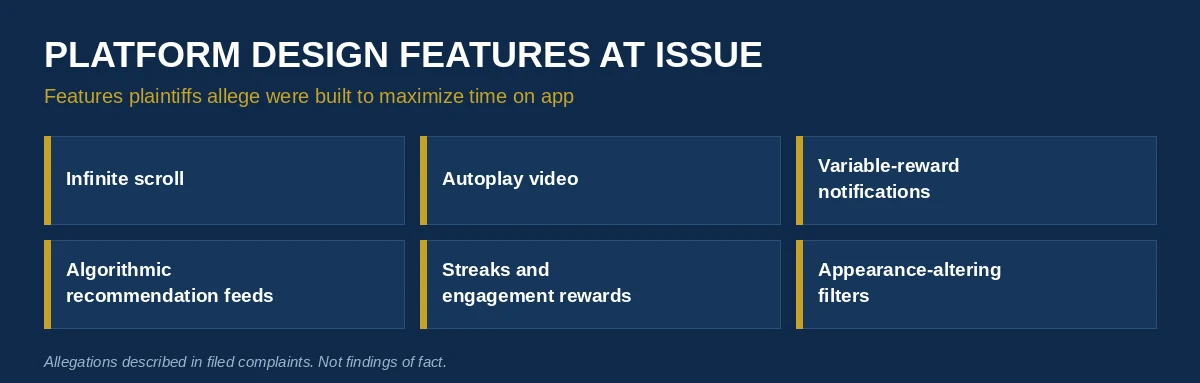
The social media addiction lawsuit litigation alleges that certain social media companies designed or operated product features in ways that encouraged compulsive use, particularly among minors, while allegedly failing to provide adequate warnings about associated risks. Plaintiffs have challenged features such as algorithmic recommendation systems, infinite scroll, autoplay, engagement notifications, social-feedback mechanisms, and other design choices.
Find out if you may have a claim
Answer a few questions and a trained case advisor will review your situation — most people finish in about a minute.
- Free — no cost, no obligation
- About a minute to complete
- Reviewed by a trained case advisor
- Nothing you submit is published
Your details are sent over a secure connection and reviewed confidentially.
MDL 3047 coordinates federal cases with overlapping factual and legal questions. Coordination can make discovery, motion practice, expert issues, and other pretrial proceedings more efficient, but each personal-injury claim retains individual facts involving platform use, medical history, alleged injury, causation, damages, state law, and filing deadlines.
The existence of the MDL does not establish that a social media platform caused a particular person’s depression, anxiety, eating disorder, self-harm, or another condition. Those issues require individual medical and legal evidence.
Latest Social Media Lawsuit Update: What Changed in 2026?
The March 2026 Meta and YouTube Verdict
On March 25, 2026, a Los Angeles County Superior Court jury found Meta and Google/YouTube liable in a lawsuit brought by a young woman identified in court as K.G.M. The jury found negligence and failure-to-warn liability and awarded $3 million in compensatory damages plus $3 million in punitive damages, allocated 70% to Meta and 30% to Google/YouTube.
This was a significant test case, but it is important to describe it correctly: the K.G.M. verdict was a California state-court trial, not a jury verdict in federal MDL 3047. It may influence litigation strategy and settlement expectations, but it is not automatically binding on other plaintiffs, courts, platforms, or claims.
The August 10, 2026 Ninth Circuit Development
On August 10, 2026, the U.S. Court of Appeals for the Ninth Circuit allowed more than 3,000 lawsuits against Meta, Google, TikTok, and Snap to continue after rejecting an effort to obtain immediate appellate relief based on Section 230. The ruling was procedural; it did not eliminate every Section 230 argument or decide the ultimate merits of the plaintiffs’ claims.
Meta Attorneys General Trial Begins in August
A separate multistate case led in part by California alleges that Meta designed Facebook and Instagram to maximize engagement by minors while violating federal and state law. California’s Attorney General states that jury selection is scheduled for August 12, 2026, with opening statements scheduled for August 18, 2026, in Oakland.
This government-enforcement track should not be confused with an individual family’s personal-injury case. The claims, parties, remedies, and proof can differ.
Who May Have a Social Media Addiction Claim?
A potential claim may warrant attorney review when a child, teenager, or young adult used one or more relevant platforms and later developed serious, documented harm that is alleged to be connected to compulsive platform use or challenged design features.
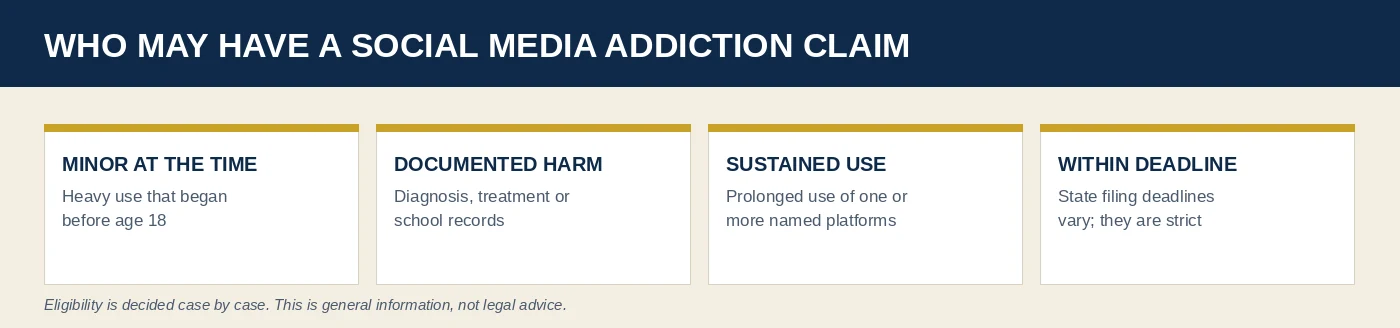
Facts that may be relevant to a review include:
- Documented mental-health injury: Depression, anxiety, eating-disorder treatment, self-harm, suicidal behavior, hospitalization, or another diagnosed condition documented by qualified healthcare professionals.
- Compulsive or unusually intensive platform use: Screen-time records, device data, account history, or other evidence showing frequency and duration of use.
- Age during relevant platform use: Many claims focus on alleged exposure to challenged platform features while the user was a minor.
- School and daily-life impact: Attendance problems, declining performance, social withdrawal, sleep disruption, treatment needs, or other documented functional effects.
- Platform-specific evidence: Account records, notifications, recommendation history, saved screenshots, parental-control records, or other digital evidence.
- Treatment timeline: Records showing when symptoms began, when treatment started, and whether clinicians documented relevant social-media use.
A diagnosis or treatment record can strengthen documentation, but it does not by itself prove that a platform legally caused the condition. Causation and liability remain disputed issues requiring individual review.
Research a Potential Social Media Addiction Claim
Use TortAdvisor’s educational resources to organize platform use, treatment, evidence, and damages before requesting a confidential review.
📞 Call: 855-664-8713
Evidence That May Matter in a Social Media Addiction Lawsuit
Because these cases challenge both platform design and individual causation, preserving digital and medical evidence can be especially important. Useful records may include:
- Account usernames, platform names, and approximate account-creation dates.
- Device screen-time reports and platform activity data.
- Downloaded account archives when available.
- Screenshots showing notifications, recommendations, harmful interactions, or other relevant platform activity.
- Therapy, counseling, psychiatric, pediatric, emergency-room, and hospitalization records.
- Eating-disorder or self-harm treatment documentation when applicable.
- School attendance, academic, disciplinary, accommodation, or counseling records.
- Parent observations recorded close in time to the alleged harm.
- Evidence of deleted accounts or changes in use after treatment began.
- Records showing alternative causes or preexisting conditions that may also require evaluation.
Do not alter records, impersonate another user, contact an alleged perpetrator, or conduct an unsafe investigation to create evidence. Preserve what already exists and allow qualified professionals to evaluate what additional information may be obtainable.
Social Media Addiction Lawsuit Settlement Amounts
No global settlement has been announced for the individual personal-injury claims in MDL 3047. A $6 million verdict in one state-court case does not establish a standard payout schedule for other families, and government enforcement judgments or school-district settlements should not be treated as individual personal-injury averages.
Potential claim value can depend on factors such as:
- Severity and duration of documented mental-health harm.
- Hospitalization, residential treatment, therapy, medication, or other care.
- Self-harm, suicide attempt, or wrongful-death allegations.
- Strength and duration of platform-use evidence.
- Age during relevant use.
- School, social, employment, or functional losses.
- Out-of-pocket treatment costs and other economic damages.
- Evidence supporting or undermining medical causation.
- Platform-specific defenses, including product-design and warning issues.
- State law, filing deadlines, and available damages.
For broader compensation research, visit TortAdvisor’s
Social Media Settlement Amounts.
For a preliminary educational estimate, use the
Social Media Addiction Settlement Calculator.
Calculator results are not settlement offers or guarantees.
How a Social Media Addiction Lawsuit Is Filed
- Identify the platforms and dates. List the platforms used, approximate ages, account names, and periods of intensive use.
- Organize medical and mental-health records. Gather diagnoses, therapy records, hospitalization records, medications, and treatment dates.
- Preserve digital evidence. Save screen-time data, account records, screenshots, platform archives, and relevant communications.
- Review jurisdiction and deadlines. Statutes of limitations and rules involving minors vary by state. There is no safe nationwide deadline that applies to every claim.
- Obtain claim-specific legal review. An attorney can evaluate whether the facts fit the federal MDL, a state-court proceeding, another cause of action, or no viable claim.
Social Media Addiction Claims vs. Exploitation or Sextortion Claims
Social media addiction/product-design litigation and online sexual exploitation claims can overlap, but they are not automatically the same lawsuit. A claim involving grooming, sextortion, child sexual exploitation, or an offline assault initiated through a platform may involve different legal theories, defendants, evidence, statutes of limitations, and court proceedings.
For exploitation-focused research, see:
For compulsive gaming claims involving different products and defendants, see the
Video Game Addiction Lawsuit Guide.
Related TortAdvisor Guides and Updated Link Hierarchy
Active LawsuitsBrowse current lawsuit categories, evidence issues, deadlines, and claim-review resources.
Social Media Addiction LawsuitDedicated social-media design, youth mental-health, MDL, evidence, and eligibility research.
Settlement CalculatorsBrowse TortAdvisor’s current educational claim-value calculators.
Social Media Addiction CalculatorOrganize harm severity, treatment, platform use, evidence, and damages factors.
Social Media Settlement AmountsCompare claim-value factors across digital-platform, abuse, injury, drug, and device claims.
Snapchat LawsuitChild-safety, exploitation, sextortion, platform-design, and evidence issues involving Snapchat.
Roblox Sexual Abuse LawsuitChild exploitation and assault claims involving Roblox and MDL 3166.
Video Game Addiction LawsuitCompulsive gaming allegations involving game mechanics, youth harm, and treatment evidence.
Legal InsightsFollow recent lawsuit developments, court decisions, safety issues, and legal explainers.
Primary and Current Sources
Court, Government, and Current Litigation Sources
Federal MDL record:
GovInfo — In re: Social Media Adolescent Addiction/Personal Injury Products Liability Litigation, MDL 3047
August 2026 Meta trial schedule:
California Department of Justice — Meta trial and June 2026 summary-judgment update
March 25, 2026 verdict reporting:
Associated Press via PBS NewsHour — K.G.M. social media addiction verdict
August 10, 2026 appellate update:
Reuters — Ninth Circuit allows thousands of social-media addiction lawsuits to continue
California youth social-media regulation context:
California DOJ — Protecting Our Kids from Social Media Addiction Act (SB 976)
Still unsure where you stand?
Have a trained case advisor review your own facts — free, confidential, and with no obligation.
- Free — no cost, no obligation
- About a minute to complete
- Reviewed by a trained case advisor
- Nothing you submit is published
Your details are sent over a secure connection and reviewed confidentially.
Frequently Asked Questions About Social Media Addiction Lawsuits
Was Meta and YouTube’s March 2026 verdict part of MDL 3047?
No. The March 25, 2026 K.G.M. verdict was reached by a Los Angeles County Superior Court jury in California state court. Federal MDL 3047 is a separate coordinated proceeding in the Northern District of California.
How much did the March 2026 jury award?
The jury awarded $3 million in compensatory damages and $3 million in punitive damages, for a total of $6 million. Meta was allocated 70% and Google/YouTube 30%. That outcome does not establish a standard settlement amount for other cases.
Are social media addiction cases a class action?
The federal personal-injury cases are coordinated in an MDL, not combined into one ordinary class action. Individual claimants retain claim-specific issues such as platform use, medical history, causation, damages, and state law.
Does Section 230 automatically block social media addiction lawsuits?
No blanket answer applies to every claim. On August 10, 2026, the Ninth Circuit declined to stop more than 3,000 lawsuits at that procedural stage. Defendants can still raise Section 230 and other defenses as the litigation continues.
Does my child need a mental-health diagnosis?
A documented diagnosis and treatment history can be important evidence, but claim viability depends on the full record. Medical documentation does not automatically establish legal causation or platform liability.
Can a parent bring a claim involving a minor child?
Parents or legal guardians may be able to pursue claims on behalf of minors, but standing, procedural requirements, settlement approval rules, and statutes of limitations vary by jurisdiction.
Is there a global social media addiction settlement?
No global settlement resolving all individual MDL 3047 personal-injury claims has been announced. Individual verdicts, school-district settlements, or government enforcement judgments should not be treated as a universal payout schedule.
What should families preserve?
Potentially useful records include account information, screen-time data, downloaded platform archives, screenshots, therapy and medical records, school records, hospitalization records, and a timeline of platform use and symptoms.
Request a Confidential Case Review
If you want to understand whether a social-media-related injury may warrant legal review, organize the platforms used, approximate dates, treatment history, and available digital evidence before contacting a qualified attorney or case-review service.
Social Media Addiction Claim Research
Review the current lawsuit guide, preserve relevant records, and use the calculator as an educational starting point.
📞 855-664-8713
Related Posts

Sexual abuse filing deadlines depend on the state, the survivor's age and whether the case is civil or criminal. How the clock works, with New York, Florida and federal law as examples.

The Boy Scouts Settlement Trust has paid $1.28 billion across 52,513 disbursements as of September 1, 2026 - but it pays only 4.7% of each allowed claim, so a $300,000 Tier 3 claim has produced about $14,100. Court-sourced figures, the payout timeline, and what is still holding the percentage down.
The Roblox lawsuit statute of limitations varies by state. This 2026 guide covers filing deadlines, the minor tolling rule, the discovery rule, and a full state-by-state table so families can determine if they still qualify to file a child exploitation claim.