
Snapchat Sexual Abuse Lawsuit 2026: Exploitation, Sextortion & Child Safety Claims
A Snapchat sexual abuse lawsuit may involve allegations that a minor was groomed, sexually exploited, coerced, sextorted or otherwise harmed after contact that began or developed through Snapchat. Depending on the facts, a claim may examine the alleged offender’s conduct, platform design and safety features, reporting history, age-assurance measures, preserved digital evidence and state law.
A harmful interaction occurring on Snapchat does not automatically make Snap Inc. legally responsible. Potential platform liability depends on the specific legal theory, the conduct being challenged, causation, applicable federal and state law, evidence, defenses and the procedural posture of the case.
You can begin with only the information you feel comfortable sharing.
You do not need to describe every detail of the alleged exploitation to begin a review.
The first step is designed to remain calm, clear and manageable for families and survivors.
Submitting the form does not require you to hire an attorney or proceed with a claim.
A Private First Step — On Your Terms
Discussing online grooming, exploitation or sextortion can be difficult. You do not need to explain everything at once. Begin only with the information you feel comfortable providing.
- Start with the child’s age, approximate timeframe and whether contact involved Snapchat.
- You do not need a completed police investigation just to request an initial civil-claim review.
- You may identify whether messages, screenshots, usernames, reports, account records or other digital evidence still exist.
- Submitting the form does not require you to hire an attorney or continue with a claim.
Check Whether the Claim May Qualify
If you are comfortable doing so, provide a few basic details about the child’s age, approximate timeframe, how Snapchat was involved and the type of harm alleged. This information can help organize a potential civil-claim review. Our step-by-step walkthrough of how a Snapchat lawsuit is filed sets out what that review covers and the order the stages usually run in.
If describing what happened feels difficult, begin with basic information. A more detailed conversation can happen later if you choose to continue.
Submitting this form does not create an attorney-client relationship and does not guarantee that an attorney will accept or file a claim.
Who May Have a Snapchat Sexual Abuse Lawsuit?
A potential Snapchat sexual abuse lawsuit requires an individualized review. Attorneys may examine what happened, the claimant’s age, how Snapchat was involved, what evidence remains, resulting harm, potential defendants, filing deadlines and the specific legal theory being pursued.
The underlying allegations may involve sexual solicitation, grooming, coercion, image-based exploitation, sextortion, trafficking or assault.
Contact began, materially developed or continued through Snapchat messages, profiles, recommendations, location features or account activity.
Therapy, medical care, school disruption, self-harm, financial loss, law-enforcement involvement or other documented effects may be relevant.
Childhood-abuse, product-liability, wrongful-death and other civil claims may follow different state filing rules and revival windows.
Snapchat Lawsuit Status in 2026
Snap Inc. is among the defendants named in the federal Social Media Adolescent Addiction/Personal Injury Products Liability litigation, MDL 3047, in the Northern District of California. The coordinated litigation includes thousands of lawsuits involving alleged youth harms and platform-design issues.
2026 Appellate & MDL Status
On August 10, 2026, the U.S. Court of Appeals for the Ninth Circuit issued a published opinion arising from the coordinated social-media litigation. The court held that Section 230 provides a defense to liability rather than immunity from suit and dismissed the interlocutory appeals before it for lack of appellate jurisdiction.
The opinion does not mean every claim survives Section 230 or that plaintiffs have proven liability. The district court had already concluded that Section 230 bars some theories to the extent they target a platform’s role as publisher of third-party content, while other claims were allowed to proceed.
Types of Snapchat Sexual Abuse & Youth-Harm Claims
Snapchat-related claims can arise from different alleged harms. Treating them separately helps preserve accurate legal analysis because the evidence and liability theories can differ substantially.
Grooming & Sexual Solicitation
Claims may involve an adult or older user allegedly using Snapchat to build trust, solicit sexual content, arrange contact or facilitate exploitation of a minor.
Image-Based Coercion & Threats
Sextortion claims may involve threats to distribute intimate images, demands for money or additional content, coercion or other exploitation.
Addiction & Youth Mental-Health Claims
Product-liability claims in MDL 3047 allege that certain platform features contributed to compulsive use and youth mental-health injury.
Severe Crisis or Death Claims
Some families allege online conduct contributed to suicide, overdose or another death, requiring claim-specific causation and wrongful-death analysis.
Fentanyl or Drug-Related Claims
Claims involving drugs allegedly obtained through social-media contacts can raise separate causation, criminal-conduct and platform-liability questions.
Location, Recommendations & Contact Features
Some claims may examine allegations involving account discovery, recommendations, location sharing, warnings, age-assurance measures or communication controls.

When Can Snap Inc. Be Liable for a Snapchat Sexual Abuse Claim?
Snap is not automatically liable because harmful third-party conduct occurred through the platform. Potential liability depends on the legal duty alleged, the platform conduct challenged, causation, applicable state law and defenses including Section 230 where relevant.
Some claims focus on the design and deployment of platform features rather than seeking to hold Snap liable merely as the publisher of user content.
A claim may examine what risks were allegedly known, what warnings or safety information existed and whether a legally sufficient duty was owed.
Age-related account controls, discovery features and restrictions on adult-to-minor contact may be relevant depending on the theory asserted.
Available reports, safety escalations, account actions and platform responses can be factually relevant in some cases.
Section 230 may bar some theories involving third-party content while other design- or conduct-based claims can raise different legal questions.
Separate civil or criminal responsibility may exist for the person accused of grooming, exploitation, sextortion, assault or other misconduct.
Evidence for a Snapchat Sexual Abuse or Sextortion Lawsuit
No single piece of evidence is required in every case. Digital account information can disappear, but other records may still help document the alleged contact, reports, resulting harm and the relationship between Snapchat and the events.
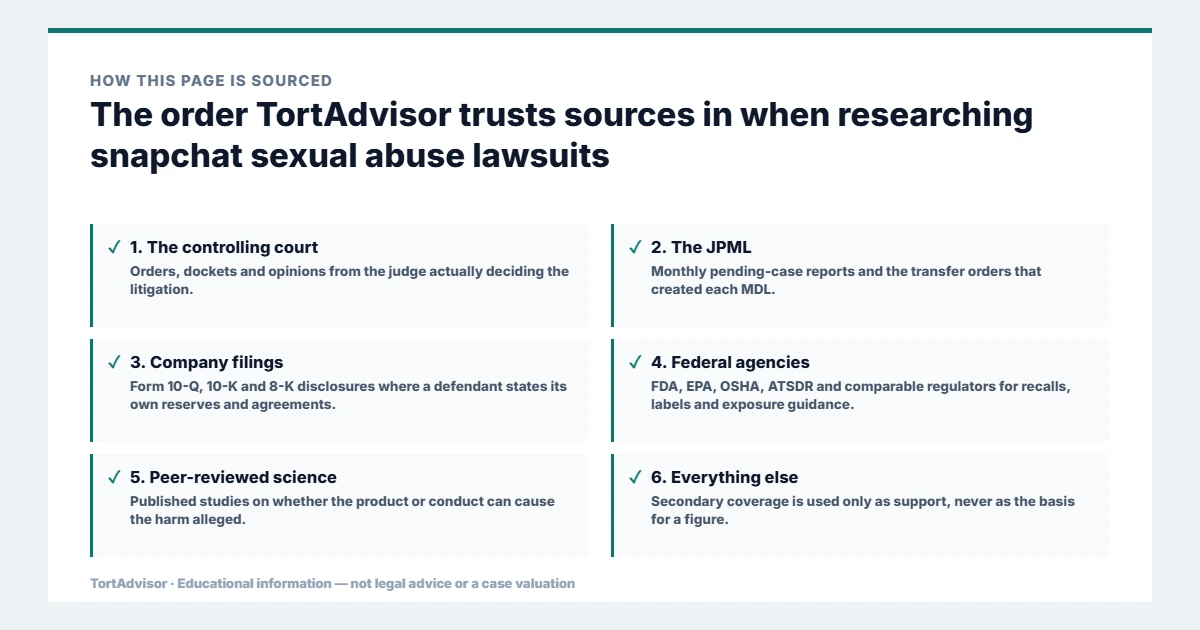
Every status, deadline and figure published on this page about snapchat sexual abuse lawsuits is traced to a primary source before it appears.
Digital & Incident Evidence
- Snapchat usernames and account identifiers
- Screenshots and saved messages
- Account-security or login notifications
- Messages from linked apps or text services
- Reports made to Snapchat or NCMEC
- Police or investigative records
- Witness names and contemporaneous disclosures
- Device backups, cloud files or emails
Damages & Impact Evidence
- Medical records where relevant
- Counseling or therapy records where relevant
- Psychiatric treatment or hospitalization records
- School absences or grade changes
- Safety-plan or accommodation records
- Lost wages or caregiver-work impacts
- Relocation or security expenses
- Other documented out-of-pocket losses
What to Do After Snapchat Grooming, Sextortion or Exploitation
Safety, reporting and civil-law options can serve different purposes. Families and survivors can decide which steps are appropriate based on the circumstances and professional guidance.
Save screenshots, usernames, dates, messages, linked-platform records, account notifications and other safely available information.
Use appropriate platform reporting tools and consider reporting suspected child sexual exploitation to NCMEC or law enforcement.
Organize therapy, medical, school, employment, financial and other records that document the impact on the child or survivor.
An attorney can review possible claims against an alleged offender, platform or other potentially responsible party under applicable law.

Snapchat Sexual Abuse Lawsuit Compensation
There is no standard settlement amount for a Snapchat sexual abuse, sextortion or exploitation claim. No public global Snapchat compensation matrix for individual families is identified in the official sources reviewed for this update. Potential damages depend on the legal claims, documented harm, treatment, evidence, defendants, causation, applicable law and how the case resolves.
Economic & Treatment Losses
- Medical expenses
- Counseling and therapy costs
- Future treatment expenses
- Lost wages or caregiver-work losses
- Education-related losses where recoverable
- Other documented financial losses
Other Potential Damages
- Emotional distress
- Pain and suffering
- Psychological injuries
- Loss of normal activities or opportunities
- Other compensatory damages permitted by law
- Punitive damages where legally available
Use TortAdvisor’s Snapchat Settlement Calculator as an educational tool for organizing claim-value factors, not as a guaranteed payout prediction.
Privacy in a Snapchat Sexual Abuse Claim
Privacy concerns are common in child-exploitation and sexual-abuse matters. The amount of confidentiality available depends on the court, type of proceeding, claimant age, state law and individual case. Families should avoid assuming that every report, civil filing or discovery record will remain completely confidential.
Potential Privacy Measures
- Pseudonym requests in some civil cases
- Protective orders in litigation
- Handling of sensitive medical or therapy records
- Procedures for minor claimants
Digital Privacy Concerns
- Preservation of messages without public disclosure
- Sensitive images or account information
- Device and cloud evidence
- Limits on who receives confidential case information

Online Enticement & Sextortion Research
2025 NCMEC CyberTipline Data
NCMEC reports that the CyberTipline received 1.4 million reports concerning online enticement in 2025, including more than 80,000 reports concerning sextortion. NCMEC also reported an average of 137 financial-sextortion reports per day in 2025.
These figures are national and cross-platform. They should not be presented as Snapchat-specific statistics or as proof of liability in any individual civil case.
Official Snapchat Lawsuit & Child-Safety Sources
Snapchat Sexual Abuse Lawsuit FAQ
Is there a Snapchat sexual abuse class action?
No dedicated nationwide Snapchat sexual-abuse class action should be assumed from the current federal social-media MDL. MDL 3047 coordinates many social-media personal-injury and product-liability cases, while grooming, sextortion and exploitation claims can involve different theories and procedural paths.
Source28 U.S.C.Sec. 1407(a)
Is Snap Inc. part of MDL 3047?
Yes. Snap Inc. is among defendants in the federal Social Media Adolescent Addiction/Personal Injury Products Liability litigation in the Northern District of California.
SourceJPML1 Sep 2026
Does Section 230 automatically prevent a Snapchat lawsuit?
No single answer applies to every claim. Section 230 can bar some theories involving third-party content, while other claims focus on a platform’s own design, warnings or conduct. On August 10, 2026, the Ninth Circuit held that Section 230 is a defense to liability rather than immunity from suit for purposes of the interlocutory appeals before it.
Source9th Cir.10 Aug 2026
What if Snapchat messages disappeared?
A claim may still be reviewable. Screenshots, account identifiers, linked-platform messages, reports, witnesses, device backups, treatment records, school records and law-enforcement materials may still be relevant.
What evidence should a family preserve?
Preserve safely available usernames, screenshots, messages, dates, reports, linked-platform communications, device records, therapy or medical documentation and other relevant information. Do not confront an alleged offender to collect evidence.
SourceNCMECCyberTipline
How much is a Snapchat sexual abuse lawsuit worth?
There is no reliable standard payout amount. Potential value depends on documented harm, survivor age, treatment, evidence, causation, defendants, applicable law, economic losses and how the claim resolves.
SourceJPML1 Sep 2026
Is there a global Snapchat settlement fund?
No public global individual-compensation matrix for Snapchat sexual-abuse or sextortion claims is identified in the official sources reviewed for this update.
SourceTechCrunch21 Jul 2026
How long do I have to file?
There is no safe nationwide deadline. Childhood sexual-abuse rules, revival windows, product-liability statutes, wrongful-death deadlines and other state filing rules can differ substantially.
SourceN.Y. CPLRSec. 214
Can a parent request a review for a minor?
A parent or legal guardian can submit basic information for an initial review. Who may legally bring a claim and how a minor’s claim is handled depend on state law and the facts.
Does submitting Form 26030 hire a lawyer?
No. Submitting information does not create an attorney-client relationship. Representation requires acceptance by a licensed attorney and a separate engagement agreement.
More Sexual Abuse & Social Media Resources
Sexual Abuse Lawsuit Guide
General survivor-focused information about civil sexual-abuse claims, evidence, filing issues and institutional responsibility.
Child Sexual Abuse Lawsuit
Resources for minors and adult survivors of childhood abuse, exploitation and related filing considerations.
Social Media Addiction Lawsuit
MDL 3047, product-design allegations, youth mental-health claims and current federal litigation updates.
Snapchat Settlement Calculator
An educational tool for organizing injury, evidence, treatment and claim-value factors.
Was a Child Groomed, Sextorted or Sexually Exploited Through Snapchat?
Use the private intake form to provide basic information about the child’s age, approximate timeframe, how Snapchat was involved and the resulting harm. You can start without sharing every detail of what happened.