
Child Sexual Abuse Lawsuit 2026: Survivor Rights, Claims & Compensation
A child sexual abuse lawsuit is a civil claim seeking accountability and compensation for sexual abuse or exploitation that occurred while the survivor was under 18. Depending on the facts and state law, a claim may involve the individual perpetrator as well as a school, church, youth organization, employer, facility or other entity.
Adults who experienced sexual abuse as children may still have legal options even when the abuse occurred years or decades ago. Filing deadlines vary significantly by state and by the circumstances of the claim, so an individualized deadline review is important.
Your situation is sensitive. You can begin with only the information you feel comfortable sharing.
You do not need to explain your entire experience all at once. Start with the basics.
The page and intake are designed to keep the first step calm, simple and clear.
Submitting the form does not obligate you to hire an attorney or continue with a claim.
A Private First Step — On Your Terms
Sharing information about childhood sexual abuse can be difficult. You do not need to explain everything at once. Begin only with the information you feel comfortable providing.
- Start with basic details such as the state, approximate timeframe and where the abuse occurred.
- You do not need a police report or complete records just to request an initial review.
- Your information may be reviewed according to the consent disclosure and Privacy Policy associated with the form.
- Submitting the form does not require you to hire an attorney or move forward.
Check Whether the Claim May Qualify
If you are comfortable doing so, share a few details about the childhood abuse, location and circumstances. The information can be used to help evaluate whether the situation may match a current civil claim.
If describing the situation feels difficult, start with the basics. A more detailed conversation can happen later only if you choose to continue.
Submitting this form does not create an attorney-client relationship and does not guarantee that an attorney will accept or file a claim.
Who May Have a Child Sexual Abuse Lawsuit?
Eligibility for a child sexual abuse lawsuit depends on state law and the individual facts. A potential claim may be evaluated when sexual abuse, assault, exploitation or other legally actionable conduct allegedly occurred before the survivor turned 18.
The alleged sexual abuse or exploitation occurred while the survivor was under 18.
The survivor can identify the state and generally where the alleged abuse occurred.
There may be an identifiable individual, institution, organization or other potentially responsible party.
The claim must satisfy the applicable state’s deadline, revival, discovery or tolling rules.
A survivor should not assume a claim is too old simply because the abuse happened many years ago. Several states have changed civil filing rules for childhood sexual abuse, but the rules are not uniform nationwide.
Types of Child Sexual Abuse Lawsuits
Child sexual abuse claims can arise in many settings. Institutional involvement is especially important when an organization allegedly employed, supervised, housed, educated, transported or otherwise provided access to the person accused of abuse.
Clergy Sexual Abuse Lawsuit
Claims involving priests, clergy members, church employees and potential responsibility of a religious institution.
Teacher Sexual Abuse Lawsuit
Claims involving teachers, coaches, school staff, administrators and potential institutional supervision issues.
Boy Scouts Sexual Abuse Claims
Information about childhood abuse claims involving the Boy Scouts and related compensation issues.
Athlete Sexual Abuse Lawsuit
Claims involving coaches, trainers, athletic programs and organizations responsible for young athletes.
Roblox Sexual Abuse Lawsuit
Claims involving alleged grooming, exploitation or unsafe interactions involving minors using Roblox.
Snapchat Sexual Abuse Lawsuit
Claims involving alleged grooming, sextortion, exploitation or other abuse involving minors and Snapchat.
Detention Center Sexual Abuse
Claims involving alleged abuse in juvenile, detention or other custodial environments.
Institutional Sexual Abuse Lawsuit
Claims involving schools, churches, youth programs, facilities and other organizations that may have owed protective duties.
Who May Be Liable in a Child Sexual Abuse Lawsuit?
The person accused of abuse may not be the only potentially responsible defendant. Whether an organization can be held liable depends on the state’s law and evidence concerning its own conduct, duties, knowledge, supervision and other facts.
The person alleged to have directly committed the sexual abuse or exploitation.
A religious institution may be evaluated where its conduct, employees, notice or supervision is relevant to the claim.
Public or private educational organizations may be evaluated depending on who was involved and what the institution knew or did.
Organizations may face claims involving coaches, volunteers, employees or adults given access to children.
Claims may involve foster care, group homes, detention facilities, camps, medical settings or other custodial environments.
Additional defendants may exist depending on employment, ownership, supervision, contractual duties and applicable state law.
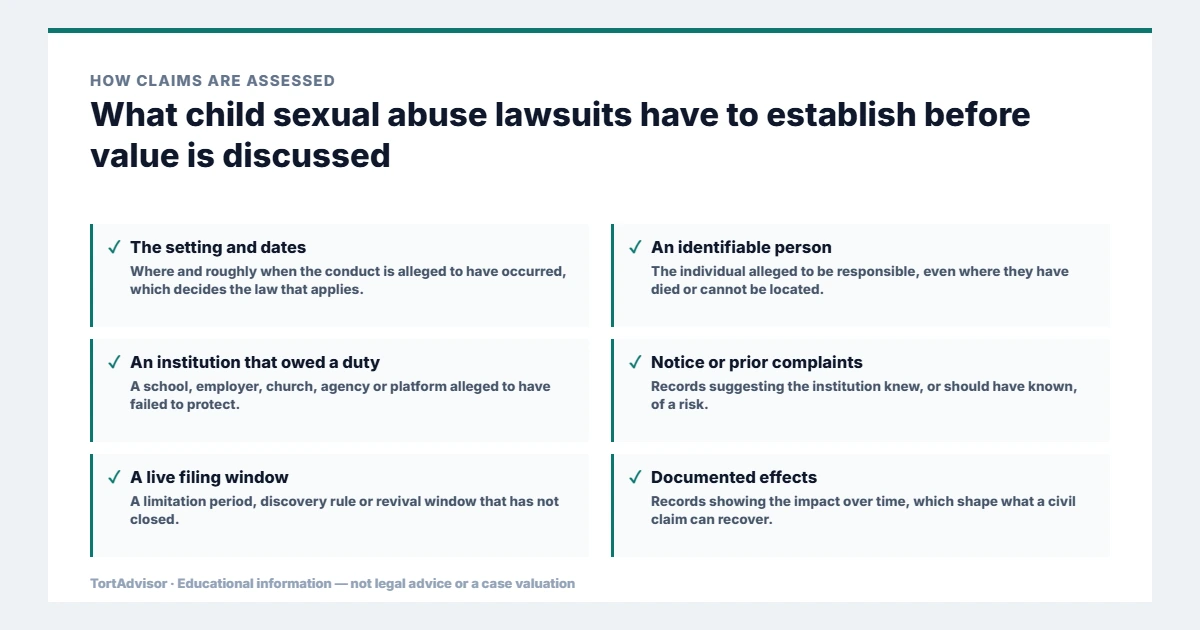
How a Child Sexual Abuse Lawsuit Is Evaluated
Approximate dates, survivor age, location and the identity or role of the person accused are reviewed.
Attorneys may examine schools, churches, organizations, facilities or employers connected to the alleged abuse.
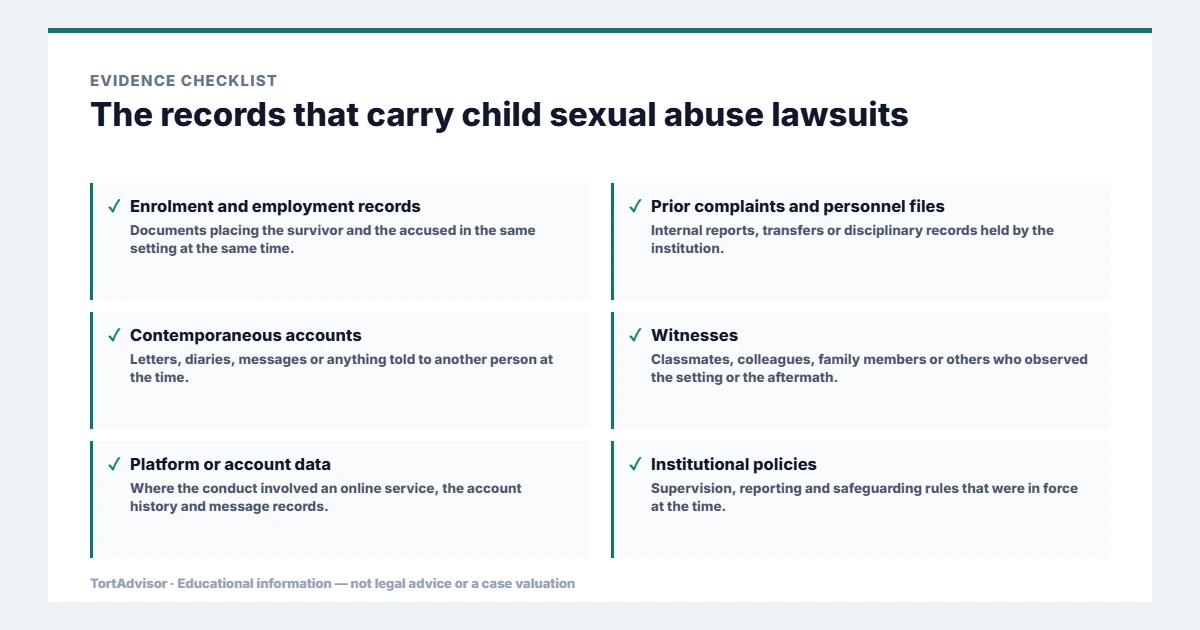
Records, messages, reports, witnesses and other information may help establish what happened and who may be responsible.
State-specific age limits, discovery provisions, tolling rules and revival laws must be reviewed.
Evidence for a Child Sexual Abuse Lawsuit
A survivor does not need every item below for a potential claim to be reviewed. Childhood abuse cases can involve events from years earlier, so evidence may come from many different sources.
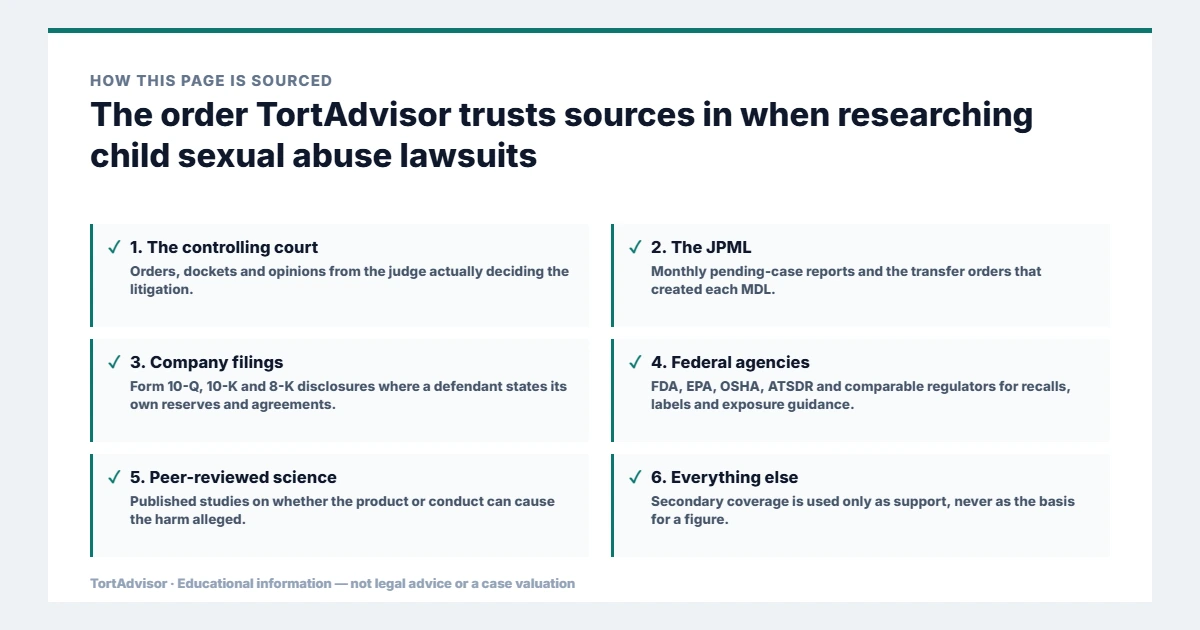
Every status, deadline and figure published on this page about child sexual abuse lawsuits is traced to a primary source before it appears.
Incident & Institutional Evidence
- Letters, emails or text messages
- Social media or platform messages
- School, church or organization records
- Complaints or prior reports
- Police or investigative records
- Witness or former employee information
- Photos, calendars or historical documents
Medical & Damages Evidence
- Medical treatment records where relevant
- Therapy or counseling records where relevant
- Medication history
- Education records where relevant
- Employment and wage-loss records
- Out-of-pocket treatment expenses
- A personal timeline of important events
Child Sexual Abuse Lawsuit Filing Deadlines in 2026
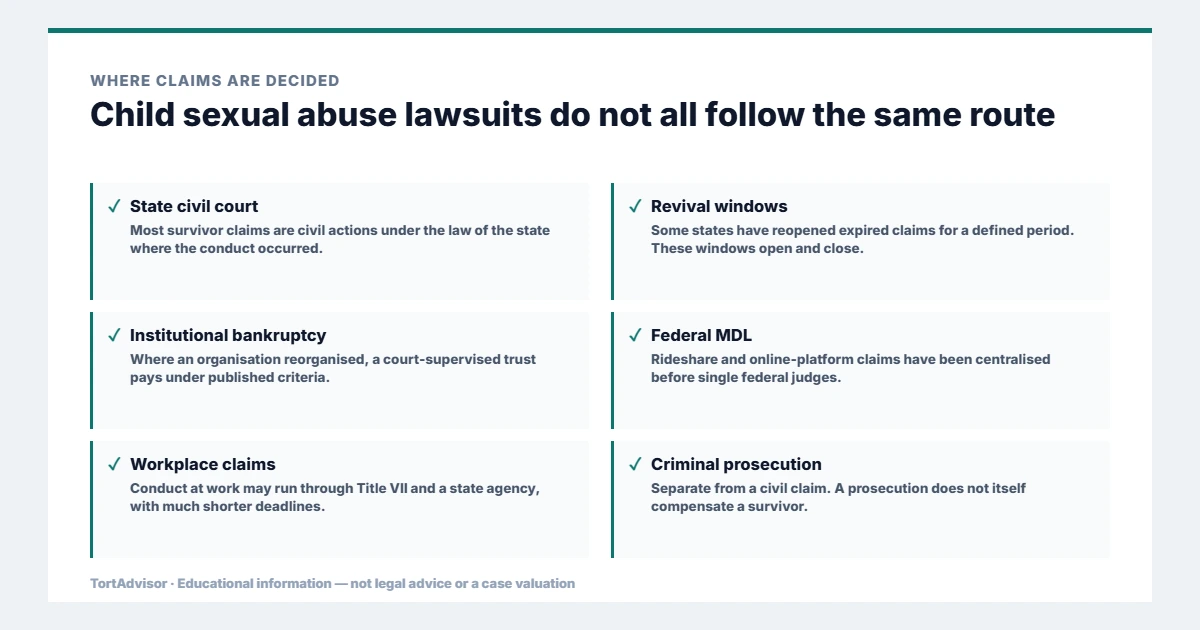
There is no single nationwide filing deadline for a child sexual abuse lawsuit. State law controls most civil filing periods, and the applicable rule can depend on the survivor’s age, when the abuse occurred, the defendant, discovery of injuries and whether a special revival law applies.
New York Courts state that qualifying civil claims involving sexual abuse suffered while under 18 may generally be commenced against an abuser or liable third party until the survivor reaches age 55.
California provides different rules depending on when the alleged childhood sexual assault occurred. Current statutory provisions should be reviewed for the individual claim.
New Jersey provides extended filing rules for certain civil claims involving sexual abuse of a minor, including discovery-related provisions.
Child Sexual Abuse Lawsuit Compensation
There is no standard settlement amount for a child sexual abuse lawsuit. Potential compensation depends on the individual facts, the nature and duration of the alleged abuse, resulting injuries, treatment, available defendants, evidence, insurance or other assets and applicable state law.
Economic Losses
- Past medical expenses
- Future treatment costs
- Therapy and counseling expenses
- Medication costs
- Lost wages
- Reduced earning capacity
Other Potential Damages
- Emotional distress
- Pain and suffering
- Psychological injuries
- Loss of enjoyment of life
- Other compensatory damages allowed by law
- Punitive damages where legally available
For additional claim-value information, see the Sexual Abuse Compensation guide and TortAdvisor’s Settlement Amounts hub .
Protecting Privacy in a Child Sexual Abuse Lawsuit
Privacy is a major concern for many survivors. Courts and attorneys may have mechanisms for protecting sensitive information, but the options and requirements vary by jurisdiction and case.
Potential Court Protections
- Requests to proceed under a pseudonym
- Protective orders for sensitive discovery
- Limited sealing requests where legally allowed
- Procedures for sensitive medical information
Confidential Legal Communications
- Attorney-client communications may be privileged
- Existing NDAs require individual review
- Settlement confidentiality varies by law
- Court-filed information may be subject to public-access rules
Official Child Sexual Abuse & Legal Sources
TortAdvisor prioritizes courts, legislatures and government agencies when reviewing child sexual abuse reporting information, federal enforcement resources and state civil filing laws.
Child Sexual Abuse Lawsuit FAQ
Can an adult file a lawsuit for sexual abuse that happened when they were a child?
Possibly. Many states provide special filing rules for claims arising from sexual abuse committed against a person while under 18. Whether a particular claim remains timely depends on the state, dates, defendants and applicable statutes.
Do I need a criminal conviction to file a child sexual abuse lawsuit?
Generally, a civil lawsuit is separate from a criminal prosecution, and a criminal conviction is not necessarily a prerequisite to evaluating a civil claim.
SourceU.S. CourtsCivil Cases
Can a school or church be sued for childhood sexual abuse?
In some circumstances, an institution may be a potential defendant if applicable law and evidence support liability based on its own conduct, duties, knowledge, supervision or other legally relevant actions or omissions.
SourceCal. CCPSec. 340.1
What if the child sexual abuse happened decades ago?
The age of the claim does not by itself determine whether it is barred. Several states have extended deadlines or enacted special rules for childhood sexual abuse claims.
What evidence is needed for a child sexual abuse lawsuit?
Potential evidence can include messages, witnesses, institutional records, prior complaints, school or church records, medical or therapy records, photographs, police records and other information.
Can I keep my identity private?
Some courts permit survivors to request use of initials or a pseudonym and may allow protective measures for sensitive information. The rules vary by jurisdiction.
What if the alleged abuser has died?
The death of an alleged perpetrator does not automatically determine whether every potential civil claim is unavailable. Claims involving estates or separately responsible institutions may have different requirements.
SourceCal. CCPSec. 377.40
How much is a child sexual abuse lawsuit worth?
There is no standard settlement amount. Potential value depends on the nature and duration of the alleged abuse, resulting harm, treatment, economic losses, defendants, evidence and applicable law.
How long does a child sexual abuse lawsuit take?
There is no universal timeline. Duration can depend on the defendants, court schedule, number of parties, discovery, motions, settlement negotiations and whether the claim proceeds to trial.
Does submitting the TortAdvisor form hire an attorney?
No. Submitting information through this page does not itself create an attorney-client relationship or guarantee representation.
More Childhood & Institutional Sexual Abuse Resources
Church & Religious Organization Abuse
Research claims involving churches and other religious organizations.
Teacher Sexual Abuse Lawsuit
Research teacher, coach and school-related abuse claims.
Protecting Children on Roblox
Research online grooming and child-safety issues related to Roblox.
Sexual Abuse Compensation
Research damages and claim-value factors for sexual abuse civil claims.
Do You Have a Potential Child Sexual Abuse Claim?
Use the private intake form to provide basic information about when and where the childhood abuse occurred and the institution or individual involved.