
Rideshare Sexual Assault Lawsuit 2026: Uber & Lyft Claims, Rights & Compensation
A rideshare sexual assault lawsuit is a civil claim that may be evaluated after sexual assault, abuse, unwanted sexual contact, or related misconduct connected to an Uber or Lyft trip. Depending on the facts and applicable law, potential claims may involve the alleged perpetrator, a rideshare company, or other responsible parties. This guide covers separate Uber and Lyft federal proceedings, evidence, compensation factors, filing deadlines, privacy options, and confidential case review.
Uber’s MDL remains before Judge Charles R. Breyer, with 4,916 actions pending on October 1, 2026. Lyft’s separate MDL was opened in February 2026 before Judge Rita F. Lin. Centralization coordinates federal pretrial work; it does not make every claim identical or determine liability.
- Trip receipts, driver details, screenshots, app messages, and platform reports can help identify the ride and timeline.
- Medical treatment, counseling, therapy, work loss, and other impacts may be relevant to a civil review.
- A criminal conviction is not necessarily required before a civil claim can be evaluated.
- Filing deadlines vary by state and individual circumstances, so case-specific review matters.
Free Confidential Case Review
Review a Potential Rideshare Assault Claim
Complete the secure intake below. Your answers help organize the trip, incident, evidence, treatment, and other facts for review.
Uber and Lyft Litigation at a Glance — October 2026
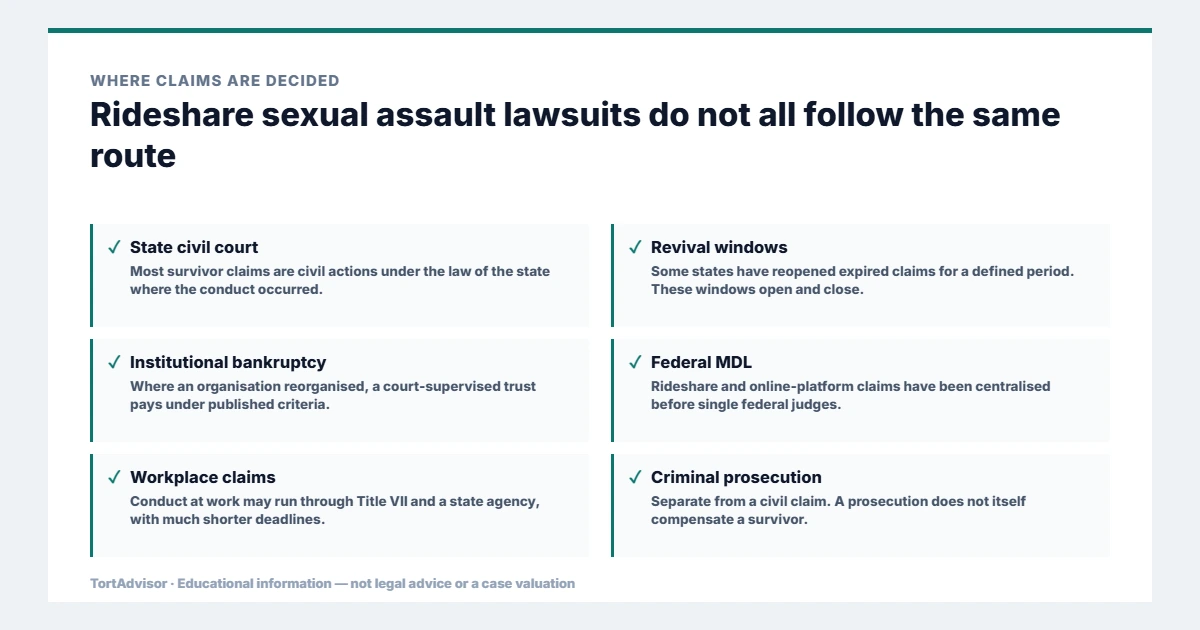
The two principal coordinated federal rideshare sexual-assault proceedings are separate. Uber MDL No. 3084, formally In re: Uber Technologies, Inc., Passenger Sexual Assault Litigation, is pending in the Northern District of California before Judge Charles R. Breyer. Two federal bellwether trials have produced verdicts so far, and the next is set to begin October 5, 2026 in Austin, Texas. Court notices also show discovery status conferences scheduled into late 2026.
Lyft passenger sexual-assault cases were separately centralized in MDL No. 3171, filed February 5, 2026 in the Northern District of California before Judge Rita F. Lin. The existence of separate MDLs is important: Uber and Lyft claims should not be described as one combined federal proceeding.
MDL 3084 Remains Active
Federal Uber passenger sexual-assault cases continue before Judge Breyer, with 4,916 actions pending on October 1, 2026, according to the JPML.
Two Bellwether Verdicts So Far
The federal docket records entry of judgment in the Dean bellwether on February 6, 2026. Reuters reported an $8.5 million compensatory award and Uber’s announced appeal. A second federal bellwether in Charlotte ended in a $5,000 judgment on April 20, 2026, which Uber is appealing to the Fourth Circuit.
MDL 3171 Is Separate
Lyft’s federal passenger sexual-assault litigation is a separate MDL before Judge Rita F. Lin, not part of Uber MDL 3084. It had 134 pending actions on October 1, 2026.
Who May Qualify for a Rideshare Sexual Assault Lawsuit?
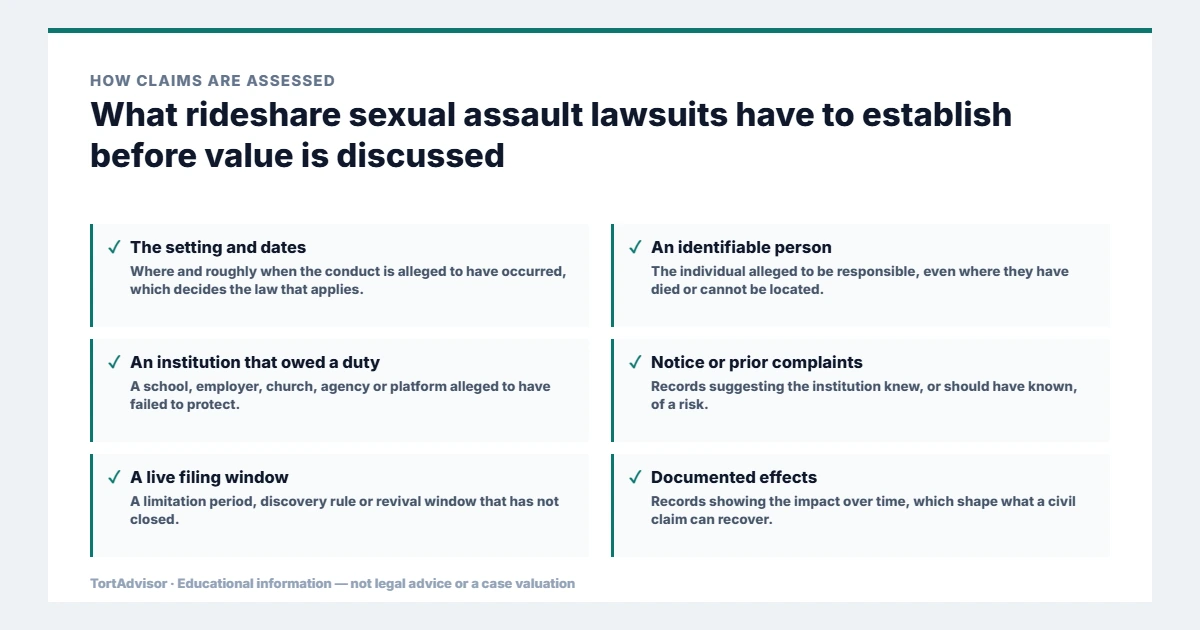
A survivor may want a rideshare sexual assault lawsuit legal review when sexual assault, sexual battery, rape, unwanted touching, or other serious sexual misconduct occurred during or in connection with an Uber or Lyft trip. The existence and strength of a civil claim depend on the facts and governing law.
Facts That May Support Review
- The incident occurred during an Uber or Lyft trip or was closely connected to the ride.
- Trip history, receipts, driver information, GPS data, messages, screenshots, or platform reports can identify the ride.
- The incident caused emotional, psychological, physical, financial, employment, or educational harm.
- There may be evidence concerning prior complaints, driver screening, platform response, or other safety issues.
What Is Not Automatically Required
- A criminal conviction is not necessarily required for civil review.
- A police report may be useful, but the absence of one does not automatically determine civil eligibility.
- Immediate reporting is not the only type of evidence attorneys may consider.
- A survivor should not assume a claim is expired based on a generic online limitations period.
Why Uber or Lyft May Be Named in a Rideshare Assault Lawsuit
Plaintiffs in a rideshare sexual assault lawsuit have advanced several theories seeking to hold a rideshare company responsible. These are allegations and legal theories, not automatic findings of liability. Uber, Lyft, and other defendants may dispute whether a driver was acting as an agent, whether the company was negligent, whether a safety measure was legally required, and whether company conduct caused the alleged harm.
Agency / Apparent Agency
A plaintiff may argue that the relationship between the platform, driver, branding, app, and passenger supports company responsibility under applicable agency law. The Dean jury found apparent agency in that specific case.
Screening & Retention
Some complaints allege negligent screening, monitoring, retention, or failure to respond appropriately to prior reports. Whether those theories succeed depends on evidence and state law.
Safety & Warning Claims
Some cases challenge platform safety practices, warnings, complaint handling, or product features. Defendants contest many of these allegations and may raise causation and legal-duty defenses.
Independent-contractor classification does not resolve every liability question by itself. In the Dean bellwether, the jury found the driver was Uber’s apparent agent for purposes of that verdict, while declining to find Uber negligent or its safety systems defective.
Evidence That May Support an Uber or Lyft Sexual Assault Claim
A rideshare sexual assault lawsuit can involve unusually detailed digital records. Preserving trip and account information early may help an attorney identify the ride, driver, timeline, reporting history, and potential damages.
Trip & Platform Evidence
- Uber or Lyft trip receipt
- Driver name, photo, license plate, and vehicle
- Pickup and drop-off locations
- App messages and support tickets
- Platform incident or safety reports
- Phone location or GPS history
Medical & Support Records
- Emergency, urgent-care, or primary-care records
- Sexual-assault examination records where applicable
- Therapy or counseling documentation
- Medication records
- Photos or other injury documentation
- Advocate or crisis-support records where relevant
Damages & Corroboration
- Police report if one was made
- Witness names and statements
- Texts or messages sent after the incident
- Work or school absence records
- Lost-income documentation
- Out-of-pocket treatment or safety expenses
Rideshare Sexual Assault Lawsuit Compensation
There is no standard settlement amount for a rideshare sexual assault lawsuit. Potential compensation depends on the severity and duration of harm, evidence, treatment, economic losses, available defendants, applicable insurance or financial resources, jurisdiction, causation, defenses, and how the case ultimately resolves.
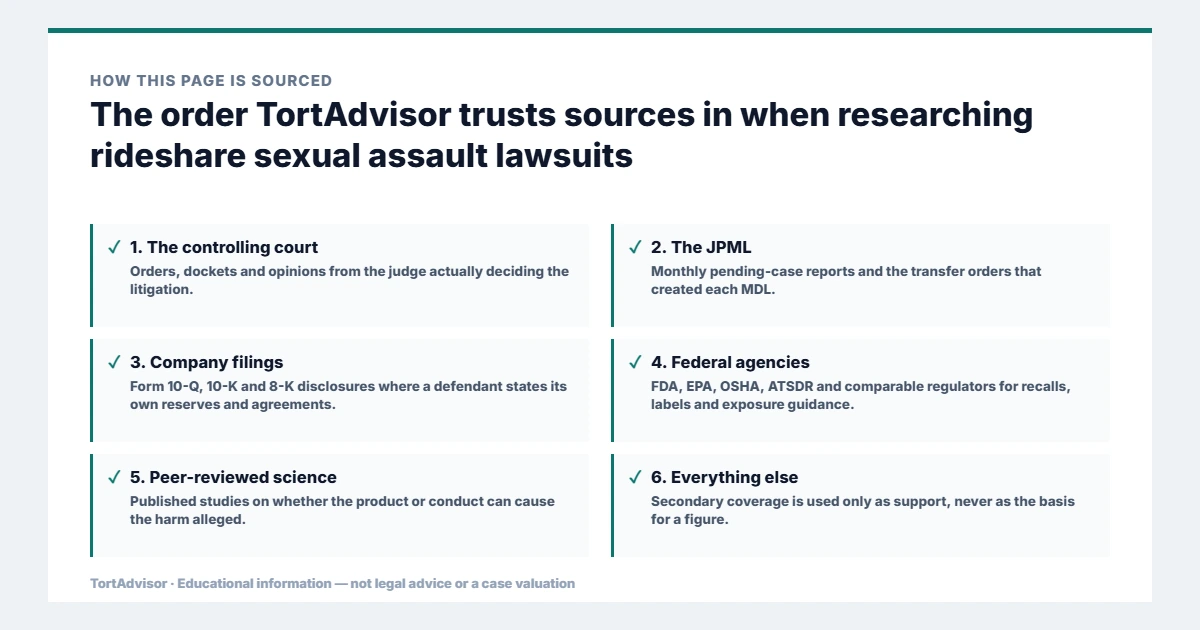
Every status, deadline and figure published on this page about rideshare sexual assault lawsuits is traced to a primary source before it appears.
Economic Losses
- Past and future medical expenses
- Therapy and mental-health treatment costs
- Lost wages or leave from work
- Reduced earning capacity where supported
- Transportation, relocation, or safety-related expenses
- Other documented out-of-pocket losses
Other Potential Damages
- Emotional distress
- Pain and suffering
- Psychological injury
- Loss of enjoyment of life
- Other non-economic damages allowed by state law
- Punitive damages only where legally available and supported
The February 2026 Dean judgment was an individual jury verdict, not a universal settlement benchmark. To organize claim-value factors, use the Rideshare Sexual Assault Settlement Calculator. For payout-focused research, review the Rideshare Assault Settlement 2026 guide.
How Long Do You Have to File a Rideshare Sexual Assault Lawsuit?
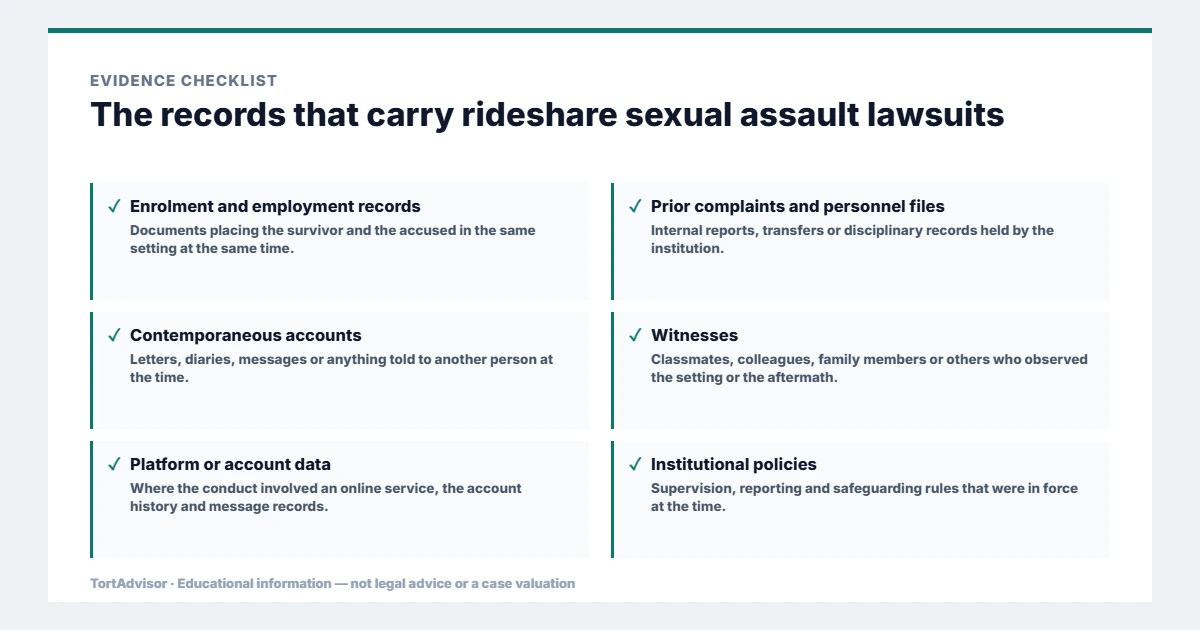
The deadline for a rideshare sexual assault lawsuit varies significantly by state and can depend on the incident date, survivor age, discovery rules, the identity of defendants, the legal claims asserted, and other circumstances. Some jurisdictions also have special rules affecting sexual-assault claims.
Privacy and Confidentiality in Rideshare Sexual Assault Litigation
Privacy options in a rideshare sexual assault lawsuit depend on the court and circumstances. Some survivors seek to proceed under initials or a pseudonym, request protective orders for sensitive discovery, or ask the court to limit public disclosure of highly personal information. These protections are not automatic in every case.
Pseudonym Requests
Courts may allow a survivor to seek permission to proceed under a pseudonym depending on the applicable legal standard and facts.
Protective Orders
Federal and state courts can use protective procedures to manage confidential discovery and sensitive personal information.
Settlement Confidentiality
Confidentiality terms vary. A lawyer can explain what information may remain private and what court records could become public.
For broader survivor-rights information across civil abuse claims, review TortAdvisor’s Sexual Abuse Lawsuit guide.
Want a Confidential Review of Your Rideshare Claim?
If you believe an Uber or Lyft trip may support a civil claim, return to the secure intake form and share only the details you are comfortable providing. Submitting information does not guarantee representation or a case result.
Rideshare Sexual Assault Research Tools & Support
These links lead directly to the closest matching resource for this topic rather than routing through a generic hub.
Rideshare Sexual Assault Settlement Calculator
Organize incident severity, evidence, treatment, economic loss, and other claim-value factors in a rideshare-specific educational tool.
Uber & Lyft Sexual Assault Lawsuit Update
Follow the latest dedicated TortAdvisor update for Uber MDL 3084 and Lyft MDL 3171.
RAINN Support Resources
Independent confidential support and sexual-violence resources separate from TortAdvisor’s legal-information and intake process.
Rideshare Sexual Assault Lawsuit FAQ
Can I sue Uber or Lyft after a sexual assault by a driver?
Possibly. A rideshare sexual assault lawsuit may involve the alleged perpetrator, a rideshare company, or other parties depending on agency law, negligence theories, company conduct, evidence, causation, jurisdiction, and the specific facts. Uber and Lyft may dispute liability.
Are Uber and Lyft sexual assault cases in the same MDL?
No. Uber passenger sexual-assault cases are coordinated in MDL 3084 before Judge Charles R. Breyer. Lyft passenger sexual-assault cases are separately coordinated in MDL 3171 before Judge Rita F. Lin, both in the Northern District of California.
What happened in the first Uber bellwether trial?
In February 2026, a federal jury in Phoenix returned a bellwether verdict awarding Jaylynn Dean $8.5 million in compensatory damages after finding that Uber’s apparent agency relationship with the driver was a substantial factor in causing the assault. The jury did not award punitive damages, and Uber said it plans to appeal.
Do I need a criminal conviction to pursue a civil claim?
Not necessarily. Civil and criminal cases use different procedures and legal standards. A lawyer can evaluate rideshare sexual assault lawsuit evidence such as trip records, platform reports, medical records, therapy records, witness evidence, messages, and other available information even when there was no criminal conviction.
Do I need a police report?
A police report can be useful rideshare sexual assault lawsuit evidence, but its absence does not automatically determine whether a civil claim can be reviewed. The importance of reporting history depends on the facts and applicable law.
Will my identity be public?
Not necessarily, but privacy is not automatic. Depending on the court and circumstances, a survivor may ask to use a pseudonym or seek protective treatment for sensitive information. An attorney can explain the applicable court rules.
How much is a rideshare sexual assault lawsuit worth?
There is no standard rideshare sexual assault lawsuit value. Settlement or verdict amounts depend on evidence, severity, treatment, long-term effects, economic loss, defendants, jurisdiction, defenses, causation, and case posture. The $8.5 million Dean verdict should not be treated as an average or guaranteed result.
Can a rideshare company force a sexual-assault claim into arbitration?
Federal law may allow a person alleging qualifying sexual assault or sexual harassment to elect not to enforce certain predispute arbitration agreements for covered disputes. Whether the law applies depends on the dates, allegations, agreement, and procedural posture, so an attorney should evaluate the specific claim.
Source9 U.S.C. 402Federal law
How do I start a confidential rideshare sexual assault case review?
To start a rideshare sexual assault lawsuit review, preserve the trip receipt, driver information, screenshots, support messages, records, and other available documentation. Then complete the confidential form on this page so the incident and potential next steps can be reviewed.
Primary & Supporting Sources
Material litigation statements are linked contextually above and collected here for verification. Court dockets and company safety materials can change after publication. Source review: October 1, 2026 for litigation status; August 19, 2026 for the other sources.
- Primary — Federal court: N.D. California — Uber Passenger Sexual Assault Litigation, MDL 3084.
- Primary — Federal court: N.D. California — current Uber MDL case-management and remote-hearing notices.
- Primary — Federal court: N.D. California — Lyft Passenger Sexual Assault Litigation, MDL 3171.
- Primary — Federal law: Public Law 117-90 — Ending Forced Arbitration of Sexual Assault and Sexual Harassment Act of 2021.
- Primary — Uber: Uber U.S. Safety Report — 2021–2022 reporting and methodology.
- Primary — Lyft: Lyft — May 22, 2026 expanded sexual-assault and sexual-misconduct safety data.
- Secondary reporting: Reuters — February 2026 Dean bellwether verdict and Uber response.