
Uber Settlement Amounts 2026: MDL 3084 Verdicts & Claim Value
Two Uber assault cases have been tried to verdict. One returned $8.5 million and the other returned $5,000. That gap is why this page publishes no projected range — any number between them would be invented.
Free Uber / Lyft Sexual Assault Case Review
Wondering how the figures on this page relate to your own situation? Share a few details below — a trained case advisor reviews every submission FREE and with no obligation, and your information stays confidential.
- Free — no cost, no obligation
- About a minute to complete
- Reviewed by a trained case advisor
- Nothing you submit is published
Call 855-664-8713Text 855-664-8713
- Share a few details. It takes about a minute, and only a few fields are required.
- A trained case advisor reviews them. Free and confidential. TortAdvisor is not a law firm.
- You choose what happens next. If you asked for a call, the advisor follows up by phone or text.
Your details are sent over a secure connection and reviewed confidentially.
Latest Uber Settlement Amounts and MDL 3084 Status
The Uber litigation has produced something unusual: two completed trials with wildly different results, which tells you more about how these claims are valued than any settlement figure would.
Federal claims alleging Uber failed to screen drivers adequately, failed to respond to complaints and misrepresented rider safety are consolidated in the Northern District of California.
The court approves a vehicle for holding settlement money. It is an administrative step and does not itself commit any amount or establish eligibility.
A jury finds for the plaintiff on an apparent agency theory — that Uber held the driver out as its agent. Negligence and design-defect theories are rejected, and no punitive damages are awarded.
A North Carolina jury returns $5,000. The same litigation, tried months apart in a different forum, produces an award roughly 1,700 times smaller than the first.
Filings indicate roughly 1,350 claims across the federal and state dockets are subject to pending settlement agreements. Terms are confidential, so none establishes a benchmark.
The docket continues. Further trial settings have been reported inconsistently across secondary sources, so this page names no date and points readers to the docket.
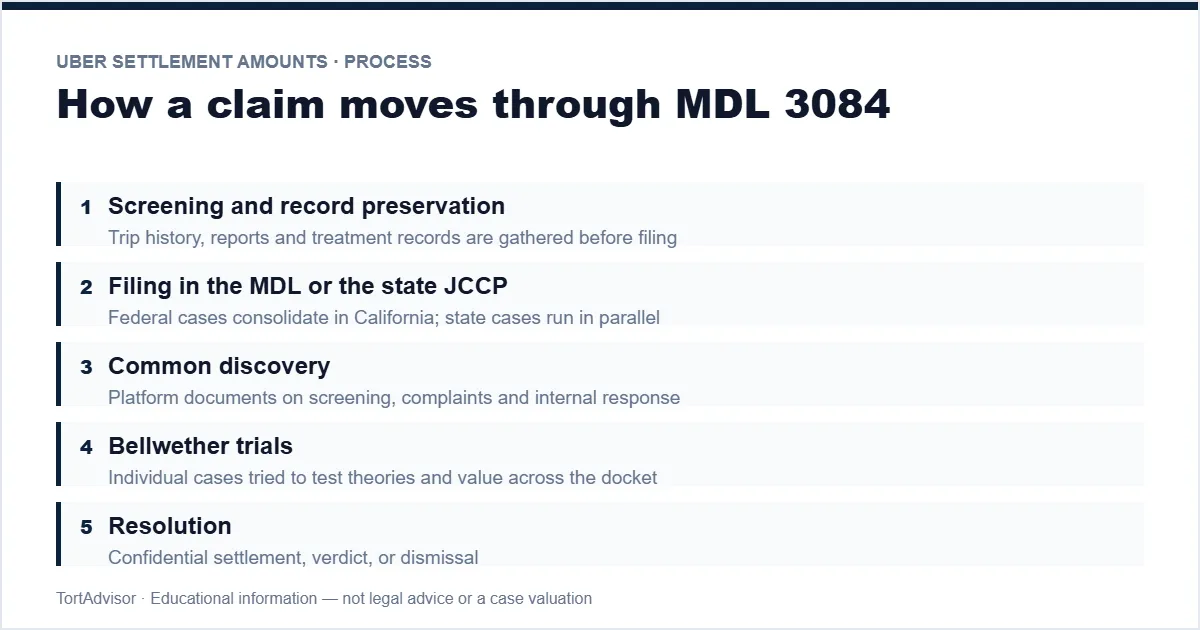
Uber Settlement Amounts: Confirmed Facts vs. Speculation
Two Uber verdicts and roughly 1,350 confidential settlements have produced almost no public information about value. That is the honest position.
What Is Confirmed
- MDL 3084 held 4,916 pending actions of 5,221 filed as of the Oct. 1, 2026 JPML report, before Judge Charles R. Breyer.
- A qualified settlement fund was approved in December 2025.
- The first bellwether returned $8.5 million in February 2026 on an apparent agency theory, with negligence and design-defect rejected and no punitive damages.
- The second bellwether returned $5,000 in April 2026 in North Carolina.
- July 2026 filings indicated roughly 972 federal and 379 state claims subject to pending settlement agreements, on confidential terms.
- Lyft claims are separate, in MDL 3171 before Judge Rita F. Lin, with 134 pending of 115 filed.
What Is Not Known
- Any settlement amount — every resolution has been confidential.
- Whether a global settlement will be reached, and on what terms.
- How the apparent agency theory will fare in other jurisdictions.
- What drove the enormous gap between the two verdicts.
- When further trials will be held — reported dates conflict across sources.
Why This Page Publishes No Uber Payout Range
No page in this library carries an illustrative payout band, and Uber shows better than any other why that rule exists. The reason is visible in the numbers themselves.
The two verdicts are 1,700x apart
$8.5 million and $5,000 came from the same litigation months apart. A band drawn between them would span almost the entire range of civil awards and tell a reader nothing.
Every settlement is confidential
Roughly 1,350 claims have been subject to pending settlement agreements with undisclosed terms. Confidentiality means there is no dataset to reason from, however many cases resolve.
Liability theory decides value
The first verdict succeeded on apparent agency while negligence and design defect failed. Which theory survives in a given jurisdiction can change a case’s value by orders of magnitude.
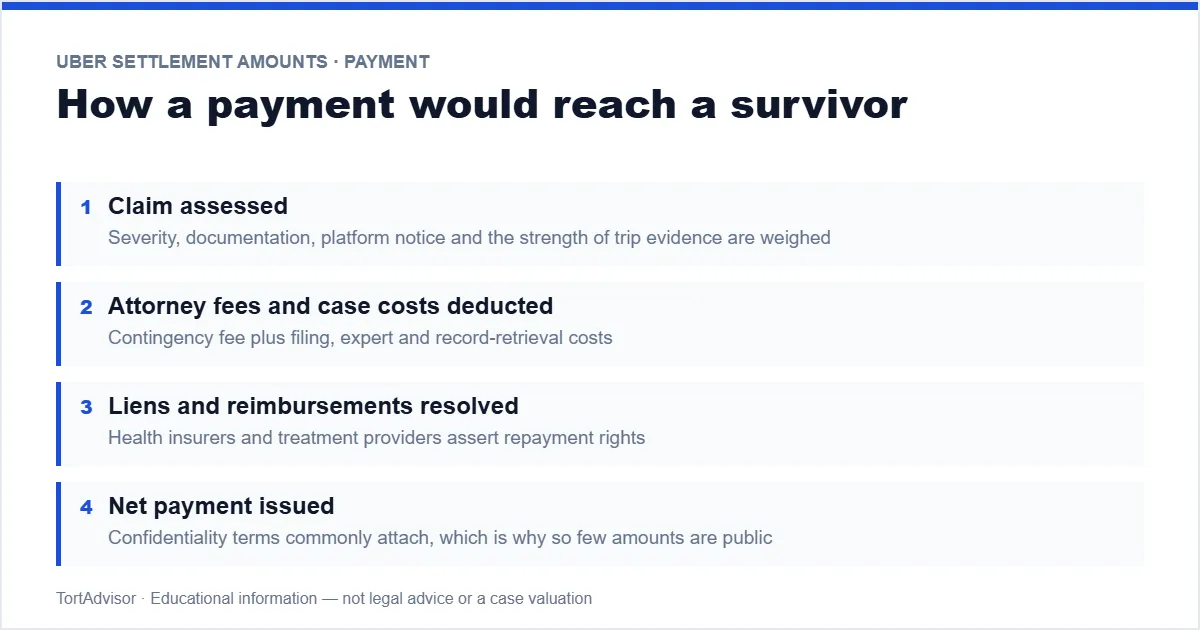
How an Uber settlement payment would reach a survivor
Where Uber claims have resolved, this is the sequence. Confidentiality attaches at the end, which is why so little is publicly known.
Claim assessed
Severity, documentation, what the platform knew and the strength of trip evidence are weighed.
Attorney fees and case costs deducted
Contingency fee plus filing, expert and record-retrieval costs come out of the gross figure first.
Liens and reimbursements resolved
Health insurers and treatment providers assert repayment rights against the recovery.
Net payment issued under confidentiality
Terms commonly prohibit disclosure, which is why no benchmark exists despite many resolutions.
Illustrative sequence only. No global Uber settlement programme exists as of Sept. 1, 2026, and no settlement amount has been publicly disclosed.
How TortAdvisor Handles Uber Settlement Amounts
On an Uber claim, where survivors are often researching in difficult circumstances, restraint about numbers matters more than usual.
Two verdicts are not a range
Where tried outcomes differ by three orders of magnitude, reporting both and declining to average them is the accurate answer.
Confidential means unknown
A settlement with undisclosed terms adds nothing to what is publicly known about value, and we do not treat volume of settlements as evidence of amount.
Name no survivors
Both bellwether plaintiffs are identified in public records. This page does not repeat their names, because nothing about the analysis requires it.
Track the current docket
Case counts come from the current month’s JPML report, and where trial dates conflict across sources we name none and point to the docket.
What the Two Uber Verdicts Actually Showed
The two tried cases are the only public Uber data points in this litigation. Read side by side, they explain why no range can be published.
| Feature | First bellwether, Feb. 2026 | Second bellwether, Apr. 2026 |
|---|---|---|
| Award | $8.5 million | $5,000 |
| Winning theory | Apparent agency — Uber held the driver out as its agent | Liability found, but valued at a nominal level |
| Theories rejected | Negligence and design defect | — |
| Punitive damages | None awarded | None awarded |
| Forum | Federal MDL bellwether | North Carolina |
| What it establishes | That the apparent agency theory can succeed | That success on liability does not guarantee a substantial award |
The lesson from these two results is not a number. It is that outcome in rideshare assault litigation depends heavily on the legal theory available, the forum, and how a jury values harm — none of which can be predicted from a claim’s facts alone.
What Three Rideshare Verdicts Actually Establish
Three rideshare sexual assault cases have now been tried to a verdict, and the three results sit so far apart that publishing an average from them would be a fiction. On September 30, 2025 a San Francisco jury in the California coordinated proceeding, JCCP 5188, found Uber negligent but not liable and returned a defense verdict worth nothing. On February 5, 2026 the first federal bellwether, Jaylynn Dean v. Uber, tried in Arizona, returned $8.5 million in compensatory damages and refused punitive damages; the plaintiff had asked for roughly $144 million. On April 20, 2026 the second bellwether, Brianna Mensing v. Uber, tried in Charlotte, North Carolina, returned $5,000. Nothing, $8.5 million, and $5,000 — a 1,700-fold spread between the two plaintiff wins alone.
The spread is not random, and understanding what separated the cases is worth more to a claimant than any number. The Arizona verdict turned on apparent agency, the theory that Uber held its drivers out in a way that made the company answerable for them; the jury accepted it and rejected the negligence and product-defect theories tried alongside it. The North Carolina verdict turned on common carrier status and a non-delegable duty, and the jury found for the plaintiff but valued the harm at $5,000. Both federal verdicts are under announced appeal and neither has been paid. A verdict is not a payment, and on this docket not one dollar awarded at trial has yet reached a claimant.
Settlements are moving in parallel and their terms are sealed. The court approved a qualified settlement fund on December 23, 2025 and appointed ARCHER Systems as administrator, with no amount disclosed then or since. A status report filed on July 24, 2026 recorded 972 cases in the federal MDL and 379 in the California JCCP as being under pending settlement agreements, again without terms. Uber’s own Q2 2026 quarterly report to the Securities and Exchange Commission discloses no reserve specific to sexual assault litigation; the large accrual in that filing relates to a United Kingdom VAT assessment, and any page presenting it as an Uber sexual assault reserve has misread the document.
One widely repeated figure deserves to be retired. The “$25 million Lyft sexual assault settlement” that circulates on claim-marketing pages is a June 2022 shareholder securities settlement over pre-IPO safety disclosures — a different plaintiff class, a different injury and a different body of law. No Lyft sexual assault verdict or settlement figure exists at all. Lyft’s own federal litigation, MDL 3171 before Judge Rita F. Lin in the Northern District of California, was created on February 5, 2026 and had 134 actions pending on October 1, 2026. Our rideshare sexual assault lawsuit guide tracks both dockets, the rideshare assault settlement calculator organises the evidence a claim turns on, and the wider settlement amounts library applies the same rule everywhere: a figure appears only when a record supports it.
Who May Qualify for a Rideshare Assault Claim
Eligibility for an Uber claim turns on the ride being documented and the platform’s role being arguable.
Common Screening Factors
- An assault by a driver during or connected to a rideshare trip
- Trip records in the app identifying the ride, the driver and the time
- A report made to the platform, to police, or both
- Medical, forensic or counselling records documenting the harm
- Claims involving passengers, and in some circumstances drivers assaulted by riders
- Conduct occurring during, immediately before or immediately after a booked trip
Factors Requiring Closer Review
- Rides booked on someone else’s account, which complicates trip records
- Incidents never reported to the platform or to police
- Whether the terms of use trigger arbitration
- Whether the applicable state recognises the apparent agency theory that succeeded federally
- State limitation periods, which differ for claims against a driver and against a platform
Our rideshare sexual assault lawsuit guide covers eligibility in more depth, and the wider category sits in our sexual abuse lawsuit research.
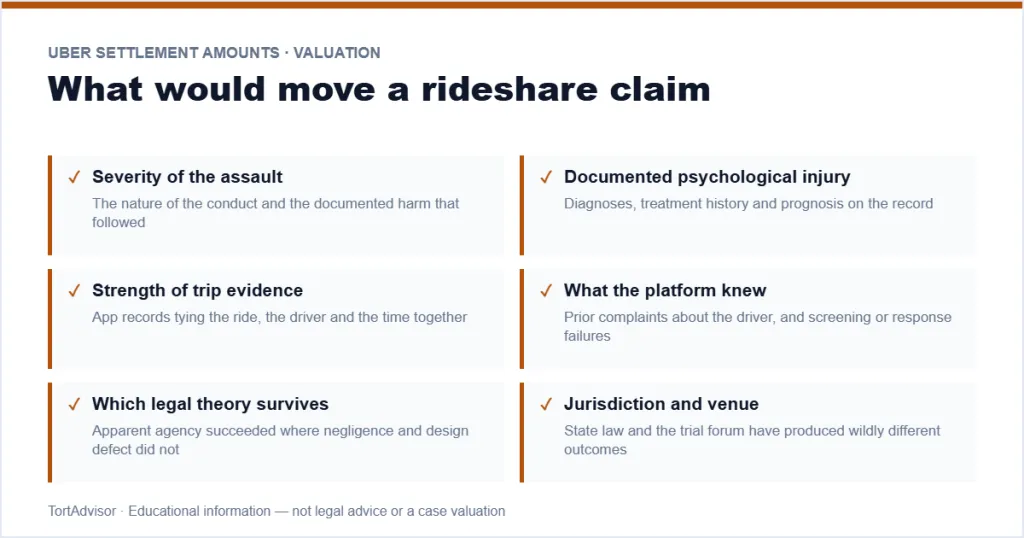
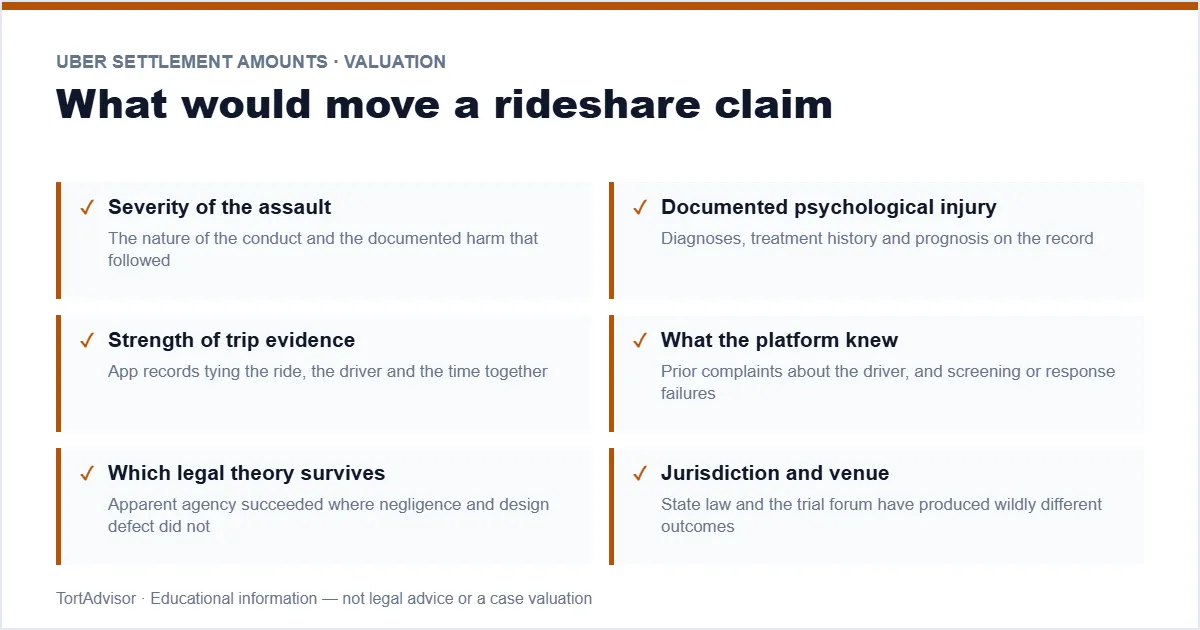
Factors That Would Affect Uber Settlement Amounts
With no published Uber matrix, these are the factors visible in how the two tried cases and the litigation as a whole have developed.
Severity and nature of the assault
The conduct itself and the documented harm that followed. This is the foundation, though the verdicts show it does not determine outcome on its own.
Documented psychological injury
Diagnoses, therapy records and prognosis. Harm never assessed clinically is substantially harder to establish and to value.
Strength of trip evidence
App records tying the ride, driver and time together. Without them a claim becomes an account rather than a documented event.
What the platform knew
Prior complaints about the same driver, screening failures, or an inadequate response to a report. This is where platform liability is won or lost.
Which legal theory is available
Apparent agency succeeded in the first bellwether where negligence and design defect failed. Availability of that theory varies by state.
Forum and jurisdiction
The two verdicts came from different forums and differed by three orders of magnitude. Venue is not a footnote in this litigation.
Evidence Supporting a Rideshare Assault Claim
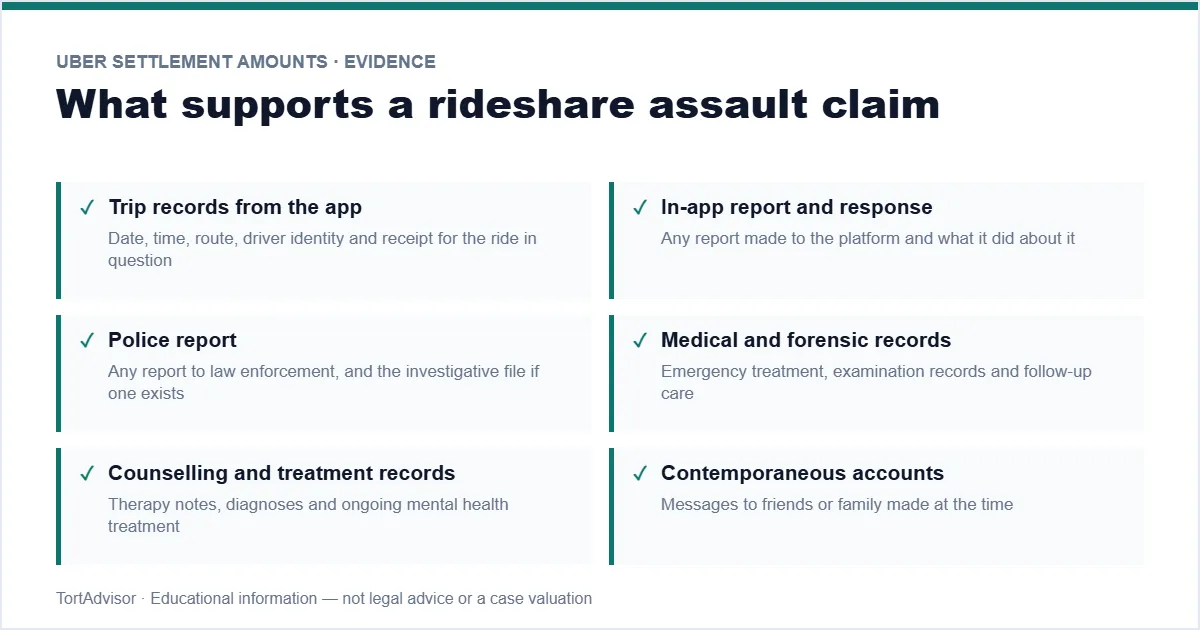
In Uber cases the decisive evidence sits inside the defendant’s app. Preserving what you can access, early, is the practical priority.
Trip records from the app
Date, time, pickup and drop-off, driver identity and the receipt. Export or screenshot these rather than relying on the account remaining accessible.
In-app report and response
Any report made through the platform, the reference number, and what the platform did. This is central to establishing notice.
Police report
Any report to law enforcement and the resulting investigative file, which can corroborate the account and the timeline.
Medical and forensic records
Emergency treatment, forensic examination records and follow-up care, with dates that align to the trip.
Counselling and treatment records
Therapy notes, diagnoses, medication and ongoing mental health treatment following the incident.
Contemporaneous accounts
Messages to friends or family sent at the time. These carry weight precisely because they predate any litigation.
If you or someone you know needs support, the RAINN National Sexual Assault Hotline provides free, confidential help. In the U.S. the 988 Suicide & Crisis Lifeline can be reached by calling or texting 988.
Filing Deadlines for Rideshare Assault Claims
There is no Uber settlement deadline, because no programme exists. State limitation periods run, and they are not uniform.
What tends to matter
- Which state’s law governs the trip
- Whether the claim is framed against the driver, the platform, or both
- Whether the state has an extended or revived period for sexual assault claims
- The claimant’s age at the time of the incident
What does not pause the clock
- The existence of a qualified settlement fund
- Waiting for further bellwether trials
- An ongoing criminal investigation or prosecution
- Continuing treatment
Take the Rideshare Settlement Calculator Below
The Uber and rideshare calculator organises what you know about the trip, what was reported, the records that still exist and the treatment that followed, then emails you a free confidential case report built from public records. It asks for no documents and no identifying detail.
The report is educational and is not a case valuation or settlement offer.
Before You Start
- Roughly when the trip took place
- Whether you still have access to the trip record
- Whether it was reported to the platform or police
- Any medical or counselling treatment that followed
- Whether the account was in your name
- The state where the trip took place
Answer what you know. You do not need every record or an exact timeline to get started.
Primary Sources for Uber Settlement Amounts
Every fact above traces to one of these. Each was checked on Oct. 1, 2026.
JPML pending-actions report
The JPML report dated Oct. 1, 2026 lists 4,916 actions pending in MDL 3084 of 5,221 filed before Judge Charles R. Breyer, and separately 134 pending in the Lyft MDL 3171 before Judge Rita F. Lin.
The MDL 3084 docket
The qualified settlement fund approval, the bellwether verdicts and the July 2026 filings indicating claims subject to pending settlement agreements are recorded on the Northern District of California docket. TortAdvisor cites the docket rather than secondary coverage.
Platform safety disclosures
Uber publishes a US Safety Report covering its most serious reported incidents, including sexual assaults. It is the company’s own account of incident volume and is the primary source for how the platform categorises these reports.
Why no range is published
Two tried verdicts roughly 1,700 times apart, and settlements resolved on confidential terms, leave no basis for an average. TortAdvisor publishes no rideshare payout range rather than manufacturing one.
Support for survivors
The RAINN National Sexual Assault Hotline provides free, confidential support. In the U.S. the 988 Suicide & Crisis Lifeline can be reached by calling or texting 988.
On naming plaintiffs
Both bellwether plaintiffs are identified in public court records and press coverage. This page does not repeat their names, because the analysis does not require it and a survivor should not have to encounter their own name in a page about payout amounts.
Frequently Asked Questions About Uber Settlement Amounts
What is the average Uber sexual assault settlement?
There is no average. The only two tried verdicts were $8.5 million and $5,000, and every settlement reached so far has been on confidential terms. An average built from those inputs would be arithmetic without meaning.
Has Uber agreed a global settlement?
No. A qualified settlement fund was approved in December 2025 and roughly 1,350 claims were reported subject to pending settlement agreements in July 2026, but no global settlement has been announced and no terms have been disclosed.
How many Uber lawsuits are pending?
The JPML report dated Oct. 1, 2026 lists 4,916 actions pending in MDL 3084 of 5,221 filed. A parallel California state proceeding runs alongside it and is not included in that count.
Why were the two verdicts so different?
They were tried in different forums on different facts, and the first succeeded on an apparent agency theory that made Uber responsible for the driver’s conduct. The second established liability but the jury valued the harm at a nominal level.
Are Lyft claims part of the same case?
No. Lyft claims are consolidated separately in MDL 3171 before Judge Rita F. Lin, with 134 actions pending. It is a smaller and earlier-stage litigation, and the Uber outcomes do not transfer to it automatically.
What is a qualified settlement fund?
In the Uber litigation it is a court-approved vehicle for holding settlement money while claims are administered. Its approval is a procedural step — it does not commit any amount, establish eligibility or guarantee that a claim will be paid.
Does the app trip record matter that much?
Yes. It is the evidence that ties a specific ride, driver and time together, and it is held by the defendant. Claims without it are considerably harder to establish regardless of the underlying facts.
Is the rideshare settlement calculator legally binding?
No. It is an educational questionnaire, and the report it emails you gives no dollar estimate for your claim. It is not a case valuation, not an offer, and binds no platform, court or law firm.
See Which Factors May Affect a Rideshare Assault Claim
Answer the questions you can about the trip, what was reported, the records that still exist and the treatment that followed. When you submit it, we email you a free confidential case report with verified case outcomes and milestones from public records. It does not produce a dollar estimate for your claim.
The report is educational and is not a case valuation or settlement offer.
Helpful Information to Have Ready
You do not need every record in hand. Answer what you know; these details make the report more useful.
Reading this page is separate from any request to be contacted. The consent boxes on this form are unchecked unless you tick them yourself.