Social Media Addiction Lawsuit 2026: Youth Mental Health, Platform Design & MDL 3047
A social media addiction lawsuit generally alleges that a platform was designed with engagement features that contributed to compulsive or harmful use and resulting injury, particularly among children and adolescents. Current cases involve allegations concerning features such as infinite feeds, autoplay, notifications, recommendations, social-reward systems and other design choices.
These are allegations, not established facts in every case. Social media can also provide benefits, and mental-health conditions usually have multiple potential causes. A viable claim requires individualized evidence connecting platform use, alleged design features and legally compensable harm.
Federal court, appellate and government sources are prioritized for material legal updates.
Excessive use alone does not establish a lawsuit. Injury, evidence, causation and deadlines matter.
Mental-health, school, treatment, evidence and filing issues are explained without guaranteed outcomes.
Submitting information does not obligate you to hire an attorney or continue with a claim.
Research the Full Claim — Not Just Screen Time
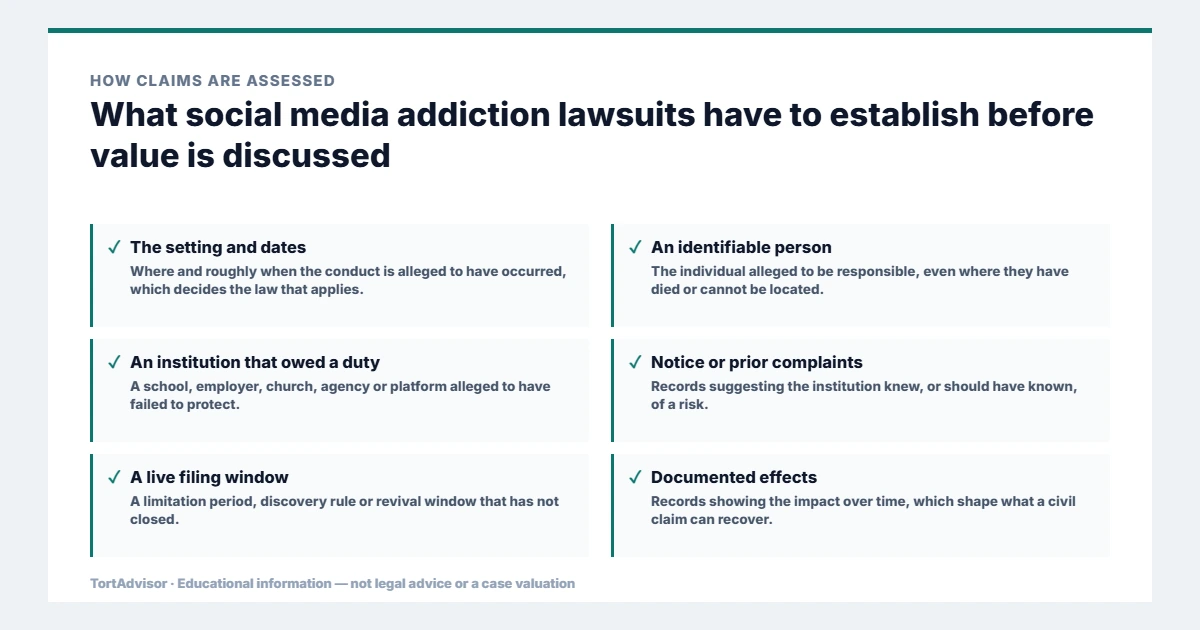
A social media addiction claim is not established simply because someone used an app heavily. Stronger reviews examine the platform, age at use, specific design features, usage history, diagnosed or documented harm, treatment, school or work impact, other possible causes and the applicable filing rules.
- Identify the platforms, account history and approximate periods of heavy use.
- Organize medical, counseling, school and other records documenting alleged injury.
- Preserve available usage records, account data, screenshots, notifications and relevant communications.
- Separate addiction/design claims from exploitation, sextortion or other online-abuse claims when the facts involve both.
Check Whether the Claim May Qualify
Provide a few basic details about the user’s age, platforms, use history, diagnosed or documented harm and treatment if you are comfortable doing so. The information can help organize an individual case review.
The intake can help organize facts for review, but legal eligibility, medical causation and filing deadlines require individualized analysis.
Submitting this form does not create an attorney-client relationship and does not guarantee that an attorney will accept or file a claim.
What Is Social Media Addiction?
“Social media addiction” is a common term used in lawsuits, research and public discussion to describe compulsive or harmful patterns of platform use. It should not be treated as a universal standalone medical diagnosis. A legal claim generally requires much more than frequent use, including evidence of serious injury, functional impairment, platform history, causation and an actionable legal theory.
Repeated difficulty disengaging from a platform can be relevant, particularly when use interferes with sleep, school, work or relationships.
Lawsuits focus on allegations involving recommendation systems, infinite feeds, autoplay, notifications, social rewards and other engagement features.
Claims may involve diagnosed or documented depression, anxiety, eating disorders, self-harm, sleep disruption or another serious injury.
Attorneys and experts may evaluate other medical, family, school, social and environmental factors when assessing causation.
Social Media Addiction Lawsuit Status in 2026
The litigation has developed across several tracks, including federal individual personal-injury cases in MDL 3047, California state-court coordinated cases, state attorney-general enforcement actions and other government litigation.
August 2026: Federal Appeals Court Allows Cases to Continue
On August 10, 2026, the Ninth Circuit dismissed interlocutory appeals by Meta and TikTok arising from the coordinated federal youth-harm litigation. The court held that Section 230 is a defense to liability, not immunity from suit, for purposes of those appeals. The decision allowed more than 3,000 federal lawsuits involving Meta, Google/YouTube, TikTok and Snap to continue procedurally.
The ruling does not mean the plaintiffs have proven that social-media design caused their injuries, and it does not eliminate Section 230 from every theory. The companies can continue to raise defenses as the cases proceed.
Which Social Media Platforms Are Facing Addiction Lawsuits?
Federal and state litigation has involved major platforms including Meta’s Instagram and Facebook, TikTok, Snapchat and YouTube. The allegations differ by platform, feature, claimant and case.
Instagram & Facebook
Claims allege that engagement-driven design, recommendation systems and other features contributed to compulsive use and youth mental-health harms. Meta denies wrongdoing and continues to contest the litigation.
TikTok
Claims challenge features including personalized recommendation systems, endless content feeds and other engagement mechanics alleged to encourage prolonged use.
Snapchat
Claims can focus on features such as social-reward mechanics, recommendations, notifications and other design choices. Separate Snapchat exploitation or sextortion claims can involve different legal theories.
YouTube
Claims allege that autoplay, recommendation systems and other design features contributed to compulsive use. Google/YouTube was one of the defendants found liable in the March 2026 California state-court bellwether.
Social Media Use and Mental Health Effects
U.S. Surgeon General materials describe meaningful risks associated with social-media and excessive screen use among children and adolescents while also recognizing that digital media can provide benefits. Public-health associations do not, by themselves, prove that a particular platform legally caused a specific person’s diagnosis.
Harms Alleged in Lawsuits
- Depression or worsening depressive symptoms
- Anxiety and emotional distress
- Eating disorders or body-image harm
- Self-harm or suicidal behavior in some cases
- Sleep disruption
- Academic or school impairment
- Social withdrawal or family conflict
- Other diagnosed mental-health conditions
What a Claim Review May Examine
- Age when social-media use began
- Platforms and features used
- Daily or weekly usage history
- Medical and mental-health history
- Treatment and counseling
- School, work and family impact
- Other potential causes or stressors
- Evidence tying alleged harm to platform use
Why Are Social Media Platforms Being Sued for Addiction?
Plaintiffs generally allege that certain platforms were designed or operated in ways that encouraged compulsive use and failed to provide adequate warnings about risks to young users. Whether those allegations create legal liability depends on the claim, product feature, evidence and applicable law.
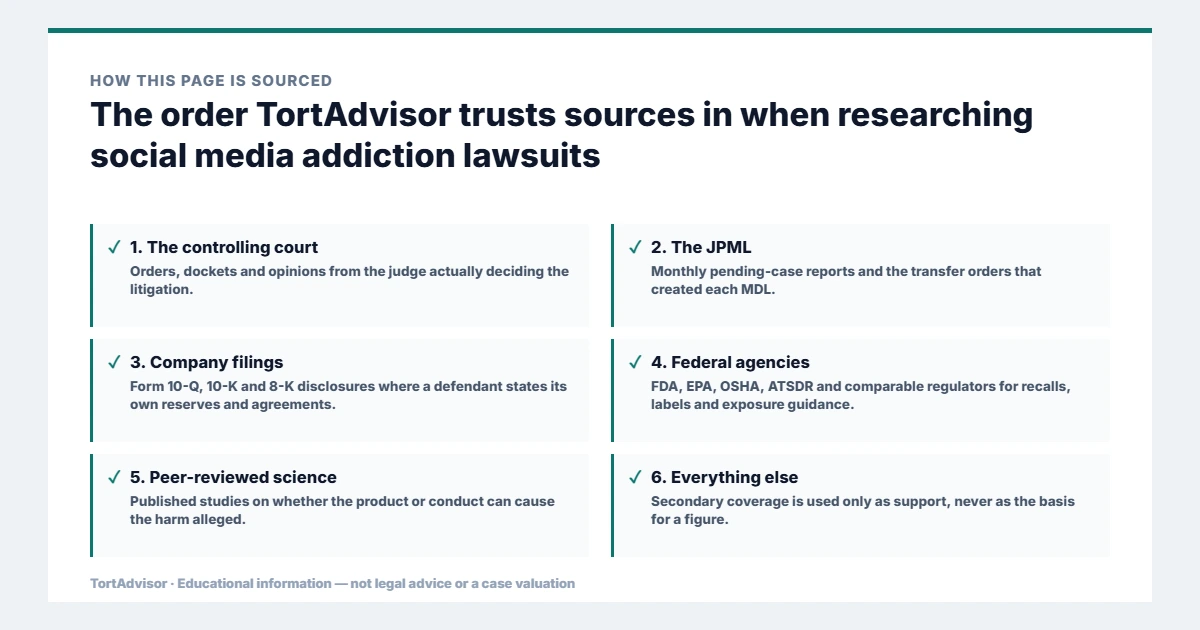
Every status, deadline and figure published on this page about social media addiction lawsuits is traced to a primary source before it appears.
Claims may challenge features alleged to encourage repeated engagement, prolonged use or compulsive interaction.
Plaintiffs may allege that users or parents were not adequately warned about particular risks associated with platform use.
Some claims allege that a company failed to use reasonable care in designing, testing, warning about or operating its product.
Age assurance, parental controls, youth account settings and child-directed practices can be relevant depending on the claim.
Section 230 can affect claims tied to third-party content, while some product-design or warning theories raise different legal questions.
Even when a legal theory survives dismissal, plaintiffs still generally must prove that the defendant’s conduct caused legally compensable harm.
Who May Have a Social Media Addiction Lawsuit?
Not everyone who spends substantial time on social media will have a legal claim. Individual cases often focus on children, teenagers or young adults with documented serious harm and a history that can be evaluated against the alleged platform design.
Many current claims involve children or adolescents who began using the platforms while still developing.
Account history, device records or other evidence may help document the duration and intensity of platform use.
Diagnosis, treatment, hospitalization, school disruption, self-harm or another significant injury can materially affect review.
State statutes, tolling for minors, discovery rules and other deadlines can affect whether a claim can still be filed.
Evidence for a Social Media Addiction Lawsuit
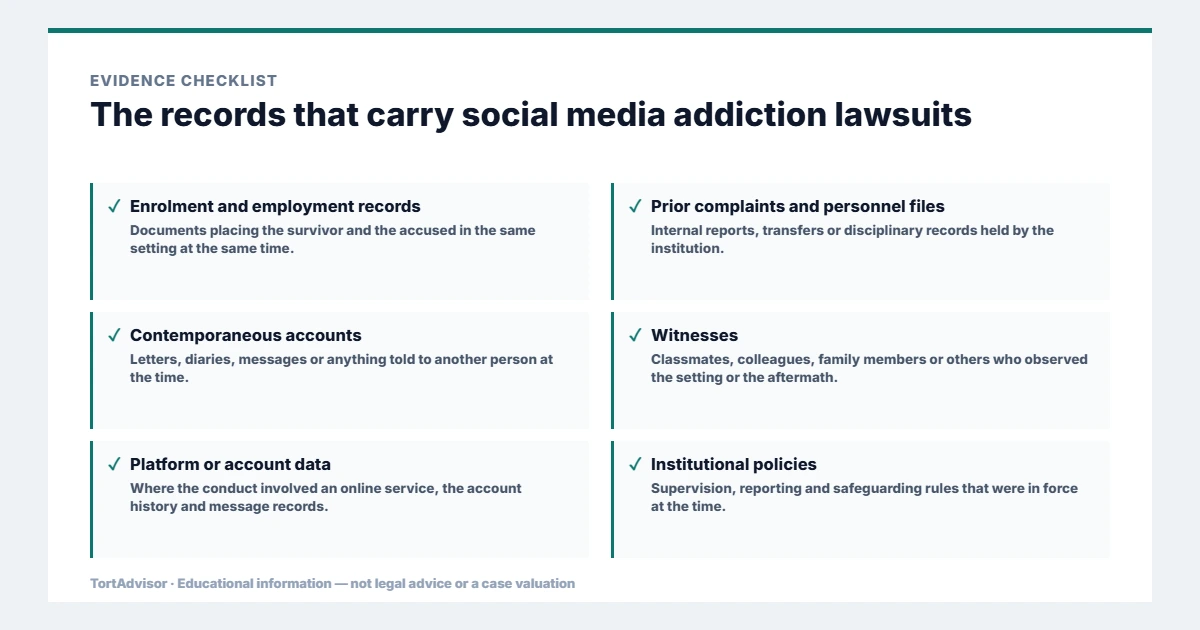
Platform & Use Evidence
- Account creation dates and usernames
- Platform download or login history
- Device screen-time or digital-wellbeing records
- Usage reports available from the platform
- Notifications, screenshots or account settings
- Subscription or purchase records where relevant
- Parental-control history
- Contemporaneous family or school observations
Injury & Damages Evidence
- Medical and mental-health records
- Therapy or counseling records
- Medication and treatment history
- Hospitalization or crisis-care records
- School attendance and grade changes
- IEP or accommodation records where relevant
- Lost wages or employment records
- Other documented out-of-pocket losses
When to Consider a Social Media Addiction Claim Review
A legal review can be useful when a child, teenager or young adult has serious documented mental-health or functional harm and the family wants to understand whether platform design, warnings or other conduct may support a civil claim.
List the platforms used, approximate start dates, account names and periods of heavy or compulsive use.
Organize diagnoses, treatment, school impact, hospitalizations and other records showing the alleged harm.
Save safely available screen-time records, account data, screenshots, downloads, notifications and relevant device information.
An attorney can assess other possible causes, legal theories, jurisdiction, tolling and the filing deadline.
Social Media Addiction Lawsuit Compensation
There is no official nationwide settlement matrix for individual social-media addiction claims. The March 2026 $6 million Meta/YouTube verdict is a significant state-court result, but it does not establish an “average settlement” or guaranteed range for other cases.
Economic Losses
- Medical expenses
- Therapy and counseling costs
- Future treatment expenses
- Lost wages or reduced earning capacity
- Education-related losses where recoverable
- Other documented financial losses
Other Potential Damages
- Pain and suffering
- Emotional distress
- Loss of normal activities
- Permanent or long-term impairment where proven
- Wrongful-death damages in qualifying cases
- Punitive damages where legally available
Use TortAdvisor’s Social Media Addiction Settlement Calculator as an educational tool for organizing value factors, not as an official court matrix or guaranteed payout.
U.S. Surgeon General Guidance on Youth Social Media & Screen Use
Social Media Is Nearly Universal Among U.S. Teens
The U.S. Surgeon General’s social-media advisory states that up to 95% of young people ages 13–17 report using a social-media platform and that the evidence raises meaningful concerns about youth mental health, while also recognizing potential benefits.
In May 2026, HHS also released a new Surgeon General advisory and toolkit addressing harms associated with excessive and harmful screen use among children and adolescents, including mental-health and behavioral concerns related to social media.
Official Social Media Addiction Lawsuit & Youth Mental-Health Sources
Social Media Addiction Lawsuit FAQ
What is a social media addiction lawsuit?
A social media addiction lawsuit generally alleges that a platform’s design, warnings or other conduct contributed to compulsive use and a serious injury. The specific claims depend on the platform, user, injury, evidence and law.
SourceJPML2 Jun 2025
Is social media addiction a formal medical diagnosis?
“Social media addiction” is widely used in litigation and public discussion, but it should not be treated as a universal standalone diagnosis. Individual claims often rely on documented mental-health conditions, treatment and functional impairment rather than the label alone.
What is MDL 3047?
MDL 3047 is the federal Social Media Adolescent Addiction/Personal Injury Products Liability Litigation in the Northern District of California. It coordinates common pretrial issues across thousands of individual federal lawsuits.
SourceJPML1 Sep 2026
Is MDL 3047 a class action?
No. An MDL coordinates federal cases for pretrial proceedings. Individual plaintiffs generally retain their own claims and damages unless a later settlement or court procedure provides otherwise.
Source28 U.S.C.Sec. 1407(a)
Does Section 230 automatically block these lawsuits?
No. Section 230 can affect some theories involving third-party content. On August 10, 2026, the Ninth Circuit held that Section 230 is a defense to liability rather than immunity from suit for purposes of the appeals before it. The defense can still matter as cases proceed.
Source9th Cir.10 Aug 2026
How much is a social media addiction lawsuit worth?
There is no standard amount. Potential value depends on documented injury, treatment, duration and intensity of use, causation evidence, school or work impact, economic losses, defendants, state law and how the claim resolves.
SourceJPML1 Sep 2026
Does the $6 million March 2026 verdict set the value of my case?
No. The March 25, 2026 verdict involved one California state-court plaintiff and Meta and Google/YouTube. It is not a federal MDL settlement schedule and does not establish a standard payout for other cases.
SourceNPR25 Mar 2026
Can a parent request a review for a minor?
A parent or legal guardian can submit basic information for review. Who may legally bring a claim and how a minor’s claim is handled depend on state law and the facts.
What evidence is useful?
Potentially useful records include account history, device screen-time data, usage reports, medical and therapy records, school records, hospitalization records, family observations and other evidence documenting both platform use and the alleged injury.
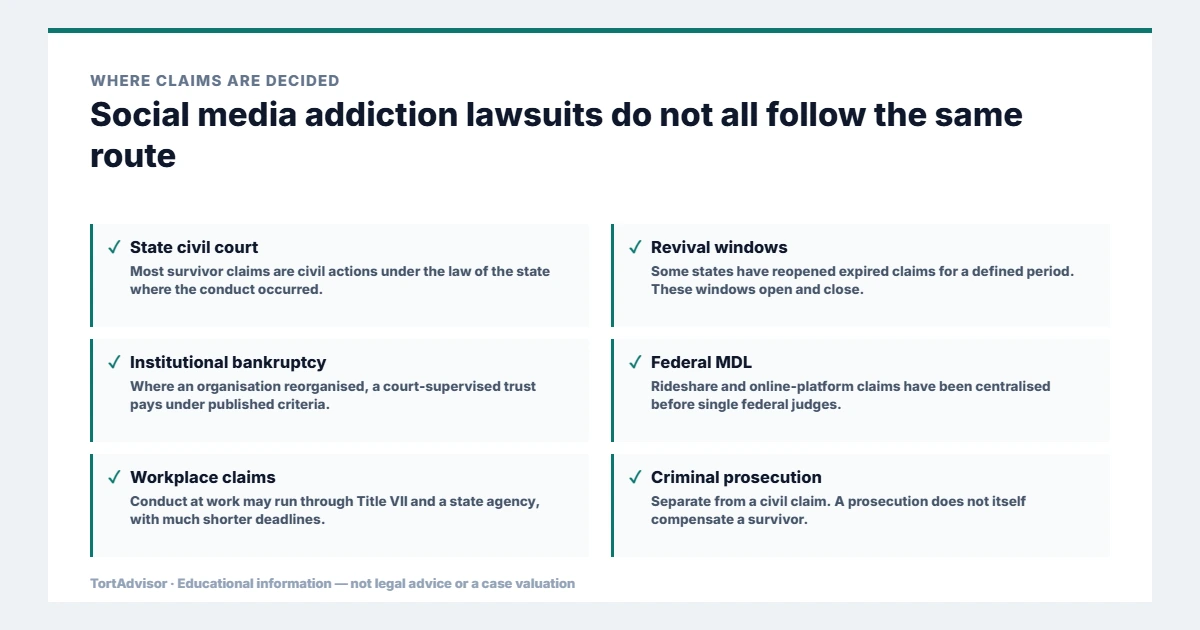
How long do I have to file?
There is no safe nationwide deadline. State statutes of limitation, tolling rules for minors, discovery rules and other filing requirements can differ substantially.
SourceN.Y. CPLRSec. 214
More Social Media, Digital Harm & Settlement Resources
Active Personal Injury Lawsuits
Browse TortAdvisor’s primary lawsuit categories, current claims, evidence guidance and legal research resources.
Mass Tort Lawsuit Updates
Current TortAdvisor updates across active mass tort, product-liability and coordinated litigation.
Social Media Addiction Settlement Calculator
An educational tool for organizing injury, treatment, usage, evidence and damages factors.
Social Media Settlement Amounts
Research compensation factors, verdicts, settlement programs and claim-specific payout information.
Did Social Media Use Contribute to Serious Documented Harm?
Use the private intake form to provide basic information about the user’s age, platforms, use history, diagnosed or documented injury, treatment and resulting impact. A review can help determine whether the facts warrant closer legal evaluation.
See Social Media Addiction Settlement Amounts 2026 for reported payout ranges, the factors that move claim value, and what the court record actually shows as of August 2026.