Social Media Settlement Amounts 2026: MDL 3047 & the $17B Meta Deal
Meta agreed a landmark settlement with every U.S. state on Aug. 26, 2026. It is worth at least $12.1 billion. None of it is compensation for a family. That distinction is the single most important thing on this page.
Latest Social Media Settlement Amounts and MDL 3047 Status
August 2026 changed the headline numbers in this litigation completely, without changing what an individual claim is worth. Both statements are true at once, and keeping them apart is the whole job of this page.
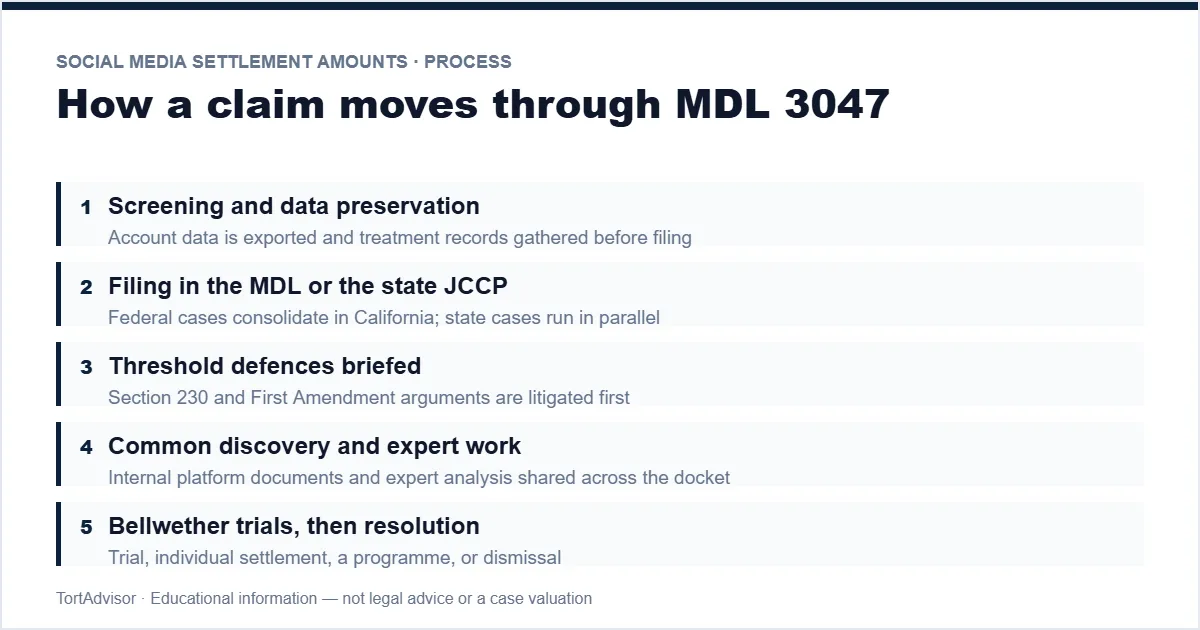
Attorneys general across the country file suit alleging Meta designed features that harm young users and misrepresented platform safety.
Several platforms resolve individual cases on undisclosed terms across the year, including a school district action. Confidential terms mean none of them establishes a benchmark for anyone else.
A Los Angeles jury in the California JCCP returns a roughly $6 million verdict against Meta and Google in K.G.M., apportioned between the two defendants and including a punitive component. It remains the only social media addiction case tried to verdict, and is subject to post-trial and appellate proceedings.
The attorneys general take Meta to trial in the Northern District of California after the court denies Meta’s attempts to avoid it.
At least $12.1 billion over ten years, plus binding platform reforms. California receives $1.5–2.1 billion, New York at least $819 million. The money funds state mental health and education programmes.
The private docket is unaffected by the state settlement. Those cases continue toward bellwether trials on their own timetable.
Social Media Settlement Amounts: Confirmed Facts vs. Speculation
A $17 billion headline is going to be misread as a family payout. Here is the line between what is documented and what is not.
What Is Confirmed
- Meta agreed on Aug. 26, 2026 to pay at least $12.1 billion to 51 U.S. jurisdictions over ten years, rising to $17.1 billion if other major platforms settle similarly.
- The money is earmarked for state mental health services, education and youth programmes — not for individual users or families.
- The agreement was filed in the Northern District of California and remains subject to court approval.
- Binding platform reforms include age verification, a two-hour daily cap for minors, overnight access and notification blackouts, and optional non-algorithmic feeds for under-18s.
- MDL 3047 held 3,824 pending actions of 4,009 filed as of the Oct. 1, 2026 JPML report, before Judge Yvonne Gonzalez Rogers.
- A parallel California JCCP proceeds before Judge Carolyn Kuhl in Los Angeles Superior Court.
- One case has been tried to verdict — K.G.M., roughly $6 million in March 2026, still subject to post-trial and appellate proceedings.
What Is Not Known
- Whether the court approves the state settlement, and when.
- Whether other platforms reach comparable state deals, which is what would lift the figure to $17.1 billion.
- Whether any personal injury compensation programme is ever created.
- What an individual claim is worth — one verdict is not a settlement value.
- The terms of the confidential individual settlements reached during 2026.
- How Section 230 and First Amendment defences will apply to the remaining theories.
Why This Page Publishes No Social Media Payout Range
Most guides in this library carry illustrative bands, and social media is a deliberate exception. This one does not, and the reason is specific rather than cautious.
The big number is the wrong number
The obvious anchor — $12.1 billion — measures what states negotiated for public programmes. Dividing it by claimants would produce a figure with no relationship to anything a family could receive, because families are not parties to it.
One verdict is not a distribution
A single tried case tells you a jury in one county valued one plaintiff’s claim. It does not establish a range, and it is still moving through post-trial and appellate review. Building bands on it would dress up a sample of one.
Liability is still contested
Section 230 and First Amendment defences have shaped what can be pleaded in these cases. Publishing a payout band implies a recovery that remains legally uncertain for most claim types.
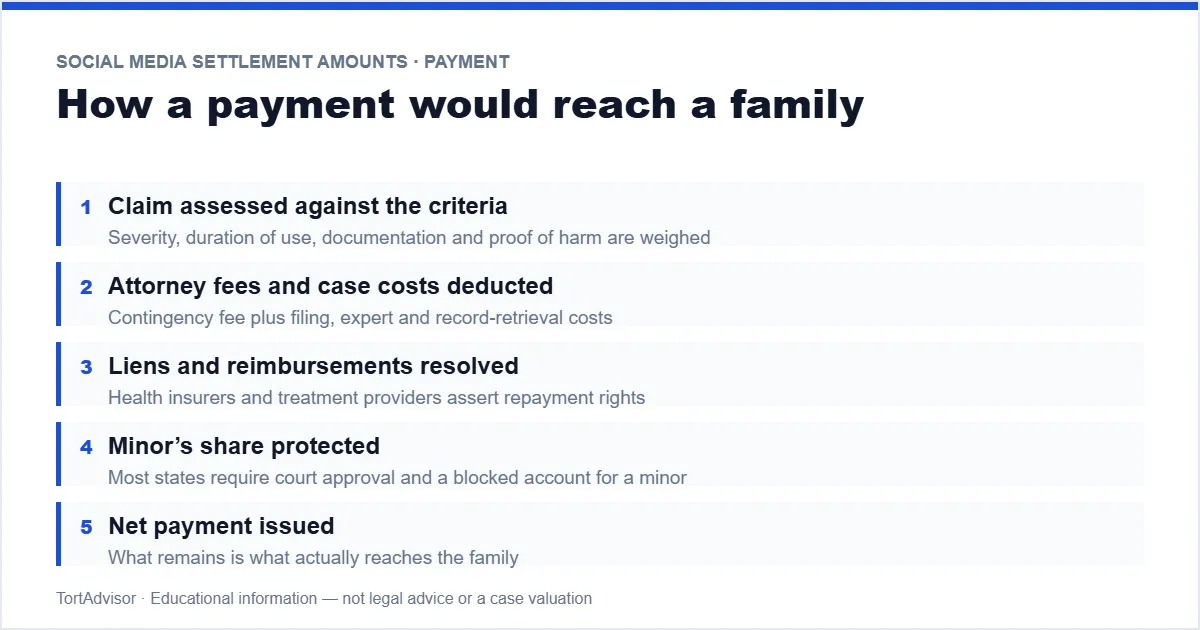
How a social media settlement payment would reach a family
If personal injury compensation becomes available, this is the sequence between a gross figure and money received. Note the step that applies because most claimants were minors.
Claim assessed
Severity of documented harm, duration of use, the strength of the usage record and proof of causation are weighed.
Fees and costs deducted
Any contingency fee, plus filing, expert and record-retrieval costs, comes out of the gross figure first.
Liens resolved
Health insurers, Medicaid and treatment providers assert reimbursement rights against the recovery.
Minor’s share protected
Most states require court approval of a minor’s settlement and payment into a blocked account or structured arrangement.
Net payment issued
What remains is what actually reaches the family, often years after filing.
Illustrative sequence only. No social media personal injury settlement fund, claims programme or administrator exists as of Sept. 1, 2026.
How TortAdvisor Handles Social Media Settlement Amounts
The risk on the social media topic is not invention so much as category error — using a real number to answer a different question.
Name what the money is
Regulatory settlements, confidential individual settlements and jury verdicts are three different things. We label each rather than blending them into one figure.
Never divide a state fund
A per-claimant number derived from a state settlement is arithmetic without meaning, because claimants are not beneficiaries of it.
Track the current docket
Case counts come from the current month’s JPML report rather than a figure repeated across secondary sites long after it went stale.
Treat one verdict as one verdict
A single tried case is reported as what it is, with its procedural posture, not converted into an average.
Where Social Media Money Has Actually Gone
Billions have changed hands in the social media litigation. Almost none of it reached a family. This table shows who received what.
| Resolution | Type | Amount and purpose | Does an individual claimant receive any of it? |
|---|---|---|---|
| Meta state settlement, Aug. 26, 2026 | Multistate enforcement resolution | At least $12.1B over ten years, up to $17.1B if other platforms settle. Funds state mental health and education programmes | No. Families are not parties and receive nothing from it |
| New Mexico consumer protection verdict, Mar. 2026 | State enforcement litigation | A substantial verdict against Meta on consumer protection grounds | No. Enforcement recoveries are paid to the state |
| Confidential platform settlements, 2026 | Private individual and institutional settlements | Terms undisclosed, including a school district action | Yes for those specific parties — but confidential terms set no benchmark for anyone else |
| K.G.M. verdict, Mar. 2026 | Personal injury jury verdict | Roughly $6M against Meta and Google, apportioned, with a punitive component | Yes for that one plaintiff, subject to post-trial and appellate proceedings |
| MDL 3047 personal injury claims | Private civil litigation | None. No global settlement or fund exists | This is the track that could pay families, and it has produced one verdict and no programme |
Free Social Media Addiction Case Review
Wondering how the figures on this page relate to your own situation? Share a few details below — a trained case advisor reviews every submission FREE and with no obligation, and your information stays confidential.
- Free — no cost, no obligation
- About a minute to complete
- Reviewed by a trained case advisor
- Nothing you submit is published
Your details are sent over a secure connection and reviewed confidentially.
The Only Settlement Amounts Ever Disclosed in This Litigation
Every headline figure in this litigation belongs to a government or an institution, with one exception, and until June 2026 even the institutional amounts were sealed. That changed when Breathitt County School District in eastern Kentucky — a rural district of roughly 1,600 students — settled its claims against the four major platforms ahead of a June 2026 trial. Because a school district is a public body, the executed agreements became disclosable records, and Reuters obtained copies through a state public-records request. They remain the only settlement amounts in the entire social media litigation to have entered the public domain.
| Defendant | Amount paid to the district | What it compensated |
|---|---|---|
| Meta (Instagram, Facebook) | $9,000,000 | The district’s own costs, not any student’s injury |
| Snap (Snapchat) | $8,000,000 | Same; no admission of liability |
| TikTok (ByteDance) | $8,000,000 | Same; no required product change |
| YouTube (Google) | $2,010,000 | Same |
| Four defendants combined | About $27,000,000 | One district, one county, one trial avoided |
The temptation is to divide that total by the district’s enrolment and produce a per-student figure, and it would be worthless. A school district’s claim is institutional: it recovers what the district spent responding to student mental-health harm — counsellors hired, programmes run, staff hours redirected — and carries no personal injury element at all. None of the four agreements required an admission of liability and none required a change to any product feature. What roughly $27 million buys is a clear reading of what four defendants would pay to avoid one institutional trial in one Kentucky county. It says nothing about the value of an individual adolescent’s claim, which turns on that adolescent’s medical records, treatment history and documented harm.
The one individual figure in this litigation is a verdict rather than a payment, and it is still not money. On March 25, 2026 a Los Angeles jury in P.F. (K.G.M.) v. Meta Platforms, JCCP 5255, awarded $6 million to a 20-year-old plaintiff — $3 million compensatory and $3 million punitive, apportioned 70 percent to Meta and 30 percent to Google’s YouTube, or $4.2 million and $1.8 million. Judge Carolyn Kuhl denied the defendants’ motions for judgment notwithstanding the verdict and for a new trial on June 9, 2026. The award remains unpaid and an appeal is expected. Every other individual resolution — Snap in January 2026, YouTube and TikTok across June and July — settled on confidential terms, which is why no per-claimant value exists for any platform.
That is the complete public record: state money, institutional money, and one unpaid verdict. Our social media addiction lawsuit guide covers who is filing and on what theories, the social media addiction settlement calculator organises the evidence a claim turns on, and Roblox settlement amounts tracks the platform-specific filings most often grouped alongside these cases.
Who May Qualify for a Social Media Claim
Eligibility for a social media claim is a legal question, not a payout question, and the answer has narrowed as threshold defences have been litigated.
Common Screening Factors
- The user was a minor during the period of heavy platform use
- Documented mental health harm — a diagnosis, treatment, hospitalisation or worse
- A usage record that can still be produced, from the platform or the device
- Use beginning at a young age and continuing over a sustained period
- Harm that can be connected in time to the pattern of use
- Claims brought by a parent or guardian, or by a young adult about earlier use
Factors Requiring Closer Review
- Whether Section 230 bars the particular theory pleaded
- First Amendment arguments about platform design and content curation
- Accounts created with a false age, which complicates both proof and defences
- Deleted accounts and expired platform data retention
- Other documented contributors to the same mental health harm
- State limitation periods, which for minors often run from the eighteenth birthday
Eligibility for this litigation is covered in more depth in our social media addiction lawsuit guide, and platform-specific claims are covered in our video game addiction research.
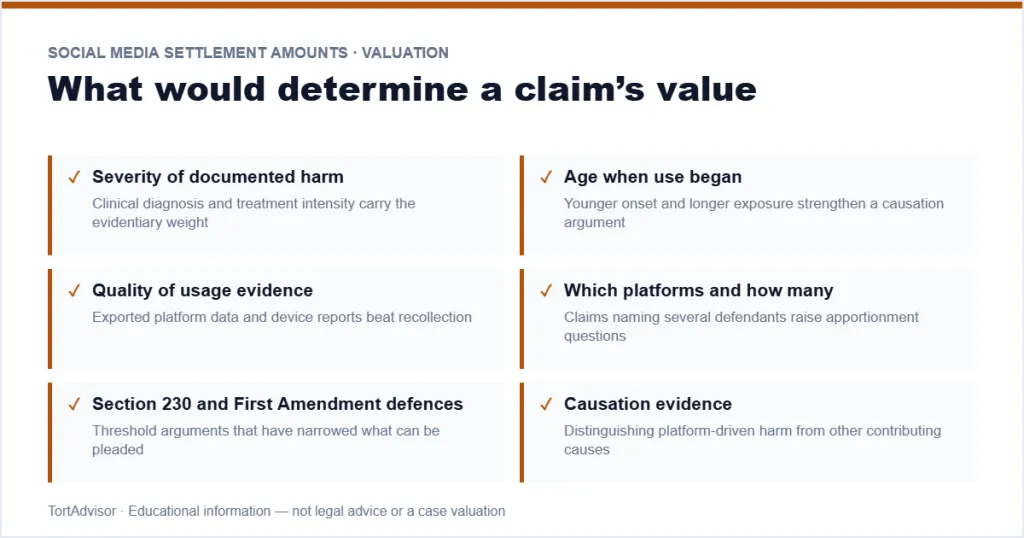
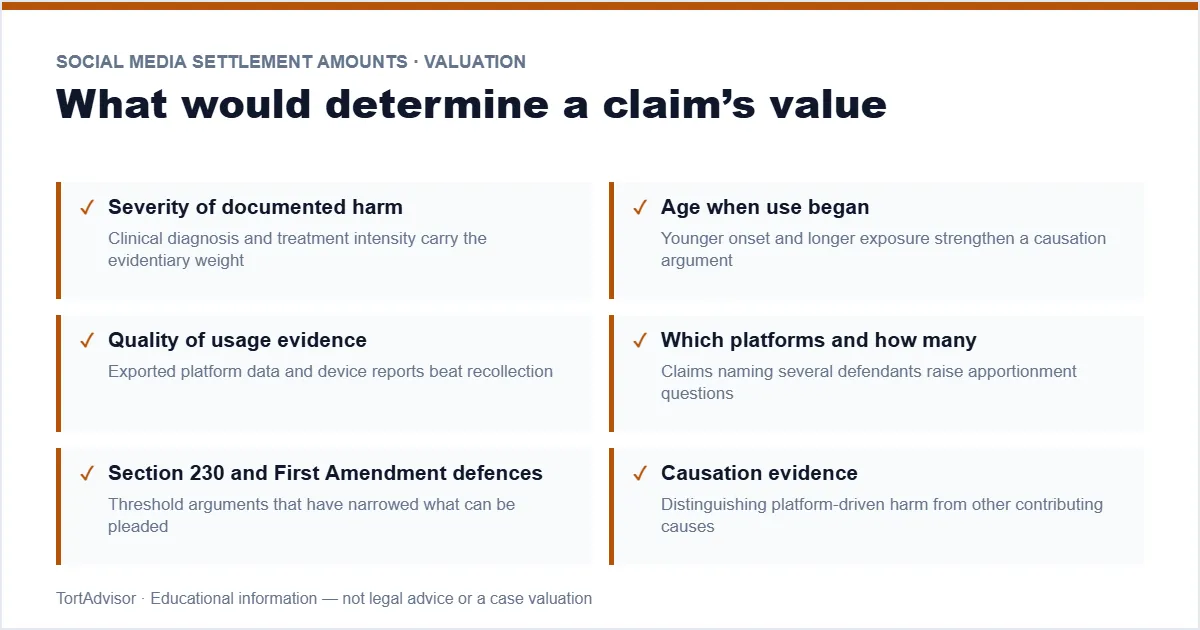
Factors That Would Affect Social Media Settlement Amounts
If compensation becomes available, these are the factors that would move a claim. None has a published weighting, because no matrix exists.
Severity of documented harm
A clinical diagnosis, sustained treatment, hospitalisation or a documented crisis carries far more evidentiary weight than a general account of unhappiness.
Age at first use and duration
Younger onset and years of heavy use strengthen the causation argument that design features, rather than ordinary adolescence, drove the harm.
Quality of the usage record
Exported platform data and device screen-time reports are close to decisive. This is the evidence most often lost to account deletion and retention limits.
Which platforms, and how many
Claims naming several defendants raise apportionment questions. The one tried verdict was split between two companies rather than assigned to one.
Threshold legal defences
Section 230 and First Amendment arguments can defeat a claim regardless of its facts, which is why they are valuation factors and not footnotes.
Competing causes
Defendants will point to family circumstances, school pressures, pre-existing conditions and other causes. Records that isolate the platform contribution matter.
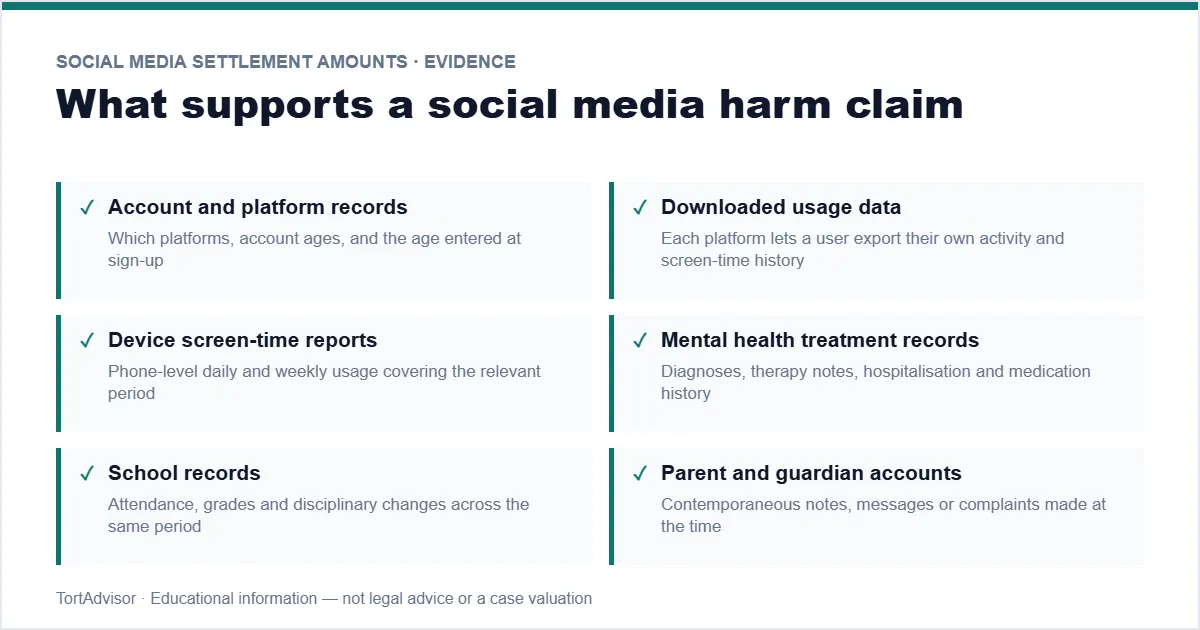
Evidence Supporting a Social Media Claim
Social media cases turn on evidence that is unusual: the central record is held by the defendant and by a phone — and both are perishable.
Downloaded platform data
Every major platform lets a user export their own account history and activity. Doing this early is the single most useful step available, and it does not require a lawyer.
Device screen-time reports
Phone-level daily and weekly usage covering the relevant years, which corroborates or contradicts the platform export.
Account details
Which platforms, when each account was created, the age entered at sign-up, and whether a parent account was linked.
Mental health records
Diagnoses, therapy notes, medication history, hospitalisation records and any documented crisis, with dates that can be aligned to the usage pattern.
School records
Attendance, grades and disciplinary history across the same period. These often show the change before any clinician did.
Contemporaneous family accounts
Notes, messages and complaints made at the time — including any report to the platform — carry more weight than a recollection formed after litigation began.
Export before you delete. The instinct after a crisis is to close the accounts. That can permanently destroy the usage record a claim depends on. Download the data first, then act on safety.
Filing Deadlines for Social Media Claims
There is no social media settlement deadline to watch, because no personal injury settlement exists. What runs is the state limitation period — and the evidence clock, which is shorter.
What tends to matter
- The claimant’s age during the period of use and their age now
- Which state’s law governs
- Whether a discovery rule applies to when the harm was connected to the platform
- Whether the account and its data still exist
What does not pause the clock
- The state attorney general settlement, which involves different parties entirely
- Waiting for a bellwether verdict in MDL 3047
- Waiting to see whether a compensation programme is created
- An ongoing course of treatment
Take the Social Media Settlement Calculator Below
The calculator organises what you know about which platforms were used, at what age, for how long, what records still exist and what treatment followed, then shows which factors would carry the most weight if compensation becomes available. It asks for no documents and no identifying detail about the child.
The result is educational and is not a guaranteed case value or settlement offer.
Before You Start
- Which platforms were used most
- The age when use began
- Roughly how many hours a day, and for how long
- Whether account data or screen-time reports still exist
- Any diagnosis, therapy or hospitalisation that followed
- The state you live in
Answer what you know. You do not need every record or an exact timeline to get started.
Primary Sources for Social Media Settlement Amounts
Every dated statement above traces to one of these. Each was checked on Oct. 1, 2026.
JPML pending-actions report
The JPML report dated Oct. 1, 2026 lists 3,824 actions pending in MDL 3047 of 4,009 filed, before Judge Yvonne Gonzalez Rogers in the Northern District of California.
California attorney general settlement announcement
The Aug. 26, 2026 announcement gives the $17 billion ten-year structure, California’s $1.5–2.1 billion share, the Northern District of California filing and the consent judgment approval requirement.
New York attorney general settlement announcement
The New York announcement sets out the at-least $12.1 billion floor, the $17.1 billion ceiling conditional on other platforms settling, the 51 participating jurisdictions and the full list of platform reforms.
Pennsylvania attorney general announcement
Pennsylvania’s announcement confirms a state share of more than $500 million and describes the same protective terms, illustrating how the money is allocated state by state.
Executed settlement agreement
The fully executed consent judgment and settlement agreement is the underlying document, filed on the docket in case 23-05448.
Support for families
If a young person is in crisis, the 988 Suicide & Crisis Lifeline can be reached in the U.S. by calling or texting 988. Nothing on this page is a substitute for clinical care, and litigation coverage should never delay treatment.
The K.G.M. verdict of March 2026 is a matter of record in the California JCCP before Judge Carolyn Kuhl in Los Angeles Superior Court. TortAdvisor cites the docket rather than the secondary coverage of it, and notes that the case remains subject to post-trial and appellate proceedings.
Frequently Asked Questions About Social Media Settlement Amounts
Will I get money from the $17 billion Meta settlement?
No. That agreement is between Meta and 51 state and territorial governments. The money funds state mental health services, education and youth programmes. Families are not parties to it and receive nothing from it, and it remains subject to court approval.
What is the average social media settlement amount?
There is no average, because there have been no personal injury settlements with disclosed terms. One case has been tried to a roughly $6 million verdict, and several were resolved confidentially. Neither produces an average.
How many social media lawsuits are pending?
The JPML report dated Oct. 1, 2026 lists 3,824 actions pending in MDL 3047 of 4,009 filed. A separate California JCCP proceeds in Los Angeles Superior Court, and neither count includes the state enforcement actions.
Who is the judge in the social media MDL?
Judge Yvonne Gonzalez Rogers in the Northern District of California. The parallel California state proceeding is before Judge Carolyn Kuhl in Los Angeles Superior Court.
What did the K.G.M. verdict decide?
A Los Angeles jury found for the plaintiff against Meta and Google in March 2026, returning roughly $6 million apportioned between the two defendants with a punitive component. It is the only social media addiction case tried to verdict and is still subject to post-trial and appellate proceedings.
Does the settlement change the platforms themselves?
Yes. Meta agreed to age verification, a two-hour daily cap for minors on Facebook and Instagram, no access between midnight and 6 a.m., no push notifications between 10 p.m. and 7 a.m., an optional non-algorithmic feed for under-18s, mindfulness reminders and content restrictions.
Is there a social media settlement fund I can claim from?
No. There is no personal injury fund, no claims administrator and no claim form. If a site invites you to file a social media settlement claim and asks for payment or sensitive information, treat it with caution.
Is the social media settlement calculator legally binding?
No. It is an educational tool that organises claim factors and shows which ones would matter most. It is not a case valuation, not an offer, and binds no platform, court or law firm.









See Which Factors May Affect a Social Media Harm Claim
Answer the questions you can about which platforms were used, at what age, for how long, the records that still exist and the treatment that followed. The calculator organizes those inputs into an educational settlement range and highlights the factors that may matter most when a claim is reviewed.
The result is educational and is not a guaranteed case value or settlement offer.
Helpful Information to Have Ready
You do not need every record in hand. Answer what you know; these details can make the estimate more useful.
Reading this page is separate from any request to be contacted. The consent boxes on this form are unchecked unless you tick them yourself.