
Motor Vehicle Accident Laws & Settlement Factors by State
Compare fault rules, negligence laws, and filing deadlines for car, truck, motorcycle, and boating accident claims across 15 states, plus the insurance figures that shape settlements.
On This Page
*Sources: Insurance Information Institute (citing ISO/Verisk Analytics) and FMCSA, 49 CFR § 387. Individual case values vary based on injury severity, liability, and insurance coverage. Not a guarantee of outcome.
Car Accident Settlement Rules by State
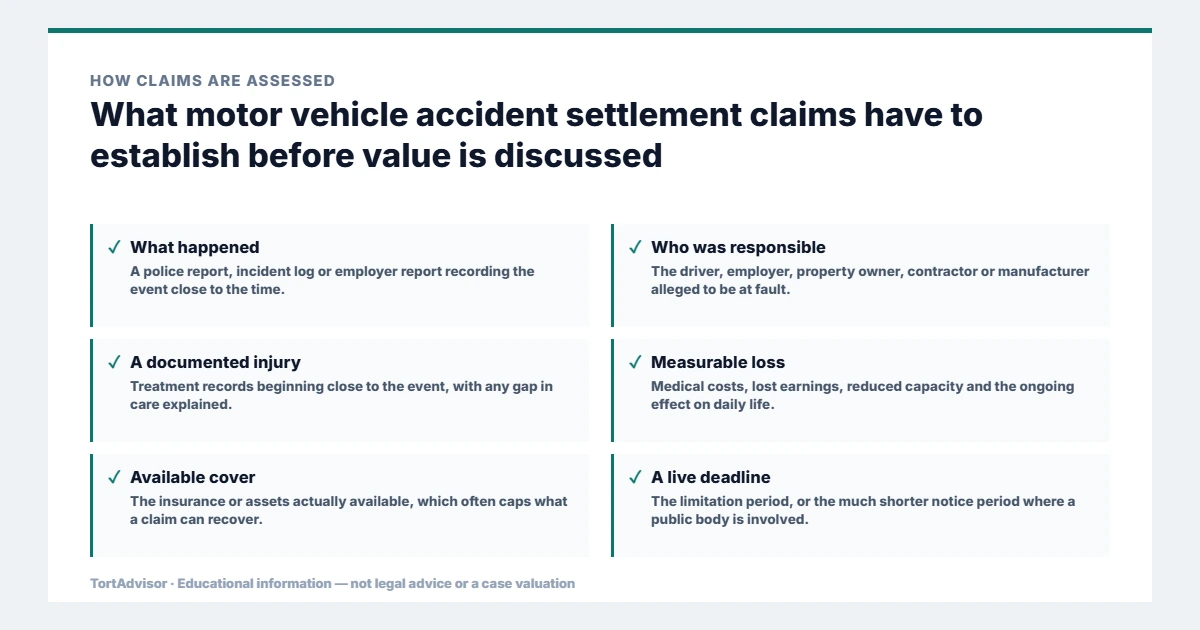
Car accidents are the largest category of motor vehicle accident (MVA) claims. The state where your crash occurred determines whether you file through no-fault (PIP) insurance or a traditional fault-based claim, how your compensation can be reduced if you share blame, and the deadline for filing a lawsuit. The table below compares 15 high-population states; state legislatures amend these rules periodically, so confirm your state’s current law with a licensed attorney.
| State | Fault System | Negligence Rule | PI Statute of Limitations |
|---|---|---|---|
| California | At-Fault (Tort) | Pure Comparative Negligence | 2 years |
| Texas | At-Fault (Tort) | Modified Comparative (51% Bar) | 2 years |
| Florida | No-Fault (PIP) | Modified Comparative (51% Bar) | 2 years |
| New York | No-Fault (PIP) | Pure Comparative Negligence | 3 years |
| Pennsylvania | Choice No-Fault | Modified Comparative (51% Bar) | 2 years |
| Illinois | At-Fault (Tort) | Modified Comparative (51% Bar) | 2 years |
| Ohio | At-Fault (Tort) | Modified Comparative (51% Bar) | 2 years |
| Georgia | At-Fault (Tort) | Modified Comparative (50% Bar) | 2 years |
| North Carolina | At-Fault (Tort) | Contributory Negligence (Pure Bar) | 3 years |
| Michigan | No-Fault (PIP) | Modified Comparative (51% Bar) | 3 years |
| New Jersey | Choice No-Fault | Modified Comparative (51% Bar) | 2 years |
| Arizona | At-Fault (Tort) | Pure Comparative Negligence | 2 years |
| Washington | At-Fault (Tort) | Pure Comparative Negligence | 3 years |
| Virginia | At-Fault (Tort) | Contributory Negligence (Pure Bar) | 2 years |
| Massachusetts | No-Fault (PIP) | Modified Comparative (51% Bar) | 3 years |
Truck Accidents: Higher Stakes, Federal Rules
Why Truck Accident Claims Are Different
Commercial trucking companies must carry significantly higher insurance minimums than passenger vehicles, and claims often involve federal safety regulations that don’t apply to standard car accidents.
- Federal minimum insurance: Under FMCSA regulation 49 CFR § 387, most interstate general-freight carriers must carry at least $750,000 in liability coverage; carriers hauling certain hazardous materials must carry $1 million to $5 million.
- Settlement value: no reliable published range exists; truck claims often involve higher insurance limits and more severe injuries.
- Key evidence: Electronic logging device (ELD) data, driver qualification files, and event data recorder (“black box”) data are frequently central to truck accident claims.
Motorcycle Accidents: Helmet Laws Vary by State
How State Helmet Laws Can Affect a Claim
Helmet requirements vary significantly across the country, and in some states the absence of a helmet can be raised by the defense as a factor in a comparative-negligence analysis.
- Universal helmet laws: Roughly 18 states plus D.C. require helmets for all riders regardless of age.
- Partial laws: Most remaining states require helmets only for younger or newly licensed riders.
- No helmet law: A small number of states, including Iowa and New Hampshire, have no helmet requirement at all.
- Settlement value: no reliable published range exists; motorcycle collisions have a higher rate of serious injury.
Boating Accidents: Federal Reporting & BUI Rules
Key Facts for Boating Accident Claims
- Boating Under the Influence (BUI): The U.S. Coast Guard enforces a 0.08% blood alcohol content threshold nationwide, the same as most state DUI laws.
- Reporting requirement: Operators must file a Boating Accident Report with their state agency when an accident results in death, an injury requiring more than first aid, or significant property damage.
- Settlement value: no reliable published range exists; value depends on injury severity and available insurance or liability coverage.
- Data source: The Coast Guard publishes an annual Recreational Boating Statistics report summarizing accidents, injuries, and fatalities nationwide.
How These Figures Are Compiled
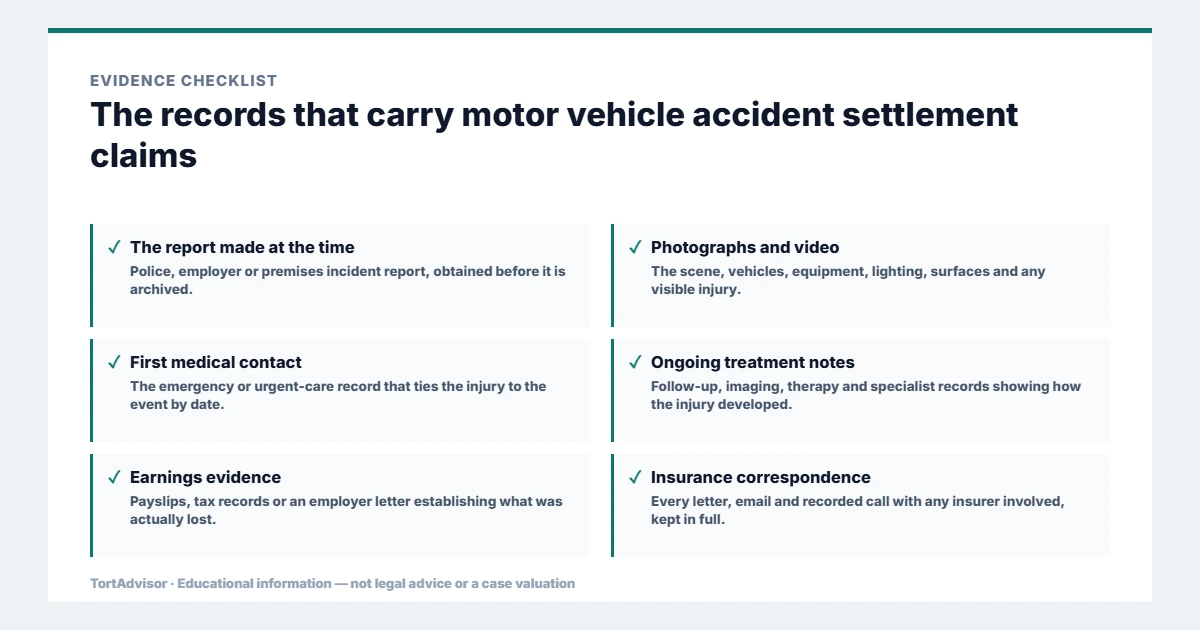
This page does not publish settlement ranges. Publicly reported settlements and verdicts are a small, unrepresentative sample, and ranges published by law firms are not data, so any range would be an estimate rather than a fact. The dollar figures shown come from the Insurance Information Institute (citing ISO/Verisk Analytics) and FMCSA regulations. Actual results in any individual case depend on facts specific to that case, including injury severity, liability, insurance limits, and the jurisdiction. State legal-framework details (fault system, negligence rule, statute of limitations) are drawn from state statutes and are current as of the “Last Updated” date above; always confirm current law with a licensed attorney before making a filing decision, since legislatures amend these rules periodically.
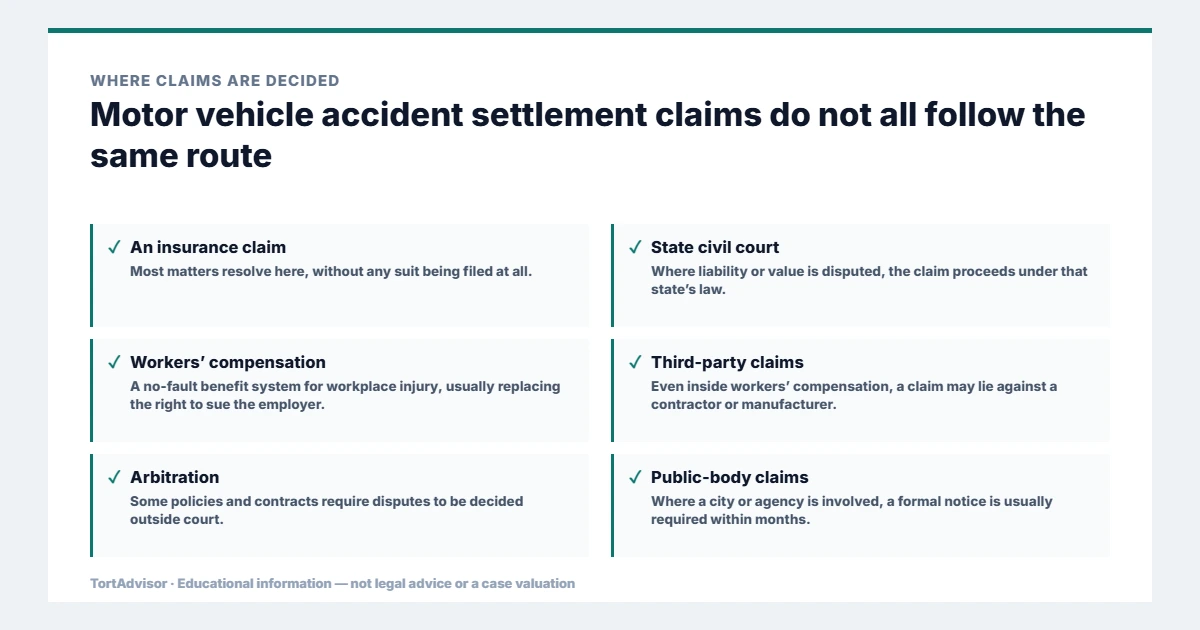
Every status, deadline and figure published on this page about motor vehicle accident settlement claims is traced to a primary source before it appears.
Sources & Citations
- National Highway Traffic Safety Administration (NHTSA) — Fatality Analysis Reporting System (FARS)
- Federal Motor Carrier Safety Administration — 49 CFR § 387, Minimum Levels of Financial Responsibility for Motor Carriers
- U.S. Coast Guard — Recreational Boating Statistics (annual report)
- National Center for State Courts (NCSC)
- Insurance Information Institute — state auto insurance requirements
- Insurance Institute for Highway Safety (IIHS) — state helmet law chart
- Individual state statutes and legislatures (fault system, comparative/contributory negligence rule, statute of limitations)
See our full fault-rule & statute-of-limitations table for all 50 states + D.C. →
Read our full editorial methodology & data-sourcing standards →
Frequently Asked Questions
What is the difference between a no-fault and at-fault state for car accidents?
In an at-fault (tort) state, the driver who caused the crash, and their insurer, are responsible for the other driver’s damages. In a no-fault state, each driver’s own Personal Injury Protection (PIP) coverage pays their medical bills regardless of fault, and you can only step outside no-fault to sue the other driver if your injury meets that state’s “serious injury” threshold.
SourceN.Y. Ins. LawSec. 5104
What is comparative negligence, and how does it affect my settlement?
Comparative negligence rules reduce your compensation by your percentage of fault. In a pure comparative negligence state, you can recover damages even if you were mostly at fault, reduced accordingly. In a modified comparative negligence state, you’re barred from recovering anything once your share of fault reaches 50% or 51%, depending on the state.
SourceN.Y. CPLRSec. 1411
How long do I have to file a motor vehicle accident lawsuit?
Most states give you two to three years from the date of the crash to file a personal injury lawsuit, but a few states allow just one year and some allow more. Missing this statute of limitations deadline generally bars you from recovering compensation in court, so it’s important to speak with an attorney as soon as possible after a crash.
SourceN.Y. CPLRSec. 214
Do I need an attorney to receive a motor vehicle accident settlement?
An attorney is not legally required, and many minor-injury claims are resolved directly with an insurance adjuster. However, for claims involving serious injury, disputed fault, commercial vehicles, or a low settlement offer relative to your damages, an attorney can help gather evidence, calculate the full value of your claim, and negotiate or litigate on your behalf.
Why are truck accident settlements typically higher than car accident settlements?
Commercial trucking companies are required to carry substantially higher liability insurance limits than passenger vehicle owners, and truck accidents more often involve catastrophic injuries due to the size and weight difference between a truck and a passenger car. Both factors tend to increase the potential settlement value.
Source49 C.F.R.Sec. 387.9
Does not wearing a helmet hurt my motorcycle accident claim?
It depends on the state. In states with a universal helmet law, failing to wear a helmet may be used by the defense to argue comparative negligence for head injuries specifically. In states without a helmet requirement, riding without one is legal and generally cannot be held against you for liability purposes, though it may still be raised in connection with the extent of certain injuries.
SourceN.Y. VATSec. 381
Get a Free Motor Vehicle Accident Case Review
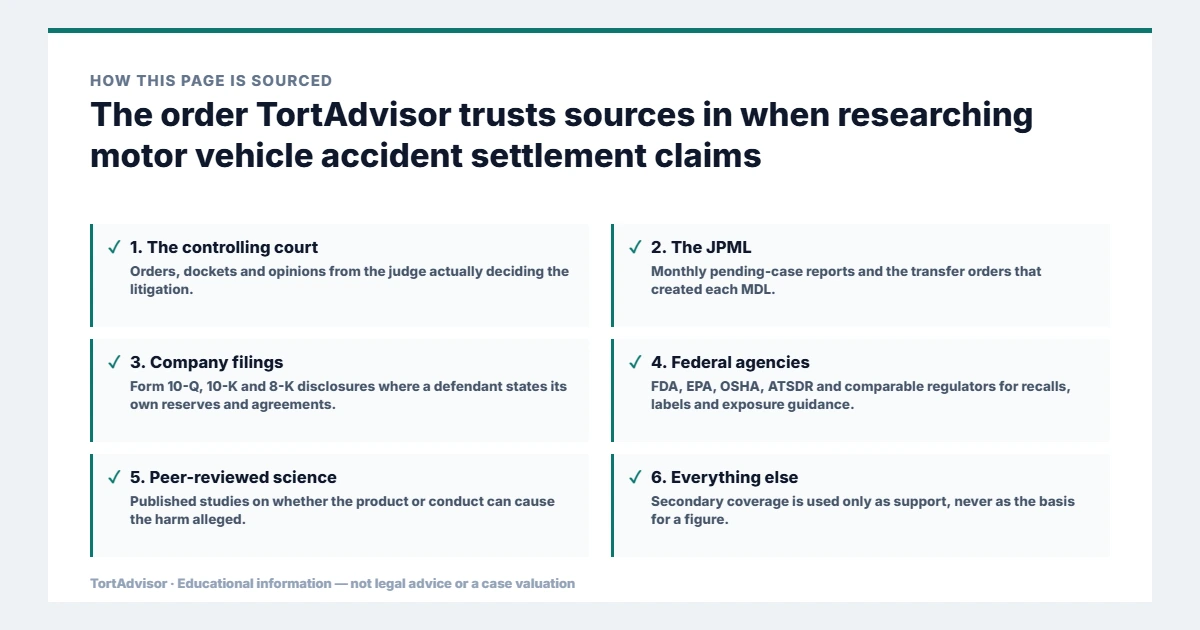
Tell us about your car, truck, motorcycle, or boating accident. There’s no cost and no obligation to find out if you have a claim.
This page is provided for general informational purposes only and does not constitute legal advice. This page does not publish settlement or verdict ranges, and nothing here is a guarantee or prediction of any outcome. Laws governing fault systems, comparative negligence, and filing deadlines vary by state and change over time; confirm current requirements with a licensed attorney in your jurisdiction before making any legal decision. TortAdvisor is not a law firm and does not provide legal representation.