Paraquat Settlement Amounts 2026: MDL 3004 Status & Claim Value
A settlement structure exists in the paraquat litigation, but no amounts have been published — and the regulator that reviewed the science reached a different conclusion from the plaintiffs. Both facts belong on this page.
Latest Paraquat Settlement Amounts and MDL 3004 Status
The paraquat litigation sits in an unusual position: a settlement structure has been put in place while the underlying scientific question remains contested, including by the federal regulator.
The agency begins its periodic reassessment of paraquat, which will run for more than a decade and become central to the litigation’s causation dispute.
EPA publishes its draft risk assessments and then a proposed interim decision, setting out its analysis of the epidemiology on Parkinson’s disease.
EPA finalises stronger exposure protections: aerial application limited to 350 acres per applicator per 24 hours, residential buffer zones, a prohibition on human flaggers, and restricted entry intervals of 48 hours for most crops.
The court excludes the plaintiffs’ general causation expert and grants summary judgment in the four bellwether cases, dismissing them with prejudice.
Syngenta submits a new vapor pressure study in January, and EPA completes its review of it in March.
Co-lead plaintiffs’ counsel and the defendants execute a master settlement agreement for certain individual claims on Sept. 3. On Sept. 29 the court extends the stay and vacates the October 2025 trial date.
An EPA memorandum concludes there is greater uncertainty about paraquat’s potential to volatilise than previously considered, and the agency says it will issue a Data-Call-In requiring manufacturers to submit further data, with updated analysis to follow. The regulatory record on paraquat is therefore still open.
The parties jointly move the court to establish a “Paraquat Products Qualified Settlement Fund,” with BrownGreer as administrator. The motion discloses no amounts.
A 7-2 ruling holds that FIFRA preempts state-law failure-to-warn claims where EPA has not required the warning on the label. The case concerned Roundup; paraquat is also registered under FIFRA, but how the ruling applies to paraquat claims has not been decided.
The court records refusal rates of 100% and over 90% at two plaintiffs’ firms and over 80% at a third, sends random samples of opt-out cases into discovery, and on Sept. 11 cancels a hearing after finding substantial progress on one firm’s cases. No amounts, tiers or eligibility criteria have been published.
Paraquat Settlement Amounts: Confirmed Facts vs. Contested Science
The docket facts are clear. The science is not, and pages that present it as settled are doing claimants no favours.
What Is Confirmed
- The Supreme Court decided Monsanto Co. v. Durnell 7-2 on June 25, 2026, holding that FIFRA preempts a label-based failure-to-warn claim where EPA never required the warning.
- MDL 3004 held 6,602 pending actions of 8,495 filed as of the Oct. 1, 2026 JPML report, before Judge Nancy J. Rosenstengel.
- A master settlement agreement for certain individual claims was executed on Sept. 3, 2025, and in February 2026 the parties jointly moved to establish a qualified settlement fund.
- On April 17, 2024 the court excluded the plaintiffs’ general causation expert and dismissed the four bellwether cases with prejudice.
- The court recorded opt-out rates of 100% and over 90% at two plaintiffs’ firms (June 2, 2026) and over 80% at a third (June 3, 2026).
- EPA states it has not found a clear link between paraquat exposure from labeled uses and Parkinson’s disease or cancer.
- A 2020 update to the Agricultural Health Study found no association between paraquat and Parkinson’s, contrasting with earlier 2011 findings.
- Paraquat is a Restricted Use Pesticide; only trained certified applicators may use it, and — uniquely among restricted products — people working under a certified applicator’s supervision are prohibited from using it.
- EPA’s 2021 interim decision imposed a 350-acre aerial limit per applicator per 24 hours, residential buffer zones, a ban on human flaggers and 48-hour restricted entry intervals for most crops.
What Is Not Known
- How much money the settlement involves, and who qualifies.
- What any individual claim would be worth.
- How the general causation dispute would resolve if cases are tried.
- What EPA’s pending Data-Call-In analysis will conclude.
- Whether off-target volatilisation exposure will support claims.
The Durnell Preemption Ruling and What It Means for Paraquat Claims
The most consequential development for paraquat claim value in 2026 did not happen in MDL 3004. It happened at the Supreme Court, in a Roundup case.
On June 25, 2026 the Supreme Court decided Monsanto Co. v. Durnell, No. 24-1068 by a vote of 7-2, reversing the judgment below and remanding. Justice Kavanaugh wrote for the majority, Justice Thomas concurred, and Justice Jackson dissented, joined by Justice Gorsuch.
The question the Court agreed to answer was narrow: whether FIFRA preempts a label-based failure-to-warn claim where EPA has not required the warning. The Court held that it does. A state tort duty that would compel a different pesticide label is a labeling requirement under FIFRA’s uniformity clause, 7 U.S.C. §136v(b), which bars a state from imposing labeling requirements “in addition to or different from” the federal ones. The full opinion, concurrence and dissent are published by Cornell’s Legal Information Institute.
What the ruling does not do is end the paraquat litigation. It addresses failure-to-warn on labeling. It does not by its terms dispose of design-defect theories, negligence claims framed independently of the label, or claims arising from conduct outside the approved label. How far it reaches is being worked through in the lower courts now, and it has not been resolved for paraquat.
What it does do is change the settlement calculus. The paraquat settlement was being finalised before Durnell was decided. Anyone assessing what a paraquat claim is worth in late 2026 is assessing it against a legal landscape that moved in the defendants’ favour after that agreement was reached, and against a regulator whose published position already runs against the causation theory. That is the honest frame, and it is why no payout range appears on this page.
Our 2026 paraquat litigation briefing tracks the MDL docket, the Durnell fallout and the EPA record as they develop.
Why This Page Publishes No Paraquat Payout Range
A signed master settlement exists, which makes this the closest call in the library. It still does not support a published range.
An agreement is not a figure
The September 2025 master settlement and the February 2026 motion for a qualified settlement fund disclose no amounts, and nothing public shows how money would be allocated between claimants.
No criteria have been published
Where a programme publishes tiers — as the Roundup class settlement and the 9/11 fund do — this library reproduces them. Here there is nothing published to reproduce.
Causation remains genuinely contested
EPA has not found a clear link on labeled uses, and the epidemiology is mixed. A payout band implies a recovery the science has not yet secured.
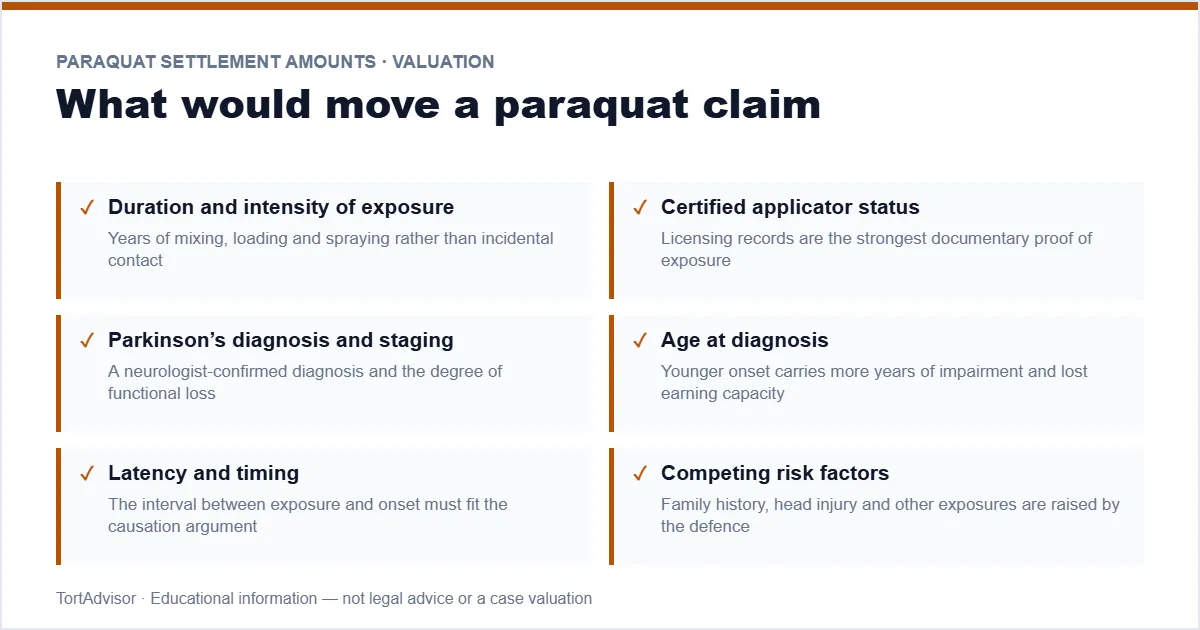
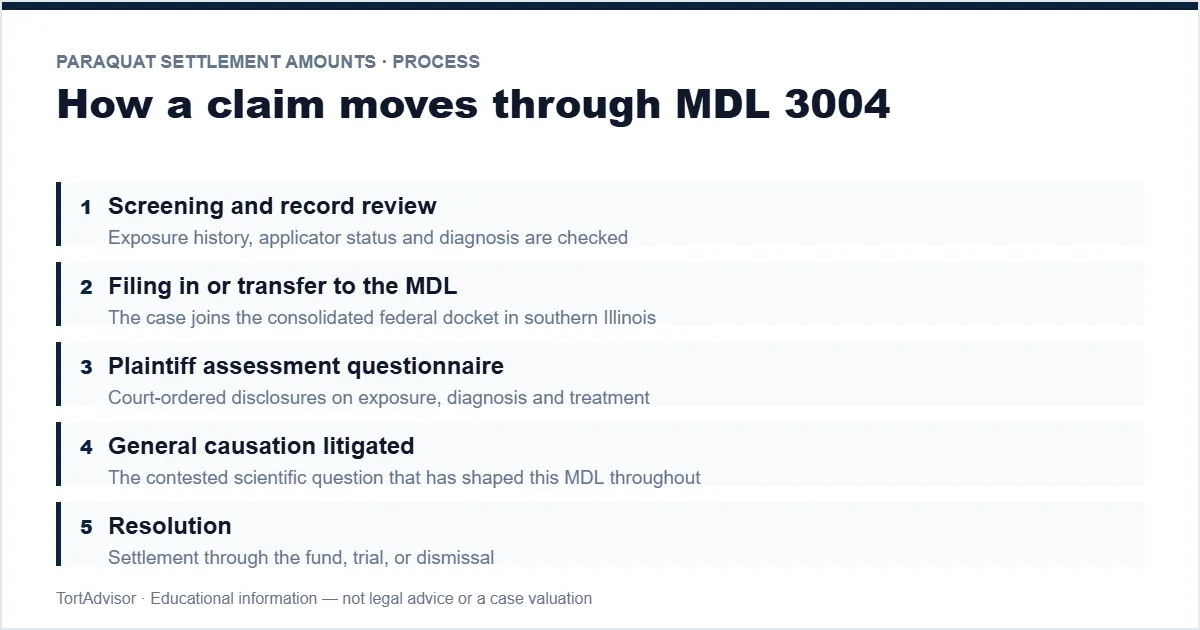
How a paraquat settlement payment would be calculated
A master settlement agreement exists and a qualified settlement fund has been requested, so this sequence is closer to reality here than on most pages in this library. The amounts are still unknown.
Claim assessed against agreed criteria
Exposure duration and intensity, applicator status, diagnosis and staging are weighed.
Attorney fees and case costs deducted
Contingency fee plus filing, expert and record-retrieval costs come out first.
Liens and reimbursements resolved
Medicare, Medicaid and private insurers recover what they paid for Parkinson’s treatment.
Net payment issued from the fund
A qualified settlement fund would hold and distribute the money once allocation is determined.
Illustrative sequence only. No paraquat settlement amounts, tiers or eligibility criteria have been published as of Oct. 5, 2026.
How TortAdvisor Handles Paraquat Settlement Amounts
On a tort where the regulator disagrees with the plaintiffs, the editorial obligation is to say so rather than quietly omit it.
Report the regulator’s position
EPA’s conclusion that it has not found a clear link is material to anyone assessing a claim, and appears here rather than being left out because it is unhelpful.
An agreement is not an amount
The September 2025 settlement agreement and the February 2026 fund motion are reported as exactly that, without inferring a value that has not been disclosed.
Distinguish exposure routes
Applicator exposure, bystander exposure and off-target drift raise different evidentiary questions and are not blended together.
Track the current docket
Case counts come from the current month’s JPML report rather than a figure repeated across secondary sites after it went stale.
The Paraquat Science, On Both Sides
Claim value in this litigation depends on a scientific dispute. Presenting only one side of it would misrepresent the risk a claimant is taking.
| Question | EPA’s stated position | The plaintiffs’ case |
|---|---|---|
| Does labeled-use exposure cause Parkinson’s? | After reviewing many studies that range in quality and provide conflicting results, EPA states it has not found a clear link | Plaintiffs rely on other epidemiological and mechanistic evidence linking paraquat to dopaminergic neuron damage |
| The Agricultural Health Study | A 2020 update found no association between paraquat and Parkinson’s, contrasting with earlier 2011 findings | Plaintiffs point to methodological limitations and to studies outside that cohort |
| Exposure beyond the label | EPA’s 2021 decision imposed stronger protections, implying exposure risk was being managed | Plaintiffs argue real-world mixing, loading and drift exposure exceeded labeled assumptions |
| Volatilisation and drift | A November 2025 EPA memorandum found greater uncertainty about volatilisation than previously considered | That uncertainty supports arguments about off-target and bystander exposure |
| Is the record closed? | No — EPA announced in November 2025 that it would require further data from manufacturers | A changing regulatory record can cut either way for pending claims |
This table is not a prediction about who is right. It is the state of a live scientific dispute, and it is the reason no responsible payout range can be published for this tort today.
Free Paraquat Case Review
Wondering how the figures on this page relate to your own situation? Share a few details below — a trained case advisor reviews every submission FREE and with no obligation, and your information stays confidential.
- Free — no cost, no obligation
- About a minute to complete
- Reviewed by a trained case advisor
- Nothing you submit is published
Your details are sent over a secure connection and reviewed confidentially.
Who May Qualify for Paraquat Settlement Amounts
Eligibility turns on documented exposure and a neurologist-confirmed diagnosis, and the exposure side is where most claims are tested.
Common Screening Factors
- A Parkinson’s disease diagnosis confirmed by a neurologist
- Occupational exposure through mixing, loading or applying paraquat
- Certification as a restricted-use pesticide applicator, which is strong documentary evidence
- Farm work, agricultural contracting or groundskeeping in areas where paraquat was applied
- Living or working adjacent to treated fields, for drift and bystander claims
- Claims brought by a personal representative where the claimant has died
Factors Requiring Closer Review
- Exposure that cannot be documented beyond recollection
- Parkinsonism from another identified cause, or an atypical diagnosis
- Family history of Parkinson’s, head injury or other risk factors raised by the defence
- Latency that does not fit the causation argument
- State limitation periods, which usually run from diagnosis
For the closest comparison in this library — an agricultural chemical where a class settlement does publish figures — see our Roundup settlement amounts research, and for the wider category our toxic exposure lawsuit research.
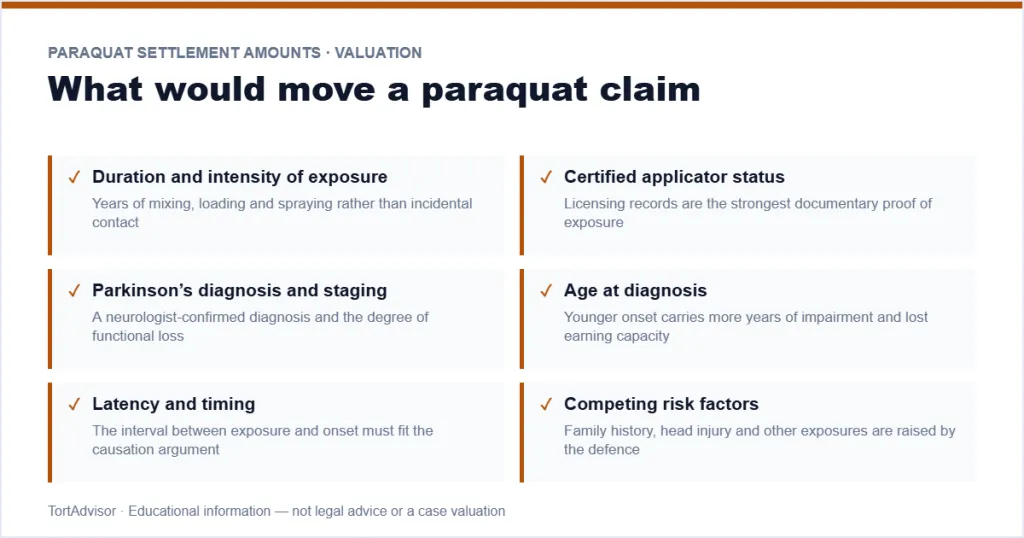
Factors That Would Affect Paraquat Settlement Amounts
With no published criteria, these are the factors that determine whether a paraquat claim is strong.
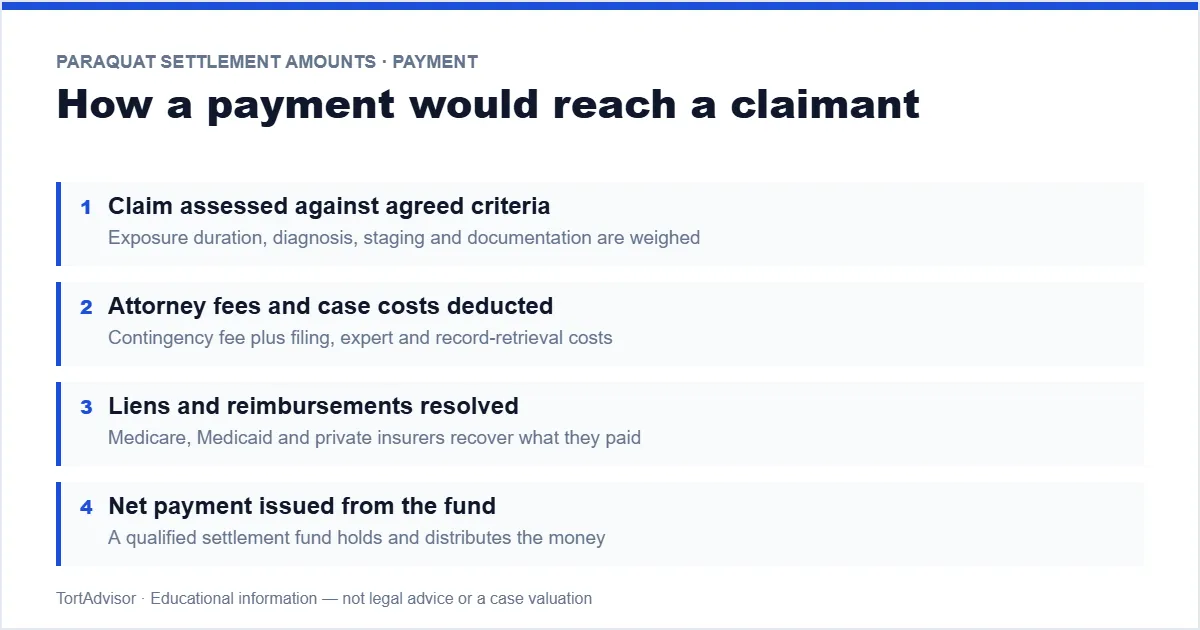
Duration and intensity of exposure
Years of mixing, loading and spraying carry far more weight than incidental or single-season contact. Frequency and handling role both matter.
Certified applicator status
Because only certified applicators may legally use paraquat, state licensing records are unusually strong documentary proof of exposure.
Diagnosis and staging
A neurologist-confirmed Parkinson’s diagnosis, with clinical staging and documented functional decline over time.
Age at onset
Younger onset carries more years of impairment, care need and lost earning capacity, and is also harder for the defence to attribute to ageing.
Latency between exposure and onset
The interval must be consistent with the causation theory. Onset very shortly after first exposure, or many decades later, invites challenge.
Competing risk factors
Family history, head trauma and other pesticide exposures are the standard defence arguments and are supported by EPA’s own stated position.
Evidence Supporting Paraquat Settlement Amounts
Documented exposure is what separates a viable paraquat claim from an account of having worked on a farm.
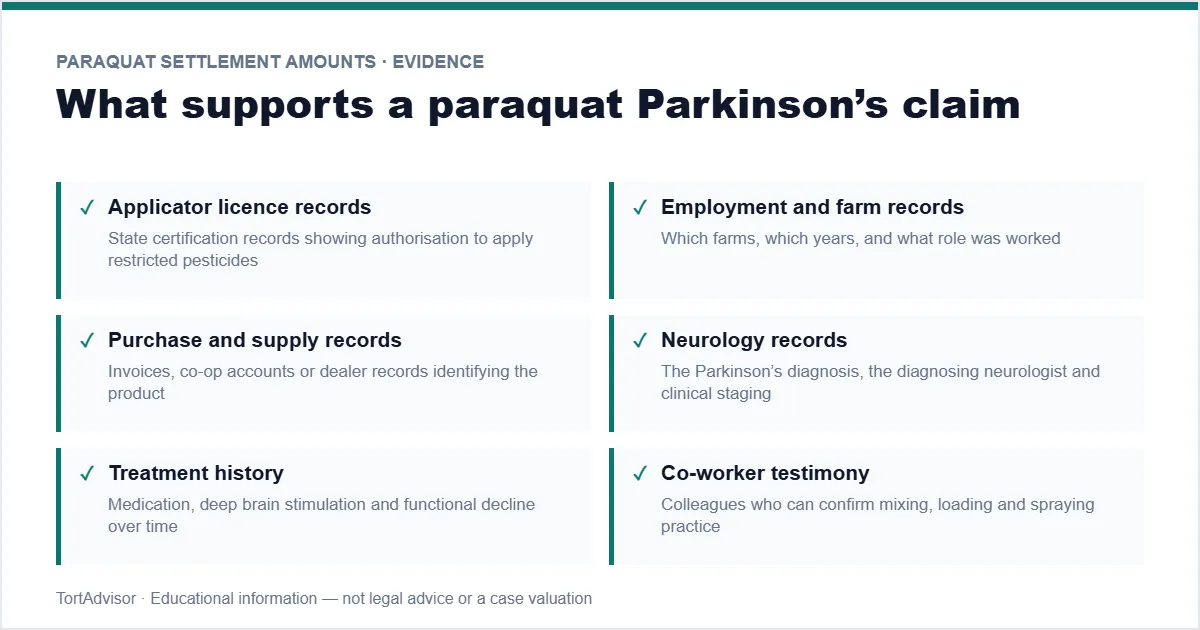
Applicator licence records
State pesticide applicator certification records. Because supervised use is prohibited, licensing is strong evidence of who actually handled the product.
Employment and farm records
Which farms or operations, which years, and what role. Payroll records, contracts and tax records all help place a claimant on specific land.
Purchase and supply records
Invoices, co-op accounts and dealer records identifying paraquat specifically rather than herbicides generally.
Neurology records
The Parkinson’s diagnosis, the diagnosing neurologist, clinical staging, imaging and response to treatment.
Treatment history
Medication regimens, dose escalation, deep brain stimulation and documented functional decline over time.
Co-worker testimony
Colleagues who can confirm mixing and loading practice, protective equipment used, and how often spraying was done.
Filing Deadlines for Paraquat Claims
The settlement process has not published a deadline for anyone outside the litigation. State limitation periods still apply, and they can start when an injury was discovered rather than at exposure.
What tends to matter
- The date of diagnosis and which state’s law governs
- Whether a discovery rule applies and when it started the clock
- Whether the claim is an injury claim or a wrongful death claim
- Whether exposure records still exist and can be obtained
What does not pause the clock
- The existence of a settlement agreement or a settlement fund
- Waiting for allocation criteria to be published
- EPA’s pending Data-Call-In and further review
- Continuing Parkinson’s treatment
Take the Paraquat Settlement Calculator Below
The calculator organises what you know about exposure, applicator status, the diagnosis, treatment and financial loss, then shows which factors carry the most weight in a paraquat claim. It takes a few minutes and asks for no documents.
The result is educational and is not a guaranteed case value or settlement offer.
Before You Start
- Roughly which years paraquat was used or encountered
- Whether you held an applicator certification
- Whether you mixed and loaded, or only worked nearby
- When Parkinson’s was diagnosed, and by whom
- Treatment received so far
- The state where the exposure occurred
Answer what you know. You do not need every record or an exact timeline to get started.
Primary Sources for Paraquat Settlement Amounts
Every fact above traces to one of these. The record was last reviewed on Oct. 5, 2026.
Monsanto Co. v. Durnell — Supreme Court docket
The docket for No. 24-1068 records the June 25, 2026 judgment reversing and remanding, the question presented on FIFRA preemption, and the line-up of the majority, concurrence and dissent. The full text of the opinions is published by Cornell’s Legal Information Institute.
FIFRA uniformity clause
7 U.S.C. §136v(b) provides that a state “shall not impose or continue in effect any requirements for labeling or packaging in addition to or different from those required under this subchapter.” That sentence is the whole of the preemption holding.
Federal Register — paraquat interim decision reconsideration
EPA’s notice of availability published Feb. 1, 2024 (docket EPA-HQ-OPP-2011-0855) opened comment on its preliminary reconsideration of issues raised against the 2021 paraquat interim registration review decision. The registration review is not final.
JPML pending-actions report
The JPML report dated Oct. 1, 2026 lists 6,602 actions pending in MDL 3004 of 8,495 filed, before Judge Nancy J. Rosenstengel in the Southern District of Illinois.
EPA paraquat registration record
EPA’s paraquat dichloride page sets out the registration review timeline from 2011, the July 2021 interim decision and its protections, the agency’s statement that it has not found a clear link to Parkinson’s from labeled uses, the 2020 Agricultural Health Study update, the 2024 vapor-pressure study, the November 2025 volatilisation memorandum and the planned Data-Call-In.
Restricted use classification
EPA classifies all U.S. paraquat products as Restricted Use Pesticides usable only by trained certified applicators, and uniquely prohibits use by people working under a certified applicator’s supervision — a fact that makes applicator licensing records central to proving exposure.
The MDL 3004 docket
The court’s MDL 3004 page posts the orders cited here, including Case Management Order 24 (Apr. 8, 2026), the opt-out orders of June 2 and June 3, 2026, and the Sept. 11, 2026 order. The February 2026 joint motion to establish a qualified settlement fund is ECF No. 5787 in No. 3:21-md-3004 (S.D. Ill.). TortAdvisor cites the docket rather than secondary coverage of it.
Why no payout figure is cited
No settlement amounts, tiers or eligibility criteria have been published, and no bellwether has produced a plaintiff verdict. TortAdvisor therefore publishes no paraquat payout range.
On reporting the science both ways
EPA’s position is adverse to the plaintiffs’ causation theory. It appears on this page because a claimant deciding whether to pursue a claim needs to know the strongest argument against it, not only the case for it.
Frequently Asked Questions About Paraquat Settlement Amounts
What is the average paraquat settlement amount?
There is no average. No settlement amounts, tier values or allocation criteria have been published, and no bellwether has produced a plaintiff verdict. Figures circulating elsewhere are estimates rather than outcomes.
Source: S.D. Ill. CMO 24 · 8 Apr 2026
Is there a paraquat settlement fund?
One has been requested. On Feb. 27, 2026, co-lead plaintiffs’ counsel and the defendants jointly moved the court to establish a “Paraquat Products Qualified Settlement Fund,” with BrownGreer as administrator and Huntington National Bank as custodian. The motion discloses no dollar amounts, and a fund of this kind does not reveal how much money is involved, who qualifies, or what any claim is worth.
Source: Joint Motion to Establish a Qualified Settlement Fund, ECF No. 5787, No. 3:21-md-3004 (S.D. Ill. Feb. 27, 2026)
How many paraquat lawsuits are pending?
The JPML report dated Oct. 1, 2026 lists 6,602 actions pending in MDL 3004 of 8,495 filed, before Judge Nancy J. Rosenstengel in the Southern District of Illinois.
Does EPA say paraquat causes Parkinson’s disease?
No. EPA says the many studies on paraquat and Parkinson’s disease “range in quality and provide conflicting results,” and states it has not found a clear link between paraquat exposure from labeled uses and adverse health outcomes such as Parkinson’s disease and cancer. Plaintiffs contest that conclusion and rely on other evidence.
Source: EPA · Paraquat dichloride
Who is allowed to use paraquat?
Only trained certified applicators. All U.S. paraquat products are Restricted Use Pesticides, and unusually, people working under a certified applicator’s supervision are prohibited from using it — which is why licensing records matter so much to these claims.
Source: EPA · Paraquat dichloride
Can I claim for exposure if I never applied it myself?
Possibly. Bystander and drift claims are brought by people who lived or worked near treated fields. They are harder to document, though EPA’s November 2025 memorandum finding greater uncertainty about volatilisation is relevant to that argument.
Source: EPA · Paraquat dichloride
When does the filing deadline run from?
It depends on the state and the type of claim. A limitation period may run from the date of injury, the date it was discovered, or the date it would have been discovered with reasonable effort, which is why the Parkinson’s diagnosis date often matters more than the exposure date. Nothing in the public settlement record extends any state deadline.
Is the paraquat settlement calculator legally binding?
No. It is an educational tool that organises claim factors into an illustrative range. It is not a case valuation, not an offer, and binds no defendant, court or law firm.
See Which Factors May Affect a Paraquat Parkinson’s Claim
Answer the questions you can about paraquat exposure, a Parkinson’s diagnosis, treatment, records, expenses and long-term impact. The calculator organizes those inputs into an educational settlement range and highlights the factors that may matter most when a claim is reviewed.
The result is educational and is not a guaranteed case value or settlement offer.
Helpful Information to Have Ready
You do not need every record in hand. Answer what you know; these details can make the estimate more useful.
Reading this page is separate from any request to be contacted. The consent boxes on this form are unchecked unless you tick them yourself.