Institutional Sexual Abuse Lawsuit 2026: Filing Guide for Clergy & School Survivors
My name is Mason Arnao, and my background in data systems and digital advocacy has given me a deep understanding of how the institutional sexual abuse lawsuit 2026 affects real survivors who were victimized by people in positions of authority — clergy, coaches, teachers, counselors, and others — within trusted institutions. As publisher of TortAdvisor.com and President of Waypoint Software, I’ve spent over 20 years connecting people with critical information. This complete guide covers who qualifies, how to file, and what you can recover.
📞 Free Case Evaluation — No Cost, No Obligation
Call Us to Speak With a Sexual Abuse Expert Now
Open 24/7 · Confidential · No upfront cost
The institutional sexual abuse lawsuit 2026 wave represents one of the most important developments in American civil rights and personal injury law. Survivors of sexual abuse perpetrated by clergy members, coaches, teachers, camp counselors, medical professionals, and other authority figures within trusted institutions now have more powerful legal tools than ever before to pursue justice and financial compensation. A combination of landmark court decisions, state legislative reforms extending statutes of limitations for childhood sexual abuse, and high-profile institutional settlements has created a powerful legal landscape for survivors in 2026. If you were abused within an institutional setting and have not yet pursued your legal rights, now is the time to act.
📋 Table of Contents
What Is an Institutional Sexual Abuse Lawsuit?
An institutional sexual abuse lawsuit is a civil legal action brought by a survivor of sexual abuse against both the individual perpetrator and the institution that employed, supervised, or enabled that perpetrator. The key distinguishing feature of institutional abuse claims is the dual-defendant strategy: survivors sue not just the person who committed the abuse, but the organization that failed to prevent it — the church diocese, the school district, the youth sports organization, the summer camp, the hospital, or another institutional entity.
The legal basis for holding institutions liable is negligence: institutions have a duty to protect the people in their care, especially children. When institutions fail to conduct proper background checks, ignore warning signs of abuse, fail to supervise employees appropriately, or actively cover up known abuse, they breach that duty and become liable for the resulting harm. In cases involving active cover-up of known abuse — as documented extensively in Catholic Church, USA Gymnastics, Boy Scouts of America, and other institutional abuse scandals — punitive damages may significantly increase total recovery.
Some of the largest institutional settlements in American history have resulted from coordinated institutional abuse claims. The Boy Scouts of America’s bankruptcy created a Scouting Settlement Trust funded with about $2.48 billion, which had paid about $1.28 billion across 52,513 claim disbursements as of September 1, 2026. Catholic dioceses have paid billions across thousands of cases. USA Gymnastics and the U.S. Olympic & Paralympic Committee agreed to a $380 million settlement with survivors of the Larry Nassar abuse scandal. These settlements demonstrate that institutional accountability is achievable and that individual survivors can receive substantial compensation for the harms they suffered. Visit our sexual abuse lawsuit page for a comprehensive overview of current institutional abuse litigation.
📞 Free Case Evaluation — No Cost, No Obligation
Call Us to Speak With a Sexual Abuse Expert Now
Open 24/7 · Confidential · No upfront cost
Types of Institutional Abuse Cases in 2026
The institutional sexual abuse lawsuit landscape in 2026 covers a broad range of settings and perpetrator types:
- Religious institution abuse: Catholic Church, evangelical churches, Jehovah’s Witnesses, and other religious organizations where clergy or church staff committed abuse
- School and university abuse: Teachers, counselors, coaches, or administrators who abused students — including both K-12 schools and higher education settings
- Youth sports organizations: Coaches, trainers, and officials in organized youth sports programs who used their positions to abuse athletes
- Camp and youth program abuse: Summer camps, scouting organizations, after-school programs, and other youth-serving organizations
- Medical and therapeutic settings: Doctors, nurses, therapists, and other healthcare providers who abused patients in their care
- Juvenile detention and foster care: Abuse by staff in juvenile detention facilities, foster care homes, and residential treatment centers
- Campus sexual assault: Universities and colleges that failed to respond appropriately to reported sexual assaults under Title IX
Who Qualifies for the Institutional Abuse Lawsuit 2026?
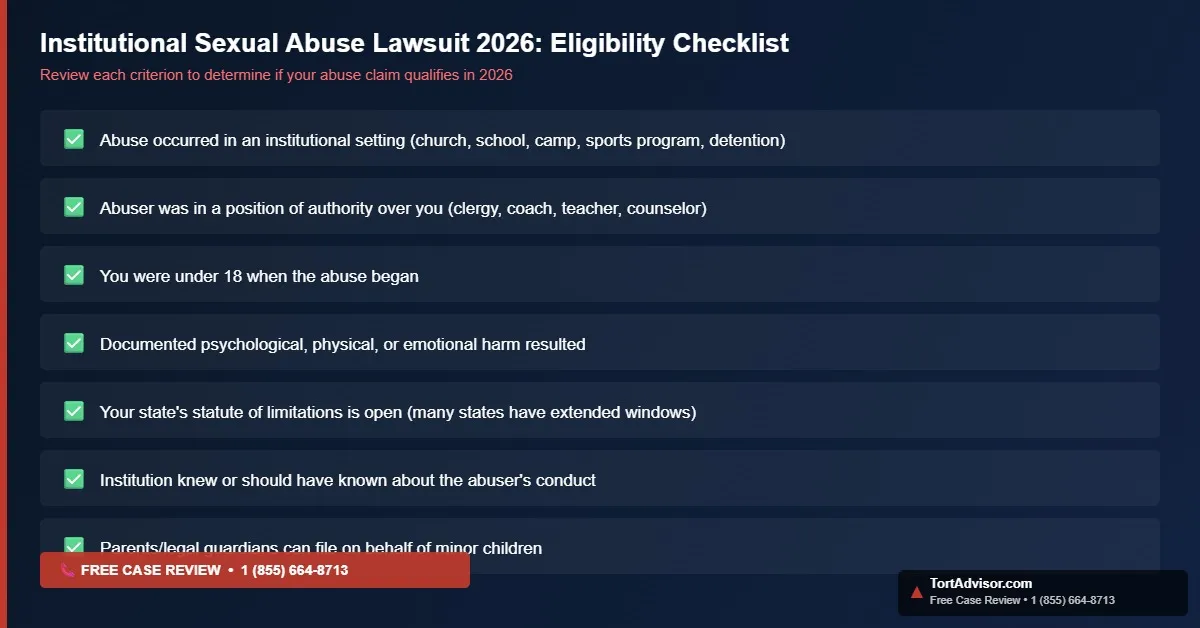
- You were sexually abused by a person in a position of authority within an institutional setting
- The abuse occurred while you were under 18 (or, in some settings, as an adult patient or student)
- The institution had a duty to protect you and failed to fulfill that duty through negligent hiring, supervision, or response to known abuse
- You have suffered psychological, emotional, or physical harm as a result of the abuse
- Your claim is within the applicable statute of limitations — see the 2026 update below
Call 855-664-8713 for a free, completely confidential case evaluation. Our case specialists understand the sensitivity of these claims and will treat your story with the respect and privacy it deserves.
Settlement Amounts: What Institutional Abuse Survivors Can Recover
Settlement amounts in institutional sexual abuse cases vary widely based on the severity and duration of abuse, the number of perpetrators, the degree of institutional culpability, and the jurisdiction. There is no standard payout scale for institutional abuse claims. What a claim is worth depends on the facts, the state, the institution and its insurance, and whether the claim is resolved in court or through a bankruptcy trust. Some trusts pay only part of each allowed claim: as of September 2026, the Scouting Settlement Trust was paying 4.7% of each allowed claim’s value. See our Boy Scouts settlement payout guide for how that works.
Use the sexual abuse settlement calculator for a personalized estimate. Explore all settlement calculators at TortAdvisor.com.
2026 Statute of Limitations Update for Institutional Abuse Claims
One of the most significant legal developments in institutional sexual abuse litigation over the past several years has been the widespread reform of statutes of limitations for childhood sexual abuse claims. As of 2026, many states have extended their limitations periods to allow survivors to file well into adulthood — some until age 55 or beyond. According to data compiled by the NIH on sexual violence research, survivors of childhood sexual abuse often do not come forward until decades after the abuse occurred, due to trauma responses, shame, and the psychological mechanisms of abuse. The law has increasingly recognized this reality. Additionally, several states have enacted “revival windows” — limited time periods during which previously time-barred claims can be filed. An attorney can advise you on whether a revival window applies in your state. For current CDC statistics on sexual violence and its impacts, see the CDC’s sexual violence fast facts page.
How to File Your Institutional Abuse Claim
- Free confidential evaluation: Call 855-664-8713 — 24/7. Completely confidential. Your privacy is protected at every step.
- Document your claim: Gather any therapy records, medical records, written accounts, witness statements, and any documentation of the institution’s response to your abuse.
- Attorney match: Connected with experienced institutional sexual abuse attorney on full contingency — zero upfront fees.
- Investigation: Your attorney investigates the institution, the perpetrator’s history, and any evidence of institutional knowledge or cover-up.
- Resolution: Most institutional abuse cases settle. Your attorney presents all settlement offers for your review and will advise you on whether to accept or demand more.
Still unsure where you stand?
Have a trained case advisor review your own facts — free, confidential, and with no obligation.
- Free — no cost, no obligation
- About a minute to complete
- Reviewed by a trained case advisor
- Nothing you submit is published
Your details are sent over a secure connection and reviewed confidentially.
Frequently Asked Questions: Institutional Sexual Abuse Lawsuit 2026
Is it too late to file an institutional sexual abuse lawsuit in 2026?
Many survivors can still file in 2026 due to extended statutes of limitations for childhood sexual abuse claims in most states. Some states allow survivors to file until age 40, 50, or later. Several states have recently enacted revival windows for previously time-barred claims. A free evaluation will confirm your state-specific deadline — call 855-664-8713 now.
How much is an institutional sexual abuse lawsuit worth?
There is no standard range: value depends on the severity and duration of abuse, the institution’s culpability, the strength of evidence, the state, and whether the claim is paid through a lawsuit or a bankruptcy trust. Use our sexual abuse settlement calculator for a personalized estimate.
Who qualifies for an institutional sexual abuse lawsuit?
Survivors of sexual abuse by clergy, coaches, teachers, counselors, or other authority figures within institutional settings may qualify. The abuse must have been enabled by the institution’s negligence, and the claim must be within the applicable statute of limitations. Call 855-664-8713 for a free confidential eligibility review.
How long does an institutional abuse lawsuit take?
Institutional abuse cases typically take 2–4 years to resolve, though some complex cases involving large institutions with many plaintiffs may take longer. Individual settlements can sometimes be reached in under 2 years for well-documented cases. Your attorney will provide a realistic timeline for your specific situation.
Do I need a police report to file an institutional abuse lawsuit?
A police report is not required to file a civil institutional abuse lawsuit. Civil and criminal cases are separate legal proceedings. Many survivors file civil claims without any prior criminal report. However, if abuse was reported to police, those records can strengthen your civil claim. Your attorney will advise on evidence strategy.
What is the current landscape of institutional abuse lawsuits in 2026?
In 2026, institutional sexual abuse litigation is at an all-time high. State legislative reforms have opened new filing windows for survivors. High-profile resolutions — the Boy Scouts settlement trust (about $2.48 billion), Catholic dioceses (billions across many cases) and USA Gymnastics with the USOPC ($380 million) — have demonstrated that institutional accountability is achievable. The combination of favorable legal climate and extended deadlines makes 2026 an important year for survivors to take action.
About the Author
Mason Arnao is the President and Managing Partner of Waypoint Software, LLC, and publisher of TortAdvisor.com. With over 20 years of experience in data systems and digital advocacy, Mason brings a unique analytical perspective to complex institutional sexual abuse litigation. He is committed to helping survivors access the information and legal resources they need to pursue justice.
⚠️ Time-Sensitive — Statutes of Limitations Apply
Call Us to Speak With a Sexual Abuse Expert Now
Free Confidential Consultation · Open 24/7 · No Cost, No Obligation
Get a Free Institutional Abuse Case Review
If you or a loved one experienced institutional sexual abuse, call 855-664-8713 or fill out the confidential form below for a free case review.
Additional Resources
Related Posts

Sexual abuse filing deadlines depend on the state, the survivor's age and whether the case is civil or criminal. How the clock works, with New York, Florida and federal law as examples.

The Boy Scouts Settlement Trust has paid $1.28 billion across 52,513 disbursements as of September 1, 2026 - but it pays only 4.7% of each allowed claim, so a $300,000 Tier 3 claim has produced about $14,100. Court-sourced figures, the payout timeline, and what is still holding the percentage down.
The Roblox lawsuit statute of limitations varies by state. This 2026 guide covers filing deadlines, the minor tolling rule, the discovery rule, and a full state-by-state table so families can determine if they still qualify to file a child exploitation claim.