Boy Scouts Sexual Abuse Settlement 2026: Payout Per Person and Trust Status
Quick answer: As of October 1, 2026 the Scouting Settlement Trust had paid $1,331,813,046 across 53,162 claim disbursements — about $27,590 per paid Matrix claim on average, by our arithmetic on the Trust’s own totals. That is far below the headline matrix figures most websites quote, because the Trust pays only a percentage of each allowed claim, and that percentage is still 4.7%. A $300,000 allowed claim has therefore produced roughly $14,100 so far, not $300,000. The Trustee has asked the bankruptcy court to raise the percentage to 5.7%; on October 13, 2026 that request was still pending.
SourceTrust report, Dkt 9429 Oct 2026Trustee report, Dkt 97113 Oct 2026
Find out if you may have a claim
Answer a few questions and a trained case advisor will review your situation — most people finish in about a minute.
- Free — no cost, no obligation
- About a minute to complete
- Reviewed by a trained case advisor
- Nothing you submit is published
Your details are sent over a secure connection and reviewed confidentially.
Speak With a Sexual Abuse Claims Advisor — Free and Confidential
If you filed a Boy Scouts claim and are trying to understand your distribution, or you think you may still be eligible to file, you can talk it through with someone at no cost. Available 24/7.
Table of Contents: Boy Scouts Settlement Payouts
- How much is the Boy Scouts settlement payout per person right now?
- What has the Settlement Trust actually paid so far?
- How does the Boy Scouts settlement matrix decide a claim’s value?
- When is the next Boy Scouts settlement payout date?
- Why only 4.7% when the Trust was funded with $2.48 billion?
- Which Boy Scouts court cases are still active in 2026?
- Can you still file a Boy Scouts abuse claim in 2026?
- Which widely repeated settlement figures are not true?
- Is the Boy Scouts settlement taxable?
- Frequently asked questions
- Where these figures come from
How much is the Boy Scouts settlement payout per person right now?
There is no single Boy Scouts settlement payout per person, because the Trust does not pay claims at face value. It assigns each claim an allowed amount and then distributes a uniform percentage of that amount to every survivor with an allowed claim. Everything else — the tier, the multipliers, the headline numbers — only determines the allowed amount. The percentage determines the cheque.
That percentage is currently 4.7%. It got there in two steps: an initial distribution of 1.5% of each allowed claim, followed by a supplemental distribution of 3.2% that the Trustee put into effect on February 11, 2026.
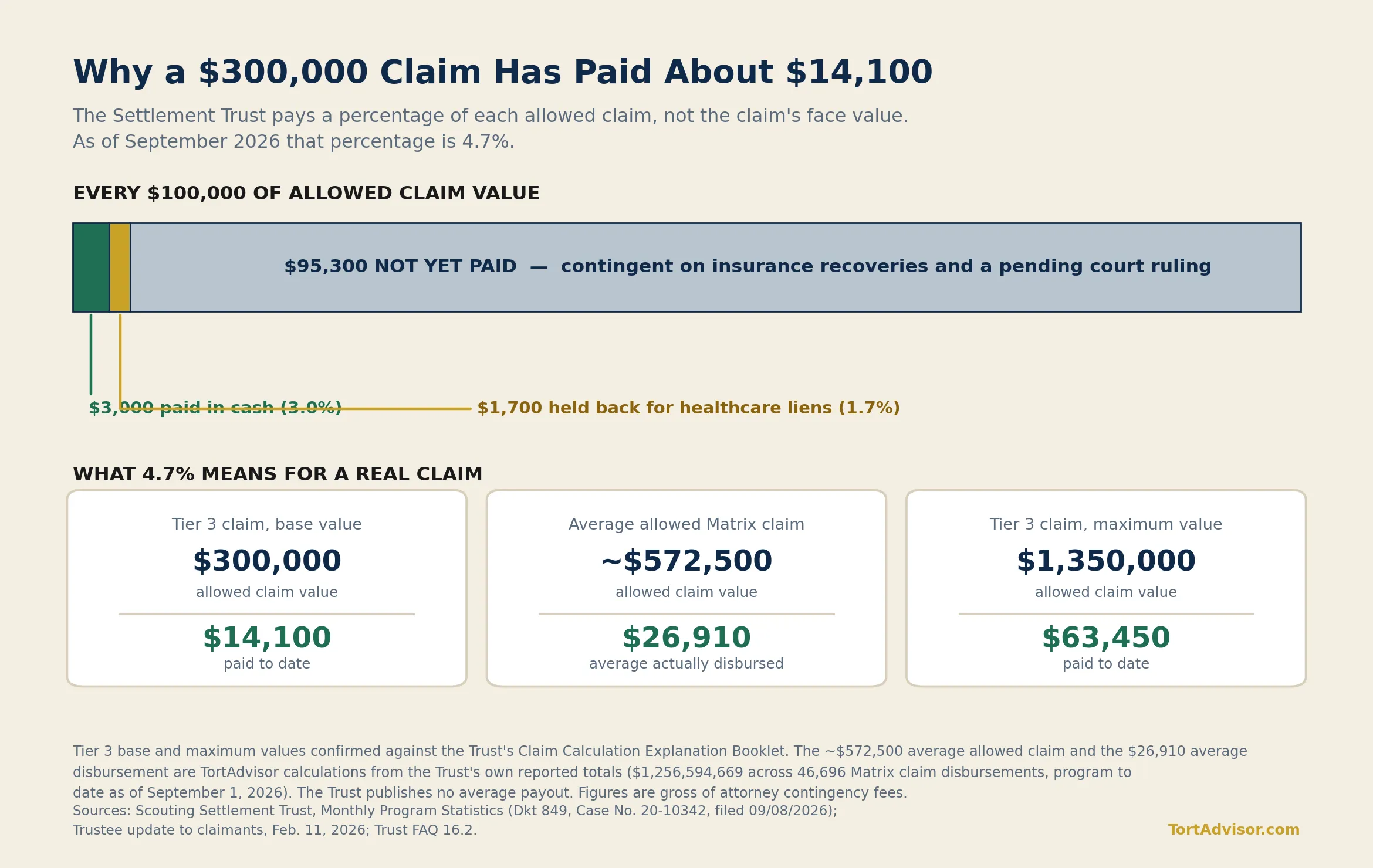
There is a second deduction most survivors do not expect. When the supplemental distribution went out, the Trustee reserved 1.7% of each allowed claim to cover potential healthcare liens — Medicare, Medicaid and similar government reimbursement rights. In the Trustee’s own arithmetic, a survivor who had not yet been paid anything received 3% in hand (4.7% minus the 1.7% reserve), and a survivor who had already received the initial 1.5% received a further 1.5%. The reserved balance is released later, once the lien administrator determines what, if anything, must actually be repaid.
| Allowed claim amount | Distributed at 4.7% | In hand after 1.7% lien reserve |
|---|---|---|
| $75,000 (lowest value for clothed touching) | $3,525 | $2,250 |
| $150,000 (lowest value for unclothed touching) | $7,050 | $4,500 |
| $300,000 (Tier 3 base) | $14,100 | $9,000 |
| $600,000 (lowest value for penetration) | $28,200 | $18,000 |
| $1,350,000 (Tier 3 maximum) | $63,450 | $40,500 |
| $2,700,000 (matrix maximum) | $126,900 | $81,000 |
How we calculated the average. The Trust does not publish an average payout. The $27,590 figure is a TortAdvisor calculation from the Trust’s own reported totals: $1,306,101,343 distributed across 47,339 Matrix claim disbursements, program to date as of October 1, 2026. The other rows simply apply the 4.7% percentage and the 1.7% lien reserve to published matrix values. All figures are gross — before any attorney contingency fee — and none of them is a final recovery.
SourceTrust report, Dkt 9429 Oct 2026Supreme Court brief4 Dec 2025
Nothing on this page substitutes for your own determination letter, which states your allowed amount directly. If you are earlier than that — still working out whether a Scouting claim belongs in the Trust at all — our sexual abuse claim questionnaire walks through the same factors the Trust weighs, and the wider survivor rights and deadlines guide covers how institutional claims work outside bankruptcy. Neither produces a valuation, and neither should: for a Boy Scouts claim already in the Trust the allowed amount is set by the Trust’s own review, and the distribution percentage is set by the bankruptcy court.
What has the Settlement Trust actually paid so far?
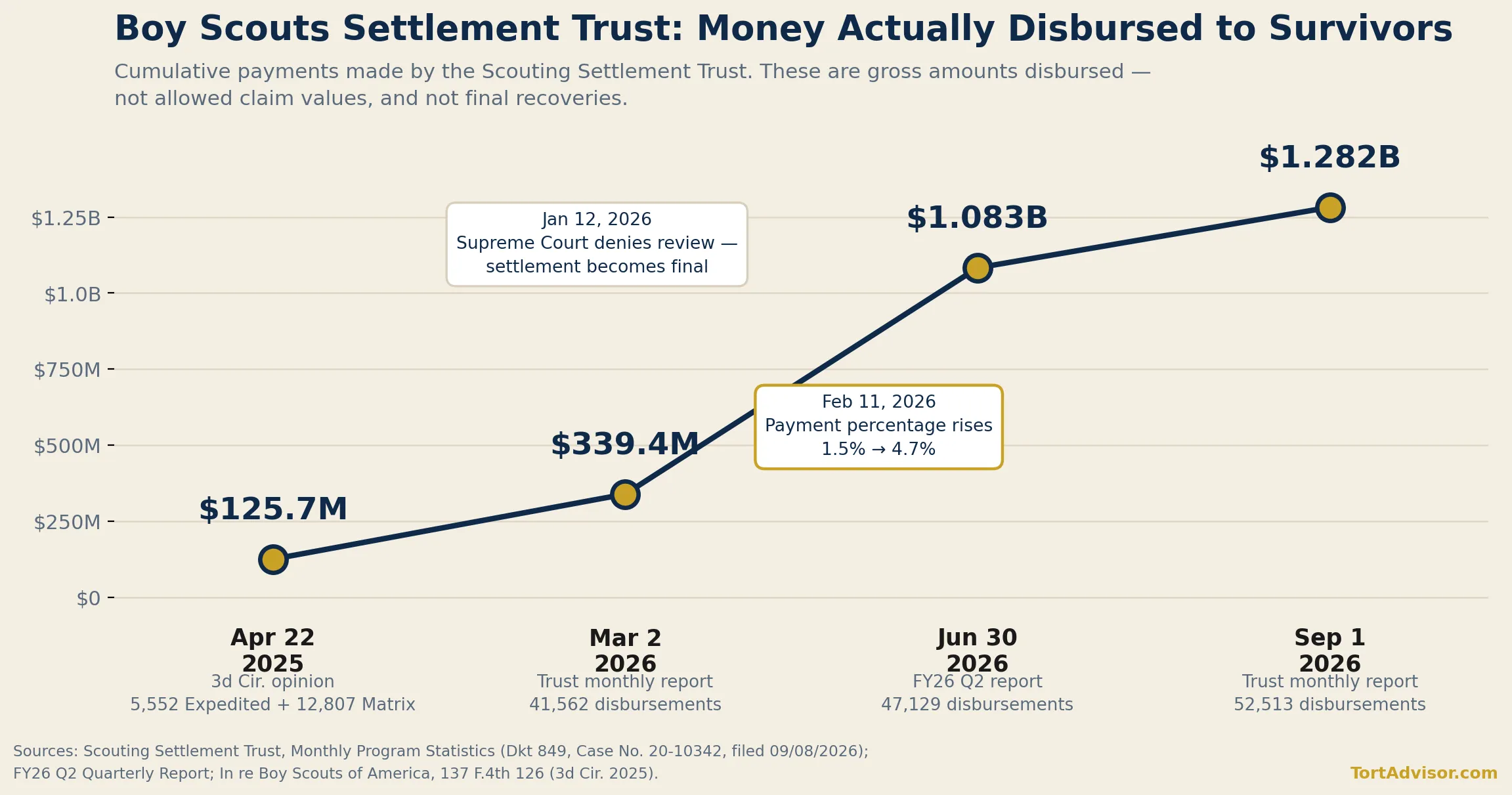
This is the number worth anchoring on, because it is reported monthly to the bankruptcy court and it is not an estimate. The most recent filing is the Trust’s Monthly Program Statistics (Program to Date as of October 1, 2026), docketed on October 9, 2026 as Dkt 942.
| Claim type | Questionnaires submitted | Claims determined | Disbursements issued | Amount disbursed |
|---|---|---|---|---|
| Expedited Distribution | 6,031 | 6,031 | 5,660 | $19,742,853 |
| Matrix | 58,115 | 56,963 | 47,339 | $1,306,101,343 |
| Independent Review Option | 201 | 196 | 163 | $5,968,850 |
| Total | 64,347 | 63,190 | 53,162 | $1,331,813,046 |
SourceTrust report, Dkt 9429 Oct 2026
Those totals are the only defensible basis for any statement about the Boy Scouts settlement payout per person. Two details in the table are easy to miss and matter a great deal.
First, Expedited Distribution claims are a different scheme entirely. Survivors who elected the expedited option took a flat $3,500 — paid as $2,535 up front with $965 held back for healthcare liens — fixed at the time they voted on the plan and unrelated to the 4.7% percentage. Averaging them together with matrix claims produces a number that describes neither, which is why the average above covers Matrix claims only.
Second, 64,347 questionnaires have been submitted against 82,209 timely claims filed in the bankruptcy. Roughly 18,000 people who filed a proof of claim in 2020 have never filed a claim questionnaire with the Trust. If that describes you or someone you know, that is the single most consequential piece of paperwork in this entire process — and the Boy Scouts claim process guide sets out what the questionnaire asks for.
How does the Boy Scouts settlement matrix decide a claim’s value?
The Trust Distribution Procedures place each allowed claim into one of six tiers based on the nature of the abuse, then apply multipliers that can move the value up substantially from the tier’s base figure. The Boy Scouts settlement matrix is what produces the allowed amount — the number the 4.7% is then applied to.
| Type of abuse, as the court filings describe it | Allowed-claim range (base to maximum) |
|---|---|
| Penetration | $600,000 – $2,700,000 |
| Oral contact | $450,000 – $2,025,000 |
| Masturbation (Tier 3) | $300,000 – $1,350,000 |
| Unclothed touching | $150,000 – $675,000 |
| Clothed touching, or exploitation for child pornography | $75,000 – $337,500 |
| Other sexual abuse that did not involve touching | $3,500 – $8,500 |
SourceSupreme Court brief4 Dec 20253d Cir. opinion13 May 2025
What is confirmed
- The matrix has six tiers with allowed values running from $3,500 to $2.7 million, as the Third Circuit described it. The ranges above are the ones the Coalition of Abused Scouts for Justice and the Future Claimants’ Representative set out in their December 2025 Supreme Court brief, citing the bankruptcy court’s confirmation opinion.
- Three multiplier categories apply, according to the Trust’s Claim Calculation Explanation Booklet: nature of the abuse (1.00–1.50), abuser profile (1.0–2.0) and impact on the survivor (1.00–1.50).
- Expedited Distribution claims are a flat $3,500, regardless of tier.
- As of June 30, 2026 the Trust had allowed 58,396 claims and disallowed 3,483.
What is not confirmed
- No public document discloses how the multipliers were applied to any individual claim.
- The Trust has never published an average or typical allowed claim amount.
For how tier placement, evidence and timing interact across institutional abuse claims generally — Scouting, clergy, schools and youth organisations — our sexual abuse lawsuit guide covers the wider framework, and the Boy Scouts sexual abuse lawsuit page covers the Scouting-specific history in more depth.
When is the next Boy Scouts settlement payout date?
There is no scheduled date for a further distribution, and no percentage above 4.7% has been authorised. That is the honest answer as of October 13, 2026, and it is worth being precise about it because several widely-read pages imply otherwise.
Boy Scout settlement payout date 2026: what has and has not happened
Here is the sequence, with the dates that are documented rather than predicted:
| Date | Event |
|---|---|
| April 19, 2023 | Plan effective date; the Settlement Trust begins operating |
| May 13, 2025 | Third Circuit dismisses the survivor appeals as statutorily moot |
| January 12, 2026 | U.S. Supreme Court denies review; the confirmation order becomes final |
| February 11, 2026 | Payment percentage rises from 1.5% to 4.7%; 1.7% lien reserve applied |
| April–June 2026 | The supplemental distribution actually reaches survivors — 28,055 disbursements totalling $464,805,656 in that quarter alone |
| September 1, 2026 | Program-to-date disbursements reach $1,282,024,931 |
| October 1, 2026 | Program-to-date disbursements reach $1,331,813,046 across 53,162 disbursements |
| October 13, 2026 | The Trustee tells the court 4.7% is still the maximum approved percentage; her motion to raise it to 5.7% remains pending |
SourceTrust report, Dkt 9429 Oct 2026Trustee report, Dkt 97113 Oct 2026
Is there a Boy Scout settlement second payout date still to come?
The second distribution has already happened — and the point that gets lost is that March 2026 was when processing began, not when survivors were paid. The Trust’s own report as of March 2, 2026 still showed only $339 million distributed. The money moved in the following quarter. So if you are searching for a Boy Scout settlement second payout date because nothing has reached you, the most common explanation is not that the payment is still pending in some queue — it is that a form is outstanding.
The one thing that controls your own timing. The Trust cannot make a further distribution on an allowed claim until the claimant returns the healthcare lien election form. Survivors who received their initial distribution before February 11, 2026 must return the Governmental Healthcare Liens Election Form; survivors not yet paid receive an acceptance package containing release forms, a Healthcare Liens Questionnaire, that election form and a sworn declaration. The Trustee has asked claimants to make these elections promptly for exactly this reason. If those forms are outstanding, nothing else in this article will move your payment.
Why only 4.7% when the Trust was funded with $2.48 billion?
Three separate disputes are holding the percentage down, and all three are live.
1. How many future claims are there? The Trust must reserve money for survivors who have not yet come forward, and the size of that reserve is the heart of the dispute. The Future Claimants’ Representative asked the bankruptcy court to resolve it in a motion filed in February 2026. The Trustee’s expert, PwC, now projects 510 future abuse claims; the FCR’s expert, Ankura, estimates approximately 11,100. The Trustee’s request has come down from an initial 6% to 5.9% and then, after a revised PwC analysis shared on April 13, 2026, to 5.7%, while the FCR asks the court to keep 4.7%. Briefing closed in July 2026. On October 13, 2026 the Trustee told the court the motion was still pending, with the increase supported by the Settlement Trust Advisory Committee and opposed by the FCR.
SourceFCR reply, Dkt 56524 Jun 2026Trustee report, Dkt 97113 Oct 2026
2. A $211 million fight over escrow interest. While the appeals were pending, roughly $1.466 billion of insurance settlement money sat in escrow and earned interest. The principal was released in early 2026; the interest was not. The Trustee moved to enforce the plan and compel its release. On September 3, 2026 Judge Laurie Selber Silverstein denied that motion — without prejudice to the Trustee seeking the same relief again afterwards — and directed the Trustee and the settling insurers to mediation.
3. The coverage litigation against non-settling insurers. This is the largest contingent asset the Trust holds. In Houser v. Allianz Global Risks US Insurance Company, No. 3:23-cv-01592-S in the Northern District of Texas, the Trustee is suing 83 insurance companies on coverage rights assigned by the Boy Scouts, the local councils and chartered organisations — rights valued in court filings at at least $4.2 billion. Judge Karen Gren Scholer refused on February 2, 2026 to dismiss or pause the case at the request of the Allianz and National Surety insurers, and on August 26, 2026 rejected three other insurers’ argument that the dispute was not yet ripe. In September 2026 the bankruptcy court also allowed insurers to file counterclaims against the Trustee in the Texas case. The Trustee’s own assessment, published in the Trust’s FAQ, is that this litigation “could take years to litigate to final conclusion” unless it settles.
SourceN.D. Tex. opinion2 Feb 2026N.D. Tex. opinion26 Aug 2026Bankr. D. Del. order24 Sep 2026
Put together: the Trust holds real money and a very large contingent claim, but it cannot distribute what it has not collected, and it cannot release reserves until the court decides how many future survivors it must protect.
Which Boy Scouts court cases are still active in 2026?
One procedural change catches people out. The original bankruptcy case, In re Boy Scouts of America, No. 20-10343, was closed on March 13, 2026. Since that date, everything connected to abuse claims or the Settlement Trust is filed in In re Delaware BSA, LLC, No. 20-10342 (LSS), before Judge Silverstein — as the District of Delaware bankruptcy court states on its own site. If you are searching the old case number, you are looking at a closed docket.
| Case | Court | Status (October 2026) |
|---|---|---|
| In re Delaware BSA, LLC, No. 20-10342 (LSS) | Bankr. D. Del., Judge Silverstein | Active. The Trustee’s motion to raise the payment percentage to 5.7% is pending, alongside late-claim motions, attorney-lien disputes and matters involving the LDS Church. Omnibus hearings are set for October 21, November 18 and December 15, 2026. |
| Houser v. Allianz Global Risks US Ins. Co., No. 3:23-cv-01592-S | N.D. Tex., Judge Scholer | Active and the biggest remaining money question. 83 insurer defendants; the core claims are proceeding after rulings in February and August 2026, and insurers were cleared to file counterclaims against the Trustee on September 24, 2026. |
| Escrow interest dispute (Dkt 553) | Bankr. D. Del. | Motion denied September 3, 2026; referred to mediation with the settling insurers. |
| In re Boy Scouts of America, 137 F.4th 126 | 3d Cir. | Closed. Decided May 13, 2025; rehearing en banc denied June 13, 2025. |
| Lujan Claimants v. Boy Scouts of America, No. 25-490 | U.S. Supreme Court | Closed. Certiorari denied January 12, 2026. |
| In re Boy Scouts of America, No. 20-10343 | Bankr. D. Del. | Closed by final decree March 13, 2026. |
SourceTrustee report, Dkt 97113 Oct 2026Hearing order, Dkt 79521 Aug 2026Bankr. D. Del. order24 Sep 2026
The appellate history deserves one paragraph, because it explains why the settlement survived a Supreme Court decision that should have killed it. In In re Boy Scouts of America and Delaware BSA LLC, 137 F.4th 126 (3d Cir. 2025), the Third Circuit acknowledged that the plan’s nonconsensual third-party releases were of a kind the Supreme Court had held impermissible in Harrington v. Purdue Pharma L.P., 603 U.S. 204 (2024). It dismissed the Lujan and Dumas & Vaughn claimants’ appeals anyway, holding them statutorily moot under 11 U.S.C. § 363(m) because the relief sought would have unwound the insurance policy buyback sale. The Supreme Court declined to review that ruling on January 12, 2026, and the confirmation order is now final.
Can you still file a Boy Scouts abuse claim in 2026?
The bankruptcy bar date — November 16, 2020 — closed nearly six years ago, and most survivors who missed it cannot join the Trust. But “most” is not “all”, and this is the section where accurate information is worth the most.
The Trust Distribution Procedures keep two doors open:
- Other Protected Party Claims. For survivors who missed the bar date where the abuse is connected to a local council or another protected party. The claim must either already be the subject of a timely-filed state court action naming the local council, or be submitted at a time when it would still be timely under applicable state law if filed in state court that day. These are still arriving: eleven such submissions came in during the April–June 2026 quarter alone.
- Future Abuse Claims. For survivors who were under 18 as of February 17, 2020, or who were unaware of their claim because of repressed memory where the state’s highest court recognises that doctrine. Again, timeliness is measured under applicable state law on the date of submission.
The mechanism inside both routes is the one worth understanding: because eligibility turns on whether the claim would be timely under state law on the day it is submitted, a state revival or lookback window that is open today can make an otherwise time-barred Scouting claim compensable. Those windows vary enormously by state and several have opened and closed in recent years, so the specific deadline in your state is worth confirming directly rather than assuming. Our institutional abuse filing guide covers how those revival statutes are used in practice.
Separately, survivors whose abuse is connected to an organisation that was never a protected party under the plan may still have a direct claim in state court, outside the Trust altogether. Whether a particular church, school district or council is covered by the channeling injunction is a document-specific question, and getting it wrong in either direction is costly.
Not sure which route applies to you?
Whether a Scouting-related claim belongs in the Trust, in state court, or nowhere depends on your state, your age at the time, and which organisation was involved. A short confidential conversation will usually answer it.
Which widely repeated settlement figures are not true?
Boy Scouts settlement amounts speculation fills forums and law firm pages, and a handful of specific errors get repeated so often they have become received wisdom.
| Commonly published | What the record actually shows |
|---|---|
| “Survivors receive $3,500 to $2.7 million” | Those are allowed claim values, not payments. At 4.7%, a $2.7 million allowed claim has produced roughly $126,900 — and about $81,000 in hand pending lien resolution. |
| “$316 million has been paid to survivors” | True on January 27, 2026. By October 1, 2026 the figure was $1,331,813,046. Pages still quoting $316 million understate actual distributions by roughly three-quarters. |
| “The Hartford paid $800 million” | The Hartford paid approximately $787 million. The $800 million figure belongs to Century Indemnity, a Chubb company. Together the insurance buyback brought $1.65 billion to the Trust. |
| “The second distribution was paid in March 2026” | The percentage changed in February 2026 and processing began in March, but the money reached survivors between April and June 2026. |
| “The average Boy Scouts payout is $X” | The Trust has never published an average. Any figure presented as the Trust’s own average is invented. Calculations from the Trust’s reported totals are legitimate — but they must be labelled as calculations. |
One naming note, since it affects what you find when you search: the Boy Scouts of America formally became Scouting America on February 8, 2025. The litigation, the Trust and the case captions still use the historical names, and the Trust itself is called the Scouting Settlement Trust.
For how Scouting compares with the other large institutional abuse programmes — diocesan bankruptcies, university cases and public-institution funds, where per-claimant allocations are almost never published either — our settlement amounts hub lets you see if you may qualify for a similar recovery.
Is the Boy Scouts settlement taxable?
The starting point is 26 U.S.C. § 104(a)(2), which excludes from gross income damages received on account of personal physical injuries or physical sickness. The IRS restates the same rule in plain language in Publication 4345. Abuse claims frequently involve documented physical injury, and where a distribution is properly characterised as compensation for that injury, the exclusion is the reason many survivors receive their money without a federal income tax bill. That characterisation is a question of fact about your particular claim, not a blanket rule about the programme.
Three features of this particular settlement complicate the analysis, and they are the reason a general answer is worth so little here. The statute says flatly that emotional distress is not itself treated as a physical injury, carving out only damages up to the amount paid for medical care attributable to that distress — so how a claim was pleaded and determined can matter a great deal. Interest on any settlement is separately taxable as interest income. And under Commissioner v. Banks, 543 U.S. 426 (2005), a claimant’s gross income generally includes the share paid to their attorney as a contingent fee — which means tax can attach to money that never reaches the claimant’s hands.
The healthcare lien mechanism adds a further wrinkle specific to the Scouting Settlement Trust. Because 1.7% of each allowed claim is held back and only released once the lien administrator determines what must be repaid, the amount a survivor ultimately keeps, the amount reported, and the amount originally distributed can all differ, and they can fall in different tax years. This is exactly the situation where the cost of an hour with a tax professional is trivial against the cost of guessing. We do not give tax advice, and a forum thread is not a substitute for someone reading your determination letter and your release.
Still unsure where you stand?
Have a trained case advisor review your own facts — free, confidential, and with no obligation.
- Free — no cost, no obligation
- About a minute to complete
- Reviewed by a trained case advisor
- Nothing you submit is published
Your details are sent over a secure connection and reviewed confidentially.
Frequently asked questions
How much is the Boy Scouts settlement payout per person?
There is no fixed per-person amount. The Trust has distributed 4.7% of each allowed claim. Across 47,339 paid Matrix claims that works out to an average of about $27,590 as of October 1, 2026 — our arithmetic on the Trust’s totals — but individual amounts vary with the tier and multipliers assigned to each claim.
SourceTrust report, Dkt 9429 Oct 2026Scouting Trust11 Feb 2026
When will I get my Boy Scouts settlement payment?
If you have an allowed claim and have returned your healthcare lien election paperwork, payment follows the Trust’s processing cycle. If that paperwork is outstanding, the Trust cannot pay you regardless of how long you have waited. No date has been set for any distribution beyond the current 4.7%.
SourceScouting Trust FAQ 16.118 Feb 2026
Will there be a third Boy Scouts settlement distribution?
The Trust says further distributions are expected but that it is too soon to say how many, and that claimants will not ultimately receive 100% of their allowed amounts. Whether the percentage rises materially depends on the pending future-claims ruling, the escrow interest mediation, and the coverage litigation against the non-settling insurers. The Trustee’s motion to raise the percentage to 5.7% was still pending on October 13, 2026.
SourceTrustee report, Dkt 97113 Oct 2026Scouting Trust FAQ 16.518 Feb 2026
Is the Boy Scouts settlement taxable?
Often not, but the answer turns on how your own claim was characterised rather than on the programme. Damages for personal physical injuries are excluded from gross income; emotional distress damages, interest and the attorney-fee share are treated differently. The tax section above sets out the three statutory provisions that decide it.
SourceIRS Pub. 4345Sep 2023
Can I sue the Boy Scouts directly instead of going through the Trust?
Generally no. The plan’s channeling injunction makes the Settlement Trust the sole source of recovery for abuse claims against the Boy Scouts, its local councils and other protected parties. Whether a specific chartered organisation is protected is a question that has to be checked against the plan’s own list.
SourceD. Del. opinion2023
What happened to the Supreme Court appeal?
The Lujan Claimants petitioned for review of the Third Circuit’s ruling. The Supreme Court denied certiorari on January 12, 2026 and no rehearing petition was filed. The confirmation order is final and no challenge to it remains live.
SourceU.S. Supreme Court12 Jan 2026
What documents should I keep for my Boy Scouts abuse claim?
Keep everything the Trust and your attorney send you: your claim number, the determination letter, payment notices, releases, lien election forms and tax documents. Records that tie the abuse to a troop, local council or chartered organization — membership cards, camp records, photographs and correspondence — and any medical or counseling records are worth keeping together as well.
How do I check the status of an existing Boy Scouts Trust claim?
Contact the Scouting Settlement Trust or the attorney who filed or manages your claim, and have your claim number ready. The Trust’s own website carries its claimant updates, and the bankruptcy court docket is public.
The bottom line
The Boy Scouts settlement payout per person is not a number the Trust publishes, and it is not the matrix figure that fills search results. It is 4.7% of whatever the Trust allowed your claim to be worth, less a lien reserve, paid in tranches as money is collected — roughly $27,590 on average across the Matrix claims paid through October 1, 2026. Whether that figure climbs meaningfully rests on three things in front of two federal courts right now: how the bankruptcy court rules on the Trustee’s request to raise the percentage to 5.7%, which turns on how many future survivors the Trust must reserve for; whether $211 million in escrow interest is released; and what 83 insurers ultimately pay on coverage worth an estimated $4.2 billion.
Everything above is checkable. Every figure in this article links to the filing it came from, and we update the page when the docket moves.
Talk to someone who handles these claims
Whether you are waiting on a distribution, unsure about your lien election, or wondering whether you can still file at all — a confidential conversation costs nothing and takes a few minutes.
More on Boy Scouts and institutional abuse claims
Boy Scouts Sexual Abuse Lawsuit 2026: Case Status, Trust Claims & Filing Options
Institutional Sexual Abuse Lawsuit 2026: Critical Filing Guide for Clergy & School Survivors
Clergy Abuse Settlement Amounts (2026): Average Payouts & Are They Taxable?

Catholic Church Sexual Abuse Settlements & Claims (2026): What Survivors Need to Know

Sexual Abuse Lawsuit Settlement 2026: Compensation Guide
Where these figures come from
Every dollar amount, count and date on this page was read from a primary record and linked to it in the same sentence, so nothing here has to be taken on trust. The distribution totals come from the Scouting Settlement Trust’s own monthly and quarterly program reports as filed with the United States Bankruptcy Court for the District of Delaware in Case No. 20-10342 — most recently Dkt 942, covering program activity to October 1, 2026. The status of the payment-percentage motion comes from the Trustee’s October 13, 2026 status report (Dkt 971) and the FCR’s June 24, 2026 reply (Dkt 565). The payment percentage, the lien reserve arithmetic and the acceptance-package requirements come from the Trustee’s February 11, 2026 update to claimants and the Trust’s published FAQ, which is the only source for the 1.7% reserve and is identified as such in the text.
Case posture comes from the dockets rather than from reporting about them: the Third Circuit’s published opinion, the Supreme Court’s own docket sheet for No. 25-490, the September 3, 2026 order of the bankruptcy court, and the Northern District of Texas memorandum opinion as published by the Government Publishing Office. Where only secondary reporting exists for a figure — the $211 million of withheld escrow interest is the clearest example, since the amount appears in trade press rather than in the order itself — we say so in the sentence that uses it.
One category is deliberately absent: we publish no projected, forecast or average future payout, because no public dataset supports one and the Trust has never released a figure of that kind. The matrix ranges above come from a court record rather than from law firm summaries — the brief the Coalition of Abused Scouts for Justice and the Future Claimants’ Representative filed in the Supreme Court on December 4, 2025, which cites the bankruptcy court’s confirmation opinion — and the Third Circuit’s opinion confirms the six-tier structure and the $3,500 to $2.7 million span. The general approach is set out in our settlement data methodology, and the editorial policy explains who reviews this material and how corrections are handled.
Primary sources
- Scouting Settlement Trust, Monthly Program Statistics (Program to Date as of October 1, 2026) — Dkt 942, Case No. 20-10342 (Bankr. D. Del.), filed October 9, 2026
- Status Report of the Settlement Trustee — Dkt 971, Case No. 20-10342, filed October 13, 2026 (4.7% in effect; 5.7% request pending)
- Reply in Support of the FCR’s Motion for Judicial Resolution of Payment Percentage Dispute — Dkt 565, Case No. 20-10342, filed June 24, 2026
- Scouting Settlement Trust, Monthly Program Statistics (Program to Date as of September 1, 2026) — Dkt 849, filed September 8, 2026
- Motion of the Future Claimants’ Representative for Judicial Resolution of Payment Percentage Dispute — Dkt 13460, Case No. 20-10343, filed February 17, 2026
- Order Denying the Trustee’s Motion to Enforce the Plan and Confirmation Order — Dkt 845, September 3, 2026
- Order Approving Stipulation and Authorizing Filing of Counterclaims — Dkt 900, September 24, 2026
- Order Scheduling Omnibus Hearing Dates — Dkt 795, August 21, 2026
- In re Boy Scouts of America and Delaware BSA LLC, 137 F.4th 126 (3d Cir. May 13, 2025)
- Lujan Claimants v. Boy Scouts of America, No. 25-490 (U.S.) — certiorari denied January 12, 2026
- Brief in Opposition of the Coalition of Abused Scouts for Justice and the Future Claimants’ Representative, No. 25-490 — December 4, 2025 (matrix ranges at page 8)
- Houser v. Allianz Global Risks US Insurance Co., No. 3:23-cv-01592-S (N.D. Tex. Feb. 2, 2026) — memorandum opinion denying the Allianz and National Surety insurers’ motion
- Houser v. Allianz Global Risks US Insurance Co. (N.D. Tex. Aug. 26, 2026) — memorandum opinion denying a ripeness challenge by three insurers
- U.S. Bankruptcy Court for the District of Delaware — Update: Boy Scouts of America Bankruptcy Case
- Scouting Settlement Trust — News and Key Links (Trustee updates, FAQ and claimant guides)
- Omni Agent Solutions — official claims and noticing agent, critical dates and full docket
Disclaimer. TortAdvisor is a legal information publisher, not a law firm, and nothing on this page is legal, tax or financial advice. Reading it creates no attorney-client relationship. Distribution percentages, court rulings and claim statistics change; figures here are stated as of October 13, 2026 with their sources linked so you can check them yourself. No outcome is guaranteed in any claim. If you are a survivor seeking support, the RAINN National Sexual Assault Hotline is available 24/7 at 800-656-4673.
Related Posts

Sexual abuse filing deadlines depend on the state, the survivor's age and whether the case is civil or criminal. How the clock works, with New York, Florida and federal law as examples.

The Roblox lawsuit statute of limitations varies by state. This 2026 guide covers filing deadlines, the minor tolling rule, the discovery rule, and a full state-by-state table so families can determine if they still qualify to file a child exploitation claim.

This page is a child resource within TortAdvisor's Sexual Abuse Lawsuit Guide and Institutional Sexual Abuse Lawsuit Guide. For the [...]