Catholic Church Sexual Abuse Settlements & Claims (2026): What Survivors Need to Know
This page is a child resource within TortAdvisor’s
Sexual Abuse Lawsuit Guide
and
Institutional Sexual Abuse Lawsuit Guide.
For the broader lawsuit directory, visit
Sexual Abuse Lawsuit Research.
Catholic Church sexual abuse settlement: Survivors of alleged sexual abuse by priests, deacons, nuns, religious-order members, teachers, youth ministers, or other Church personnel may have civil claim options involving a diocese, parish, religious order, school, or another responsible institution. Depending on the organization and its legal status, a claim may proceed through a civil lawsuit, a bankruptcy claims process, or another compensation program. Eligibility, deadlines, available defendants, and compensation are case-specific.
Background: Catholic Church Sexual Abuse Claims
Investigations, civil lawsuits, grand-jury reports, Church-commissioned research, and bankruptcy proceedings have documented allegations of sexual abuse involving Catholic clergy and other Church personnel across the United States. Some claims also allege that dioceses, religious orders, parishes, schools, or other Church-affiliated organizations failed to respond appropriately to reports, inadequately supervised personnel, or allowed accused individuals continued access to children or vulnerable people.
Find out if you may have a claim
Answer a few questions and a trained case advisor will review your situation — most people finish in about a minute.
- Free — no cost, no obligation
- About a minute to complete
- Reviewed by a trained case advisor
- Nothing you submit is published
Your details are sent over a secure connection and reviewed confidentially.
These cases are part of the broader category of Sexual Abuse Lawsuit Research, where legal questions may involve both the conduct of the alleged perpetrator and the actions or omissions of the institution responsible for hiring, assigning, supervising, retaining, or responding to complaints about that person.
Catholic Church Sexual Abuse Settlement 2026 Status
The Catholic Church sexual abuse settlement landscape is not one nationwide case or one single compensation fund. Claims are handled at the diocese, archdiocese, religious-order, parish, school, or other organizational level, and the legal process can differ substantially from one jurisdiction to another.
In 2026, diocesan bankruptcy proceedings and large institutional settlements remain an important part of the claims landscape. A June 2026 agreement involving the Archdiocese of San Francisco was reported at approximately $395 million for about 530 people alleging childhood sexual abuse, subject to bankruptcy-court approval. Other dioceses and archdioceses have reached separate resolutions under different procedures and funding arrangements.
The U.S. Conference of Catholic Bishops also released its 2025 annual child-protection report in May 2026. The report covers allegations received during the July 2024 through June 2025 audit period and shows that lawsuits, compensation programs, and bankruptcies continue to play a significant role in how historical allegations reach diocesan or eparchial representatives.
Important: A settlement involving one diocese does not establish the value, deadline, or procedure for a claim involving another diocese or religious order.
Who May Qualify to File a Catholic Church Sexual Abuse Claim?
A potential claim may warrant legal review when alleged abuse involved a priest, deacon, nun, brother, seminarian, religious-order member, teacher, coach, youth minister, employee, volunteer, counselor, or another person connected to a Catholic institution.
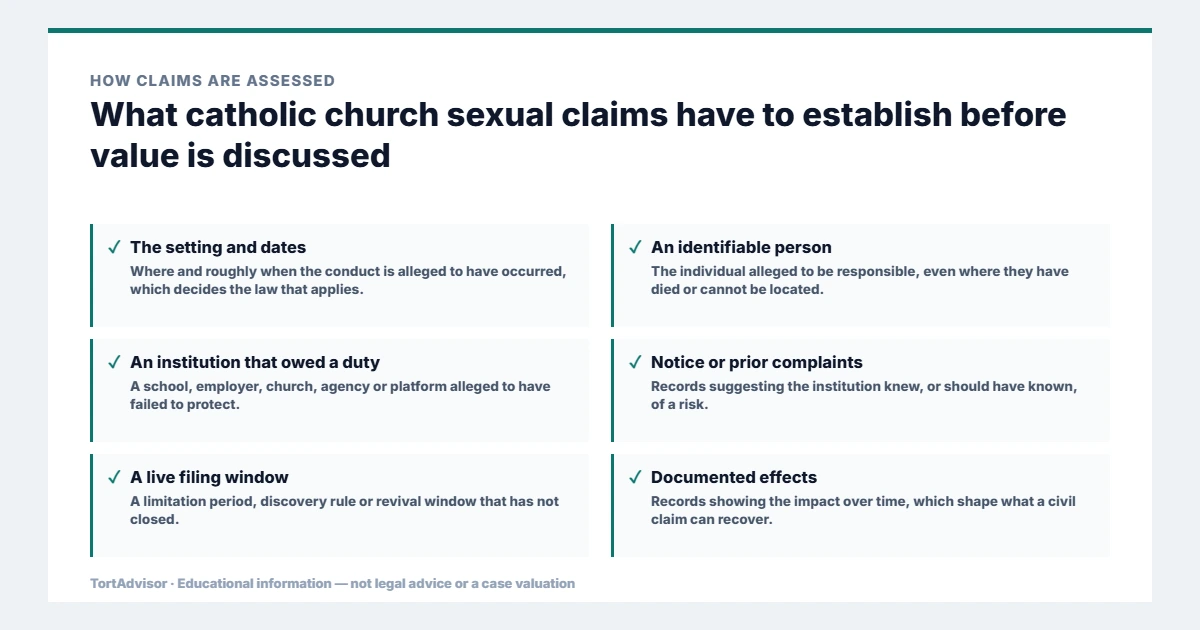
Important facts can include the survivor’s age at the time, the parish or institution involved, the diocese or religious order, the alleged abuser’s role, when and where the conduct occurred, whether there were prior complaints, whether the institution had notice of concerns, and whether the survivor has previously filed a bankruptcy claim, compensation-program claim, lawsuit, settlement, or release.
Adult survivors of childhood abuse should not assume that the passage of time automatically prevents legal review. Filing rules vary by state, and some jurisdictions have extended limitation periods or created temporary revival windows for certain childhood sexual abuse claims.
For broader eligibility information, see TortAdvisor’s Sexual Abuse Lawsuit Research and Child Sexual Abuse Lawsuit Guide.
Diocese Bankruptcy Filings and Compensation Trusts
Some Catholic dioceses and archdioceses have used Chapter 11 bankruptcy proceedings to resolve large numbers of sexual abuse claims collectively. In a bankruptcy case, a court may establish a claims deadline, commonly called a bar date, and the confirmed reorganization plan may create a trust or other process for evaluating and paying eligible claims.
The exact procedure differs by bankruptcy. Some processes use claim-review criteria, documentation requirements, settlement matrices, neutral reviewers, trustees, or other mechanisms established through the confirmed plan and related court orders.
If a diocese connected to an alleged abuse claim is or was in bankruptcy, determine the exact diocese, bankruptcy court, case number, bar date, whether a proof of claim was previously filed, and whether any settlement or release has already been executed.
Catholic Church Sexual Abuse Settlement Amounts
Catholic Church sexual abuse settlement amounts vary widely because these cases can involve different institutions, different state laws, different bankruptcy plans, different insurance arrangements, and very different individual facts.
Potential value factors may include the survivor’s age, nature and duration of the alleged abuse, documented psychological or physical harm, counseling or medical treatment, education or employment impact, evidence of prior complaints, institutional knowledge, available witnesses, records identifying the alleged abuser, and the financial resources or insurance available to responsible parties.
A large institutional settlement should not be divided by the number of claimants to create an “average” individual payout. Bankruptcy expenses, insurance recoveries, claim-review rules, trust funding, severity tiers, legal fees, liens, and individual proof can all affect actual distributions.
For broader compensation research, use TortAdvisor’s Sexual Abuse Lawsuit Research or read the Sexual Abuse Lawsuit Settlement Guide. Survivors who want an educational estimate can also use the Sexual Abuse Settlement Calculator.
Evidence and Records That May Matter
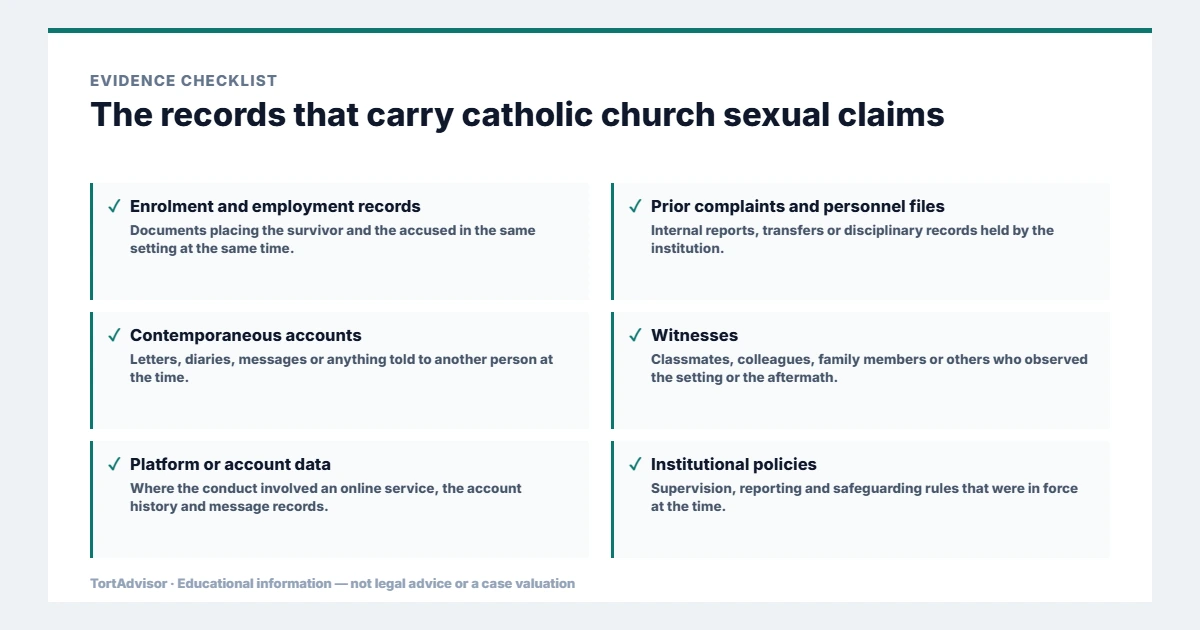
Many clergy-abuse claims involve events that occurred years or decades ago, so evidence is not limited to a single police report or medical record. Depending on the case, potentially relevant information may include:
- Parish, school, camp, youth-group, altar-server, choir, athletics, or religious-education records.
- Sacramental records, yearbooks, photographs, newsletters, directories, rosters, or correspondence identifying the survivor’s connection to the institution.
- Documents identifying the priest, clergy member, employee, volunteer, religious order, parish, school, or diocese involved.
- Prior complaints, Church investigations, law-enforcement records, child-protection records, or published accused-clergy lists.
- Therapy, counseling, psychiatric, medical, prescription, school, employment, or disability records documenting later harm.
- Witness information, family disclosures, contemporaneous statements, letters, emails, journals, or other records that help establish a timeline.
- Prior lawsuit, bankruptcy, compensation-program, settlement, release, or attorney records.
Survivors should not feel pressured to gather every possible record before requesting legal review. An attorney can help determine what evidence is relevant and what records may be obtainable through investigation or legal process.
How to File a Catholic Church Sexual Abuse Claim
The appropriate path depends first on identifying the institution connected to the alleged abuse. A legal review may determine whether the relevant defendant is a diocese or archdiocese, parish, religious order, Catholic school, youth organization, affiliated institution, individual perpetrator, insurer, or another potentially responsible entity.
- Identify the institution and location. Record the parish, school, diocese, religious order, city, state, and approximate years involved.
- Identify the alleged abuser if possible. A full name is helpful, but a title, role, nickname, parish assignment, or approximate time period may also assist an investigation.
- Check bankruptcy or settlement status. Determine whether the responsible diocese or organization has an active or completed bankruptcy proceeding, compensation program, settlement process, or prior release.
- Preserve available records. Keep documents, photographs, correspondence, therapy records, prior reports, and legal paperwork that may help establish the timeline.
- Have deadlines reviewed individually. State statutes of limitations, revival windows, bankruptcy bar dates, government notice rules, and prior settlement documents can affect available options.
Submitting an inquiry does not guarantee that a claim qualifies or that an attorney will accept representation.
Filing Deadlines and Lookback Windows
Sexual abuse filing deadlines vary substantially by state and can be especially complicated for childhood abuse. Some states have extended the age by which a survivor may sue, adopted discovery rules, or created revival windows allowing certain previously time-barred claims to be filed for a limited period.
Bankruptcy proceedings can create separate deadlines that are different from a state’s ordinary civil statute of limitations. A survivor may therefore need both the state-law filing rules and any bankruptcy bar date or plan provisions reviewed.
Related TortAdvisor Guides and Tools
Sexual Abuse Lawsuit Guide
Broad survivor-rights, evidence, privacy, filing, and compensation guidance.
Institutional Sexual Abuse Lawsuit
Claims involving churches, schools, sports organizations, medical settings, and other institutions.
Sexual Abuse Settlement Guide
General compensation factors, settlement structure, and claim-value research.
Sexual Abuse Settlement Calculator
Educational estimate based on harm, evidence, institutional involvement, and damages.
Clergy Abuse Lawsuit Research
Compare settlement research across abuse, injury, mass tort, and other claim categories.
Child Sexual Abuse Lawsuit
Filing issues and legal considerations for childhood sexual abuse claims.
Boy Scouts Sexual Abuse Settlement
Youth-organization abuse claims, bankruptcy trust issues, and survivor options.
Athlete Sexual Abuse Lawsuit
Claims involving coaches, trainers, teams, clubs, and sports organizations.
Legal Insights
Current lawsuit updates, settlement developments, and legal explainers.
Primary and Official Sources
- U.S. Conference of Catholic Bishops — Child and Youth Protection Research
- USCCB — 2025 Annual Report announcement, released May 27, 2026
- John Jay College research update published by USCCB
- RAINN — confidential sexual assault support resources
For a specific diocese bankruptcy, settlement trust, bar date, or claims procedure, use the applicable bankruptcy court docket, confirmed plan, trust website, or court-approved claims administrator as the controlling source.
Still unsure where you stand?
Have a trained case advisor review your own facts — free, confidential, and with no obligation.
- Free — no cost, no obligation
- About a minute to complete
- Reviewed by a trained case advisor
- Nothing you submit is published
Your details are sent over a secure connection and reviewed confidentially.
Catholic Church Sexual Abuse Settlement FAQ
Can I still file a claim if my diocese already settled with other survivors?
Possibly. A prior settlement with other survivors does not by itself answer whether another person can file. The result depends on the specific settlement, bankruptcy plan, bar date, release provisions, applicable state law, and the individual’s claim history.
What if the priest or other alleged abuser has died or left the Church?
The alleged abuser’s death or departure from ministry does not necessarily resolve whether a civil claim involving an institution, estate, insurer, or other responsible party may exist. The available defendants and deadlines require individual review.
Is there a list of credibly accused priests I can check?
Many dioceses and religious orders publish lists of clergy they identify as credibly accused or subject to substantiated allegations. These lists can help identify assignments and historical information, but inclusion or omission from a list does not by itself establish or defeat a civil claim.
How is a bankruptcy trust claim different from a civil lawsuit?
A bankruptcy claim follows procedures established by the bankruptcy court and confirmed plan, while a civil lawsuit proceeds through the ordinary court system. Proof requirements, deadlines, discovery, confidentiality, valuation, releases, and appeal rights can differ significantly.
How much is a Catholic Church sexual abuse settlement worth?
There is no universal average. Individual outcomes depend on the survivor’s facts, documentation, applicable law, institutional responsibility, available defendants, insurance or trust assets, prior settlements, and the procedure through which the claim is resolved.
Do I need a police report?
Not necessarily. A civil claim can involve many forms of evidence, including survivor testimony, Church records, witnesses, counseling records, prior complaints, institutional documents, and other corroborating evidence. The importance of a police report varies by case.
Can I estimate potential claim value online?
You can use TortAdvisor’s Sexual Abuse Settlement Calculator as an educational starting point. It is not a legal valuation, settlement offer, or guarantee of compensation.
Contact Us About a Catholic Church Sexual Abuse Claim
If you experienced alleged sexual abuse involving Catholic clergy, a parish, diocese, religious order, school, or another Church-affiliated institution, you may request a free, confidential case review to discuss the basic facts and possible next steps.
Confidential Catholic Church Abuse Case Review
You can share only the information you are comfortable providing. Submitting an inquiry does not guarantee representation or compensation.
Get a Free Catholic Church Abuse Case Review
Complete the confidential form below and a member of the intake team can follow up regarding the information you submit.
About the Author
This guide was prepared by Mason Arnao. TortAdvisor publishes educational lawsuit research, settlement calculators, settlement information, and case-review resources. This article is for general informational purposes only and does not constitute legal, medical, tax, or financial advice. TortAdvisor is not a law firm, and reading this page, calling, or submitting information does not create an attorney-client relationship.
Related Posts

Sexual abuse filing deadlines depend on the state, the survivor's age and whether the case is civil or criminal. How the clock works, with New York, Florida and federal law as examples.

The Roblox lawsuit statute of limitations varies by state. This 2026 guide covers filing deadlines, the minor tolling rule, the discovery rule, and a full state-by-state table so families can determine if they still qualify to file a child exploitation claim.
Quick answer: As of October 1, 2026 the Scouting Settlement Trust had paid $1,331,813,046 across 53,162 claim disbursements — about [...]