
Clergy Sexual Abuse Lawsuit 2026: Church Abuse Claims, Rights & Compensation
A clergy sexual abuse lawsuit may seek accountability and compensation for sexual abuse, assault or exploitation allegedly committed by a priest, pastor, minister, deacon, religious leader, youth leader or another person connected to a religious organization.
Depending on the facts and applicable law, potential claims may involve both the individual accused of abuse and a church, diocese, parish, religious order, school, ministry or other organization whose own conduct may create legal responsibility.
Use TortAdvisor’s Sexual Abuse Settlement Calculator to review factors commonly considered when evaluating sexual abuse claims. Results are educational estimates and are not guarantees of a settlement or verdict.
Begin with only the information you feel comfortable sharing.
You do not need to describe every detail of the alleged abuse to begin.
The first step is designed to remain calm, manageable and respectful.
Submitting the form does not require you to hire an attorney or continue.
A Private First Step — On Your Terms
Discussing clergy sexual abuse can be difficult, particularly when the alleged abuse involved a trusted religious leader or occurred many years ago.
- Start with the state, religious organization and approximate timeframe.
- You do not need a criminal conviction or complete church records to request an initial review.
- If known, identify the priest, pastor, religious leader, parish, church or other organization involved.
- Submitting the form does not obligate you to move forward.
Check Whether the Claim May Qualify
If you are comfortable doing so, provide a few basic details about when and where the alleged abuse occurred and the clergy member or religious organization involved.
If describing what happened feels difficult, begin with the basics. More detailed information can be discussed later if you choose to continue.
Submitting this form does not create an attorney-client relationship and does not guarantee that an attorney will accept or file a claim.
Who May Have a Clergy Sexual Abuse Lawsuit?
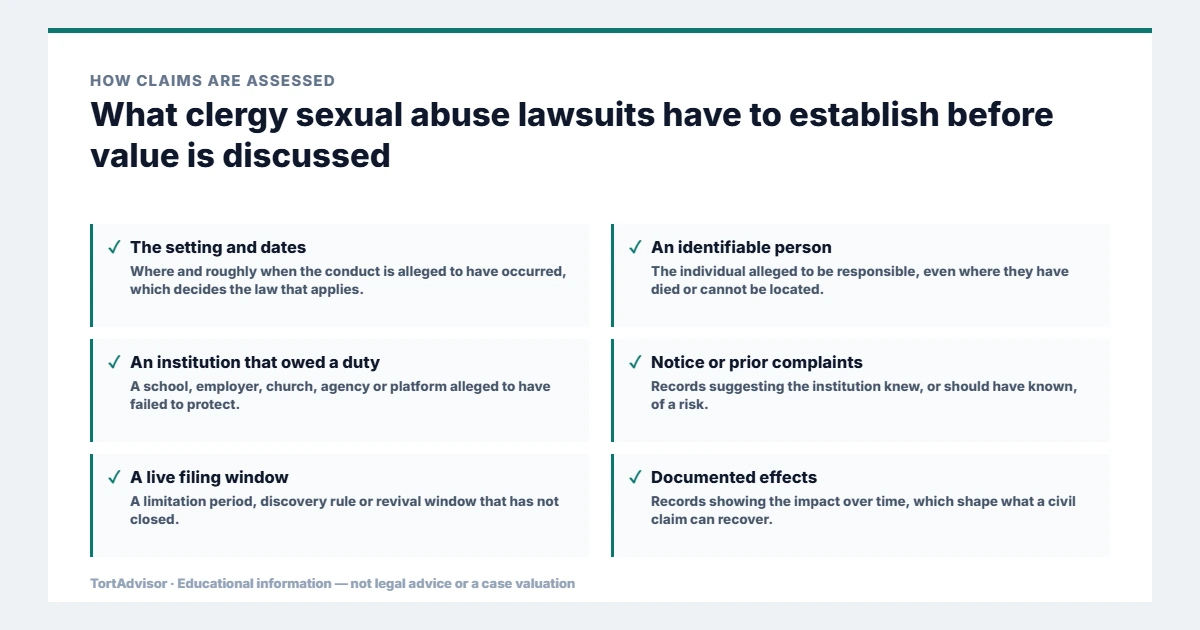
A potential clergy sexual abuse lawsuit depends on the facts, applicable state law and the parties involved. Older abuse may still qualify in some jurisdictions, so a survivor should not automatically assume a claim is too old.
The allegations involve sexual abuse, assault, exploitation or other legally actionable sexual misconduct.
The accused person was connected to a church, parish, diocese, ministry, religious school or other faith-based organization.
The organization’s knowledge, supervision, transfer decisions, prior complaints or response may be legally relevant.
State statutes, discovery provisions, revival laws and bankruptcy deadlines can affect the claim.
Types of Clergy Sexual Abuse Claims
Clergy abuse claims are not limited to one denomination or one type of religious leader. The relevant issue is the alleged conduct and relationship among the survivor, accused person and religious institution.
Priest Sexual Abuse Claims
Claims may involve priests, diocesan clergy, religious orders, parishes or other Catholic organizations.
Pastor or Minister Sexual Abuse
Claims can involve pastors, ministers, elders, deacons and other religious leaders accused of abusing a position of trust.
Youth Pastor & Religious Program Abuse
Youth groups, camps, retreats and religious education programs can create substantial access to minors.
Church School Sexual Abuse
Claims may involve clergy, teachers, coaches or employees working within religious schools and educational programs.
Alleged Concealment or Transfer Claims
Records concerning previous complaints, reassignments or transfers may become important when evaluating institutional responsibility.
Grooming & Online Communications
Claims may involve private messaging, gifts, secrecy, inappropriate communications and other alleged grooming behavior.
Who May Be Liable in a Clergy Sexual Abuse Lawsuit?
A religious organization is not automatically liable simply because an individual clergy member allegedly committed abuse. Institutional responsibility requires a separate analysis under applicable law.
The person alleged to have directly committed the sexual abuse may face potential civil liability.
A local church or parish may require analysis of its legal relationship to the accused person and its own actions.
Claims may examine supervision, complaints, transfers, assignments, policies and other institutional conduct.
A separate religious order may be relevant when it employed, assigned, supervised or controlled the accused clergy member.
Schools, camps, ministries and youth programs may face their own liability questions depending on the facts.
Other entities may become relevant based on ownership, employment, supervision, insurance and applicable law.
Evidence for a Clergy Sexual Abuse Lawsuit
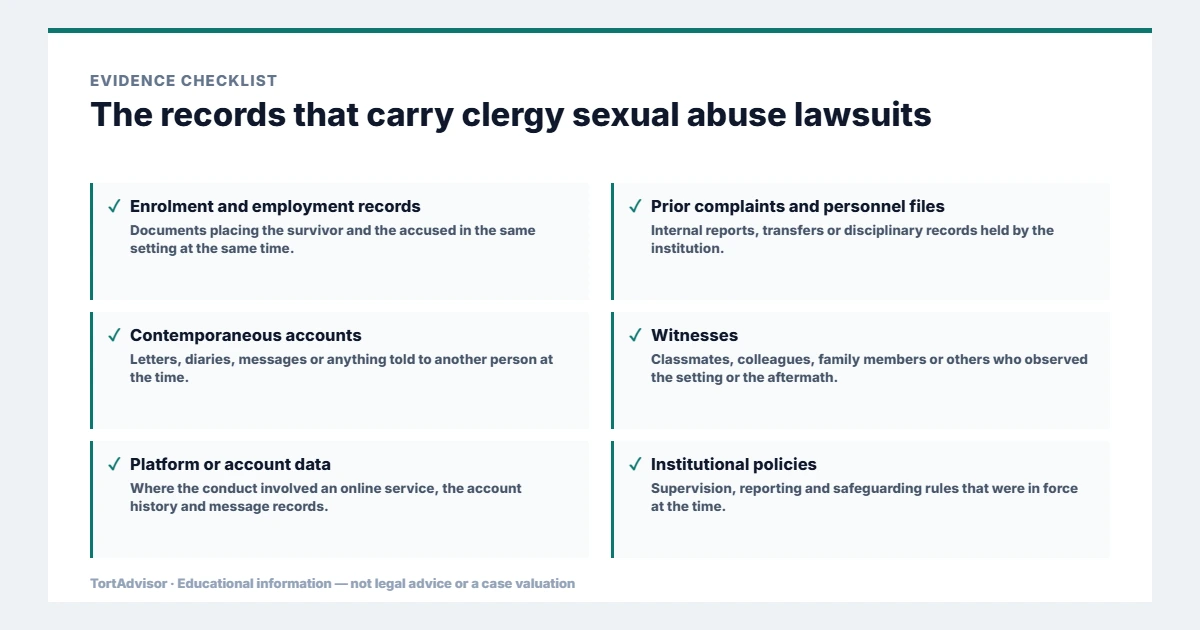
Clergy abuse cases may involve events from years or decades earlier. A survivor does not need every type of evidence below for a claim to be evaluated.
Abuse & Institutional Evidence
- Letters, emails or text messages
- Church, parish or diocesan records
- Clergy assignment histories
- Transfer or reassignment records
- Prior complaints or reports
- Police or investigative records
- Witness or former parishioner information
- Photos, calendars or historical documents
Harm & Compensation Evidence
- Medical records where relevant
- Therapy or counseling records where relevant
- Medication history
- Education records where relevant
- Employment or wage-loss records
- Treatment expenses
- A personal timeline of events
- Records showing life or relationship impacts
Records and Investigations That Can Support a Clergy Abuse Claim
Clergy cases often turn on records the church created itself: personnel and assignment files, prior complaints, and the lists of accused clergy many dioceses now publish. Government investigations and the bishops’ own audits add another layer, showing when complaints were received and what was done with them.
Released May 27, 2026 and covering July 1, 2024 to June 30, 2025, the U.S. bishops’ audit report counted 1,070 allegations of child sexual abuse by clergy, reported by 973 victims and survivors in 194 participating dioceses and eparchies. Twenty-four allegations involved current minors.
A report on the Diocese of Providence released March 4, 2026, covering 1950 to 2011, identified 75 accused clergy and more than 300 victims.
A report released September 30, 2026 on the Fall River, Springfield and Worcester dioceses found that more than 270 Catholic clerics abused nearly 1,000 children.
Reports on the Diocese of Grand Rapids (December 15, 2025, listing 51 priests) and the Diocese of Saginaw (June 25, 2026, with 38 entries), the sixth of seven diocesan reports.
Audits and attorney general reports do not decide individual claims, but they can corroborate a timeline, identify transfers between parishes and show what a diocese knew and when.
Clergy Sexual Abuse Lawsuit Filing Deadlines in 2026
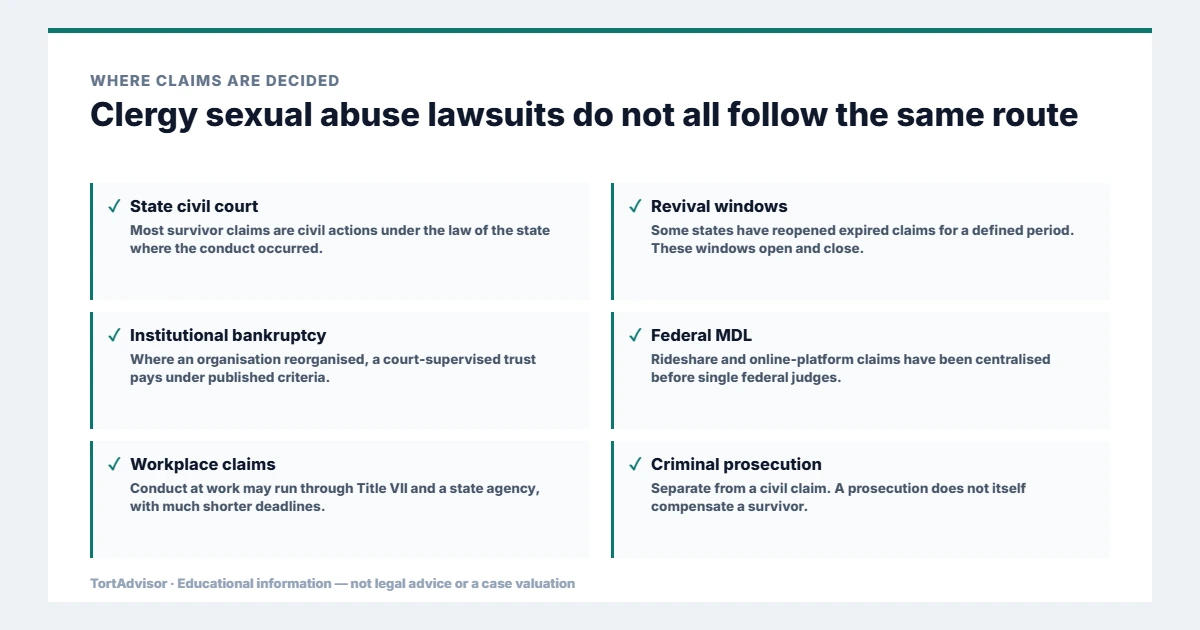
There is no single national deadline for clergy sexual abuse lawsuits. State statutes of limitation and special childhood sexual-abuse laws control most civil claims.
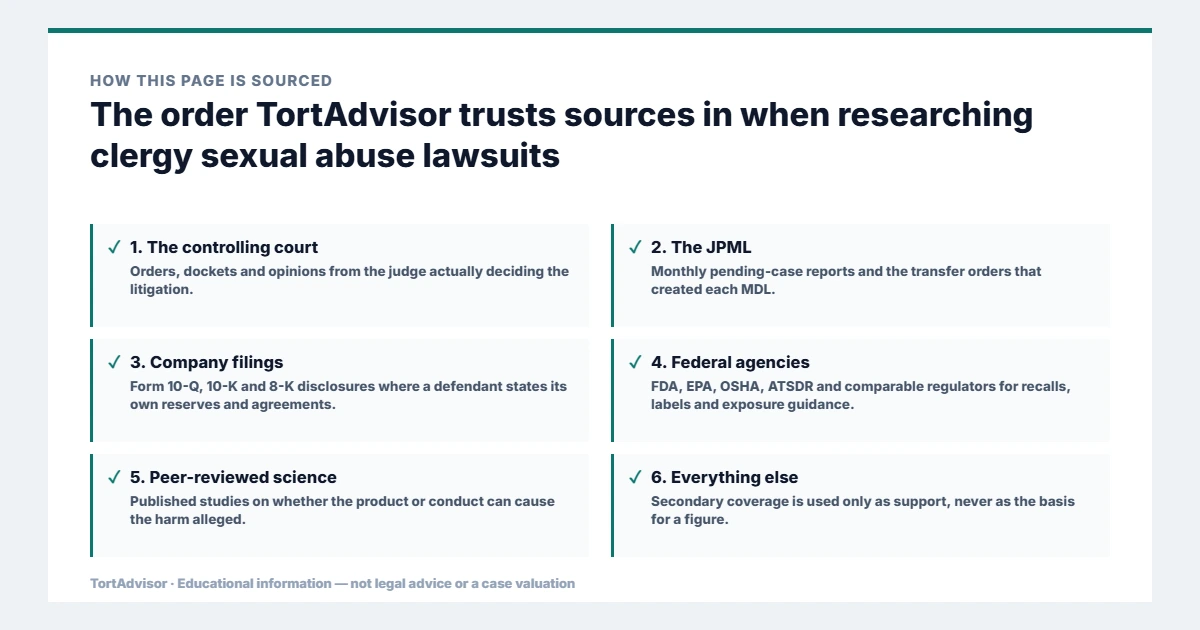
Every status, deadline and figure published on this page about clergy sexual abuse lawsuits is traced to a primary source before it appears.
New York Courts state that qualifying civil claims for abuse suffered while under 18 may be brought against the abuser or a liable third party such as a church or school until age 55.
California provides no general time limit under CCP §340.1 for covered childhood sexual assault occurring on or after January 1, 2024. Earlier conduct is governed by separate rules, including CCP §340.11.
New Jersey generally permits covered childhood sexual-abuse actions within 37 years after the survivor reaches majority or seven years after reasonable discovery of the injury and its causal relationship to the abuse, whichever is later.
Clergy Abuse Claims & Religious Organization Bankruptcy
A Bankruptcy Case Can Create a Separate Claim Deadline
If a diocese, church or other organization files for bankruptcy protection, survivors may face a separate bankruptcy proof-of-claim deadline, sometimes called a bar date.
Chapter 11 creditors may receive notice of a deadline by which a claim must be filed. That bankruptcy deadline can be separate from a state’s ordinary civil statute of limitation.
Because bankruptcy orders and deadlines are case-specific, a survivor whose potential defendant is in bankruptcy should have the relevant court notices reviewed promptly.
Where Major Diocesan Cases Stand
Settlement totals are not individual awards. In a diocesan bankruptcy, survivors are paid from a trust under the confirmed plan’s allocation procedures, and our sexual abuse guide explains what institutional abuse trusts have actually paid. The cases below were checked against court records and the institutions’ own statements on October 1, 2026.
The archdiocese’s bankruptcy plan was confirmed on December 8, 2025, establishing a $230 million survivor trust.
A $395 million agreement in principle to resolve more than 500 AB 218 lawsuits was announced on June 29, 2026. A Chapter 11 plan still has to be filed and confirmed.
The court approved the disclosure statement on August 28, 2026, and the confirmation hearing is set for October 27, 2026 before Chief Bankruptcy Judge Carl L. Bucki.
The archdiocese filed for Chapter 11 on September 29, 2023, two days before Maryland’s Child Victims Act took effect. Its revised plan proposes $246 million; no plan had been confirmed when this page was reviewed.
The Long Island diocese’s plan was confirmed on December 4, 2024 and is worth just over $323 million, including more than $85 million from insurers.
In October 2024 the archdiocese announced an $880 million agreement covering 1,353 AB 218 claims.
Clergy Sexual Abuse Lawsuit Compensation
There is no standard clergy sexual abuse settlement amount. Potential compensation depends on the facts, resulting harm, treatment, evidence, applicable law, available defendants and other case-specific factors.
The categories of damages are the same as in other sexual abuse claims, and the compensation section of our sexual abuse lawsuit guide lists them. What differs in clergy cases is where the money comes from. When a diocese is in Chapter 11, claims are resolved through a survivor trust funded by the diocese, related Catholic entities and insurers, as in the plans described in the bankruptcy section above, and each survivor’s share depends on the plan’s allocation procedures rather than a jury verdict.
Use TortAdvisor’s Sexual Abuse Settlement Calculator to review factors that may influence the evaluation of a clergy or church sexual abuse claim.
Sexual Abuse Settlement Calculator
Review Potential Claim-Value Factors
The TortAdvisor Sexual Abuse Settlement Calculator asks questions about factors commonly considered when reviewing a sexual abuse claim and provides an educational estimate.
The calculator cannot predict a settlement, verdict or attorney evaluation and does not guarantee compensation.
Privacy in a Clergy Sexual Abuse Lawsuit
Privacy is a major concern for many clergy-abuse survivors. Legal options for protecting sensitive information vary by court, jurisdiction and case.
Potential Court Protections
- Requests to proceed using initials or a pseudonym
- Protective orders involving sensitive discovery
- Requests to limit disclosure where legally permitted
- Protection of sensitive medical information
Important Limitations
- Pseudonym requests are not automatically granted
- Court filings may be subject to public-access rules
- Bankruptcy records can have separate disclosure rules
- Confidentiality depends on the process and jurisdiction
Official Clergy Sexual Abuse Legal Sources
Clergy Sexual Abuse Lawsuit FAQ
What is a clergy sexual abuse lawsuit?
It is a civil claim arising from alleged sexual abuse or exploitation involving a priest, pastor, minister or other religious leader. Depending on the facts, claims may also involve a church, diocese, religious order or other organization.
Can a church be sued for sexual abuse committed by a priest or pastor?
Possibly. Institutional liability is not automatic. Relevant issues can include notice, prior complaints, hiring, supervision, retention, transfers and how the organization responded.
SourceCal. CCPSec. 340.1
Can an adult sue for clergy abuse that happened when they were a child?
Possibly. Many states provide special filing rules for childhood sexual-abuse claims. Whether a particular claim remains timely depends on the jurisdiction, dates, defendants and applicable statutes.
Do I need a criminal conviction to bring a clergy sexual abuse claim?
A criminal conviction is not necessarily required just to have a potential civil claim evaluated. Criminal and civil proceedings are separate legal processes.
SourceU.S. CourtsCivil Cases
What evidence helps a clergy sexual abuse lawsuit?
Evidence may include messages, letters, church records, clergy assignments, prior complaints, witnesses, investigative records, medical records and other documentation.
What if the priest or pastor was transferred to another church?
Transfer or reassignment records can be relevant when evaluating what an organization knew, when it knew it and how it responded to previous concerns or complaints.
What happens if the diocese or church files bankruptcy?
A bankruptcy may establish a separate process and deadline for filing a proof of claim. Bankruptcy deadlines can differ from state civil statutes of limitation, so the specific bankruptcy court notices should be reviewed.
How much is a clergy sexual abuse lawsuit worth?
There is no standard settlement amount. Potential value depends on the alleged abuse, harm, treatment, economic losses, defendants, evidence and applicable law.
Can I keep my identity private?
Some survivors may request to proceed under initials or a pseudonym or seek protective measures for sensitive information. Whether those requests are available or granted depends on the jurisdiction and case.
Can I use the Sexual Abuse Settlement Calculator for a clergy abuse claim?
Yes. TortAdvisor’s Sexual Abuse Settlement Calculator can be used to review common claim-value factors. The result is an educational estimate and does not guarantee or predict a settlement or verdict.
More Clergy & Sexual Abuse Claim Resources
Sexual Abuse Settlement Calculator
Review factors that may influence the potential evaluation of a clergy or institutional sexual abuse claim.
Child Sexual Abuse Lawsuit
Research filing rules, institutional liability, evidence and compensation for childhood abuse claims.
Church & Religious Organization Abuse
Research broader claims involving religious organizations, ministries, churches and institutional responsibility.
Sexual Abuse Compensation
Research damages, therapy costs, economic losses and other factors affecting sexual abuse claims.
Sexual Abuse Lawsuit Guide
Browse TortAdvisor’s broader sexual-abuse claim directory and survivor-rights information.
Institutional Sexual Abuse Lawsuit
Research claims involving organizations alleged to have failed to protect children or vulnerable people from sexual abuse.
Did You Experience Sexual Abuse by a Priest, Pastor or Other Clergy Member?
Start with a private case review or use the Sexual Abuse Settlement Calculator first. You can provide basic information without describing every detail of what happened.