Roundup Settlement Amounts 2026: Class Payout Bands & MDL 2741
Roundup settlement amounts are no longer purely hypothetical. A Missouri court has preliminarily approved a nationwide class programme that publishes its own compensation range — but that programme is not yet final, and thousands of federal cases sit outside it.
Latest Roundup Settlement Amounts and Case Status
The Roundup litigation is unusual among mass torts: a compensation programme with published dollar figures already exists on paper, while a separate federal docket continues without one. Understanding which track a claim sits on is the first step in understanding what it might be worth.
Monsanto announces a proposed U.S. nationwide class settlement to resolve current and future Roundup claims alleging non-Hodgkin lymphoma, filed in the Circuit Court of the City of St. Louis as King v. Monsanto Company.
The Missouri court preliminarily approves the settlement, stays covered Missouri cases and authorises notice to the class. Preliminary approval permits notice; it does not decide fairness.
The 90-day window for class members to exclude themselves or file written objections closes. Claimants who opted out keep the right to sue individually and are not covered by the published range.
In a 7–2 decision the Court holds that FIFRA expressly preempts state-law failure-to-warn claims where EPA has made a definitive determination on product safety. Monsanto states that warning-based claims were the vast majority of the litigation to date.
Monsanto asks the court to move the hearing from Aug. 19 to allow roughly three additional weeks to process opt-out revocation requests and resolve opt-out invalidity challenges following Durnell.
The court heard arguments on whether the settlement is fair, reasonable and adequate; no ruling had been reported as of Sept. 26, 2026. Approval is not automatic, and any approval can be appealed, which would delay payment further.
Roundup Settlement Amounts: Confirmed Facts vs. Projections
Most pages that quote Roundup settlement amounts blur two very different things: figures a court has authorised and figures somebody has estimated. Here is the line.
What Is Confirmed
- The class programme is capped at up to $7.25 billion, paid through declining capped annual payments over 17 to 21 years.
- The court-authorized notice states class members diagnosed with NHL may receive $6,000 to $165,000 or more.
- Those amounts turn primarily on type of exposure (home or occupational), age at diagnosis and NHL type.
- The class covers U.S. exposure before Feb. 17, 2026, with NHL diagnosed then or within a 16-year period after final approval.
- Preliminary approval was granted Mar. 4, 2026; the final approval hearing was held Sept. 14, 2026.
- MDL 2741 had 1,104 pending actions as of the Oct. 1, 2026 JPML report.
- The Supreme Court ruled 7–2 for Monsanto in Durnell on June 25, 2026 on FIFRA preemption of failure-to-warn claims.
What Is Not Yet Known
- Whether the court will grant final approval at all, and whether any approval is appealed.
- How the administrator will distribute claims across the published range in practice.
- What an average paid Roundup claim will actually be — no average exists, because no class claim has been paid.
- What claims outside the class are worth after Durnell narrowed failure-to-warn theories.
- How EPA’s updated human health risk assessment, anticipated in late 2026, may affect future claims.
- Whether Monsanto exercises any termination right tied to the volume of opt-outs.
Published Roundup Settlement Amount Bands by Claim Profile
The court-authorized notice publishes a single span — $6,000 to $165,000 or more — and names the three factors that move a Roundup settlement payout within it. The endpoints below are the programme’s own figures. How TortAdvisor divides the space between them is editorial modelling, not a published matrix.
Occupational exposure, younger diagnosis, aggressive subtype
- Years of documented commercial, agricultural or groundskeeping application
- Diagnosis at a younger age, implying a longer horizon of loss
- An aggressive NHL subtype requiring intensive treatment
- Employment records, licences or purchase history proving exposure
- Substantial documented medical costs and lost earnings
Mixed or moderate exposure, mid-life diagnosis
- Regular but not occupational use over a sustained period
- Diagnosis in middle age with completed treatment
- Either an aggressive or an indolent NHL subtype
- Partial documentary proof of exposure, supported by recollection
- Moderate documented economic loss
Residential use, older diagnosis, indolent subtype
- Home and garden use only, over shorter periods
- Diagnosis at an older age
- An indolent subtype managed with monitoring or lighter treatment
- Limited documentary proof of purchase or application
- Modest documented out-of-pocket loss
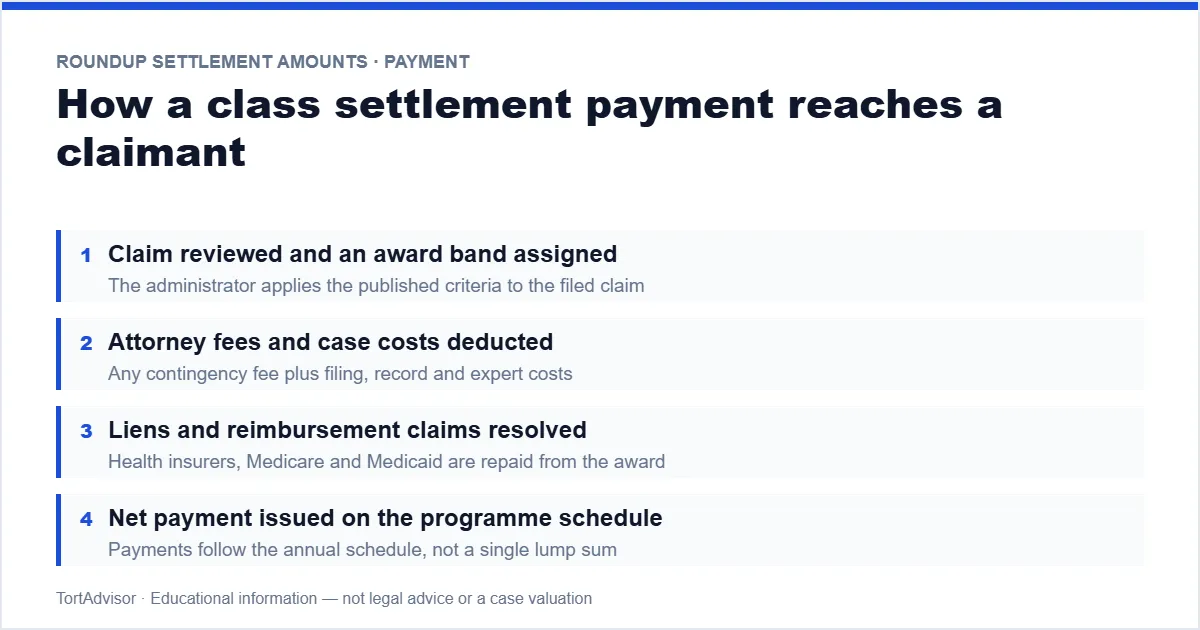
How a Roundup settlement payment would be calculated
The published range is a gross figure. This is the sequence between that figure and money in a claimant’s hand.
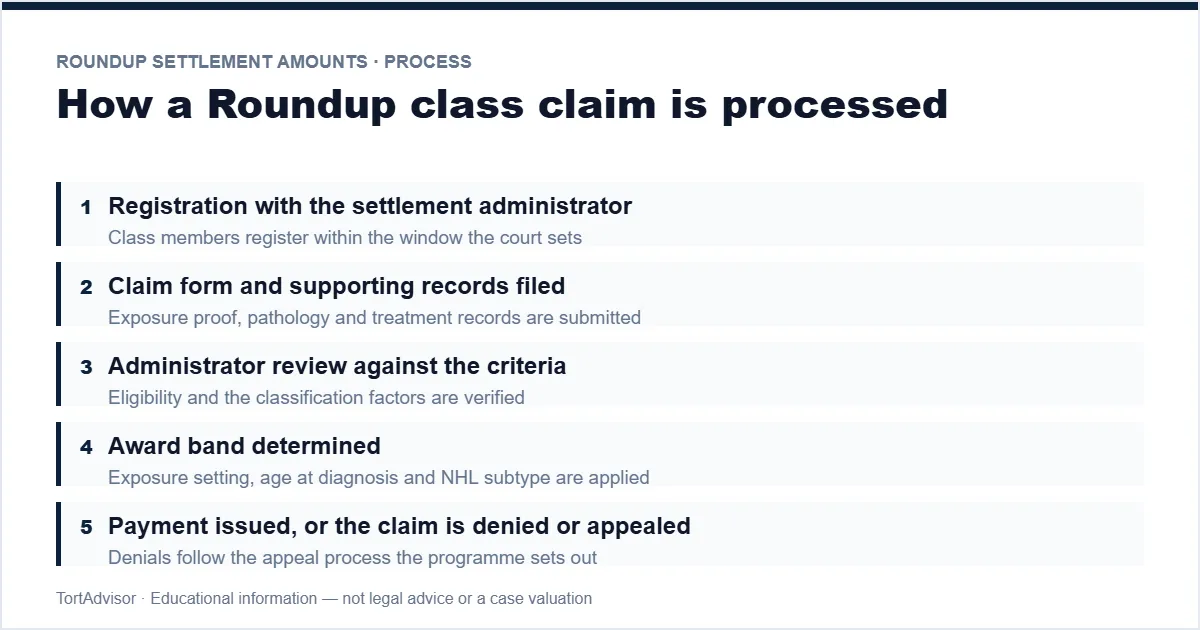
Register and file
A class member registers with the administrator, then files a claim with exposure proof and pathology records.
Eligibility verified
The administrator checks exposure before Feb. 17, 2026, a qualifying NHL diagnosis and a timely filing.
Award band determined
Exposure setting, age at diagnosis and NHL subtype are applied to place the claim within the published range.
Fees, costs and liens deducted
Attorney fees and case costs come out first, then health-insurer, Medicare and Medicaid reimbursement claims.
Net payment issued
What remains is paid on the programme schedule of declining capped annual payments, not as one lump sum.
Illustrative sequence only. No Roundup class payment has been issued as of Sept. 1, 2026, and the programme does not begin paying until the court grants final approval and any appeals conclude.
How Roundup Settlement Amount Estimates Are Developed
TortAdvisor does not survey law firms or repeat figures circulating on other sites. Every Roundup settlement amount on this page is traceable to one of four steps.
Anchor to published figures
The endpoints come from the court-authorized class notice, not from modelling. Where a programme publishes numbers, we use its numbers.
Separate the two tracks
Class programme amounts are never presented as the value of an MDL 2741 case or an opted-out claim, which have no published range.
Weight only the named factors
Bands are built from the three drivers the notice itself identifies — exposure setting, age at diagnosis and NHL type — plus proof and documented loss.
Recheck on every update
Case counts come from the current month’s JPML report, and hearing dates from the court-authorized site rather than secondary coverage.
Roundup Settlement Amounts by Claim Profile
The same published range covers very different claimants. This table shows how the three factors named in the class notice interact, using illustrative positions inside the programme’s own $6,000 to $165,000+ span.
| Claim profile | Exposure setting | Age at diagnosis | Illustrative position in the published range | What moves it |
|---|---|---|---|---|
| Commercial applicator | Licensed agricultural or landscaping spraying over many seasons | Younger working age | Upper band | Documented employment history, long exposure duration, aggressive subtype, high lost earnings |
| Groundskeeper or municipal worker | Institutional grounds maintenance, often without personal purchase records | Working age | Upper to middle band | Employment proof is strong but product identification may rest on employer records |
| Farm household member | Living on a treated property without applying the product personally | Any | Middle band | Exposure is real but harder to document; the diagnosis and subtype carry more weight |
| Frequent home gardener | Regular residential use across many years | Middle to older age | Middle to lower band | Purchase receipts and consistent use history support the claim; occupational multipliers do not apply |
| Occasional residential user | Limited home and garden use | Older age | Lower band | Short exposure and an indolent subtype sit at the lower end; proof of purchase becomes decisive |
Positions in this table are TortAdvisor modelling, not a published matrix. The class notice names the factors but does not publish a public tier chart, and the settlement administrator determines every individual award.
Free Roundup Case Review
Wondering how the figures on this page relate to your own situation? Share a few details below — a trained case advisor reviews every submission FREE and with no obligation, and your information stays confidential.
- Free — no cost, no obligation
- About a minute to complete
- Reviewed by a trained case advisor
- Nothing you submit is published
Your details are sent over a secure connection and reviewed confidentially.
Who May Qualify for Roundup Settlement Amounts?
Eligibility for the class programme is defined by the settlement itself. Eligibility to sue outside it is governed by state law and has narrowed considerably since Durnell.
Common Screening Factors
- Exposure to Roundup or another glyphosate-based weed killer in the United States before Feb. 17, 2026
- A non-Hodgkin lymphoma diagnosis, whether already made or made within the 16-year period following final approval
- Exposure in a residential, agricultural, landscaping, groundskeeping or other occupational setting
- Records that connect the person to the product — receipts, employment history, licences or application logs
- Claims brought by family members or representatives of deceased, minor or incapacitated class members
Factors Requiring Closer Review
- Cancers other than NHL, which the class programme does not cover
- Claimants who opted out by June 4, 2026 and must now pursue an individual case
- Failure-to-warn theories affected by the Supreme Court’s FIFRA preemption ruling
- Exposure that cannot be documented beyond recollection
- Diagnoses far outside the latency window typically argued for glyphosate and NHL
- State statutes of limitation that may already have expired for individual claims
Where a claimant has died, the analysis differs from a living-claimant claim. Our guide to filing a Roundup wrongful death claim covers the additional records and standing questions that apply. Eligibility screening for the litigation generally is covered in the Monsanto Roundup lawsuit eligibility guide.
Factors That May Increase or Reduce Roundup Settlement Amounts
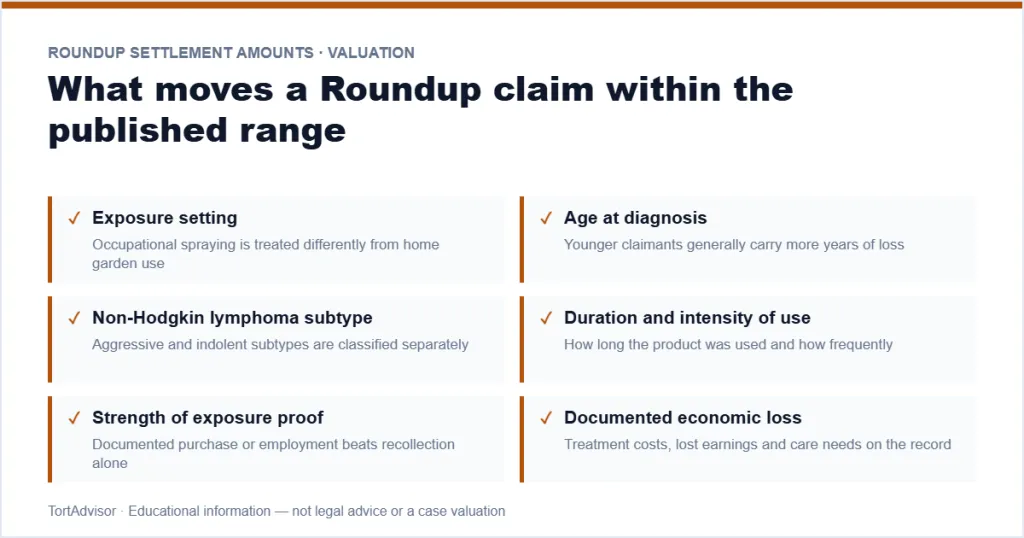
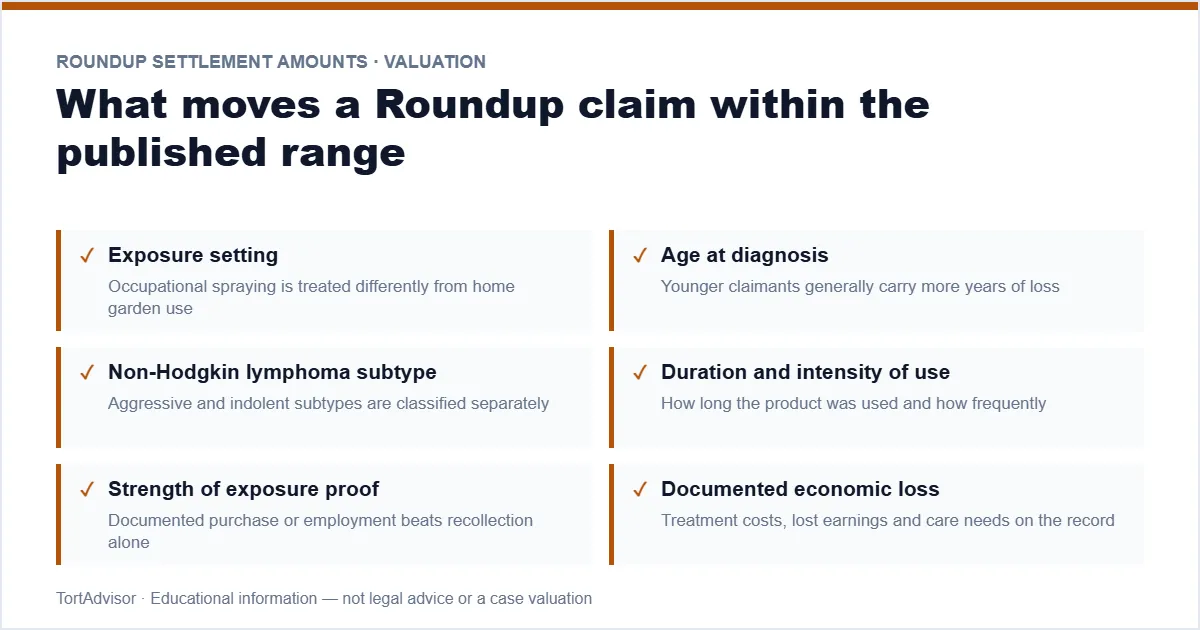
Three factors are named in the class notice. Several others decide whether a claim can be substantiated at all, which in practice matters just as much to the Roundup settlement amounts a claimant sees.
Exposure setting
Occupational application — farming, landscaping, groundskeeping, nursery and municipal work — is treated differently from residential garden use. The notice names type of exposure as a primary driver.
Age at diagnosis
A younger claimant generally carries more years of lost earning capacity and future medical need, and the programme uses age at diagnosis as a classification factor.
NHL subtype
The settlement documentation distinguishes aggressive from indolent non-Hodgkin lymphoma subtypes. Subtype affects treatment burden, prognosis and classification.
Duration and frequency of use
Sustained seasonal application over many years supports a stronger causation argument than occasional use over a short period.
Quality of exposure proof
Purchase receipts, employer records, pesticide applicator licences and application logs carry more weight than recollection. Weak proof can move a claim down a band or defeat it entirely.
Documented economic loss
Treatment costs, hospitalisation, transplant care, lost earnings and ongoing monitoring expenses need to be on the record to count.
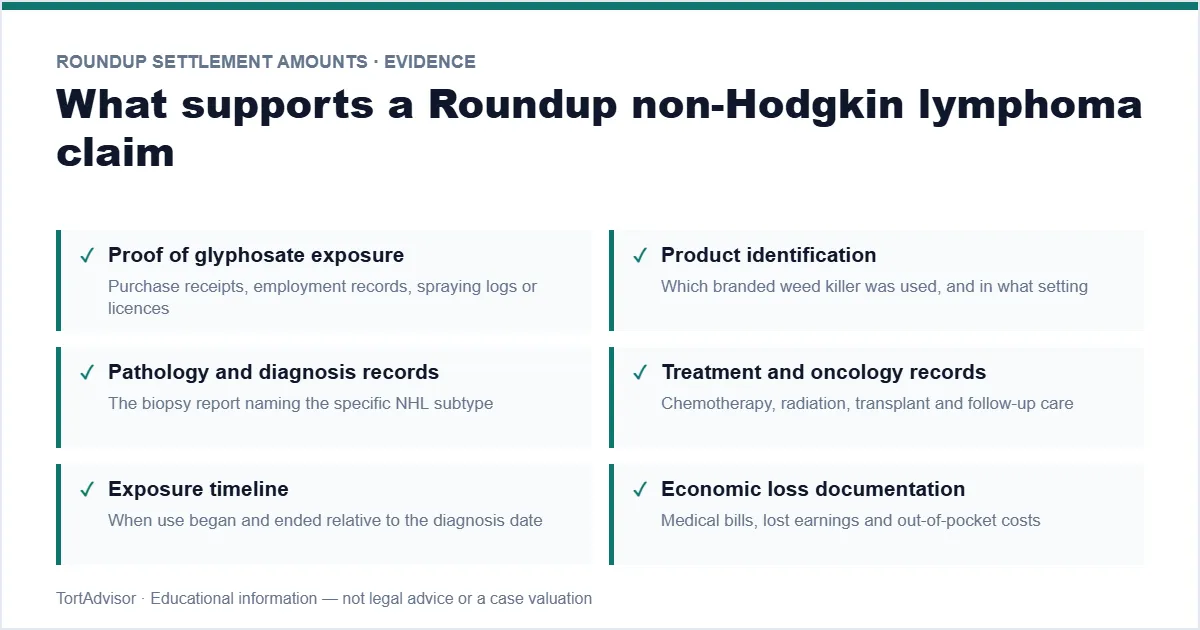
Evidence Supporting Roundup Settlement Amounts
Two evidence problems decide most Roundup claims: proving the person was exposed, and proving what they were diagnosed with. Neither is assumed.
Proof of exposure
Purchase receipts and loyalty records, employment history, pesticide applicator licences, spraying logs, supply invoices and, where available, photographs of product on the property.
Product identification
Which branded glyphosate product was used, in what concentration and in what setting. The settlement documentation includes a list of EPA-registered glyphosate products.
Pathology and diagnosis
The biopsy or pathology report naming the specific non-Hodgkin lymphoma subtype. Subtype classification is a programme factor, so the report itself matters, not just the diagnosis label.
Oncology treatment records
Chemotherapy regimens, radiation, stem-cell or bone-marrow transplant records, hospitalisations, remission and relapse history and ongoing surveillance.
Exposure timeline
When use began and ended relative to the diagnosis date. A coherent timeline supports latency arguments; gaps and contradictions undermine them.
Economic loss records
Medical bills and explanations of benefits, payroll or tax records showing lost earnings, and out-of-pocket costs for travel, care and equipment.
Filing Deadlines for Roundup Settlement Amount Claims
The class programme runs on its own clock, and that clock only starts when the court grants final approval. Individual claims run on state statutes of limitation, which do not pause for the settlement.
If you are inside the class
- No action is required while the court decides final approval, and no payment can issue before it
- Registration opens only after final approval; watch the court-authorized site rather than third-party sites
- An appeal of any approval would push all payment dates later
If you opted out or fall outside the class
- Your claim is governed by your own state limitation period, which may be as short as one or two years from diagnosis
- Discovery rules vary by state and change when the clock starts
- Wrongful death claims usually run from the date of death, on a separate clock from the injury claim
- The FIFRA preemption ruling in Durnell may bar failure-to-warn theories outright
Take the Roundup Settlement Calculator Below
The calculator organises what you know about glyphosate exposure, diagnosis, treatment, records and financial loss into an educational range, and shows which factors carry the most weight in a Roundup claim. It takes a few minutes and asks for no documents.
The result is educational and is not a guaranteed case value or settlement offer.
Before You Start
- Roughly when glyphosate use began and ended
- Where it was used — home, farm, grounds or commercial site
- The non-Hodgkin lymphoma subtype from the pathology report
- Age at diagnosis
- Treatment received, including any transplant
- Any purchase receipts or employment records you can find
Answer what you know. You do not need every record or an exact timeline to get started.
Primary Sources for Roundup Settlement Amounts
Every time-sensitive figure on this page traces to one of these. Each was checked on Oct. 1, 2026.
JPML pending-actions report
The JPML report dated Oct. 1, 2026 lists 1,104 actions pending in MDL 2741 before Judge Vince Chhabria in the Northern District of California, from 5,323 filed historically.
Court-authorized class notice
The official settlement site for King v. Monsanto Company publishes the $6,000 to $165,000+ range, the class definition, the registration and claim windows and the Sept. 14, 2026 hearing date.
Monsanto settlement announcement
Monsanto’s Feb. 17, 2026 announcement sets out the up to $7.25 billion ceiling, the declining capped annual payments over up to 21 years and the class period.
Statement on the rescheduled hearing
Monsanto’s statement on rescheduling the final approval hearing explains the move to Sept. 14, 2026 to process opt-out revocation requests and resolve opt-out invalidity challenges.
Supreme Court decision in Durnell
The June 25, 2026 decision held 7–2 that FIFRA expressly preempts state-law failure-to-warn claims where EPA has made a definitive determination on product safety.
EPA glyphosate registration review
EPA’s glyphosate page states the agency has found glyphosate is not likely to be carcinogenic to humans, and that an updated human health risk assessment is anticipated in late 2026 after an open literature review released in August 2026.
IARC monograph on glyphosate
IARC classified glyphosate as Group 2A, probably carcinogenic to humans, in 2015 — a hazard classification that asks whether an agent can cause cancer, not whether it does at real-world exposure levels.
Agricultural Health Study
The 2018 Agricultural Health Study analysis in JNCI, a large prospective cohort of pesticide applicators, found no statistically significant association between glyphosate use and non-Hodgkin lymphoma overall.
The scientific record behind any glyphosate settlement is genuinely contested. IARC and EPA reached different conclusions using different questions, and courts have reached different verdicts on the same evidence. This page reports that disagreement rather than resolving it.
Frequently Asked Questions About Roundup Settlement Amounts
What is the average Roundup settlement amount?
There is no average, because no class settlement payment has been issued. The court-authorized notice publishes a range of $6,000 to $165,000 or more for class members diagnosed with non-Hodgkin lymphoma, but an average can only exist once claims are actually paid. Any site quoting an average Roundup settlement is quoting an estimate.
How much does the Roundup class settlement pay?
The programme is capped at up to $7.25 billion, paid through declining capped annual payments over 17 to 21 years. Individual awards are stated as $6,000 to $165,000 or more, determined primarily by type of exposure, age at diagnosis and NHL type.
Is the $7.25 billion Roundup settlement final?
No. The Missouri court granted preliminary approval on Mar. 4, 2026, which allowed notice to go out. The final approval hearing was held on Sept. 14, 2026, and the court could still approve, modify or decline to approve the settlement. Any approval can also be appealed.
Can I still join the Roundup class settlement?
The class is defined by exposure before Feb. 17, 2026 and an NHL diagnosis, so membership is not something you join — it is something you either fall within or do not. The deadline that has passed is the June 4, 2026 deadline to opt out or object. Registration for benefits opens only after final approval.
How many Roundup lawsuits are still pending?
The JPML report dated Oct. 1, 2026 lists 1,104 actions pending in federal MDL 2741 before Judge Vince Chhabria, out of 5,323 filed historically. That count covers the federal docket only and does not include state-court cases or class members who have not sued.
Does the settlement cover cancers other than non-Hodgkin lymphoma?
No. The class settlement is limited to claims alleging non-Hodgkin lymphoma. Claims involving other diagnoses are outside the programme and would have to be pursued individually, subject to state law and the preemption ruling.
What did the Supreme Court change in Durnell?
On June 25, 2026 the Court held 7–2 that FIFRA expressly preempts state-law failure-to-warn claims where EPA has made a definitive determination on product safety. Monsanto states that warning-based claims made up the vast majority of the litigation, so the ruling materially narrows what can be argued outside the class programme.
How is a Roundup settlement payout different from a jury verdict?
A verdict is what a jury awards after trial, and the headline figure is frequently reduced by the trial judge or on appeal. A Roundup settlement payout is a negotiated amount paid under an agreement, with no trial and no appeal of the amount itself. Historic Roundup verdicts therefore say very little about what a non-Hodgkin lymphoma settlement under the class programme would pay.
Is the Roundup settlement calculator legally binding?
No. The calculator on this page is an educational tool that organises claim factors into an illustrative range. It is not a case valuation, not an offer, and produces no result that binds Monsanto, the settlement administrator, any court or any law firm.
See Which Factors May Affect a Roundup Non-Hodgkin Lymphoma Settlement
Answer the questions you can about glyphosate exposure, a non-Hodgkin lymphoma diagnosis, treatment, records, expenses and long-term impact. The calculator organizes those inputs into an educational settlement range and highlights the factors that may matter most when a claim is reviewed.
The result is educational and is not a guaranteed case value or settlement offer.
Helpful Information to Have Ready
You do not need every record in hand. Answer what you know; these details can make the estimate more useful.
Reading this page is separate from any request to be contacted. The consent boxes on this form are unchecked unless you tick them yourself.