
PFAS Settlement Amounts: Which Billions Are Real, and Who They Actually Pay
The PFAS settlements you have read about are real and enormous. They are also, almost entirely, not personal injury money. 3M’s $10.5 to $12.5 billion resolution pays public water systems. The personal injury track in MDL 2873 has produced no settlement, and in 2026 the court vacated the first bellwether trial date without setting a new one.
Where the PFAS Litigation Actually Stands
MDL 2873 contains several different lawsuits wearing one name. Keeping them apart is the only way the numbers make sense.
Aqueous film-forming foam cases were centralised before Judge Richard M. Gergel in the District of South Carolina. The docket has since grown into one of the largest in the federal system, holding water provider claims, personal injury claims, property claims and state attorney general actions side by side.
3M agreed to pay $10.5 billion to $12.5 billion in total to resolve released claims by public water systems, with payments scheduled from 2024 through 2036. It recorded a pre-tax charge of $10.3 billion, the discounted present value at a 5.2 percent rate. This is the source of nearly every headline PFAS figure, and it pays utilities.
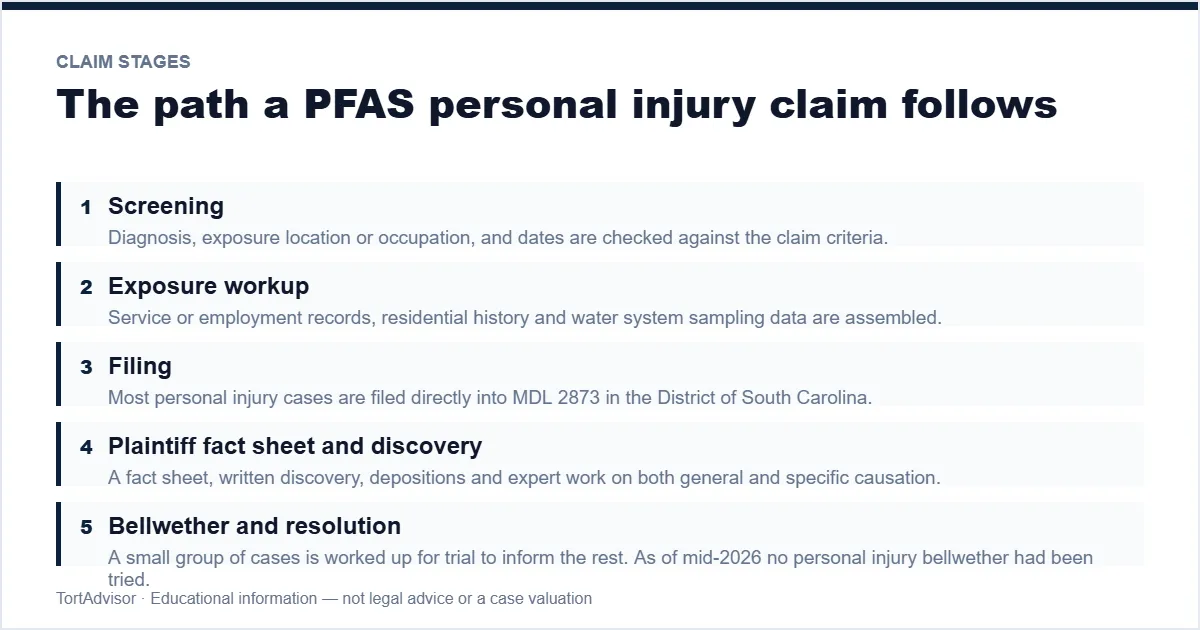
The court selected 25 plaintiffs for potential bellwether personal injury cases. Nine advanced into discovery in July 2024 and three more were added in April 2025. This is the process that would eventually establish what an individual PFAS claim is worth.
3M agreed to pay up to $450 million to New Jersey and recorded a $400 million pre-tax charge. The structure runs $207 million beginning in 2026 over eight years, plus $74 million for future claims from 2030 through 2050. The money goes to the state.
The court vacated the schedule for the first bellwether personal injury trial that was to have begun in October 2025, and as of 3M’s July 2026 filing no new trial date had been set. The parties are in court-ordered settlement discussions before a court-appointed mediator. New Jersey approval hearings were held in January and June 2026 with a ruling awaited.
The JPML report published that morning shows 15,264 actions pending in MDL 2873 out of 19,840 filed. 3M separately reported roughly 15,200 AFFF-related cases pending as of July 1, 2026, based on the same JPML data.
Confirmed PFAS Facts vs. TortAdvisor Editorial Estimates
More money has been confirmed in this litigation than in almost any other, which makes it unusually easy to quote a real number for the wrong thing.
Confirmed public facts
- 3M will pay $10.5 to $12.5 billion to public water systems, from 2024 through 2036, per its own SEC filings.
- 3M proposed up to $450 million to New Jersey, recording a $400 million charge, with approval still pending after hearings in January and June 2026.
- MDL 2873 held 15,264 pending actions of 19,840 filed as of the JPML report dated October 1, 2026.
- The first personal injury bellwether trial was vacated and no new date had been set as of 3M’s July 2026 filing.
- EPA set enforceable drinking water limits on April 10, 2024, at 4 parts per trillion for PFOA and PFOS.
- The National Academies recommends cancer screening at 20 ng/mL, naming kidney cancer, testicular cancer, thyroid dysfunction, ulcerative colitis and dyslipidemia.
Not established, whatever you have read
- Any per-person PFAS settlement amount for a personal injury claim. No matrix, no fund, no administrator.
- When a personal injury bellwether will be tried. The date was vacated and not reset.
- Whether the mediation will produce a personal injury settlement at all.
- What DuPont, Chemours and the other defendants will ultimately pay individuals.
- Whether EPA’s 2024 limits will survive intact. In May 2026 the agency proposed an extension to 2031 for PFOA and PFOS and a rescission covering four other compounds.
PFAS Claim Profiles, Without Invented Per-Person Figures
We publish no per-person dollar range for a PFAS personal injury claim, because no reliable one exists. The profiles below describe how these claims differ. They carry no figures on purpose.
Kidney or testicular cancer with heavy documented exposure
- One of the two cancers at the centre of this litigation
- Years of occupational foam exposure, or a base or water system with documented contamination
- Service or employment records that prove the exposure
- Serum PFAS testing, where it exists
- Substantial treatment and economic loss
A recognised condition with residential exposure
- Thyroid disease, ulcerative colitis or another named condition
- Long residence on a documented contaminated system
- Exposure proved by address history and utility sampling rather than occupation
- Treatment records supporting the diagnosis
Conditions outside the core group
- Diseases with thinner published support in the PFAS literature
- Shorter or undocumented exposure
- No serum testing and no utility data for the relevant years
- Higher risk of not surviving the causation stage at all
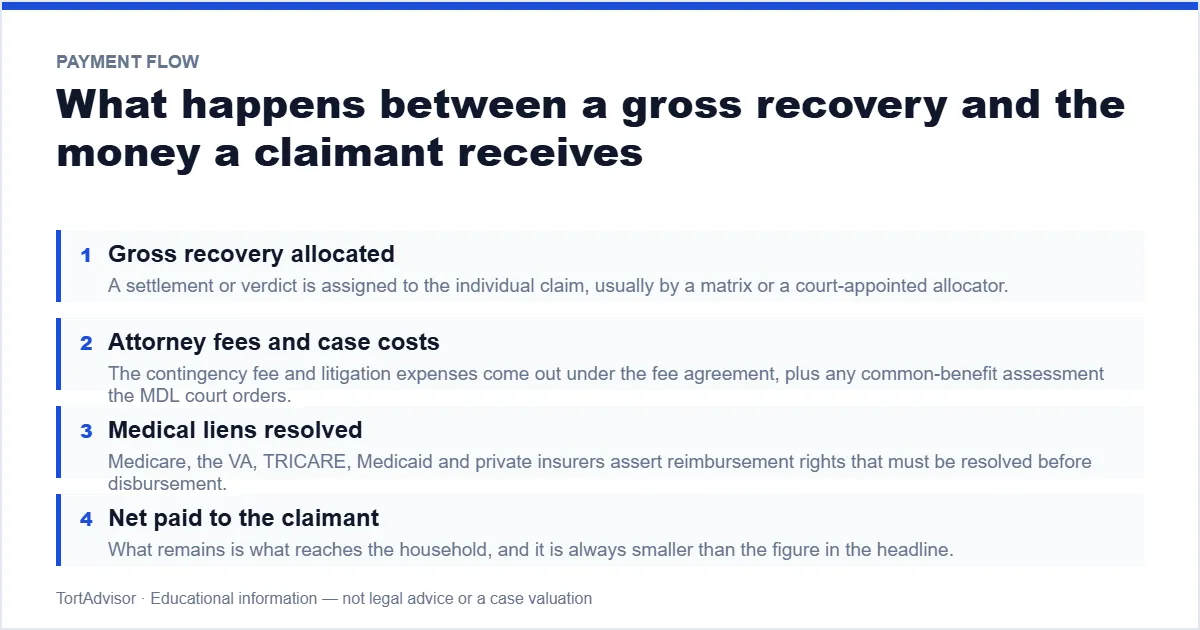
What Happens Between a Gross PFAS Recovery and a Deposit
Applies to a personal injury recovery. The water utility settlements run through an entirely separate claims process that pays systems, not people.
Allocation
A settlement or verdict is assigned to the individual claim, usually by a matrix or a court-appointed allocator weighing disease, exposure and severity.
Fees and costs
The contingency fee and case expenses come out under the fee agreement, plus any common-benefit assessment the MDL court orders. Expert costs in this litigation are unusually high.
Liens
Medicare, the VA, TRICARE, Medicaid and private insurers assert reimbursement rights. For military and firefighter claimants this step is frequently the most complicated part.
Net to the claimant
What remains is what reaches the household. The gap between a headline figure and a deposit is real and it is large.
This flow is descriptive, not predictive. It explains what would happen to a PFAS personal injury recovery, not that there will be one.
How TortAdvisor Compiles This PFAS Page
On a docket where the confirmed money and the claimed money are different things, the method is mostly about refusing to blur them.
Controlling court first
Orders from Judge Gergel’s court outrank every summary of them, including ours.
Then the JPML
Case counts come from the Panel’s own monthly report. 3M cites the same source in its filings.
Then SEC filings
Settlement amounts are used only where the defendant disclosed them to the SEC, where misstating them carries consequences.
Then agencies and peer review
EPA for the regulatory position, the National Academies for what the medical evidence supports.
Where the PFAS Money Actually Went
These are the confirmed PFAS settlement figures and who each one pays. Read the right-hand column before quoting any of them.
| Settlement | Confirmed amount | Who receives it | Status and timing |
|---|---|---|---|
| 3M public water systems | $10.5 billion to $12.5 billion total; $10.3 billion pre-tax charge recorded | Public water systems. No individual claimant receives anything from it. | Payments scheduled 2024 through 2036 |
| 3M and New Jersey | Up to $450 million; $400 million pre-tax charge recorded | The State of New Jersey | $207 million from 2026 over eight years, plus $74 million for future claims 2030 to 2050. Approval still pending after hearings in January and June 2026. |
| Personal injury claims in MDL 2873 | None announced | Would pay individual claimants | Bellwether trial vacated, no new date, court-ordered mediation continuing as of July 2026 |
| Other defendants and state actions | None disclosed at a comparable scale | Varies by case | Pending across multiple jurisdictions without finalised agreements |
Why the arithmetic everyone does is wrong. Dividing $10.3 billion by the roughly fifteen thousand pending cases produces a number in the high six figures, and that number describes nothing. The water settlement resolves claims by utilities, most of which are not among those fifteen thousand personal injury cases, and no part of it is allocated to a person with cancer. This is the same pattern that appears in the Roblox and social media litigations, where enormous state enforcement money pays governments rather than claimants.
Free PFAS Case Review
Wondering how the figures on this page relate to your own situation? Share a few details below — a trained case advisor reviews every submission FREE and with no obligation, and your information stays confidential.
- Free — no cost, no obligation
- About a minute to complete
- Reviewed by a trained case advisor
- Nothing you submit is published
Your details are sent over a secure connection and reviewed confidentially.
Two Separate PFAS Tracks, and Why Their Numbers Never Mix
PFAS is the litigation most often misread on the internet, and almost every misreading comes from collapsing two entirely separate tracks into one number. The first track resolves claims by water systems — public utilities suing over the cost of treating contaminated drinking water. That track has settled repeatedly and enormously: 3M’s public water settlement received final approval on March 29, 2024 and is worth $10.5 billion to $12.5 billion nominal across 2024 to 2036; DuPont, Chemours and Corteva received final approval on February 8, 2024 for $1.185 billion; Tyco’s $750 million and BASF’s $316.5 million were approved on November 22, 2024. Every dollar of that money goes to utilities and their ratepayers, not to a person who drank the water.
The second track is personal injury, and it has produced no settlement at all. No AFFF personal injury settlement exists, 3M records no accrual specific to personal injury claims, and the October 2025 personal injury bellwether was vacated in August 2025 with no replacement date set. The Judicial Panel counted 15,264 actions pending in MDL 2873 before Judge Richard M. Gergel on October 1, 2026, out of 19,840 filed since 2018 — a very large inventory with no compensation programme behind it. A page that reports “$12.5 billion in PFAS settlements” and then offers a per-claimant estimate has silently moved between these two tracks, and the estimate is the part with nothing underneath it.
One widely repeated claim is simply wrong and worth correcting directly: it is often said that no PFAS personal injury settlement has ever occurred. That is false. The C-8 litigation in Ohio, MDL 2433, was a PFAS personal injury settlement. DuPont and Chemours paid $670.7 million in 2017 to resolve approximately 3,500 suits arising from the Parkersburg discharge, and a follow-up group of about 95 cases settled for exactly $83 million in January 2021, split $27 million from DuPont, $27 million from Corteva and $29 million from Chemours. The accurate statement is narrower: no AFFF personal injury settlement exists. C-8 shows what a real PFAS injury resolution looks like, and it remains the only one.
Verdicts are similarly thin and similarly misquoted. The $40 million awarded in the Abbott case is final — the Sixth Circuit affirmed it on December 5, 2022 and the Supreme Court denied certiorari on November 20, 2023 — so describing it as “on appeal” is out of date by nearly three years. One final verdict and one historical settlement is the entire personal injury record. Our PFAS lawsuit guide covers eligibility and the exposure pathways, the PFAS settlement calculator organises the exposure and diagnosis records a claim turns on, and the settlement amounts library keeps the two tracks apart wherever it reports a figure.
Who May Have a PFAS Claim
The personal injury track has organised itself around a fairly narrow set of diseases and a fairly demanding standard of exposure proof.
Commonly present in these claims
- A diagnosis of kidney cancer or testicular cancer, the two conditions at the centre of the litigation
- Or thyroid disease, ulcerative colitis or another condition within the recognised group
- Documented occupational exposure: military firefighting, airport or municipal fire service, or foam manufacturing
- Or long-term residence on a water system with documented PFAS contamination
- Records that establish where and when the exposure happened
- A claim brought within the limitation period the relevant state applies
What weakens or complicates a claim
- No documentary link between the claimant and a contaminated system or a foam-using role
- A condition outside the recognised group, where the published support is thinner
- Short or intermittent exposure, or exposure that postdates the diagnosis
- No serum testing and no utility sampling data for the relevant years
- A limitation period that has already run under the applicable state rule
Eligibility is a legal question that depends on the records and the law of the state involved, and only an attorney reviewing the actual file can answer it. Our AFFF firefighting foam lawsuit guide covers the claims and defendants in more detail, and the PFAS settlement calculator organises these factors without deciding any of them.
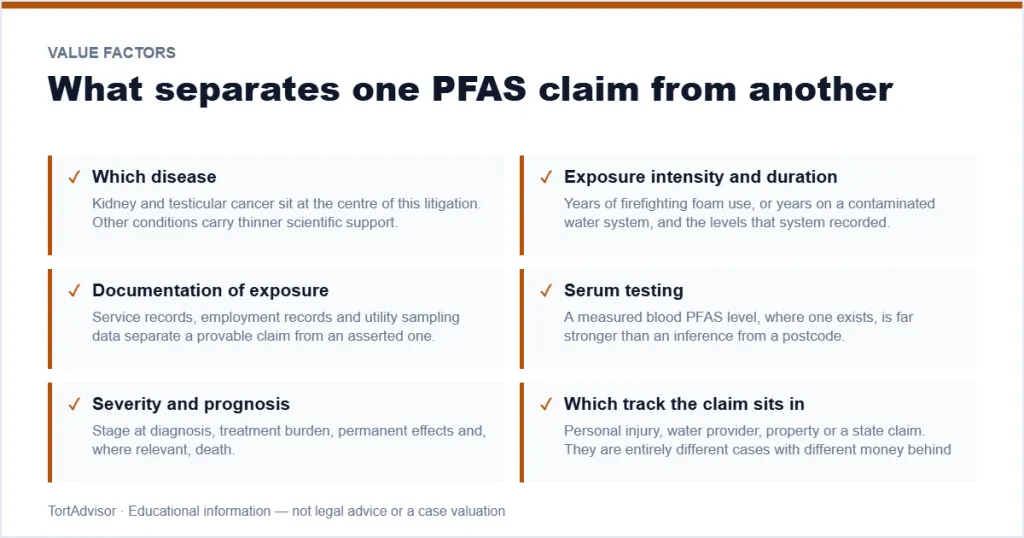
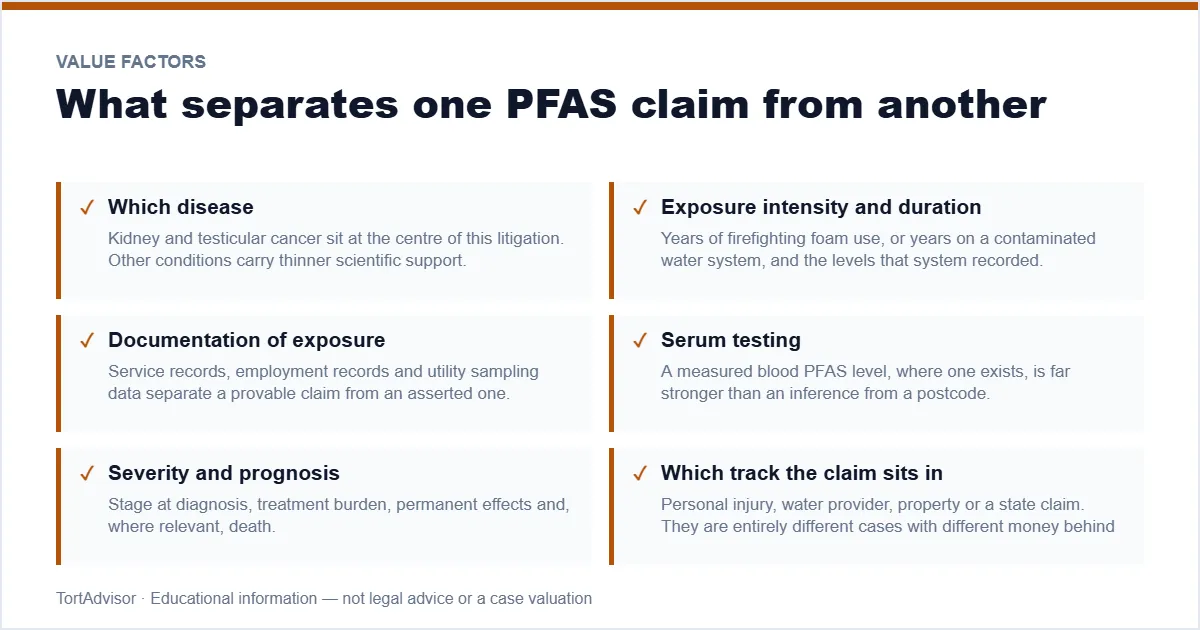
What Moves the Value of a PFAS Claim
These are the differences the PFAS litigation treats as material. None of them produces a number, and none is a guarantee.
Which disease
Kidney and testicular cancer sit at the centre of this litigation because they carry the strongest published support. A condition further from that centre is a materially harder PFAS claim.
Exposure intensity and duration
Years of hands-on foam use in training and response, or decades on a system with recorded contamination, is a different claim from incidental contact.
Documentation of exposure
Service records, employment histories and utility sampling data separate a provable PFAS claim from an asserted one, and this is where most claims are won or lost.
Serum PFAS testing
A measured blood level is far stronger evidence than an inference drawn from an address. Most claimants have never been tested, which is why the exposure record matters so much.
Severity and prognosis
Stage at diagnosis, treatment burden, permanent effects and, where relevant, death. This is the damages half of the analysis.
Which track the claim sits in
Personal injury, water provider, property damage or a state action. They are different cases with different money behind them, and only the personal injury track pays individuals.
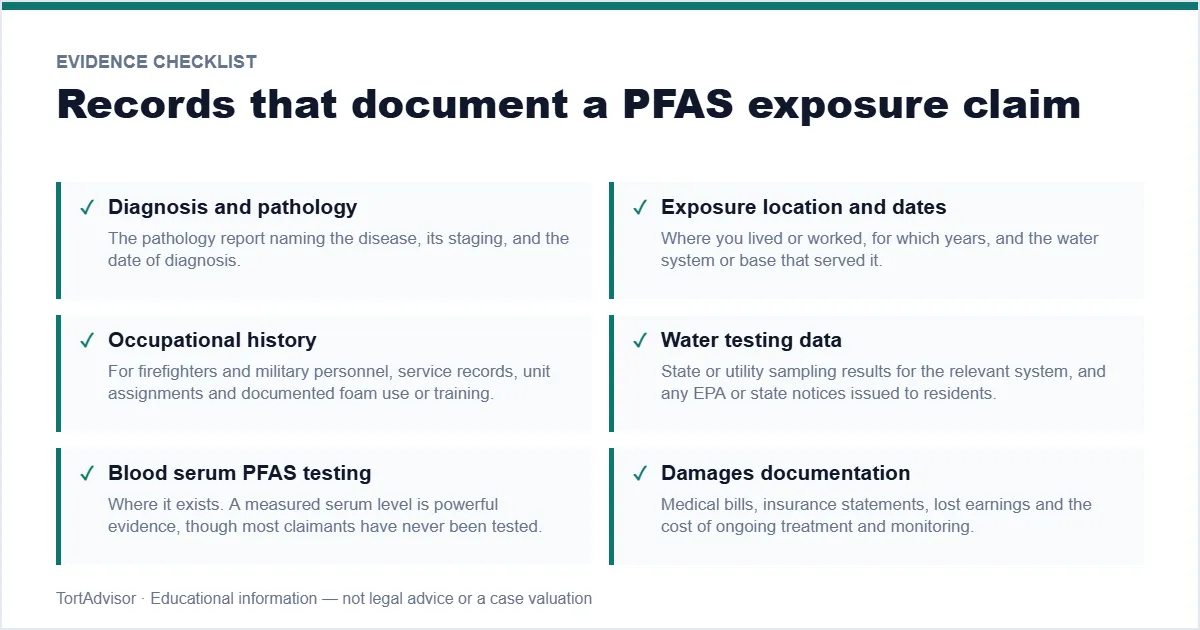
The Records a PFAS Claim Is Built From
This litigation demands two separate proofs: that you have the disease, and that you were exposed. The second is the harder one and it lives in more places.
Diagnosis and pathology
The pathology report naming the disease, its staging and the date of diagnosis. Nothing substitutes for it and everything else supports it.
Exposure location and dates
Where you lived or worked and for which years, matched against the water system or installation that served that address. Address histories are more useful than people expect.
Service and employment records
For military and fire service claimants: units, postings, dates and any record of foam training or response. These take months to obtain and are worth requesting early.
Water testing data
State or utility sampling results for the relevant system and years, plus any notice the utility issued to residents. Much of this is public.
Serum PFAS testing
Where it exists. The National Academies recommends screening at or above 20 nanograms per millilitre, which makes a documented level clinically as well as legally meaningful.
Damages documentation
Medical bills, insurance statements, lost earnings and the cost of ongoing treatment and surveillance.
Start with the exposure record, not the medical record. Medical records can be obtained at any time. Service files, decades-old employment records and historical utility sampling data are slower, and in some cases they are the only thing standing between a claim and a dismissal.
Deadlines in a PFAS Claim
PFAS deadlines are genuinely difficult because the exposure may have run for decades and the disease appeared long afterwards.
Why time may still be available
- Most states run the clock from diagnosis, or from when the link between the illness and the exposure was reasonably discoverable
- Public notice of contamination in a particular system can be what starts, or fails to start, that clock
- Cases are generally filed directly into MDL 2873 rather than filed elsewhere and transferred
- The MDL remains open and continues to receive filings
Why time may already have run
- Limitation periods are commonly two or three years and vary substantially by state
- Wrongful death claims usually run from the date of death and are frequently shorter
- Some states impose a statute of repose that can cut off a claim regardless of discovery
- Widely publicised contamination in your area may have started the discovery clock earlier than you expect
Take the PFAS Settlement Calculator Below
The calculator organises what you know about the diagnosis, the exposure, the records you have and the financial loss, then shows which factors carry the most weight in a PFAS claim. It takes a few minutes and asks for no documents.
The result is educational and is not a guaranteed case value or settlement offer.
Before You Start
- The diagnosis and roughly when it was made
- Where you lived or served, and for which years
- Whether the exposure was occupational or residential
- Whether any serum PFAS testing was ever done
- What treatment followed and any lasting effects
Primary Sources for This Page
Every figure above traces to one of these. We link them so you can check the page rather than trust it.
JPML pending MDL report
The Panel’s monthly statistics, the source of the 15,264 pending and 19,840 total figures for MDL 2873. 3M cites the same source in its own filings. See the pending MDL statistics
3M Form 10-Q, quarter ended June 30, 2026
3M’s own disclosure of the $10.5 to $12.5 billion public water systems settlement and its $10.3 billion charge, the up to $450 million New Jersey proposal, the bellwether structure, the vacated trial date and the court-ordered mediation. Find 3M’s filings on EDGAR
EPA PFAS drinking water standards
The April 10, 2024 final rule setting enforceable limits of 4 parts per trillion for PFOA and PFOS and 10 parts per trillion for PFHxS, PFNA and GenX, with the May 2026 proposals to extend the PFOA and PFOS deadline to 2031 and rescind the limits on the other four. Read the EPA rule
National Academies clinical guidance
Guidance on PFAS Exposure, Testing, and Clinical Follow-Up, July 2022. Below 2 nanograms per millilitre adverse effects are not expected; at 20 or above clinicians are advised to screen for dyslipidemia, thyroid dysfunction, testicular cancer, ulcerative colitis and kidney cancer. Read the guidance highlights (PDF)
ATSDR on PFAS health effects
The federal Agency for Toxic Substances and Disease Registry’s clinical overview of what the evidence does and does not support. Read the ATSDR overview
National Academies full report
The complete committee report behind the guidance, including how it graded the evidence for each health outcome. Open the full report
Questions People Ask
What is the average PFAS settlement per person?
There isn’t one. No personal injury settlement has been announced in MDL 2873, no matrix has been published and no administrator exists. Individuals were paid in the earlier DuPont C-8 litigation in Ohio (MDL 2433): DuPont and Chemours paid $670.7 million in 2017 to resolve approximately 3,500 personal-injury suits — the figure Chemours stated in its own Form 8-K, not the 3,550 that circulates elsewhere — a follow-up group of about 95 cases settled for exactly $83 million, and one plaintiff’s $40 million testicular-cancer verdict was affirmed by the Sixth Circuit in 2022. Those are historical C-8 figures from a different litigation, not a PFAS average and not a benchmark for MDL 2873. Sites quoting a per-person PFAS settlement figure have either divided the water utility money by a claimant count, which is meaningless, or borrowed a range from a different litigation.
Doesn’t the $10 billion settlement pay claimants?
No. 3M’s $10.5 to $12.5 billion resolution pays public water systems for testing and treating their water. It resolves claims brought by utilities. A person who drank that water and later developed cancer has a separate claim, in a separate track, which has not settled.
Why was the first trial cancelled?
3M’s filing states the court vacated the schedule for the first bellwether personal injury trial that was to begin in October 2025, and that no new trial date has been set. The parties are in court-ordered settlement discussions with a court-appointed mediator. A vacated trial date during active mediation is not necessarily bad news for claimants, but it does mean the value question stays unanswered longer.
Which illnesses does this litigation cover?
Kidney cancer and testicular cancer sit at the centre. Thyroid disease and ulcerative colitis appear frequently. The National Academies advises clinicians to screen for exactly that group, plus dyslipidemia, in people with serum PFAS at or above 20 nanograms per millilitre, which is a useful independent check on which conditions the evidence actually supports.
Do I need a blood test to bring a PFAS claim?
No, and most claimants have never had one. A measured serum level is strong evidence where it exists, but the ordinary route is documentary: service or employment records, address history and utility sampling data for the years in question.
Does EPA’s drinking water rule prove my case?
No. A regulatory limit is a public health standard, not a finding that a particular illness in a particular person was caused by PFAS. It is useful context and it can help establish that a system was contaminated, but causation in an individual claim is proved with evidence about that claimant.
What about Camp Lejeune?
Camp Lejeune claims run under their own federal statute with its own filing rules and its own deadlines, and they are not part of MDL 2873. If your exposure was at Camp Lejeune, the analysis on this page is not the one that governs your claim.
Does TortAdvisor handle PFAS claims?
No. TortAdvisor is a legal research publisher. We do not represent claimants, give legal advice, accept cases or review claims, and using this page or the calculator does not create an attorney-client relationship. Our purpose is to show you what the public record says before you speak with an attorney of your own choosing.
See Which Factors May Affect a PFAS Claim
Answer the questions you can about PFAS or AFFF exposure, the diagnosis, treatment, records, expenses and long-term impact. The calculator organizes those inputs into an educational settlement range and highlights the factors that may matter most when a claim is reviewed.
The result is educational and is not a guaranteed case value or settlement offer.
Helpful Information to Have Ready
You do not need every record in hand. Answer what you know; these details can make the estimate more useful.
Reading this page is separate from any request to be contacted. The consent boxes on this form are unchecked unless you tick them yourself.