
Mesothelioma Settlement Amounts 2026: Trust Payouts & Claim Value
Asbestos is the oldest mass tort in America and the only one with a parallel private compensation system. Most claimants recover from two places at once — bankruptcy trusts and solvent defendants — and the trusts pay only a fraction of what they say a claim is worth.
How Mesothelioma Settlement Amounts Actually Work
Asbestos litigation does not resolve the way the other cases in this library do. There is no single defendant to settle with, no MDL bellwether to wait for, and no global settlement to approve. There is a system, and understanding it is what makes the numbers make sense.
Construction, shipyards, insulation, boiler work, automotive brake and clutch repair, and manufacturing. OSHA states there is no safe level of exposure to any asbestos fibre type.
The gap between exposure and diagnosis is why cases filed today concern products removed from the market long ago, and why product identification is the central evidentiary problem.
The National Cancer Institute describes mesothelioma as a cancer of the mesothelium lining the lung, chest wall and abdomen, with asbestos exposure as the major risk factor.
One work history can support claims against many bankrupt manufacturers. Each is assessed separately against that trust’s own criteria and schedule.
Companies that never went bankrupt are sued in state court. Many jurisdictions expedite cases where the plaintiff is terminally ill.
The total is the sum of trust payments and any tort settlements or verdicts, arriving at different times over months or years.
Mesothelioma Settlement Amounts: Confirmed Facts vs. Projections
The structure is documented. What any individual recovers is not, and cannot be, because it depends on which companies exposed them.
What Is Confirmed
- The GAO counted 60 asbestos trusts holding approximately $37 billion in assets, established since 1988 to pay present and future claims.
- Trusts publish scheduled values by disease and pay a payment percentage of them rather than the full amount.
- Payment percentages differ substantially between trusts and are revised over time as finances change.
- OSHA states there is no safe level of exposure to any asbestos fibre type, and that exposures as short as a few days have caused mesothelioma.
- OSHA associates asbestos with asbestosis, lung cancer and mesothelioma, across construction, ship repair, manufacturing and brake and clutch work.
- The National Cancer Institute identifies asbestos exposure as the major risk factor for mesothelioma.
What Varies by Claimant
- Which trusts a work history qualifies against, which is the single largest driver of total recovery.
- Each trust’s current payment percentage at the time a claim is processed.
- Whether any solvent defendants remain for that particular exposure history.
- The jurisdiction, which affects procedure, expedition and outcome.
- Whether product identification can be established at all after forty or fifty years.
Mesothelioma Settlement Amounts by Claim Profile
Because recovery accumulates from many sources, these profiles describe relative outcomes rather than dollar bands. They are TortAdvisor modelling, not official settlement offers, historical averages or predictions.
Documented multi-site exposure, mesothelioma, solvent defendants remain
- Decades of work across sites with many identifiable manufacturers
- Qualifies against numerous trusts, each paying separately
- One or more solvent defendants still available to sue
- Co-worker witnesses able to confirm products and conditions
- Working age at diagnosis, with substantial lost earnings
Single-employer exposure, mesothelioma, mostly bankrupt defendants
- A clear exposure history but concentrated on fewer manufacturers
- Recovery comes largely from trusts, subject to payment percentages
- Few or no solvent defendants remaining
- Documentation adequate but witnesses limited
Secondary exposure, or a non-malignant diagnosis
- Household or bystander exposure, harder to document
- Asbestosis or pleural disease rather than mesothelioma — scheduled far lower
- Product identification resting on recollection alone
- Older at diagnosis with limited economic loss
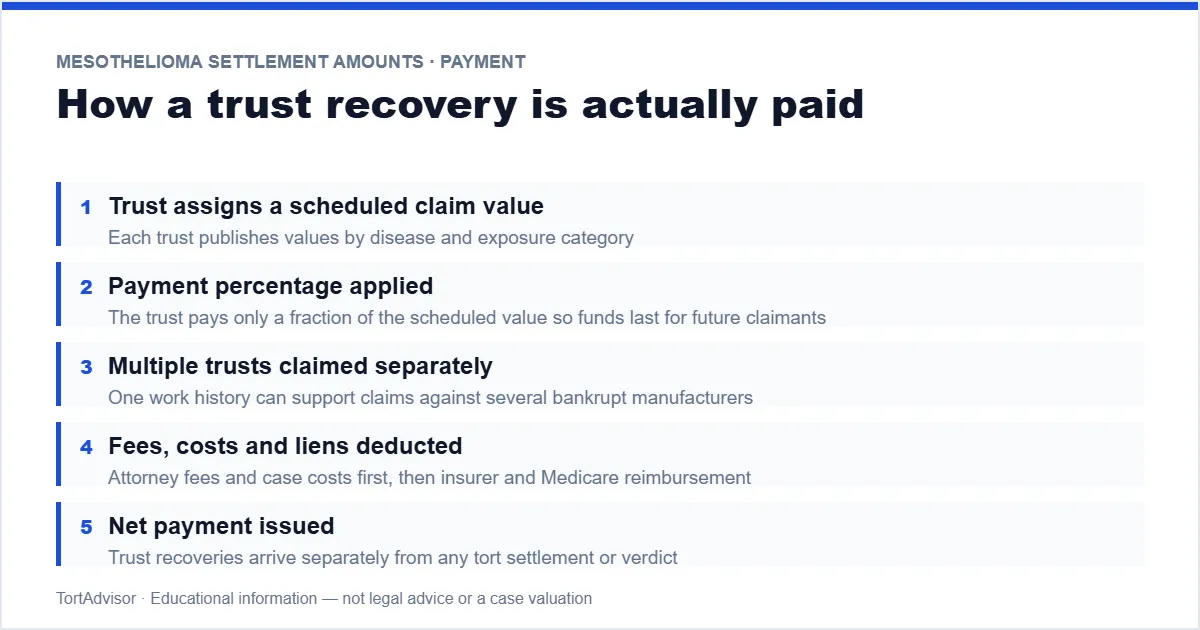
How a mesothelioma trust recovery is actually paid
This is the sequence that turns a published trust schedule into money received, and where most of the value is lost along the way.
Trust assigns a scheduled value
Each trust publishes values by disease and exposure category. Mesothelioma sits well above non-malignant conditions.
Payment percentage applied
The trust pays only a fraction of the scheduled value so funds remain for claimants not yet diagnosed.
Repeated across every qualifying trust
A single work history can produce many separate claims, each assessed and paid on its own terms.
Fees, costs and liens deducted
Attorney fees and case costs first, then Medicare, Medicaid and insurer reimbursement claims.
Net payments arrive over time
Trust payments and any tort settlement arrive separately, often months or years apart.
This is why a scheduled value is not a settlement amount. Quoting a trust schedule without its payment percentage overstates the recovery, and doing it across several trusts compounds the error.
How TortAdvisor Handles Mesothelioma Settlement Amounts
This is the topic where headline figures are most often quoted without the mechanism that reduces them.
Never quote a schedule alone
A trust’s scheduled value appears here only alongside the payment percentage concept, because one without the other is not information.
Separate trusts from tort
Trust recoveries and tort settlements follow different rules and different timetables. Blending them into a single average hides both.
Separate disease types
Mesothelioma, lung cancer and non-malignant asbestosis are scheduled at very different values. A single asbestos figure is meaningless.
Describe the system, not a number
Where recovery depends on which companies exposed a claimant, the honest answer explains the structure rather than inventing an average.
Trust Claims vs. Tort Claims: Where Mesothelioma Money Comes From
The two routes differ in almost every respect, and most claimants use both.
| Feature | Asbestos bankruptcy trusts | Tort claims against solvent defendants | Why it matters |
|---|---|---|---|
| Who pays | A trust funded by a bankrupt manufacturer | A company still operating, or its insurers | Determines whether there is any negotiation at all |
| How value is set | A published schedule by disease and exposure category | Negotiation, or a jury | Trust values are predictable; tort values are not |
| What is actually paid | A payment percentage of the scheduled value | The negotiated settlement or the verdict as finally sustained | This is the single biggest misunderstanding in asbestos compensation |
| How many claims | One per qualifying trust, potentially many | One action, potentially naming several defendants | Total recovery depends heavily on how many trusts qualify |
| Speed | Administrative review, usually faster | Litigation, though often expedited for terminally ill plaintiffs | Matters enormously given the prognosis |
Two claimants with the same diagnosis can recover very different totals. Not because one case is stronger on the medicine, but because one worked with products made by companies that still exist and the other did not. That is a structural feature of asbestos compensation, not an anomaly.
Free Mesothelioma & Asbestos Case Review
Wondering how the figures on this page relate to your own situation? Share a few details below — a trained case advisor reviews every submission FREE and with no obligation, and your information stays confidential.
- Free — no cost, no obligation
- About a minute to complete
- Reviewed by a trained case advisor
- Nothing you submit is published
Your details are sent over a secure connection and reviewed confidentially.
Who May Qualify for Mesothelioma Settlement Amounts
Eligibility turns on diagnosis and on being able to reconstruct an exposure history that is usually decades old.
Common Screening Factors
- A pathology-confirmed mesothelioma diagnosis, or asbestosis, asbestos-related lung cancer or pleural disease
- Occupational exposure — construction, shipyards, insulation, boilers, refineries, power plants, brake and clutch work
- Military service exposure, particularly Navy shipboard service
- Secondary or household exposure, typically from laundering a worker’s clothing
- A work history detailed enough to identify sites and products
- Claims brought by a personal representative where the claimant has died
Factors Requiring Closer Review
- Exposure that cannot be tied to identifiable products or manufacturers
- Employers that no longer exist and were never covered by a trust
- Non-malignant diagnoses, which are scheduled far lower than mesothelioma
- Prior settlements or trust claims already filed for the same exposure
- State limitation periods, which for mesothelioma usually run from diagnosis
Talc-related mesothelioma is a distinct route with its own defendants and its own science — see our talc mesothelioma coverage. For broader environmental and occupational exposure claims, see our toxic exposure lawsuit research.
Factors That Increase or Reduce Mesothelioma Settlement Amounts
In asbestos claims, who exposed you matters more than in any other litigation covered here.
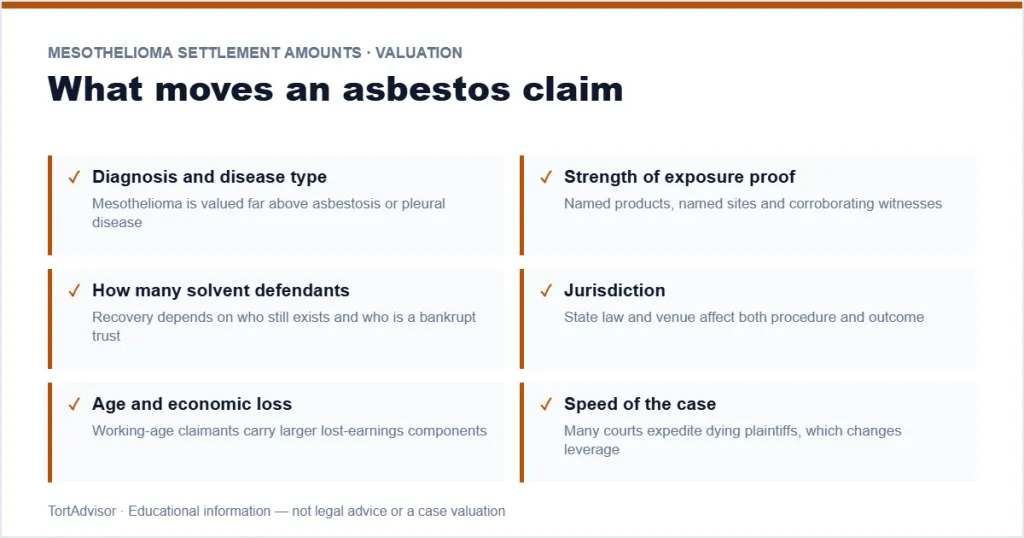
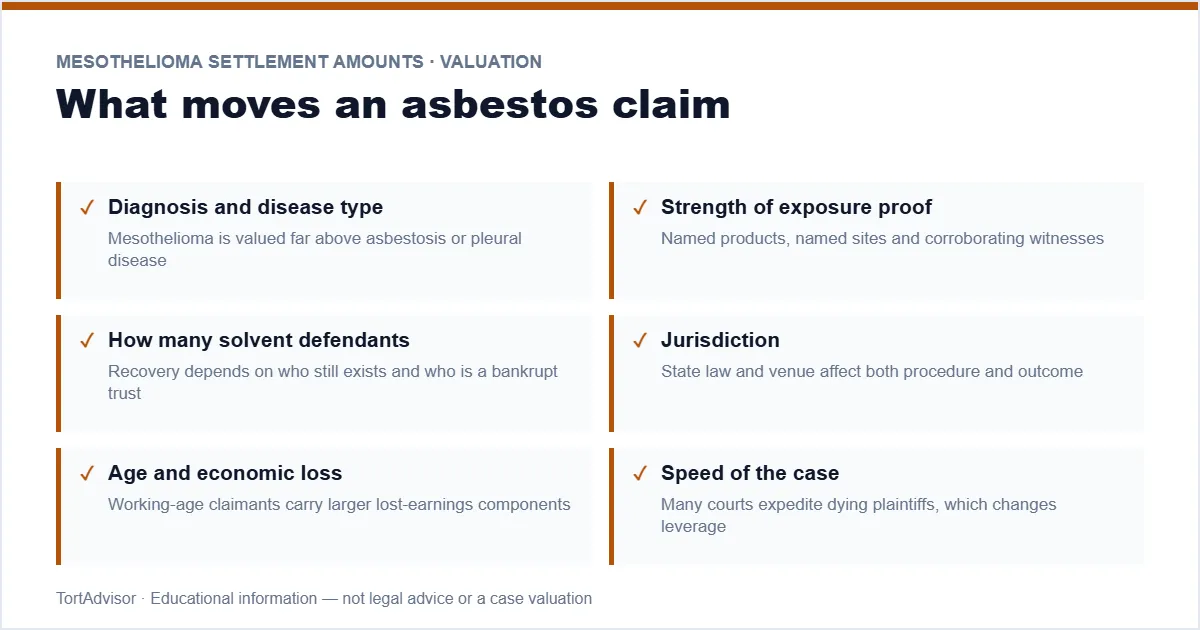
Diagnosis and disease type
Mesothelioma is scheduled and valued far above asbestosis, pleural plaques or asbestos-related lung cancer. The diagnosis is the first and largest determinant.
Number of qualifying trusts
Each trust a work history qualifies against is a separate payment. A varied career across many sites can produce far more total recovery than a single-employer history.
Whether solvent defendants remain
Trusts pay a percentage; solvent defendants negotiate or face a jury. Having at least one solvent defendant changes the economics of a case substantially.
Strength of product identification
Named products at named sites, corroborated by co-workers or records. After four or five decades this is the evidence most often missing.
Jurisdiction and venue
State law, procedure and the availability of expedited trial settings for dying plaintiffs vary widely and materially affect outcomes.
Age and economic loss
A claimant diagnosed while still working carries a substantial lost-earnings component. Most mesothelioma claimants are diagnosed later in life, which compresses it.
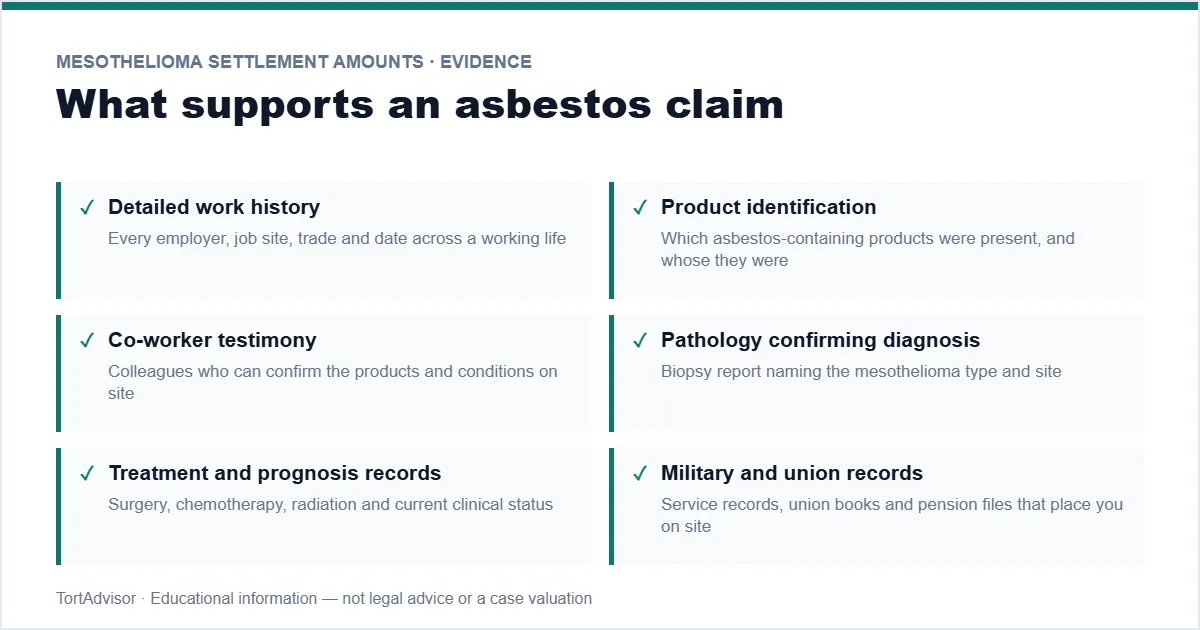
Evidence Supporting Mesothelioma Settlement Amounts
Asbestos cases are won on work history. The medicine is usually straightforward; proving which company’s product caused the disease is not.
Detailed work history
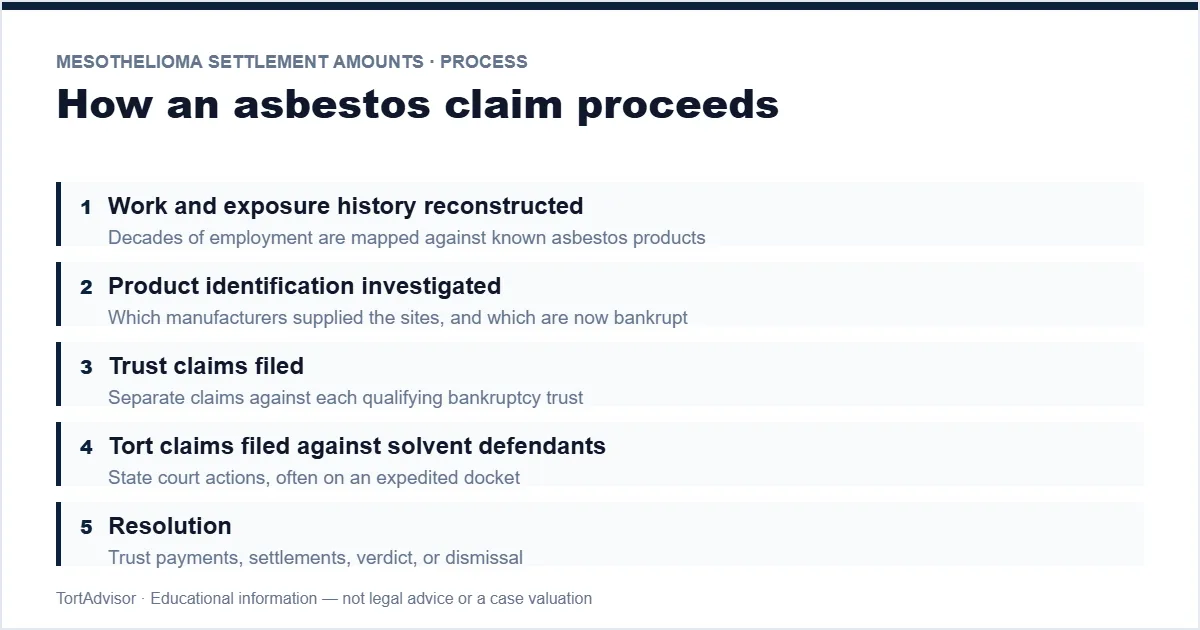
Every employer, job site, trade, job title and date across an entire working life. This document is the foundation of every trust claim and every tort action.
Product identification
Which asbestos-containing products were present at each site and who manufactured them. This determines which trusts qualify and who can be sued.
Co-worker testimony
Colleagues who can confirm the products, brands and conditions. Given latency, tracing these witnesses early is often decisive and gets harder every year.
Military and union records
Service records, ship assignments, union books and pension files place a claimant at specific sites in specific years when employer records are long gone.
Pathology and treatment records
The biopsy confirming mesothelioma and its site, plus surgery, chemotherapy, radiation and current clinical status.
Household exposure evidence
For secondary claims, evidence of the worker’s job, the clothing brought home and who laundered it.
Filing Deadlines for Mesothelioma Claims
Asbestos limitation periods are short, and they start at diagnosis rather than exposure — which is the only reason claims are possible at all after fifty years.
What tends to matter
- The date of diagnosis, and which state’s law governs
- Whether the claim is an injury claim or a wrongful death claim
- Each trust’s own procedural requirements and deadlines
- Whether prior claims were filed for the same exposure
Why speed matters beyond the deadline
- Co-worker witnesses are elderly and their testimony may be needed
- Many courts expedite trial settings for terminally ill plaintiffs
- Preserving testimony while a claimant can give it materially strengthens a case
- Trust payment percentages can be revised downward over time
Take the Mesothelioma Settlement Calculator Below
The calculator organises what you know about work history, exposure sites, diagnosis, treatment and financial loss, then shows which factors carry the most weight in an asbestos claim. It takes a few minutes and asks for no documents.
The result is educational and is not a guaranteed case value or settlement offer.
Before You Start
- The main employers and job sites, with rough dates
- The trade or job titles worked
- Whether military service was involved
- The diagnosis and roughly when it was made
- Treatment received so far
- Whether any co-workers can still be contacted
Answer what you know. You do not need every record or an exact timeline to get started.
Primary Sources for Mesothelioma Settlement Amounts
Every structural fact on this page traces to one of these. Each was checked on Oct. 1, 2026.
GAO report on asbestos injury trusts
The Government Accountability Office’s report on asbestos injury trusts records that 60 trusts have been established since 1988 holding about $37 billion in assets, and documents how trusts set scheduled values and apply payment percentages.
OSHA asbestos standard
OSHA states there is no safe level of asbestos exposure for any fibre type, that exposures as short as a few days have caused mesothelioma in humans, and identifies asbestosis, lung cancer and mesothelioma as the associated diseases across construction, ship repair, manufacturing and brake and clutch work.
National Cancer Institute
The NCI describes mesothelioma as a cancer of the mesothelium lining the lung, chest wall and abdomen, and identifies asbestos exposure as the major risk factor.
Individual trust disclosures
Each asbestos bankruptcy trust publishes its own trust distribution procedures, scheduled values and current payment percentage. Because these differ between trusts and are revised over time, the governing figures for any claim are the ones published by the specific trusts it qualifies against.
Why no single average is cited
TortAdvisor does not publish an average mesothelioma settlement because recovery is an accumulation of payments from multiple trusts and any tort defendants, governed by different rules. An average across that structure would describe no actual claimant.
Where the tort track is documented
Verdicts and settlements against solvent defendants are recorded on individual state court dockets rather than centrally. Because asbestos cases are not consolidated in an active MDL, there is no single federal report equivalent to the JPML counts used elsewhere in this library.
Frequently Asked Questions About Mesothelioma Settlement Amounts
What is the average mesothelioma settlement amount?
TortAdvisor does not publish one, because recovery in asbestos cases is an accumulation of payments from multiple bankruptcy trusts plus any tort settlement, each under different rules. An average across that structure would not describe any real claimant.
What is a trust payment percentage?
Each asbestos bankruptcy trust publishes scheduled values by disease, then pays only a percentage of that scheduled value so its funds last for claimants not yet diagnosed. A scheduled value of $100,000 at a 25% payment percentage produces $25,000.
How many asbestos trusts are there?
The GAO counted 60 trusts established since 1988, holding roughly $37 billion in assets. Which of them a claimant qualifies against depends entirely on where they worked and which products were present.
Can I claim from trusts and sue at the same time?
Generally yes, and most mesothelioma claimants do both. Trust claims are administrative and made against bankrupt manufacturers; tort claims are litigated against companies still solvent. They are separate processes with separate timetables.
Why do two people with the same diagnosis recover different amounts?
Because recovery depends on which companies exposed them. A claimant who worked with products from many manufacturers that later established trusts, and at least one company still solvent, has more sources of recovery than someone exposed by a single employer that no longer exists.
Is there a mesothelioma MDL?
Asbestos claims are not consolidated in an active MDL accepting new filings the way the other litigations in this library are. Cases proceed in state courts, often on expedited settings for terminally ill plaintiffs, alongside administrative trust claims.
Does secondary or household exposure qualify?
It can. Claims from family members exposed by laundering a worker’s contaminated clothing are recognised, though they require evidence of the worker’s job and the pathway of exposure into the home.
Is the mesothelioma settlement calculator legally binding?
No. It is an educational tool that organises claim factors into an illustrative range. It is not a case valuation, not an offer, and produces nothing that binds any trust, defendant, court or law firm.
See Which Factors May Affect a Mesothelioma Claim
Answer the questions you can about work history, asbestos exposure, diagnosis, treatment, records and long-term impact. The calculator organizes those inputs into an educational settlement range and highlights the factors that may matter most when a claim is reviewed.
The result is educational and is not a guaranteed case value or settlement offer.
Helpful Information to Have Ready
You do not need every record in hand. Answer what you know; these details can make the estimate more useful.
Reading this page is separate from any request to be contacted. The consent boxes on this form are unchecked unless you tick them yourself.