WTC 9/11 Settlement Amounts 2026: VCF Award Caps & Payouts
This is the rare compensation programme where the numbers are not estimates. The September 11th Victim Compensation Fund publishes its own statutory caps, and every WTC award is built from a formula the fund sets out in writing.
Free WTC 9/11 Case Review
Wondering how the figures on this page relate to your own situation? Share a few details below — a trained case advisor reviews every submission FREE and with no obligation, and your information stays confidential.
- Free — no cost, no obligation
- About a minute to complete
- Reviewed by a trained case advisor
- Nothing you submit is published
Call 855-664-8713Text 855-664-8713
- Share a few details. It takes about a minute, and only a few fields are required.
- A trained case advisor reviews them. Free and confidential. TortAdvisor is not a law firm.
- You choose what happens next. If you asked for a call, the advisor follows up by phone or text.
Your details are sent over a secure connection and reviewed confidentially.
Latest WTC Settlement Amounts and VCF Programme Status
The WTC compensation route is not litigation and produces no verdicts. It is a federal compensation programme with a written formula, statutory ceilings and a claims process that runs to the end of this century. That makes WTC settlement amounts more knowable than almost any other claim covered in this library.
The September 11th Victim Compensation Fund Act establishes compensation for those killed or physically injured in the attacks, in exchange for waiving most litigation.
The James Zadroga 9/11 Health and Compensation Act reactivates the VCF and creates the WTC Health Program, recognising illnesses that emerged years after the exposure.
The reactivated fund starts issuing awards. The overwhelming majority of WTC settlement amounts paid today flow from this reopened programme rather than the original 2001 fund.
H.R. 1327 extends the filing deadline from December 2020 to Oct. 1, 2090 and removes the funding ceiling that had forced earlier awards to be cut.
NIOSH announces continued funding for the World Trade Center Health Registry and publishes a progress update on its youth research cohort.
The Scientific/Technical Advisory Committee continues evaluating petitions to add conditions. A newly certified condition can make a previously ineligible claimant eligible.
WTC Settlement Amounts: Published Figures vs. What Varies
Unusually for this library, the WTC ceilings here are documented. What varies is everything between zero and the ceiling.
What Is Published
- Non-cancer non-economic loss runs $10,000 to $90,000.
- Cancer non-economic loss is capped at $250,000.
- A small number of cases reach $340,000 for multiple cancers, or cancer with multiple severe non-cancer conditions.
- Emphysema, interstitial lung disease including asbestosis, and sarcoidosis carry the presumptive $90,000 maximum without additional documentation.
- Prostate cancer has a $200,000 baseline; medical records showing recurrence or metastasis support an increase to $250,000, and long-term treatment complications lasting more than two years can also support a higher award.
- Death claims carry a presumed $250,000, plus $100,000 for a spouse and each dependent.
- Economic loss counts annual gross income only up to $255,610.
- The award formula is non-economic loss plus economic loss, minus collateral offsets.
What Varies by Claimant
- Where within the range a condition falls — severity and daily-living impact decide.
- The size of the economic loss component, which dominates most large awards.
- How much is subtracted as collateral offsets.
- Whether presence in the exposure zone can be documented at all.
- Whether and when a condition is certified by the Health Program.
- Whether a future condition will be certified years from now, allowing an amendment.
Published WTC Settlement Amount Caps by Condition Type
These are the fund’s own published figures for the non-economic loss component. They are statutory and policy ceilings, not TortAdvisor estimates — but an individual award is set within them, and economic loss and offsets are calculated separately on top.
Multiple cancers, or cancer with multiple severe non-cancer conditions
- Reached in a small number of cases only
- Requires documented severity across conditions
- Not automatic — additional certifications alone do not raise an award
- Economic loss is calculated separately and added
Certified cancer conditions
- The standard published ceiling for cancer
- Prostate cancer has a $200,000 baseline; recurrence or metastasis supports $250,000, and long-term treatment complications can also support a higher award
- Position within the range reflects severity and daily-living impact
- Also the presumed figure for a death claim, before spouse and dependent amounts
Certified non-cancer conditions
- Emphysema, interstitial lung disease including asbestosis, and sarcoidosis receive the presumptive $90,000 maximum
- Asthma, chronic bronchitis, sleep apnea and similar conditions are treated as presumptively less severe
- Medical documentation is needed to move above the baseline
- Chronic conditions that severely limit daily activity sit toward the top of the range
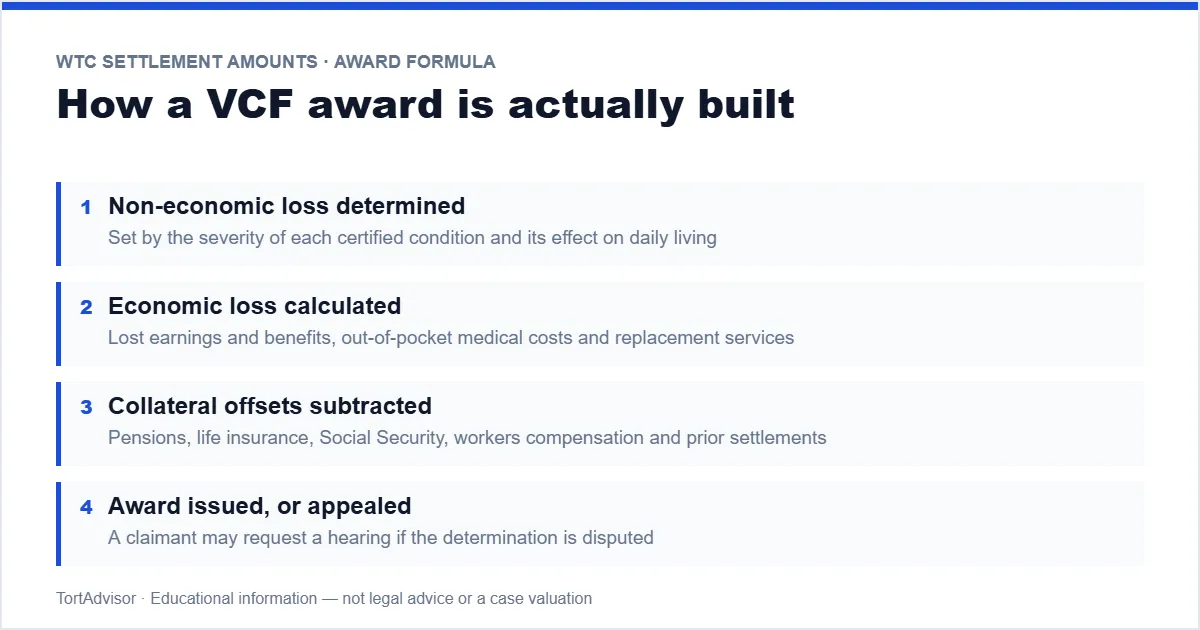
How a VCF award is actually calculated
The fund publishes this formula. Unlike a litigation settlement, there is no negotiation — the components are computed and the offsets are mandatory.
Non-economic loss set
Determined by the severity of each certified condition and its effect on the ability to maintain normal daily activities.
Economic loss calculated
Past and future lost earnings and benefits, out-of-pocket medical costs and replacement services loss.
Income cap applied
Annual gross income counted toward lost earnings is limited to $255,610 under the fund methodology.
Collateral offsets subtracted
Pension payments, life insurance, Social Security, workers compensation and any prior 9/11 lawsuit settlement.
Award issued or appealed
A claimant who disputes the determination may request a hearing, and may amend the claim if a condition worsens.
This formula is published, not inferred. It is why WTC settlement amounts can be discussed with more precision than the litigation payouts covered elsewhere in this library.
How TortAdvisor Handles WTC Settlement Amounts
Because the fund publishes real WTC figures, the editorial job here is different: the risk is not invention but misuse of figures that are genuinely public.
Quote the source figure
Every dollar amount on this page appears in a VCF policy document or fact sheet, and is reproduced rather than rounded or reinterpreted.
Label ceilings as ceilings
A cap is not an expected payout. We say so wherever a cap appears, because presenting one as an average is the standard error in this topic.
Keep the components separate
Non-economic loss, economic loss and offsets do different work. Collapsing them into a single headline number misleads on both ends.
Track policy, not commentary
Award policy changes by amendment and guidance. We check the fund’s own pages rather than repeating figures from secondary coverage.
WTC Settlement Amounts by Claim Profile
The same published caps produce very different awards depending on which components apply. This table shows how the pieces combine.
| Claim profile | Non-economic component | Economic component | What usually decides the outcome |
|---|---|---|---|
| Working-age responder with certified cancer | Up to $250,000 | Often the larger share — lost earnings and benefits to retirement age, capped at $255,610 a year | Earnings history and the size of pension or disability offsets |
| Retired responder with certified cancer | Up to $250,000 | Limited — little or no future earnings loss to claim | Severity of the condition, and how much pension income offsets the award |
| Survivor with severe non-cancer respiratory disease | Presumptive $90,000 for emphysema, interstitial lung disease or sarcoidosis | Depends entirely on documented work loss | Whether presence in the exposure zone can be documented |
| Claimant with a presumptively less severe condition | Toward the lower end of the $10,000 to $90,000 range | Often minimal | Medical documentation showing the condition is more severe than presumed |
| Death claim | Presumed $250,000, plus $100,000 for a spouse and each dependent | Lost future earnings, reduced by a personal consumption adjustment | Dependent structure, earnings history and collateral offsets |
Profiles are illustrative combinations of published rules, not reported outcomes. The VCF does not publish average awards by profile, and TortAdvisor does not estimate them.
Who May Qualify for WTC Settlement Amounts
Eligibility for a WTC 9/11 settlement turns on two things the fund does not decide by itself: where you were, and whether a condition has been certified as 9/11-related.
Common Screening Factors
- Presence in the New York City exposure zone between Sept. 11, 2001 and May 30, 2002
- Presence at the Pentagon site through Nov. 19, 2001, or the Shanksville site through Oct. 3, 2001
- Responders, recovery and clean-up workers, and also residents, students, office workers and passers-by — survivors are eligible, not only responders
- Children and students who were in the zone at the time, now adults
- A condition certified by the World Trade Center Health Program
- Personal representatives bringing a claim on behalf of someone who has died
Factors Requiring Closer Review
- Presence that cannot be documented — the most common obstacle by a wide margin
- A condition that has not yet been certified, or that is not on the covered list
- Large collateral payments already received, which reduce the award
- A prior 9/11-related lawsuit settlement, which is treated as an offset
- Registration deadlines that may already have passed for the claim type
You do not have to be sick to register with the VCF, and registering does not commit you to filing. Our current WTC claim update covers who is being certified now and what has changed this year.
Factors That Increase or Reduce WTC Settlement Amounts
Within the published ceilings, these are the levers that actually move a WTC award.
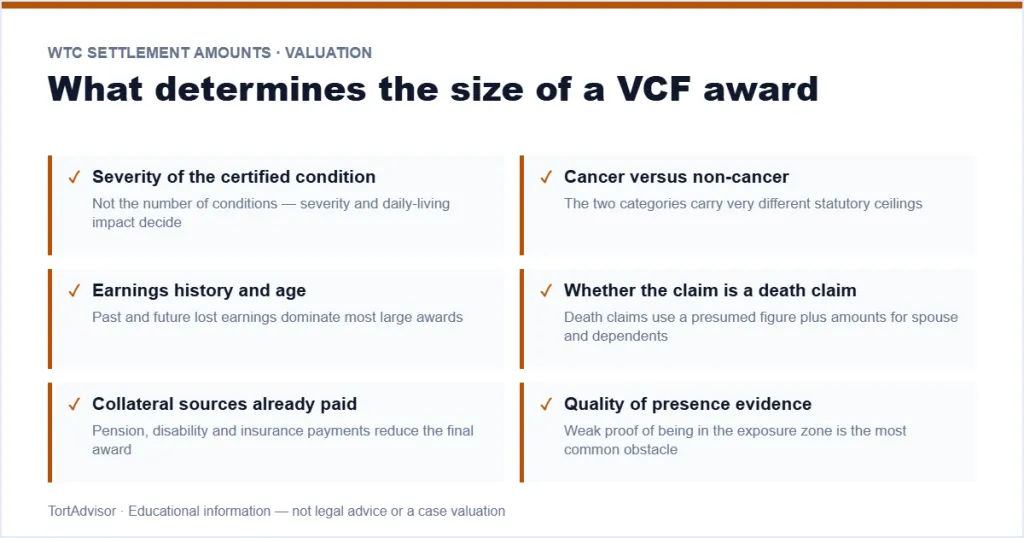
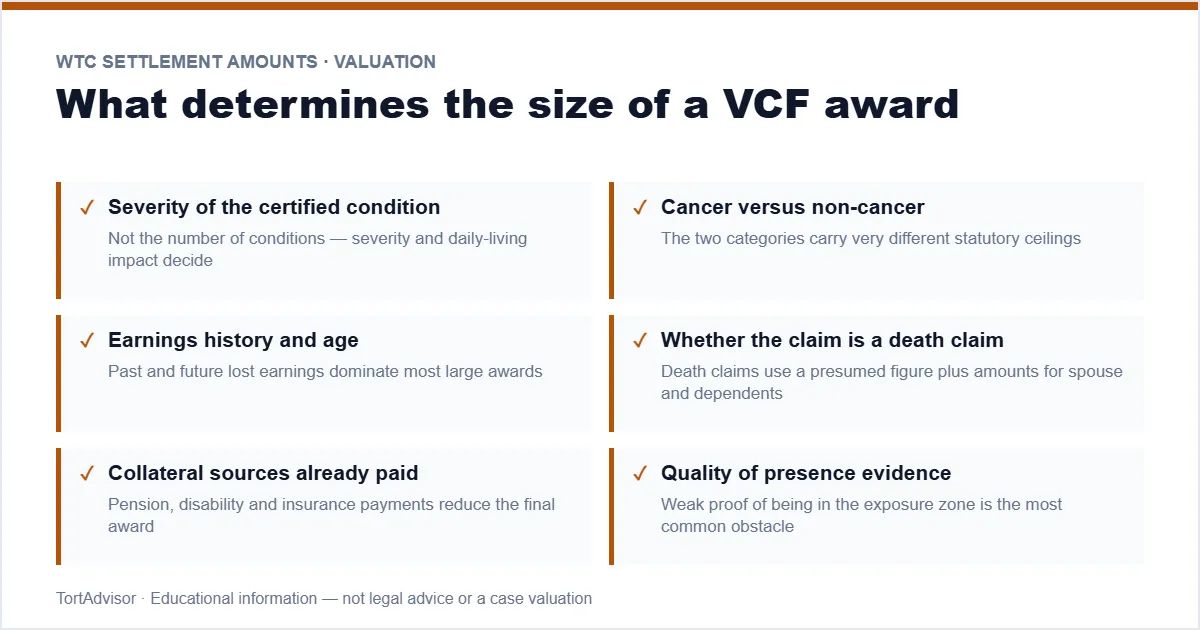
Severity, not quantity
The fund states plainly that the award is not tied to the number of certified conditions. A single severe condition can be worth more than several mild ones.
Cancer versus non-cancer
The two categories carry ceilings almost three times apart, so certification of a cancer changes the arithmetic more than any other single factor.
Earnings history and age at diagnosis
For a working-age claimant, lost earnings and benefits usually dominate the award. The methodology counts annual gross income only up to $255,610.
Collateral offsets
Pension payments, life insurance, Social Security, workers compensation and any prior 9/11 settlement are subtracted. Substantial offsets can reduce an award dramatically.
Quality of presence evidence
Employment records, union records, affidavits and contemporaneous documents. Weak presence proof ends more claims than any medical question.
Whether the claim is amended later
Conditions can worsen and new conditions can be certified. Claims may be amended until Oct. 1, 2090, so an early award is not necessarily the final one.
Evidence Supporting WTC Settlement Amounts
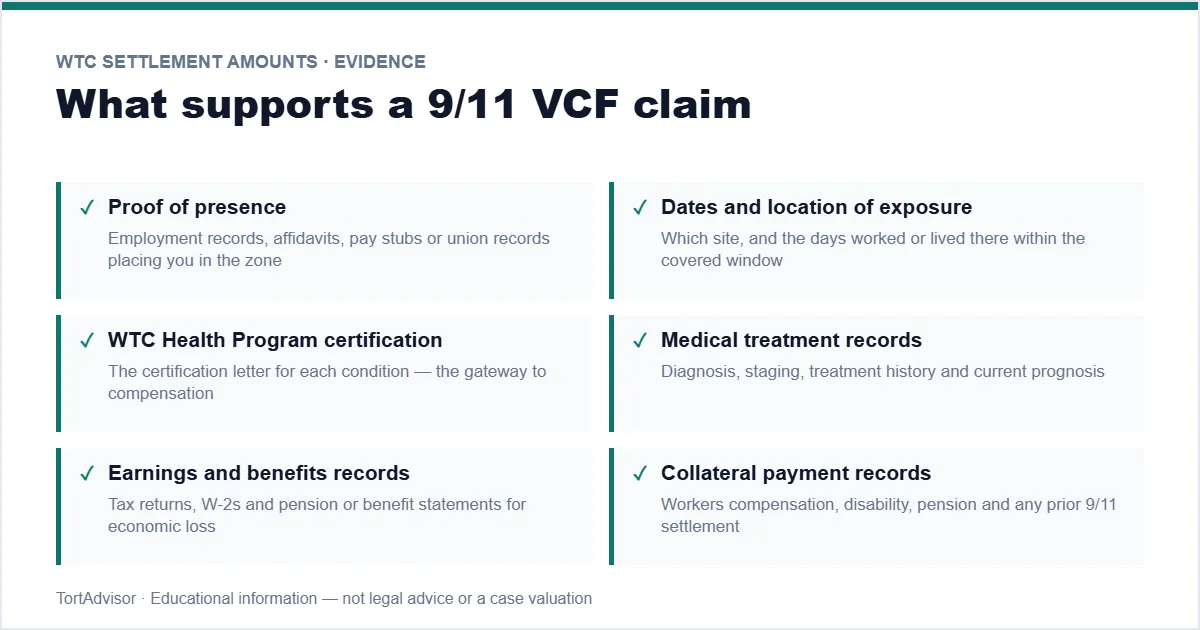
Two evidence problems decide most WTC claims: proving you were there, and getting the condition certified.
Proof of presence
Employment and payroll records, union records, contemporaneous photographs, sign-in logs, school or residency records, and affidavits from people who were there with you.
Dates and location
Which site, and which days. The covered windows differ by site, and a claim can turn on whether the dates worked fall inside them.
Health Program certification
The certification letter for each condition. Without certification there is nothing for the fund to compensate, so enrolment usually comes first.
Full medical records
Diagnosis, staging, treatment history, hospitalisations, current prognosis and any documentation of effect on daily activities.
Earnings and benefits records
Tax returns, W-2s, pay records and pension or benefit statements. These drive the economic loss component and are frequently the largest part of an award.
Collateral payment records
Workers compensation, disability, pension and prior settlement documentation. These will be offset whether or not they are disclosed, so gathering them early avoids delay.
Filing Deadlines for WTC Settlement Amount Claims
The WTC programme has two clocks, and almost everyone worries about the wrong one.
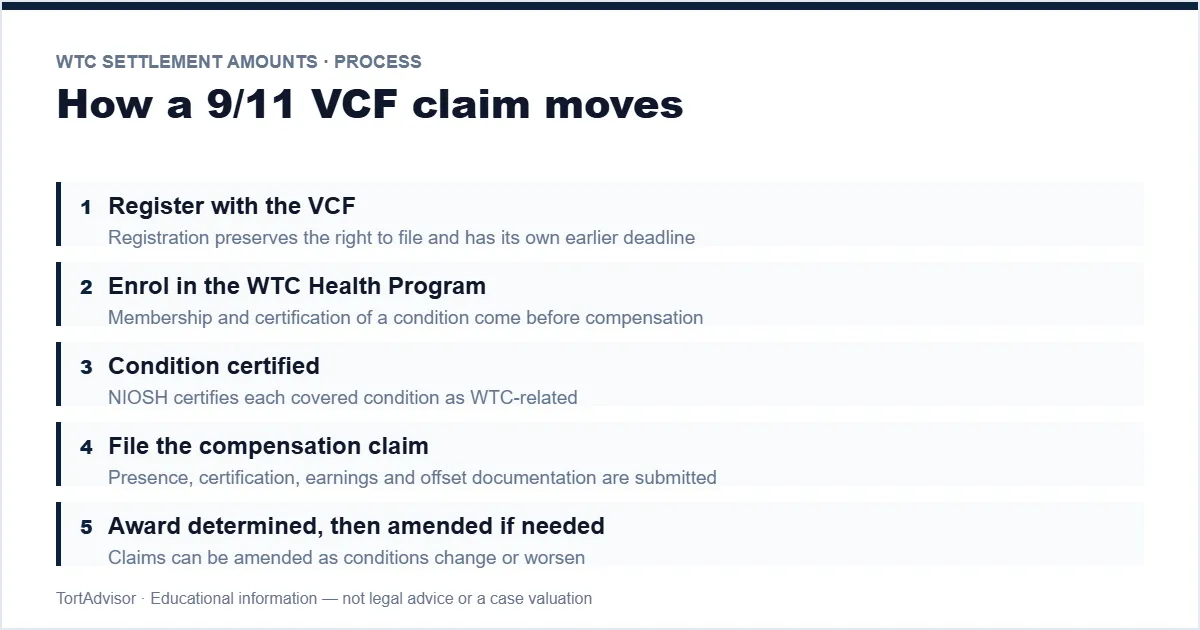
Register now, decide later
- Registration is free and takes minutes
- You do not need to be sick to register
- Registering preserves the right to file — it does not commit you to a claim
- It is the single cheapest protective step available in this programme
What does not extend a deadline
- Being enrolled in the WTC Health Program but not registered with the VCF
- Waiting for a condition to be certified
- Waiting to see whether symptoms worsen
- An open workers compensation or disability claim
Take the WTC Settlement Calculator Below
The WTC calculator organises what you know about where you were, which conditions have been certified, your treatment and your earnings history, then emails you a free VCF claim report on what the fund has actually paid and the rules it follows. It asks for no documents.
The report is educational and is not a case valuation or settlement offer.
Before You Start
- Which site you were at, and roughly which dates
- Whether you are enrolled in the WTC Health Program
- Which conditions have been certified, if any
- Whether the condition is a cancer
- Your approximate earnings at the time and now
- Any pension, disability or workers compensation you receive
Answer what you know. You do not need every record or an exact timeline to get started.
Primary Sources for WTC Settlement Amounts
Every figure above traces to one of these. Each was checked on Oct. 5, 2026.
VCF non-economic loss fact sheet
The VCF fact sheet on non-economic loss awards and certified conditions publishes the $10,000–$90,000 non-cancer range, the $250,000 cancer cap, the $340,000 multiple-condition figure, the presumptive maximums and the prostate cancer baseline.
VCF calculation of loss policy
Section 2 of the VCF policy manual sets out the award formula, the $255,610 annual gross income limit, the three economic loss components, the collateral offset categories and the personal consumption adjustment for death claims.
VCF programme authority
The VCF’s own programme description gives the authorising statutes, the Oct. 1, 2090 filing deadline under the 2019 permanent authorization, and the covered exposure zones and date windows for each of the three sites.
WTC Health Program
The World Trade Center Health Program, administered by NIOSH within the CDC, provides monitoring and treatment and certifies conditions as WTC-related. Certification is a precondition to compensation.
Programme totals
The VCF’s monthly statistics report as of Aug. 31, 2026 records $18.56 billion awarded, 112,302 claims submitted and 77,302 initial compensation determinations. It publishes totals, not an average award.
Covered condition review
NIOSH’s Scientific/Technical Advisory Committee evaluates petitions to add conditions to the covered list. A newly certified condition can make a previously ineligible claimant eligible, which is why registration matters even without a current diagnosis.
Frequently Asked Questions About WTC Settlement Amounts
What is the average WTC settlement amount?
The VCF’s monthly statistics report publishes totals, not an average, and an average would be misleading if it did. Awards combine a capped non-economic component with an economic component that ranges from nothing to several hundred thousand dollars depending on earnings history, then subtract collateral offsets. Two claimants with the same condition can receive very different amounts.
What is the maximum VCF payout?
The largest WTC 9/11 settlement figures published by the fund are for non-economic loss, $250,000 for cancer and $90,000 for non-cancer conditions, with up to $340,000 in a small number of cases involving multiple cancers or a cancer with multiple severe non-cancer conditions. Economic loss is calculated on top of that and has no single published ceiling, though annual gross income is counted only up to $255,610.
Sources: VCF non-economic loss fact sheet · VCF Calculation of Loss
Does having more certified conditions increase the award?
No. The fund states directly that the amount of non-economic loss is not tied to the number of certified conditions. What matters is the severity of the condition and its effect on the ability to maintain normal daily activities.
Source: VCF non-economic loss fact sheet
Why was my award lower than the published cap?
Most often because of collateral offsets. Pension payments, life insurance, Social Security, workers compensation and any prior 9/11 lawsuit settlement are subtracted from the calculated loss. A modest economic loss component also brings the total well below the headline figures.
Source: VCF Calculation of Loss
What is the deadline to file a 9/11 claim?
Claims may be filed and amended until Oct. 1, 2090 under the 2019 permanent authorization. Registration is a separate and much earlier deadline that varies by claim type, and missing it can bar a claim.
Sources: VCF deadlines · VCF FAQ 5.1 · amendments
Do I have to be a first responder?
No. Survivors are eligible too — residents, students, office workers, cleanup workers and people who were simply in the exposure zone. Children and students who were there at the time are eligible as adults now.
Source: VCF eligibility criteria
Do I need to be sick to register?
No. Registration preserves your right to file later and does not commit you to a claim. Because conditions can be certified years or decades after exposure, registering while healthy is the standard protective step.
Source: VCF · How to register
Is the WTC settlement calculator legally binding?
No. It is an educational questionnaire, and the report it emails you gives no dollar estimate for your claim. It is not a case valuation, not an offer, and produces nothing that binds the VCF, the Special Master or any law firm.
Source: VCF non-economic loss fact sheet
See Which Factors May Affect a WTC 9/11 VCF Award
Answer the questions you can about where you were, which conditions have been certified, treatment, records, earnings and long-term impact. When you submit it, we email you a free 9/11 VCF claim report on what the fund has actually paid and the rules it follows. It does not produce a dollar estimate for your claim.
The report is educational and is not a case valuation or settlement offer.
Helpful Information to Have Ready
You do not need every record in hand. Answer what you know; these details make the report more useful.
Reading this page is separate from any request to be contacted. The consent boxes on this form are unchecked unless you tick them yourself.