
World Trade Center Lawsuit 2026: 9/11 VCF Claims & Compensation Guide
The World Trade Center lawsuit and September 11th Victim Compensation Fund provide compensation pathways for 9/11 responders, survivors, cleanup workers, residents, students, volunteers, and families affected by toxic exposure.
This guide explains eligibility, WTC Health Program certification, covered conditions, filing deadlines, compensation factors, evidence needs, and official source links for 2026 claim review.
What Is a World Trade Center Lawsuit or VCF Claim?
A WTC claim may involve the VCF, WTC Health Program certification, workers’ compensation, disability benefits, or a civil claim. Compensation depends on diagnosis, exposure proof, certified conditions, economic losses, disability, wrongful death factors, deadlines, offsets, and medical documentation.
The VCF’s ultimate claim filing deadline is October 1, 2090, but claimants should not wait because registration, certification, medical records, exposure evidence, and economic-loss documentation can take time to gather.
See our WTC 9/11 Settlement Amounts guide for reported VCF award ranges by condition severity.
FREE CONFIDENTIAL REVIEW
Start Your Free WTC Claim Evaluation
Answer a few quick questions about your exposure history, diagnosis, WTC Health Program status, and potential VCF claim. No upfront cost and no obligation.
- For responders, survivors, cleanup workers, residents, students, volunteers, and families.
- WTC Health Program certification may support treatment and VCF compensation.
- Exposure records, medical records, and income records can affect claim value.
- Free confidential review available with no upfront cost.
How It Works — 3 Steps
Key Facts: World Trade Center Lawsuit and VCF Claims
The World Trade Center lawsuit topic usually refers to VCF compensation, WTC Health Program certification, and related legal or benefits pathways for people affected by 9/11 toxic exposure. The VCF’s program statistics report dated August 31, 2026 shows $18.56 billion in total compensation awarded since the fund reopened in October 2011.
VCF Filing Deadline
Oct. 1, 2090
The ultimate VCF claim filing deadline is October 1, 2090. Registration rules and individual documentation issues may still matter.
Compensation Paid
$18.56B
The VCF’s program statistics report dated August 31, 2026 shows $18.56 billion in total compensation awarded, from 112,302 claims submitted and 77,302 eligibility determinations.
SourceVCF31 Aug 2026
Medical Certification
WTCHP
WTC Health Program certification can provide treatment coverage and help support VCF claim documentation.
Who Is Eligible to File a World Trade Center Lawsuit or VCF Claim?
Eligibility may extend to responders and survivors who were present in qualifying exposure areas and later developed a certified 9/11-related physical health condition. Families may also seek review for wrongful death or deceased victim claims.
Potential Exposure Groups
- FDNY, NYPD, EMS, Port Authority, and emergency volunteers
- Recovery, cleanup, construction, debris removal, and utility workers
- Residents, students, office workers, and school staff in affected Lower Manhattan areas
- Pentagon and Shanksville recovery workers
- Surviving family members of qualifying victims
Helpful Exposure Evidence
- Employment, union, payroll, responder, or agency records
- Lease, school, address, utility, or business records
- Photos, affidavits, volunteer logs, or coworker statements
- Medical records and WTC Health Program certification
WTC-Related Health Conditions Covered in 2026
The WTC Health Program provides monitoring and treatment for certified 9/11-related health conditions. Covered categories include acute traumatic injuries, airway and digestive disorders, cancers, mental health conditions, and certain musculoskeletal disorders for responders.
Cancer Conditions
- Blood and lymphatic cancers
- Lung, thyroid, prostate, breast, kidney, bladder, and liver cancers
- Mesothelioma and other asbestos-related malignancies
- Oral, pharyngeal, laryngeal, colorectal, and skin cancers
Non-Cancer Conditions
- Asthma, COPD, RADS, chronic cough, and airway disorders
- GERD and other digestive conditions
- Sleep apnea when certified as related to WTC exposure
- Mental health conditions and certain responder musculoskeletal disorders
World Trade Center VCF Compensation Amounts 2026
World Trade Center compensation through the VCF is calculated using economic losses, non-economic losses, condition severity, wrongful death factors, disability impact, offsets, and supporting documentation.
| Award Component | What the VCF Publishes |
|---|---|
| Non-economic loss: cancer | Up to $250,000 for any one type of cancer |
| Non-economic loss: non-cancer | Up to $90,000 for any one type of non-cancer condition |
| Deceased victims | Presumed $250,000 in non-economic loss, plus $100,000 for the spouse and each dependent |
| Economic loss | Past and future lost earnings and benefits, counting annual gross income up to $255,610 |
| Collateral offsets | Deducted from the award: pension funds, life insurance, Social Security, workers’ compensation, and settlements from 9/11-related lawsuits |
The WTC Claim Filing Process
- Enroll in the WTC Health Program: Seek medical certification for qualifying 9/11-related health conditions.
- Register with the VCF: Preserve your right to file by meeting the registration deadline applicable to your individual circumstances.
- Gather documentation: Collect exposure records, diagnosis records, employment history, earnings history, and medical evidence.
- File the VCF claim: Submit required forms, supporting documents, and loss calculations.
- Review the award: The VCF may request more information, issue a determination, or allow appeal procedures if needed.
Evidence That Can Strengthen a WTC Claim
A strong claim usually connects three things clearly: qualifying exposure, certified medical condition, and documented economic or non-economic loss.
Exposure Evidence
- Employment records
- Union or payroll records
- Responder logs or agency records
- Address, lease, or school records
Medical Evidence
- WTC Health Program certification
- Diagnosis records
- Pathology or imaging records
- Treatment and prognosis records
Damages Evidence
- Income and tax records
- Disability records
- Caregiving and out-of-pocket costs
- Wrongful death and dependency records
How a World Trade Center VCF Award Is Calculated
Most people researching a World Trade Center claim look first for a single payout figure. The September 11th Victim Compensation Fund does not work that way. Every award is built from the same formula: non-economic loss, plus economic loss, minus collateral offsets. Understanding those three parts explains why two claimants with the same diagnosis can receive very different amounts.
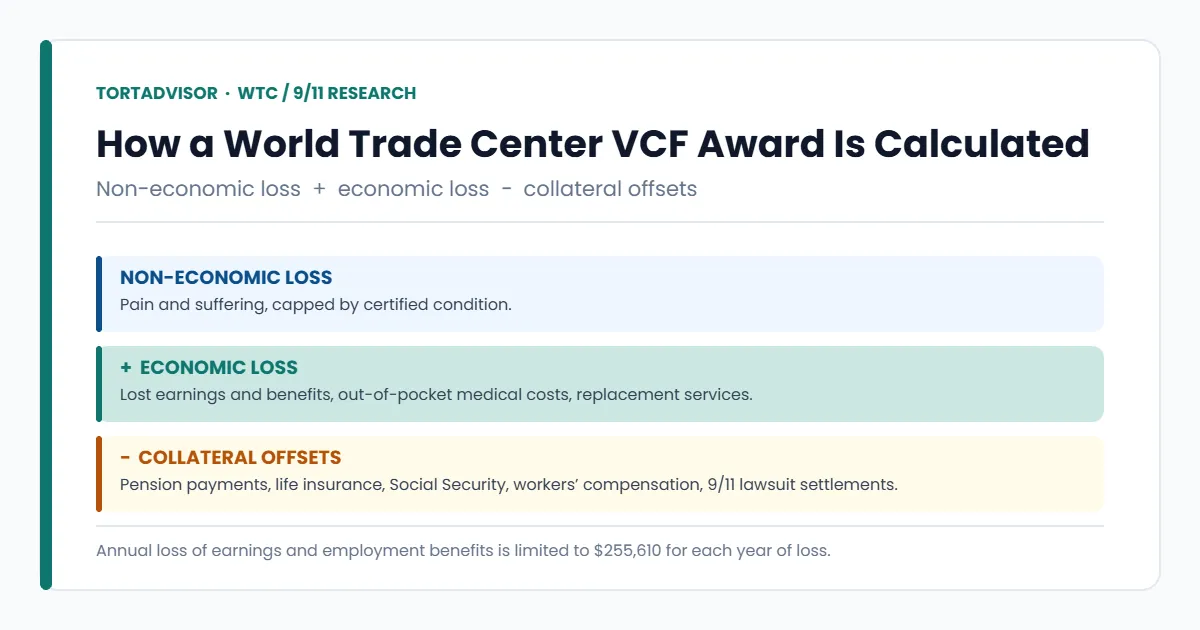
Non-economic loss
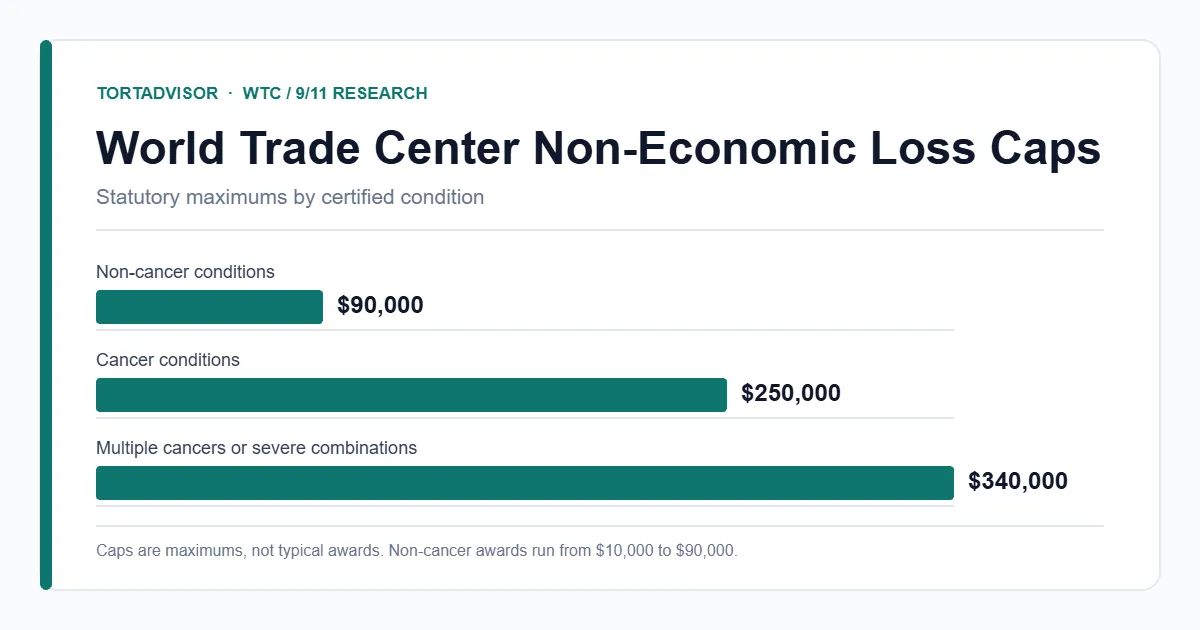
This is the pain-and-suffering component, and it is the part the VCF caps by statute. The published maximums are $10,000 to $90,000 for non-cancer conditions, up to $250,000 for cancer conditions, and up to $340,000 where a claimant has multiple cancers or a cancer alongside multiple severe non-cancer conditions. The VCF sets the figure within those bands based on the severity of each certified World Trade Center condition and the effect it has on the claimant’s ability to carry out normal daily activities.
Economic loss
Economic loss covers three things: lost earnings and employment benefits, out-of-pocket medical expenses already paid for the eligible condition, and replacement services loss — the cost of replacing household work the claimant used to do. This is usually the larger component for a working-age World Trade Center claimant, and it is also the part that requires the most documentation. One statutory limit matters here: for each year of loss, the methodology caps the annual loss of earnings and employment benefits at $255,610.
Collateral offsets
The VCF then subtracts compensation already received for the same injury from other sources. Pension payments, life insurance proceeds, Social Security benefits, workers’ compensation awards and settlements from 9/11-related lawsuits are all deducted. This is the step most often missed by people estimating their own World Trade Center claim value, and it is why a headline cap is never a reliable prediction of what a World Trade Center claim actually pays.
The Two World Trade Center Deadlines People Confuse
The World Trade Center deadline most often quoted is October 1, 2090 — the last date on which anyone can file a VCF claim. Because it is so far away, it creates a false sense that there is no hurry. For most claimants the deadline that actually governs their claim is a different one, and it is much shorter.
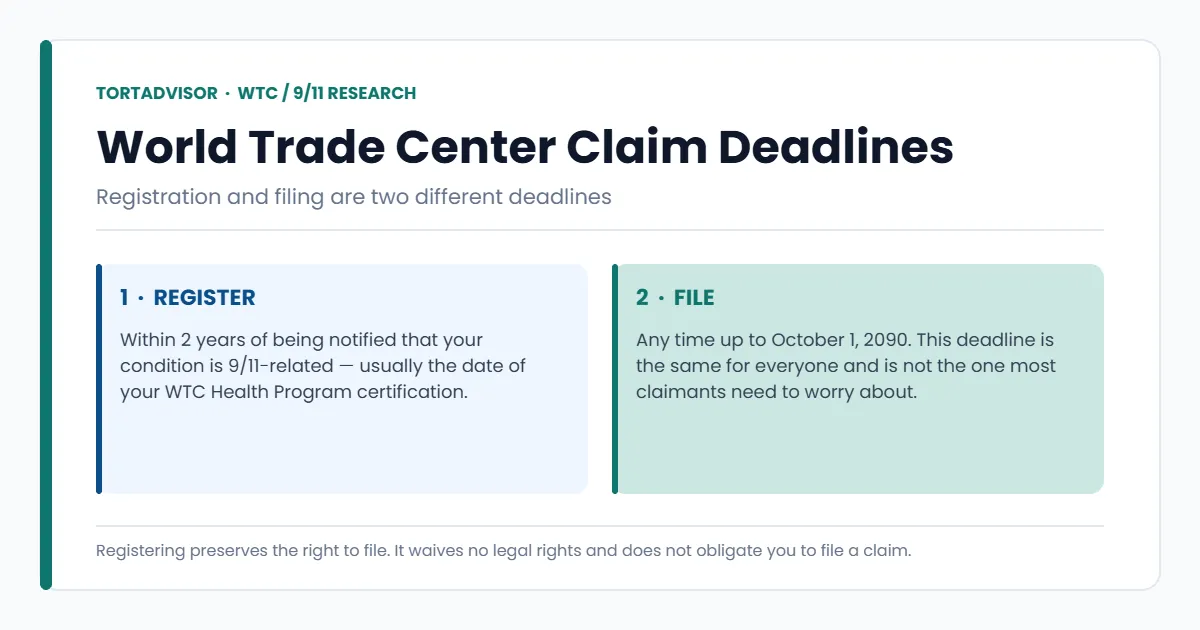
Registration is separate from filing, and the distinction decides most World Trade Center claims. Registering preserves the right to file a claim later; the VCF is explicit that it waives no legal rights and does not obligate anyone to file. For a personal injury claim, registration must happen within two years of the date a federal, state or local government entity notifies the claimant that their physical health condition is 9/11-related. In practice that clock usually starts on the date of WTC Health Program certification.
For a claim brought on behalf of someone who has died, the personal representative must register within two years of whichever comes later: the date of death, or the date the VCF verifies the condition as 9/11-related. Registering on time is what makes an eventual claim timely filed, which is why it is the first thing to do rather than the last.
What the World Trade Center Fund Has Actually Paid
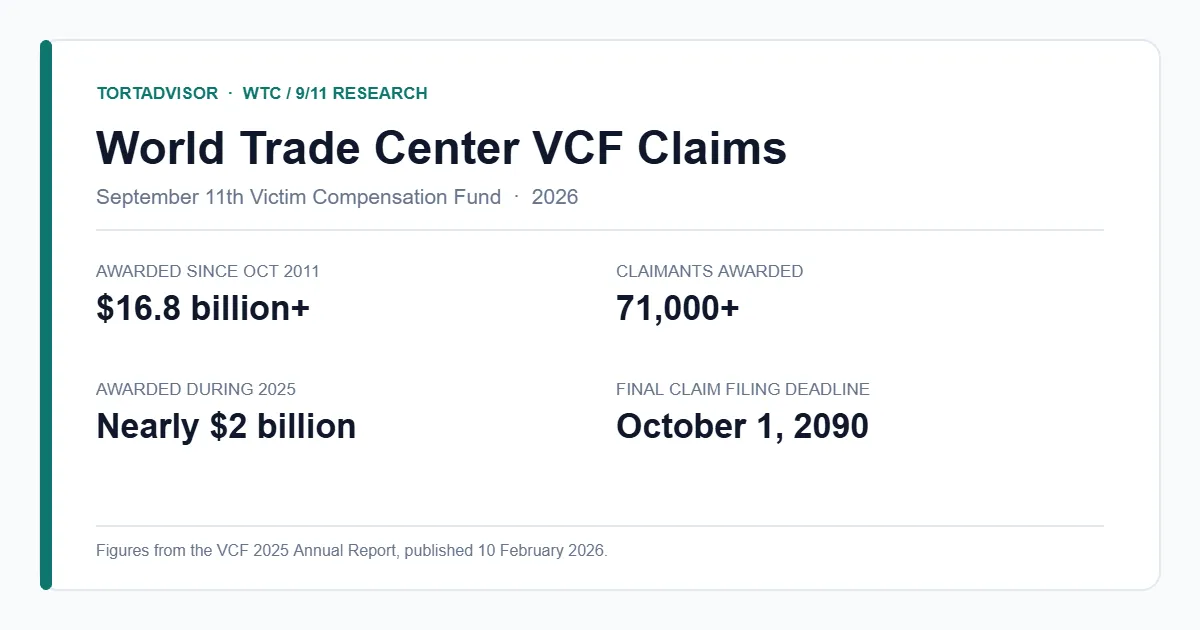
The VCF publishes its own numbers annually, and they are the most reliable guide to the programme’s scale. Its 2025 Annual Report, published on 10 February 2026, records that the fund has awarded more than $16.8 billion to over 71,000 claimants since it reopened in October 2011, including nearly $2 billion during 2025 alone.
The report also notes that new claims are still increasing: the VCF received an average of 700 new claims a month during 2024, rising to 900 a month in 2025. That trend matters for anyone weighing whether the World Trade Center programme is winding down. It is not — the population of people receiving a first certification for a 9/11-related condition is still growing, two decades on, because many of the covered cancers have long latency periods.
What these totals cannot tell an individual claimant is what their own award will be. An average across 71,000 awards spanning deceased and living claims, cancer and non-cancer conditions, and wildly different earnings histories is not a prediction. It is context.
Common Misconceptions About World Trade Center Claims
“The cap is what I will receive”
The $250,000 and $340,000 figures are statutory maximums for the non-economic component only, awarded for the most severe presentations. They are not typical awards, and collateral offsets are subtracted afterwards.
“I have to sue somebody”
The VCF is an administrative compensation programme, not litigation. There is no defendant, no trial and no requirement to prove fault — the questions are presence, timing, certification and documented loss. A World Trade Center claim and a civil lawsuit are different routes, and accepting a VCF award has consequences for the other.
“2090 is the deadline, so there is no rush”
The registration deadline, not the filing deadline, is the one that ends most claims. It runs two years from the notification that a condition is 9/11-related.
“Certification and compensation are the same thing”
WTC Health Program certification provides monitoring and treatment for a covered condition. It is the usual gateway to a VCF claim, but it is a separate programme with a separate application, and being certified does not by itself produce a payment.
Sources and Official References
This guide uses official and public sources for the VCF deadline, program statistics, covered condition categories, and claim process context. Source links are included for reader trust, AI citation clarity, and search understanding.
Frequently Asked Questions: World Trade Center Lawsuit and VCF Claims
Is there still time to file a World Trade Center VCF claim in 2026?
Yes. The VCF claim filing deadline is October 1, 2090. However, claimants should register and file as soon as possible because documentation, certification, and other legal deadlines may affect claim strategy.
SourceVCFDeadlines
Who may qualify for a World Trade Center lawsuit or VCF claim?
Responders, recovery workers, cleanup workers, residents, students, office workers, volunteers, Pentagon or Shanksville workers, and surviving family members may qualify if exposure and certified 9/11-related health conditions can be documented.
Can I receive WTC Health Program benefits and VCF compensation?
Yes. The WTC Health Program provides medical monitoring and treatment for certified conditions, while the VCF provides financial compensation for eligible economic and non-economic losses.
What evidence helps a WTC claim?
Helpful evidence may include employment records, responder logs, union records, address records, school records, medical records, WTC Health Program certification, diagnosis records, income records, and affidavits.
Does TortAdvisor provide legal advice?
No. TortAdvisor is not a law firm. This page provides general information only and does not guarantee compensation or create an attorney-client relationship.
Request a Free World Trade Center Claim Review
If you were present near a 9/11 disaster site and later developed a qualifying illness, request a free confidential review. There is no upfront cost, and partner firms typically work on contingency.
Prefer to start now? Use the free evaluation form above, or call for a confidential review.