
Depo Provera Brain Tumor Lawsuit 2026: Who Qualifies

Find out if you may have a claim
Answer a few questions and a trained case advisor will review your situation — most people finish in about a minute.
- Free — no cost, no obligation
- About a minute to complete
- Reviewed by a trained case advisor
- Nothing you submit is published
Your details are sent over a secure connection and reviewed confidentially.
Quick Answer: The depo provera brain tumor lawsuit involves claims that long-term use of injectable medroxyprogesterone acetate, sold as Depo-Provera, is associated with increased risk of intracranial meningioma and that patients were not adequately warned.
This guide explains eligibility, medical evidence, settlement-value factors, filing deadlines, litigation status, and how to request a free confidential review.
What Is the Depo Provera Brain Tumor Lawsuit?
The depo provera brain tumor lawsuit is a pharmaceutical mass tort involving people who allege they developed meningioma after receiving Depo-Provera injections. Plaintiffs generally claim that the manufacturer failed to provide adequate warnings about meningioma risk tied to repeated or prolonged use.
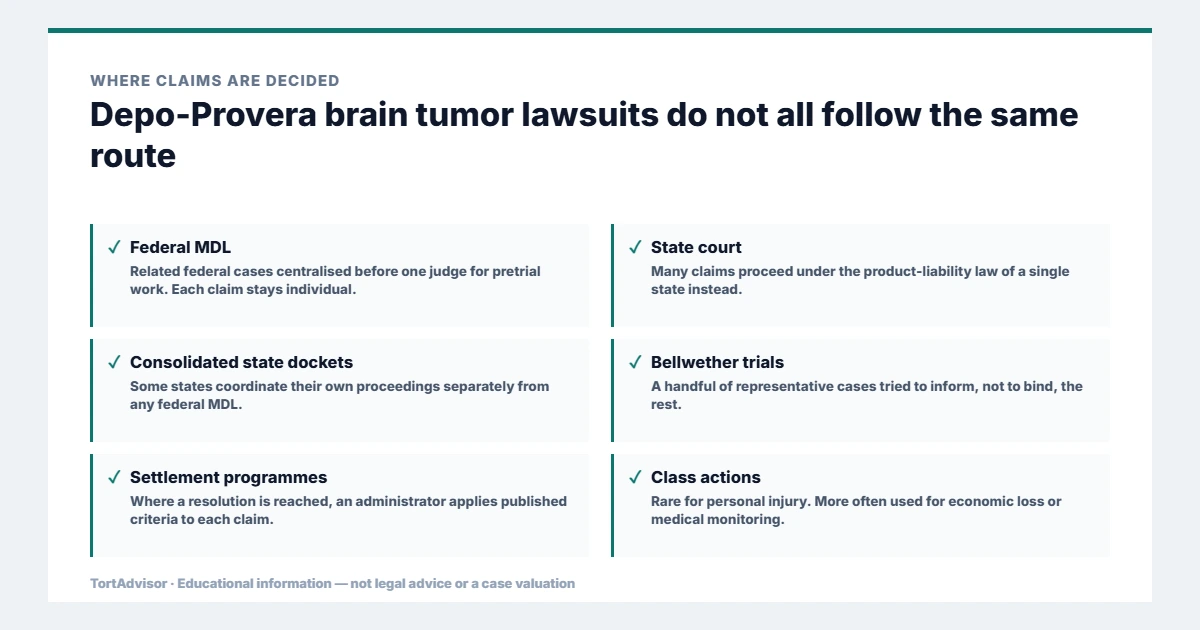
Federal cases are centralized in In re: Depo-Provera (Medroxyprogesterone Acetate) Products Liability Litigation, MDL No. 3140, in the Northern District of Florida before Judge M. Casey Rodgers. The court’s MDL page identifies the proceeding and its transfer for coordinated pretrial management.
Meningiomas are tumors that develop from the membranes surrounding the brain and spinal cord. Although many are classified as benign, they can still cause seizures, headaches, vision changes, neurological deficits, cognitive problems, brain surgery, radiation treatment, recurrence monitoring, and permanent life disruption.
The Science: Depo-Provera and Meningioma Risk
Scientific support for the depo provera brain tumor lawsuit centers on research involving progestogens and meningioma risk. A 2024 BMJ study found that prolonged use of injectable medroxyprogesterone acetate was associated with increased risk of intracranial meningioma. BMJ Group’s summary reported a 5.6-fold increased risk for prolonged medroxyprogesterone acetate injection use.
Depo-Provera contains medroxyprogesterone acetate, a synthetic progestin. Meningioma biology is relevant because many meningiomas express hormone receptors, and plaintiffs often argue that long-term hormonal exposure can promote tumor growth in susceptible patients.
The FDA-approved Depo-Provera labeling now includes a meningioma warning section stating that cases of meningiomas have been reported following repeated administration of medroxyprogesterone acetate, primarily with long-term use. That label language is important context for users and attorneys reviewing warning-history arguments.

Depo-Provera Brain Tumor Lawsuit Settlement Amounts 2026
No settlement amount has been published for any depo provera brain tumor lawsuit claim. On 15 June 2026, plaintiffs’ leadership counsel announced a settlement of a majority of the claims in MDL 3140 and in New York state court, and the parties signed a confidential Master Settlement Agreement on 21 July 2026. The parties estimate that roughly 80% of MDL plaintiffs will be eligible. No aggregate, per-plaintiff or per-tier figure has been released.
SourceN.D. Fla. CMO 1227 Jul 2026
Claimants must register for the Settlement Program by 30 November 2026. What an individual claim is worth will depend on the program’s confidential terms and on the claimant’s diagnosis, treatment and records, so this page publishes no dollar range.
Who Qualifies for the Depo Provera Brain Tumor Lawsuit?
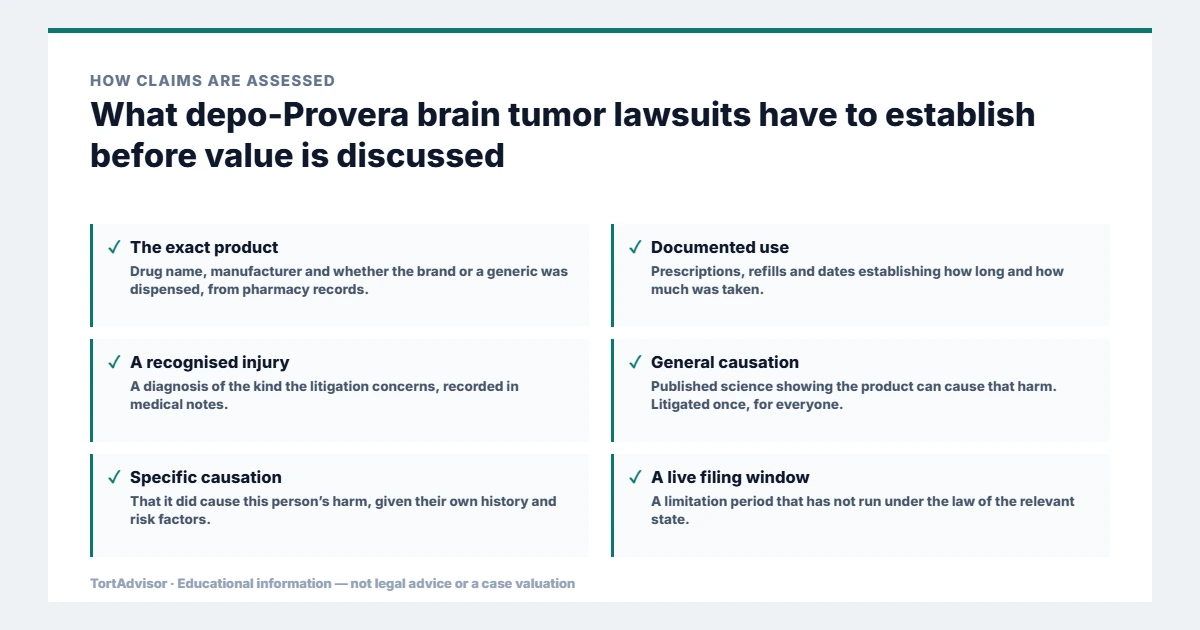
Eligibility for the depo provera brain tumor lawsuit usually depends on diagnosis, Depo-Provera use history, records, timing, and state-specific deadline rules.
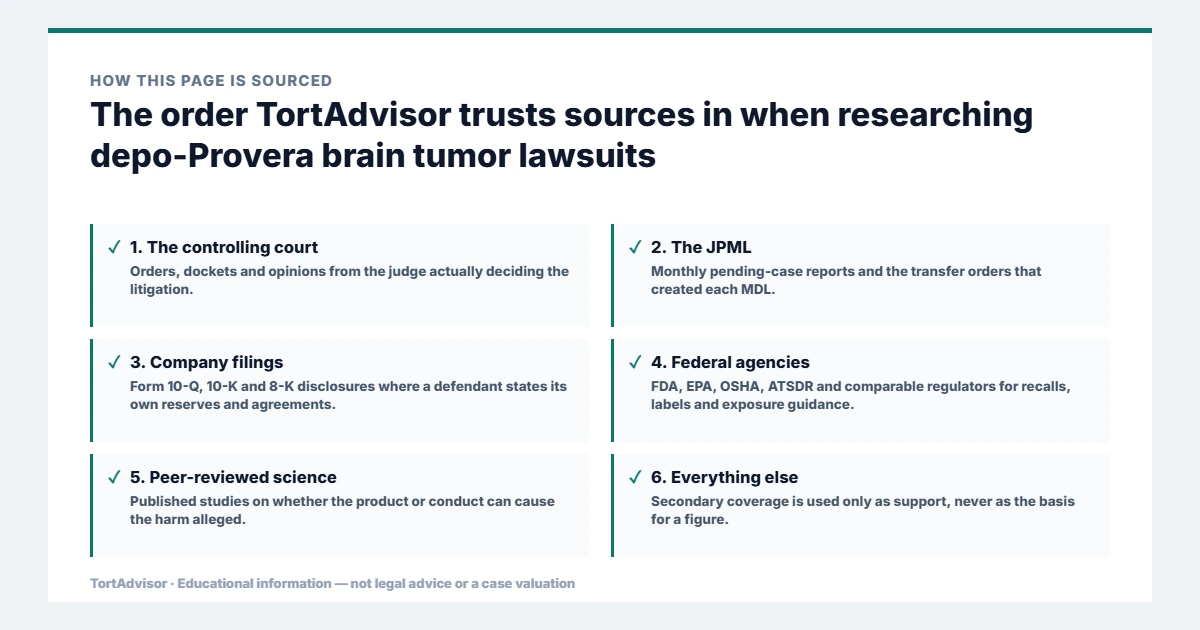
Every status, deadline and figure published on this page about depo-Provera brain tumor lawsuits is traced to a primary source before it appears.
Potentially stronger claims
- Intracranial or brain meningioma diagnosis after Depo-Provera injections.
- Repeated or long-term injectable medroxyprogesterone acetate use.
- MRI, pathology, surgical, radiation, neurology, or oncology records.
- Pharmacy records, OB/GYN logs, prescription history, or injection records.
- Significant symptoms, surgery, permanent impairment, lost income, or major medical bills.
Claims needing closer review
- Spinal-only meningioma or uncertain tumor type.
- Short-term use or unclear injection history.
- Missing medical records or pharmacy documentation.
- Diagnosis before Depo-Provera use began.
- Expired or uncertain state filing deadline.
Pfizer Liability and the Failure-to-Warn Theory
The central allegation in many depo provera brain tumor lawsuit claims is failure to warn. Plaintiffs generally contend that the manufacturer knew or should have known about meningioma risk and failed to provide adequate warnings to patients and prescribing physicians.
Defendants may respond with several defenses, including arguments about scientific causation, federal labeling law, FDA communications, case-specific alternative causes, and whether any alleged warning would have changed prescribing decisions. Public reporting has noted that Pfizer has raised federal preemption arguments in the litigation.
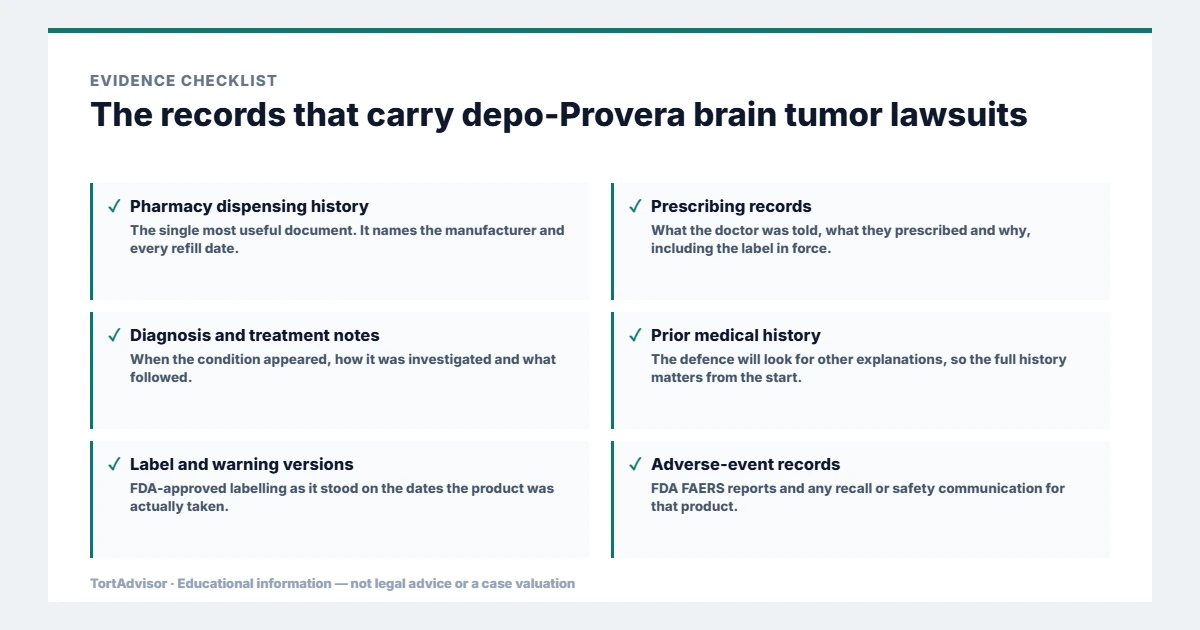
Because warnings and causation arguments are complex, individual claims require review of product history, label timing, medical records, prescribing records, and state law.
How to File a Depo-Provera Brain Tumor Claim
Filing a depo provera brain tumor lawsuit starts with record collection and attorney review. Most mass tort firms review these cases for free and work on contingency, meaning no upfront attorney fee is charged unless a recovery is obtained.
1. Gather Depo-Provera records
Collect injection records, pharmacy records, OB/GYN notes, prescription history, and documents showing product timing and duration.
2. Gather tumor records
Collect MRI reports, pathology reports, surgery records, radiation records, neurology notes, oncology records, and symptom timelines.
3. Request legal review
A qualified attorney can review causation, product history, injuries, damages, deadline risk, and whether your claim may fit litigation criteria.

Filing Deadlines by State
Do not wait to ask about deadlines. The statute of limitations for a depo provera brain tumor lawsuit can vary by state and may depend on diagnosis date, discovery of the Depo-Provera connection, product warnings, injury date, or other legal rules.
| State Example | Common Personal Injury/Product Liability Period | Deadline Note |
|---|---|---|
| California | Often 2 years | Discovery-rule issues may apply. |
| Florida | Often 2 years for negligence-based injury claims | Product and discovery rules require attorney review. |
| New York | Often 3 years | Timing depends on claim type and discovery issues. |
| Texas | Often 2 years | Strict timing review is important. |
| Illinois | Often 2 years | Discovery and repose rules may matter. |
Depo Provera Brain Tumor Lawsuit Updates 2026
As of 1 October 2026, 6,412 actions were pending in MDL No. 3140 in the Northern District of Florida before Judge M. Casey Rodgers.
SourceJPML MDL report1 Sep 2026
The June 2026 settlement changed the court’s calendar. Because the Pilot (bellwether) plaintiffs became eligible to take part, the court cancelled their December 2026 trial, and it scheduled the hearing on the parties’ Rule 702 (Daubert) motions for 18 September 2026. Those rulings apply to cases that do not settle.
Sources and External References
These sources support the regulatory, scientific, litigation, and medical context on this page. They are included for reader trust and citation clarity, not as legal or medical advice.
- Northern District of Florida — Depo-Provera Products Liability Litigation, MDL No. 3140. Accessed June 10, 2026.
- FDA label — Depo-Provera CI prescribing information, meningioma warning. Accessed June 10, 2026.
- BMJ — Use of progestogens and the risk of intracranial meningioma. Accessed June 10, 2026.
- BMJ Group — summary of increased brain tumour risk findings for certain progestogens. Accessed June 10, 2026.
- National Cancer Institute — Meningioma Treatment (PDQ). Accessed June 10, 2026.
- American Association of Neurological Surgeons — Meningiomas. Accessed June 10, 2026.
- Google Search Central — creating helpful, reliable, people-first content. Accessed June 10, 2026.
- Google Search Central — structured data guidelines. Accessed June 10, 2026.
Still unsure where you stand?
Have a trained case advisor review your own facts — free, confidential, and with no obligation.
- Free — no cost, no obligation
- About a minute to complete
- Reviewed by a trained case advisor
- Nothing you submit is published
Your details are sent over a secure connection and reviewed confidentially.
Frequently Asked Questions — Depo Provera Brain Tumor Lawsuit
What is the depo provera brain tumor lawsuit?
It is litigation involving claims that Depo-Provera use is associated with meningioma and that patients and physicians were not adequately warned about risk.
For the current litigation status, evidence requirements and settlement research behind this topic, see TortAdvisor’s depo provera lawsuit research.
How much is a Depo-Provera meningioma claim worth?
No amount has been published. The settlement announced on 15 June 2026 is confidential, and no aggregate, per-plaintiff or per-tier figure has been released. An individual claim’s value will depend on the program’s terms and on the claimant’s diagnosis, treatment and records.
Who may qualify?
People with intracranial meningioma after repeated or long-term Depo-Provera injections may qualify for review, especially with strong medical and injection records.
Do I need surgery to qualify?
Not always. Surgery can increase severity, but radiation, monitoring, serious symptoms, and documented diagnosis may still require legal review.
Is there a filing deadline?
Yes. Deadlines vary by state and may depend on diagnosis, discovery, warnings, and other facts. Prompt attorney review is important.
Does this page give legal advice?
No. This page is educational only and does not create an attorney-client relationship.
Request a Free Depo-Provera Meningioma Case Review
If you used Depo-Provera and were later diagnosed with meningioma, call now for a confidential review. There are no upfront fees to ask whether your records may support a claim.
Related Posts

How VCF registration works: who should register, the two-year deadline and when it starts, how to register online or by phone, and how it fits with the WTC Health Program.
Paraquat exposure explained from EPA, CDC and court records: how it happens, who is most at risk, drift and vapor, the safety rules since 2016, Parkinson’s research, and the records that help show exposure.

The Supreme Court's June 25, 2026 ruling in Monsanto v. Durnell held that FIFRA can preempt state failure-to-warn claims, unsettling a central theory in paraquat cases. With 6,666 actions pending in MDL 3004 and a global settlement agreed in principle but no terms disclosed, here is what is verified and what is not.