
What to Do After a Car Accident: 7 Critical Steps to Protect Your Health & Claim
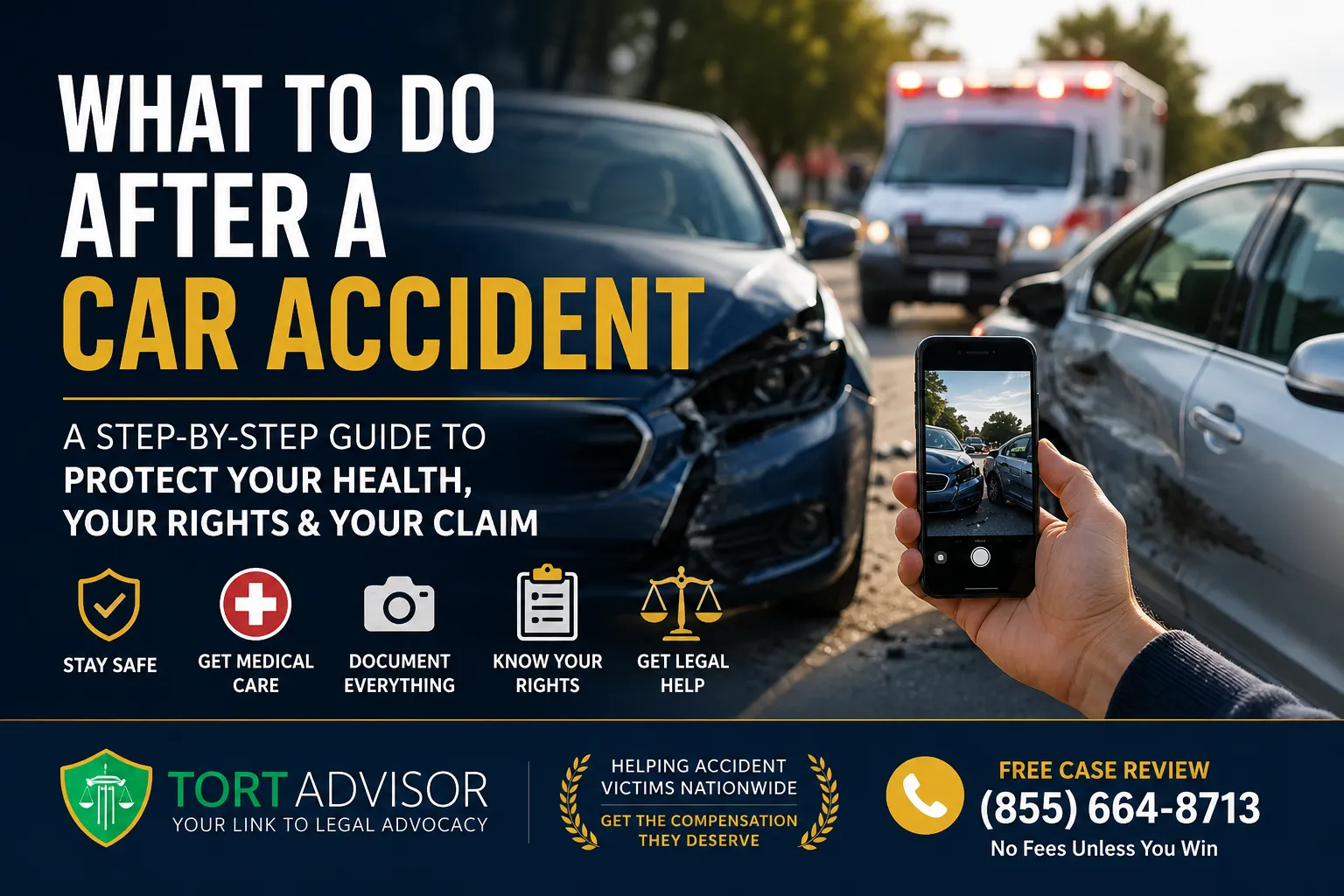
What to do after a car accident starts with three priorities: safety, medical care, and evidence preservation — in that order. Call 911, document the scene thoroughly, seek appropriate medical attention, notify your insurance company, and understand your legal options before accepting any settlement offer. The steps you take in the first hours and days after a crash can affect both your recovery and your injury claim.
Find out if you may have a claim
Answer a few questions and a trained case advisor will review your situation — most people finish in about a minute.
- Free — no cost, no obligation
- About a minute to complete
- Reviewed by a trained case advisor
- Nothing you submit is published
Your details are sent over a secure connection and reviewed confidentially.
Need Help With What to Do After a Car Accident?
You may be entitled to compensation for your injuries, lost wages, and pain and suffering. Get a free case review today.
No charge to submit a case review. Attorney fees, if representation is offered, are governed by a separate engagement agreement.
Published by: Mason Arnao | Primary Sources: NHTSA 2024 Traffic Fatality Report, NHTSA CrashStats, State No-Fault Laws
Knowing what to do after a car accident can protect your health, preserve important evidence, and help you avoid mistakes that may affect an insurance or personal injury claim. Each year, millions of Americans are involved in motor vehicle crashes. According to the National Highway Traffic Safety Administration (NHTSA), there were an estimated 39,345 traffic fatalities in 2024 — a 3.8% decrease from 2023, but still far above pre-pandemic levels. Millions more survive crashes with injuries that range from minor to life-altering. What you do in the minutes, hours, and days following a crash directly affects your physical recovery, your ability to file an insurance claim, and your right to pursue compensation. This guide walks you through every step — from the scene to the settlement — so you’re never left wondering what comes next.
What to Do After a Car Accident: Why Your First Steps Matter
Insurance companies and opposing attorneys begin building their defense the moment a crash occurs. Evidence degrades quickly: skid marks fade, witnesses leave, surveillance footage is overwritten, and injuries that aren’t documented early become targets for the claim that they were pre-existing or unrelated to the accident. At the same time, your state’s laws set hard deadlines on when you can file a claim or lawsuit — called the statute of limitations — which ranges from one to six years depending on the state. Protect yourself by acting deliberately and methodically from the very start.
Step 1: What to Do After a Car Accident at the Scene
Your first obligation after any crash is physical safety. Do not let concern about your car, your schedule, or your phone distract you from these immediate priorities:
- Turn on your hazard lights immediately.
- Move your vehicle out of active traffic if it is drivable and safe to do so — pull to the shoulder or a nearby parking lot. Do not abandon the scene.
- Check yourself and passengers for injury before exiting the vehicle. Do not move anyone who may have a neck or spine injury unless there is an immediate fire or safety threat.
- Set up road flares or warning triangles if you have them and it is safe to exit the vehicle.
- Stay calm. Adrenaline masks pain — you may feel fine and still be injured.
Step 2: Should You Call 911 After a Car Accident? (Yes — Here’s Why)
Many people hesitate to call 911 after what feels like a minor fender-bender. This is one of the most costly mistakes you can make. You should call 911 after every crash, for these reasons:
- A police report creates an official record of the accident, the other driver’s information, witness statements, and an officer’s preliminary assessment of fault. Insurance companies treat these reports as primary evidence.
- Many states legally require you to report accidents that result in injury, death, or property damage above a threshold (typically $500–$1,000). Failure to report can result in fines or license suspension.
- Injuries are often not apparent immediately. Whiplash, traumatic brain injury, and internal injuries routinely don’t present symptoms for 24–72 hours after a crash. A police report documents the accident before symptoms appear, protecting your ability to connect the injury to the crash later.
- The other driver may change their story. Without a police report, disputes over who was at fault become your word against theirs.
When the officer arrives, provide factual information only. Do not speculate about speed, fault, or your condition. Ask the officer for the report number before they leave — you’ll need it when contacting your insurance company.
Step 3: How Do You Document a Car Accident Scene Properly?
While waiting for police (or after they arrive), use your phone to gather evidence. The goal is to make it impossible for anyone to dispute what happened or how severe the damage was.
What to photograph and collect:
- All vehicles involved — multiple angles, close-ups of damage, and wide shots showing position on the road
- License plates of all vehicles
- Skid marks, debris, traffic signs, and road conditions
- Your own visible injuries — bruises, lacerations, swelling
- The other driver’s: name, address, phone number, driver’s license number, insurance company, policy number, and vehicle registration
- Names and contact information of all witnesses
- Name and badge number of responding officers
- Nearby business names (for potential surveillance footage)
- Traffic camera locations
What to write down:
- Time, date, and exact location of the crash
- Weather, lighting, and road conditions
- Your own account of what happened — written while memory is fresh
- Any statements made by the other driver
Step 4: Why Should You Get Medical Attention After a Car Accident — Even if You Feel Fine?
Seeking medical care immediately after a crash is not just about your health — it is a legal and financial necessity. Here’s why: Delayed symptoms are common and dangerous. Soft tissue injuries, whiplash, concussions, and internal bleeding frequently don’t produce obvious symptoms for 24–72 hours. By the time pain appears, the window for establishing a clear causal link to the accident may have narrowed. A gap in treatment is a gift to the insurance adjuster. If you wait days or weeks before seeing a doctor, the insurance company will argue your injuries aren’t serious, weren’t caused by this accident, or were pre-existing. That argument is hard to defeat without contemporaneous medical records.
What “getting medical attention” means in practice:
- If you have any pain, dizziness, confusion, or obvious injury: go to the emergency room or urgent care that day.
- If you feel fine: see your primary care doctor within 24–48 hours and tell them you were in an accident. Ask for a full evaluation including neurological checks.
- Follow up with specialists as referred — do not skip appointments. Every missed appointment is a record the insurance company will use.
- Keep all medical bills, prescription records, and treatment notes.
Your medical records are the foundation of your personal injury claim. The stronger and more complete they are, the stronger your settlement position.
Step 5: How Do You Notify Your Insurance Company After a Car Accident?
Most auto insurance policies require you to report accidents “promptly” — some within 24 hours. Failure to report in a timely manner can jeopardize your coverage. Here’s how to handle this carefully:
What to do:
- Call your own insurance company first to report the accident. Give them the police report number, the other driver’s information, and a factual account of the crash.
- Do not give a recorded statement to the other driver’s insurance company without first consulting an attorney. They are not on your side — recorded statements are frequently used to minimize payouts.
- Do not accept any settlement offer before you understand the full extent of your injuries. Some injuries — especially soft tissue and neurological — take weeks or months to fully present.
What not to do:
- Do not post about the accident on social media. Anything you post can be used against you.
- Do not sign any release or waiver without legal review.
- Do not assume the other driver’s insurance will handle everything fairly.
Step 6: Does Your State’s Fault Law Change What You Do After a Car Accident?
Yes — significantly. The United States is divided into fault states (also called tort states) and no-fault states, and the rules are different in each.
What is confirmed:
- As of 2026, there are 12 true no-fault states where your own Personal Injury Protection (PIP) insurance pays your medical bills and lost wages regardless of who caused the accident: Florida, Hawaii, Kansas, Kentucky, Massachusetts, Michigan, Minnesota, New Jersey, New York, North Dakota, Pennsylvania, and Utah. (Source: World Population Review)
- In no-fault states, you generally cannot sue the at-fault driver unless your injuries meet a “serious injury threshold” — which varies by state but typically includes permanent disability, significant disfigurement, or medical bills exceeding a set dollar amount.
- In fault (tort) states, you may file a claim directly against the at-fault driver’s liability insurance and sue them in civil court if needed.
What is not yet confirmed:
- Several states are currently debating reforms to their no-fault systems — the specific thresholds and PIP limits applicable in your state may have changed. Always verify with a licensed attorney in your state before deciding whether to file a lawsuit.
Not sure which laws apply in your state?
A participating attorney can review the facts of your case and explain which state laws, insurance rules, and potential recovery options may apply.
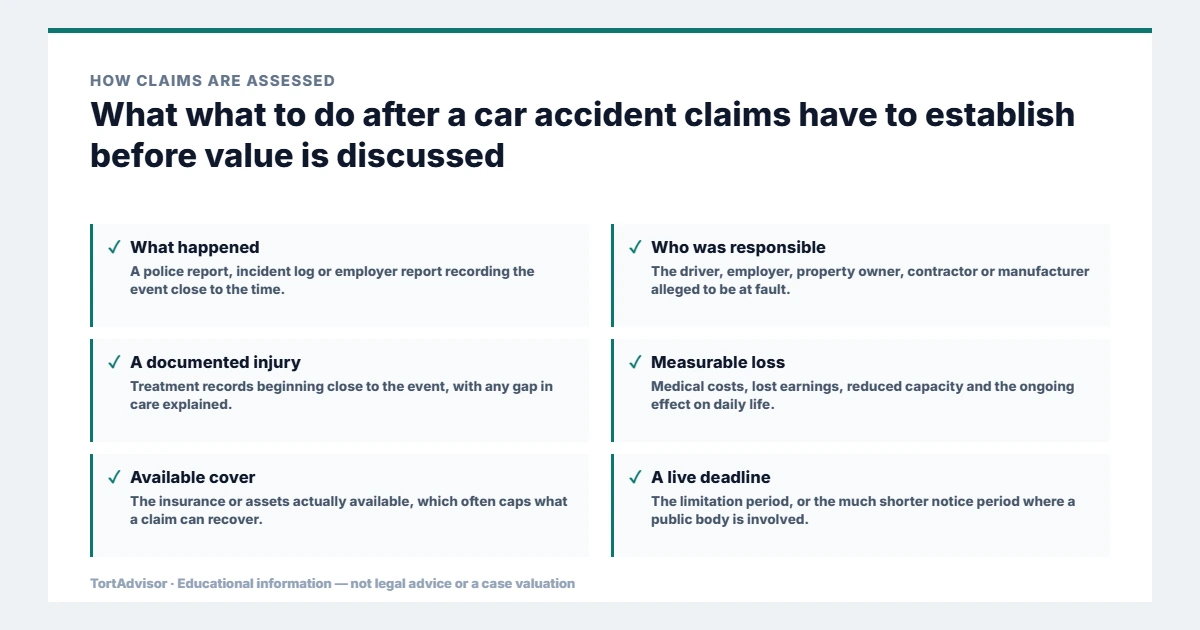
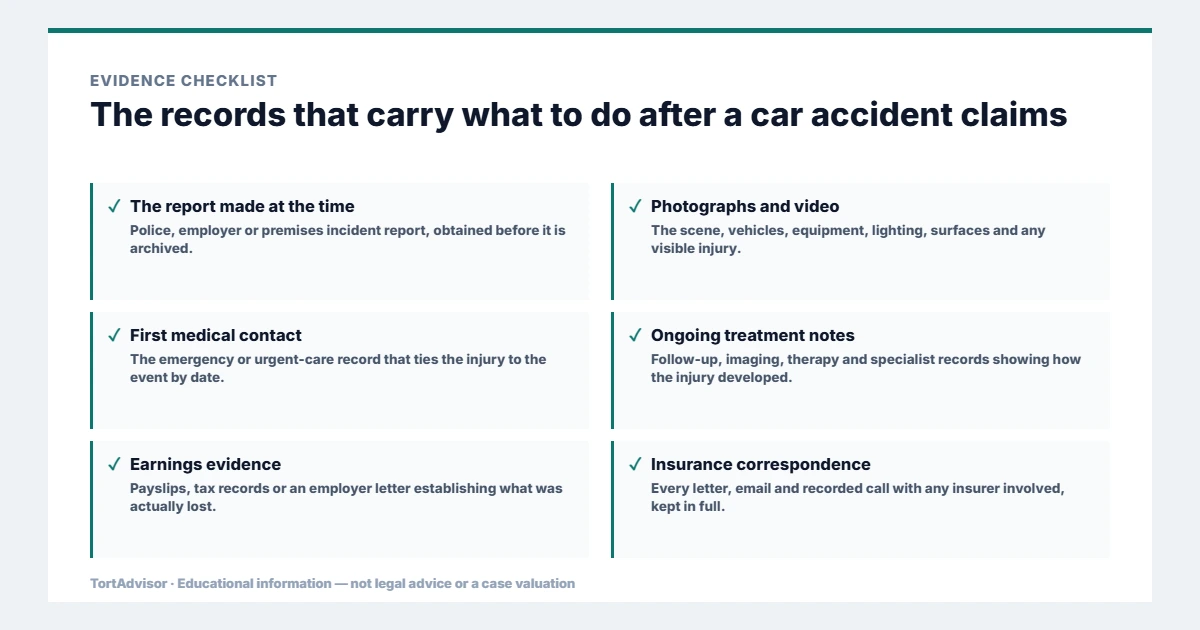
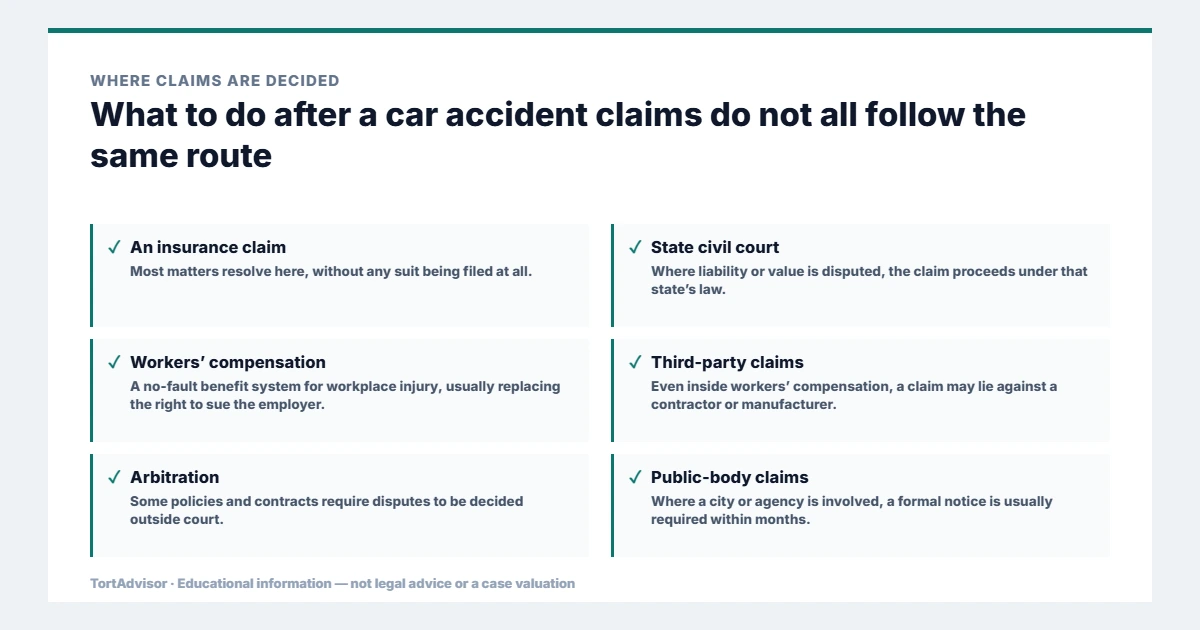
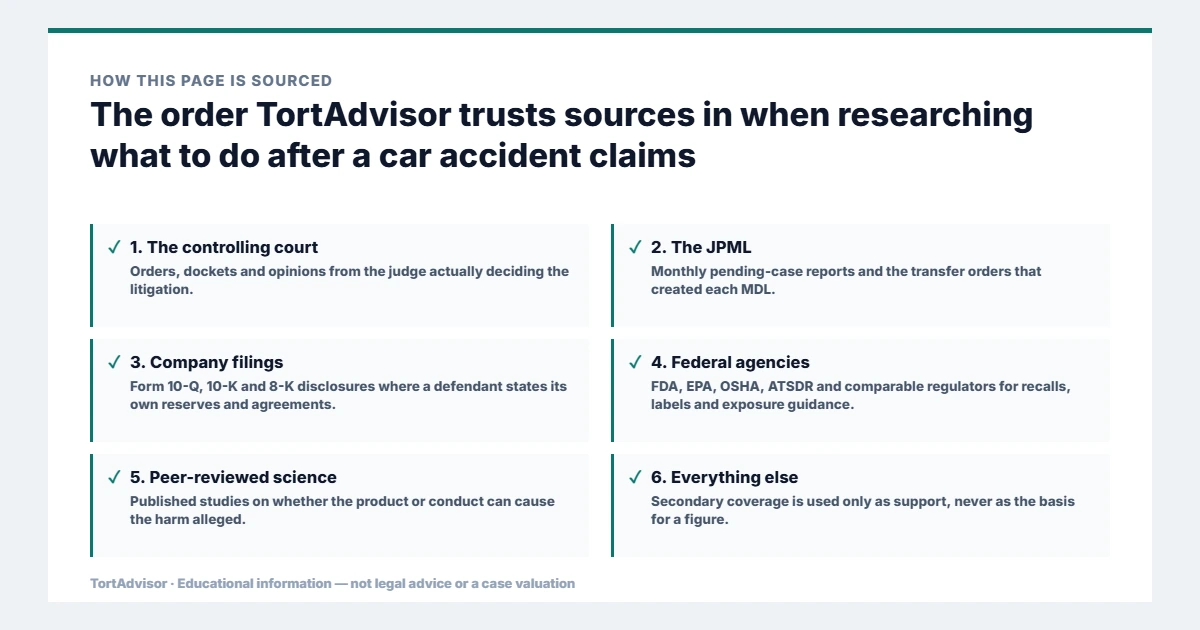
Every status, deadline and figure published on this page about what to do after a car accident claims is traced to a primary source before it appears.
Step 7: When Should You Hire a Car Accident Attorney?
Consider speaking with a car accident attorney when injuries, disputed fault, coverage issues, substantial losses, or a settlement offer make the claim difficult to evaluate on your own. Key reasons include:
- Insurance companies employ teams of adjusters and attorneys whose job is to settle your claim for as little as possible. An experienced personal injury attorney levels the playing field.
- Many personal injury law firms use contingency-fee arrangements. The percentage, costs, and other terms vary by firm and should be explained in a written engagement agreement.
- An attorney can evaluate damages and insurance issues, preserve evidence, address disputed liability, calculate recoverable losses, and explain whether litigation may be appropriate.
- You have a limited window to sue. Statutes of limitations (typically 2–3 years in most states) mean that waiting too long eliminates your right to file entirely.
You should definitely consult an attorney if:
- You suffered any injury beyond minor cuts and bruises
- The other driver was uninsured or underinsured
- Fault is disputed
- A government vehicle was involved
- The accident involved a commercial truck, rideshare vehicle, or bus
- The insurance company has already made a settlement offer
- You missed work due to your injuries
After reviewing what to do after a car accident, you can estimate what your case could be worth now with our free settlement calculator. You can also explore active car accident lawsuits to understand the current legal landscape, and see real car accident settlement amounts broken down by injury type.
What Not to Do After a Car Accident: Critical Claim Mistakes
Knowing what not to do is just as important as the steps above. These are the mistakes that most often damage or destroy otherwise valid claims:
- Leaving the scene. This is a crime in all 50 states — even in minor crashes. Always stop, exchange information, and wait for police.
- Admitting fault or apologizing. Even “I’m sorry” can be recorded and used as an admission. Stick to facts only.
- Skipping the doctor. The single most common reason insurance companies deny or minimize injury claims. See a doctor within 24–48 hours, no exceptions.
- Posting on social media. A photo of you at a party the week after a “back injury” claim can tank your case. Go dark on social media during any ongoing claim.
- Giving a recorded statement to the other driver’s insurer. You are not legally required to do this before speaking with your own attorney.
- Accepting the first settlement offer. First offers are almost always far below what a represented claimant can negotiate. Never sign anything without legal review.
- Waiting too long to act. Evidence disappears, witnesses forget, and statutes of limitations expire. Act quickly on every step above.
Frequently Asked Questions: What to Do After a Car Accident
What should I do immediately after a car accident?
What to do after a car accident begins with safety: move out of active traffic if it is safe, call 911, check for injuries, exchange required information, document the scene, and seek appropriate medical care. Preserve records and notify your insurer promptly, but avoid signing a release or accepting a settlement before you understand the full extent of any injuries.
Do I have to call the police after a minor car accident?
In many states, yes — you are legally required to report accidents that result in injury or property damage above a set threshold (usually $500–$1,000). Even when not legally required, filing a police report is strongly recommended because it creates an official, dated record of the crash that is difficult for the other party to dispute later.
What if the other driver doesn’t have insurance?
You may be able to file a claim under your own Uninsured Motorist (UM) coverage, which is required in most states. You may also be able to sue the other driver personally, though collecting on a judgment from an uninsured driver can be difficult. An attorney can help you identify all available recovery options.
How long do I have to file a car accident claim?
The statute of limitations for car accident claims varies by state, ranging from one year (Kentucky, Louisiana, Tennessee) to six years (Maine, North Dakota). Most states allow two to three years. The clock typically starts on the date of the accident. Missing this deadline eliminates your right to sue entirely — do not wait.
Should I accept the insurance company’s first settlement offer?
Almost never. First offers are designed to close claims quickly and cheaply — before you understand the full extent of your injuries or your legal rights. Once you accept a settlement and sign a release, you typically cannot go back for more, even if new injuries emerge. Always consult an attorney before accepting any offer.
What if I was partially at fault for the accident?
You may still be entitled to compensation. Most states use either comparative negligence (your payout is reduced by your percentage of fault) or modified comparative negligence (you can recover as long as you’re less than 50% or 51% at fault, depending on the state). Only four states — Alabama, Maryland, North Carolina, and Virginia — still use the harsh contributory negligence rule that bars recovery if you’re even 1% at fault.
How long does a car accident insurance claim take?
Simple property damage claims can resolve in days to weeks. Injury claims typically take three months to two years, depending on the severity of injuries, whether surgery or long-term treatment is needed, whether fault is disputed, and whether a lawsuit is filed. The more complex the injuries, the longer it generally takes — but that time typically results in a larger settlement.
Do I need a lawyer for a minor car accident?
If the accident caused any injury beyond superficial scrapes, or if there is any dispute about fault or coverage, consulting an attorney — even for a brief free consultation — is worth it. Many personal injury firms offer an initial consultation without charge and may use contingency-fee arrangements, but fee terms vary and should be confirmed directly with the law firm.
About the Author: This article was researched and reviewed by Mason Arnao, the publisher and editor of TortAdvisor, who has spent more than 15 years analyzing personal injury and mass tort litigation and writing reports on it. All articles are cross-referenced against primary legal sources, government data, and court records before publication.
Sources & References
- NHTSA — 2024 Traffic Fatality Estimates: 39,345 Deaths (2025)
- NHTSA CrashStats Database — Traffic Safety Facts
- World Population Review — No-Fault States 2026
- NHTSA — 2024 Early Traffic Fatality Estimates by Category
- U.S. News & World Report — What to Do After a Motor Vehicle Accident Checklist
- FindLaw — After a Car Accident: Essential Follow-Up Steps
Related Posts

A plain-language guide to truck electronic evidence, the difference between engine-control data and electronic driving logs, and questions to ask after a crash.
Understand how to estimate driving speed from distance and elapsed time—and why a calculation needs context after a crash. Learn about unit conversions, stopping distance and vehicle-recorded evidence.
A practical checklist for collecting crash details and organizing medical, insurance and expense records. Start with safety, then use the record prompts when you are able.