Talcum Powder and Ovarian Cancer: What the 2026 Science Says, Legal Rights & Settlement Guide

On this page:
- What Is the Talcum Powder Ovarian Cancer Lawsuit About? Understanding the Dangers
- The Science: Does Talcum Powder Cause Ovarian Cancer
- The Talcum Powder Ovarian Cancer Lawsuit Timeline: From Individual Claims to Mass Tort
- Who Qualifies for a Talcum Powder Ovarian Cancer Lawsuit
- Talcum Powder Ovarian Cancer Lawsuit Settlements: What Can You Expect in 2026
- Johnson & Johnson’s Defense Strategy
- How to File a Talcum Powder Ovarian Cancer Lawsuit in 2026: Step-by-Step
- What Happens If J&J Tries Bankruptcy Again
- Regulatory Actions and Product Changes
- Frequently Asked Questions About the Talcum Powder Ovarian Cancer Lawsuit
- Take Action Now: Your Path Forward in the Talcum Powder Ovarian Cancer Lawsuit
The talcum powder ovarian cancer lawsuit against Johnson & Johnson is now one of the most significant product liability litigations in U.S. history. For decades, millions of women used J&J’s baby powder and Shower to Shower products as part of their daily hygiene routines — not knowing that talcum powder contaminated with asbestos fibers may significantly increase the risk of developing ovarian cancer and mesothelioma. Today, with J&J’s third bankruptcy attempt rejected, 69,340 cases pending in the federal MDL, a proposed $5.5 billion resolution of ovarian cancer claims on the table, and the IARC’s 2024 classification of talc as probably carcinogenic to humans, the legal landscape has changed significantly.
This comprehensive guide explains the science behind talcum powder and cancer, what the research shows as of 2026, how to determine whether you qualify for a talcum powder ovarian cancer lawsuit, what settlements look like, and exactly what steps to take right now to protect your legal rights.
Find out if you may have a claim
Answer a few questions and a trained case advisor will review your situation — most people finish in about a minute.
- Free — no cost, no obligation
- About a minute to complete
- Reviewed by a trained case advisor
- Nothing you submit is published
Your details are sent over a secure connection and reviewed confidentially.
What Is the Talcum Powder Ovarian Cancer Lawsuit About? Understanding the Dangers
Talc is a naturally occurring mineral composed of magnesium, silicon, and oxygen. It is mined from the earth and processed into the fine white powder sold under brand names like Johnson’s Baby Powder. In its natural state, talc often forms in proximity to asbestos deposits — a known human carcinogen. During mining and processing, asbestos fibers can contaminate the talc, and when that contaminated powder is applied to the body, those fibers may be inhaled or migrate internally to the ovaries and lungs.
There are two primary biological pathways through which talcum powder exposure has been linked to cancer:
- Retrograde migration: Talc particles applied to the perineal area (genitals, inner thighs) can travel upward through the vagina, uterus, and fallopian tubes, eventually reaching the ovaries. Once there, the particles trigger chronic inflammation — a known driver of cancer development.
- Inhalation of asbestos-contaminated talc: When puffed from a bottle, the fine talc cloud is easily inhaled. Asbestos fibers that lodge in lung tissue can cause malignant mesothelioma, a rare and aggressive cancer with a median survival time of 12 to 18 months after diagnosis.
The Asbestos Connection in the Talcum Powder Ovarian Cancer Lawsuit
Internal Johnson & Johnson documents obtained through litigation show that the company was aware of asbestos contamination in its talc supply as early as the 1970s. A Reuters investigation published in 2018 revealed test results showing asbestos in Johnson’s Baby Powder samples dating back to 1971. Despite these findings, J&J continued marketing the product as pure, safe, and gentle for generations of users. The company has consistently denied that its talc products caused any cancers, calling the science “junk.”
However, internal memos uncovered during discovery tell a different story. One 1973 internal document showed that a J&J medical consultant recommended removing the word “asbestos-free” from product labels because the company couldn’t guarantee such a claim. Another document showed scientists scrambling to retest products after government regulators began scrutinizing talc safety.
The Science: Does Talcum Powder Cause Ovarian Cancer?
The scientific literature supporting the talcum powder ovarian cancer lawsuit has grown substantially over five decades, with evidence linking talcum powder and ovarian cancer. While no single study is definitive, the weight of evidence — including epidemiological studies, meta-analyses, and biological plausibility research — supports a statistically significant association between regular perineal talc use and ovarian cancer risk.
Key Research Findings
Evidence cited in talcum powder ovarian cancer lawsuits comes mainly from case-control studies, which compare women with and without ovarian cancer. Meta-analyses that pool these studies have reported a modestly higher risk of epithelial ovarian cancer among women who used talc in the genital area, although critics argue that case-control studies can be affected by recall bias.
The Sister Study, conducted by the National Institute of Environmental Health Sciences (NIEHS), followed 41,654 women and found little association between perineal talc use and later ovarian cancer (hazard ratio 0.73), although douching was associated with a higher risk, according to a 2016 analysis published in the journal Epidemiology.
The African American Cancer Epidemiology Study (AACES), published in 2016 in Cancer Epidemiology, Biomarkers & Prevention, compared 584 African American women with ovarian cancer and 745 without and found that genital powder use was associated with a 44% higher risk of epithelial ovarian cancer (odds ratio 1.44), a notable finding given that Black women have historically used these products at higher rates.
However, not all science aligns. A 2020 prospective cohort study published in the Journal of the American Medical Association (JAMA) analyzed data from about 250,000 women across four large cohort studies and found no statistically significant association. This study has been criticized for methodological limitations, including reliance on self-reported lifetime use and potential underreporting of perineal talc application specifically.
The IARC Classification
In July 2024, the International Agency for Research on Cancer (IARC), part of the World Health Organization, classified talc as “probably carcinogenic to humans” (Group 2A), based on limited evidence for ovarian cancer in humans, sufficient evidence in experimental animals and strong mechanistic evidence. Plaintiffs cite this evaluation in talcum powder ovarian cancer lawsuits, while J&J points out that the human evidence was rated as limited.
The 2024 evaluation applies to talc that does not contain asbestos, which suggests talc itself may be capable of causing cancer. Talc containing asbestos was already classified as carcinogenic to humans.

The Talcum Powder Ovarian Cancer Lawsuit Timeline: From Individual Claims to Mass Tort
The first significant talcum powder ovarian cancer lawsuit verdict came in 2016, when a St. Louis jury awarded $72 million to the family of Jacqueline Fox, an Alabama woman who died of ovarian cancer after using Johnson’s Baby Powder for 35 years. That verdict was later reversed on jurisdictional grounds, but it opened the floodgates.
In July 2018, a Missouri jury delivered the largest verdict to date: $4.69 billion awarded to 22 women who developed ovarian cancer after using J&J talc products. The award included $550 million in compensatory damages and $4.14 billion in punitive damages. J&J appealed, and the Missouri Court of Appeals reduced the award to approximately $2.12 billion, still one of the largest product liability verdicts in history.
J&J’s Bankruptcy Strategy and Its Collapse
Facing tens of thousands of talcum powder ovarian cancer lawsuit claims, Johnson & Johnson devised a controversial legal strategy known as the “Texas Two-Step” — a maneuver used by large corporations to funnel mass tort liability into a newly created subsidiary that then files for bankruptcy, potentially capping total payouts. J&J spun off all talc-related liability into a subsidiary called LTL Management LLC, which immediately filed for Chapter 11 bankruptcy in October 2021.
The gambit failed twice. Federal courts, including the Third Circuit Court of Appeals, dismissed J&J’s first two bankruptcy filings in 2023 and 2024, finding that LTL Management was not in “financial distress” — a prerequisite for bankruptcy protection — because J&J’s broader balance sheet remained strong. These dismissals sent tens of thousands of plaintiffs’ cases back to state and federal courts.
In 2024, J&J attempted a third bankruptcy restructuring through a new subsidiary called “Red River Talc LLC,” proposing an $8 billion settlement fund to resolve all ovarian cancer claims over 25 years. That attempt also faced fierce opposition from plaintiffs’ attorneys and was ultimately rejected by bankruptcy courts in early 2025. As of mid-2026, J&J faces individual and consolidated litigation in both federal multidistrict litigation (MDL) and state courts without the protection of bankruptcy proceedings.
Where Cases Stand in 2026
As of October 1, 2026, 69,340 talcum powder cases were pending against Johnson & Johnson in the federal MDL (MDL No. 2738) in the U.S. District Court for the District of New Jersey, according to the Judicial Panel on Multidistrict Litigation. Additional talcum powder ovarian cancer lawsuit cases are proceeding in state courts in Missouri, California, and New York.
On July 27, 2026, J&J announced a proposed $5.5 billion resolution of the remaining ovarian cancer claims in the federal MDL and related state courts, about 76,000 claims in all, with a first payment of no more than $3 billion in 2027. The proposal is conditioned on participation by lead plaintiff firms representing at least 95% of those claims, J&J maintains that the claims lack scientific merit, and the proposal is not final.
Mesothelioma claims, which tend to have stronger scientific causation evidence given asbestos’s well-established role in the disease, have been proceeding more quickly. In December 2025, for example, a Baltimore jury returned a verdict of about $1.56 billion for a woman who alleged asbestos in J&J talc caused her peritoneal mesothelioma.
Who Qualifies for a Talcum Powder Ovarian Cancer Lawsuit?
Not everyone who used talcum powder qualifies for a lawsuit, but the eligibility requirements are straightforward. If you meet the following criteria, you likely have a viable talcum powder ovarian cancer lawsuit claim worth pursuing:

Ovarian Cancer Claims in the Talcum Powder Ovarian Cancer Lawsuit
To qualify for an ovarian cancer talcum powder lawsuit, you generally need to show: (1) regular perineal use of talc-based products, such as Johnson’s Baby Powder or Shower to Shower, for at least a year — though many plaintiffs used these products for decades; (2) a diagnosis of epithelial ovarian cancer, fallopian tube cancer, or primary peritoneal cancer; and (3) a diagnosis within the applicable statute of limitations period, which varies by state but is typically 2 to 3 years from the date you knew or should have known that talc use may have contributed to your cancer.
The most commonly claimed diagnosis is serous ovarian cancer, the most prevalent type of epithelial ovarian cancer. However, claims have also been successfully filed for endometrioid, clear cell, and mucinous ovarian cancers.
Mesothelioma Claims
Mesothelioma is also covered in the talcum powder ovarian cancer lawsuit framework, making the talcum powder ovarian cancer lawsuit relevant for mesothelioma victims as well. For mesothelioma claims, plaintiffs must demonstrate regular use of talc-based products (either through personal use or occupational exposure), a confirmed diagnosis of malignant mesothelioma (typically pleural or peritoneal), and exposure to asbestos-contaminated talc. Given the long latency period of mesothelioma — often 20 to 50 years between asbestos exposure and disease manifestation — many current claimants used talcum powder products in the 1970s, 1980s, and 1990s.
Family Members of Deceased Victims
If a loved one passed away from ovarian cancer or mesothelioma linked to talcum powder use, you may be able to file a talcum powder ovarian cancer lawsuit wrongful death or survival action claim on behalf of their estate. These claims can include damages for the decedent’s medical expenses, pain and suffering before death, lost income, and the family’s loss of companionship. Statutes of limitations for wrongful death claims vary by state, so it is critical to consult an attorney promptly to preserve these rights.
To explore whether your situation qualifies, use our free Talcum Powder Settlement Calculator to get an instant estimate of your potential case value — no personal information required beyond basic case details.

Talcum Powder Ovarian Cancer Lawsuit Settlements: What Can You Expect in 2026?
There is still no court-approved settlement fund with published payout tiers for talc ovarian cancer claims. On July 27, 2026, Johnson & Johnson announced a proposed $5.5 billion resolution of the remaining ovarian cancer claims in the federal MDL and related state courts, with a first payment of no more than $3 billion in 2027. The proposal is conditioned on participation by lead plaintiff firms representing at least 95% of those claims. It is not final, and no per-claimant payment schedule has been published.
What the Proposal Means for Individual Ovarian Cancer Claims
Dividing a proposed total by the number of claims does not tell you what any one claimant would receive, because resolution programs usually score claims by factors such as diagnosis, age and length of use, and the final terms have not been published. Past trial results show how widely outcomes can vary: a St. Louis jury awarded $72 million to the family of Jacqueline Fox in 2016, while in February 2026 a Philadelphia jury awarded $250,000 to the estate of a woman who died of ovarian cancer.
Mesothelioma Claims and Verdicts
Mesothelioma claims tied to asbestos in talc are litigated separately from the ovarian cancer MDL and are not part of the July 2026 ovarian proposal. Verdicts in these cases can be very large, such as the December 2025 Baltimore verdict of about $1.56 billion, but large verdicts are often reduced after trial or on appeal, and settlement amounts are usually confidential.
Factors That Affect Your Talcum Powder Ovarian Cancer Lawsuit Settlement Value
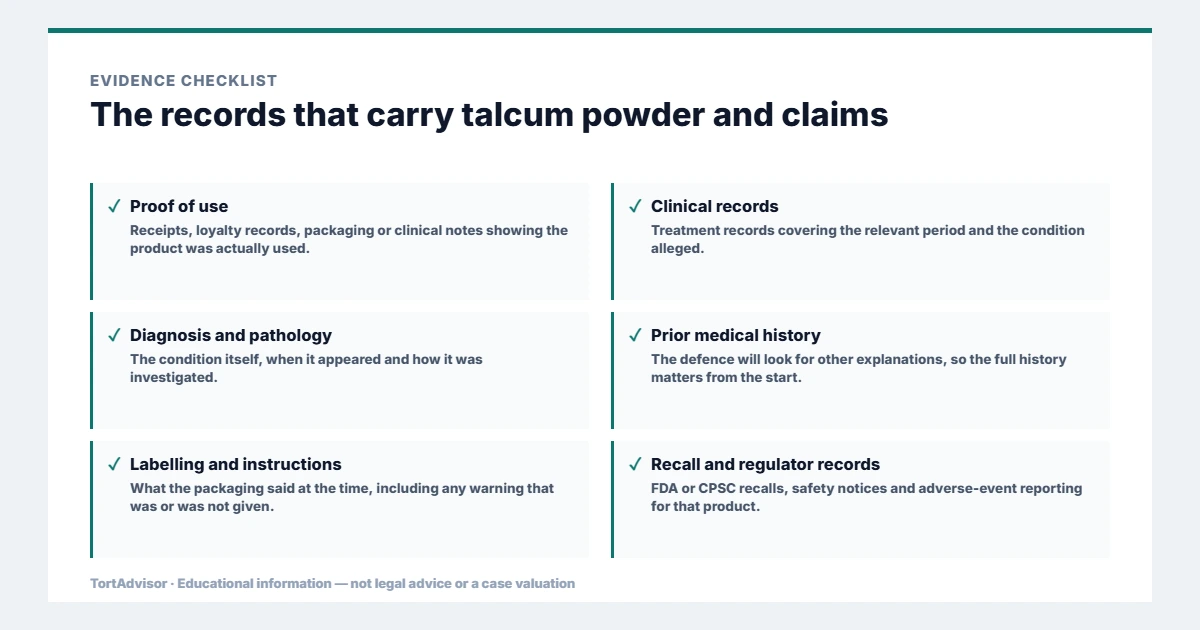
Several factors determine where a specific talcum powder ovarian cancer lawsuit claim is valued. The severity and stage of your cancer at diagnosis has the largest impact — Stage IV diagnoses with poor prognoses typically result in higher awards. The duration and frequency of your talcum powder use matters, as decades of daily use creates stronger causation evidence than occasional exposure. Your age at diagnosis affects the calculation of lost future income and quality of life damages. Medical documentation is critical in any talcum powder ovarian cancer lawsuit — plaintiffs with complete pathology reports, treatment records, and expert medical testimony linking talc to their specific cancer type present far stronger cases.
Finally, the jurisdiction where your talcum powder ovarian cancer lawsuit is filed significantly affects outcomes. Missouri, California, and New Jersey have historically produced the largest verdicts in talcum powder cases, while some other states have been less favorable to plaintiffs.
For a personalized estimate based on your specific circumstances, visit the Talcum Powder Lawsuit Settlement page where an experienced legal team provides detailed case evaluation guidance.
Johnson & Johnson’s Defense Strategy
Understanding J&J’s defense strategy is important for potential plaintiffs because it shapes how cases are litigated and why strong documentation matters. J&J has employed several consistent arguments throughout the litigation:
J&J maintains that its talc products never contained harmful levels of asbestos and that the scientific evidence does not establish causation between its products and ovarian cancer. The company has repeatedly cited the 2020 JAMA cohort study as supporting its position, while arguing that the positive association studies suffer from recall bias — plaintiffs who developed cancer may be more likely to remember and report talc use than healthy controls.
J&J also argues that it relied on regulatory approvals from the Food and Drug Administration (FDA), which did not require asbestos testing of talc products, and that any product defect claims are preempted by federal regulation. However, courts have largely rejected the preemption argument, finding that J&J’s alleged concealment of internal testing results constitutes fraud that removes federal shield protection.
Notably, in 2020 J&J discontinued its talc-based baby powder in the United States and Canada — a move plaintiffs’ attorneys characterized as a tacit acknowledgment of the product’s dangers, though J&J insisted it was purely a business decision driven by declining demand and “misinformation” from litigation-driven media coverage.
How to File a Talcum Powder Ovarian Cancer Lawsuit in 2026: Step-by-Step
Starting a talcum powder ovarian cancer lawsuit costs nothing upfront — filing your talcum powder ovarian cancer lawsuit — all reputable mass tort attorneys handle these cases on a contingency fee basis, meaning they get paid only if you recover compensation. Here is exactly what the process looks like:
Step 1: Document Your Talcum Powder Use
Begin gathering evidence of your talcum powder use before contacting a talcum powder ovarian cancer lawsuit attorney. This includes any product containers, receipts, or photographs. More importantly, try to reconstruct a detailed timeline of when you used talcum powder products, which products you used, and how frequently. If family members or friends can corroborate your use, make a note of their contact information as potential witnesses.
Step 2: Gather Your Medical Records
For your talcum powder ovarian cancer lawsuit, request complete copies of your cancer diagnosis records, including pathology reports, surgical records, chemotherapy and radiation treatment documentation, and any genetic testing results (such as BRCA1/BRCA2 status). Your attorney will need these to evaluate the strength of your case and will also obtain them independently if you sign a medical records release.
Step 3: Check Your Statute of Limitations
For any talcum powder ovarian cancer lawsuit, the statute of limitations for product liability and personal injury claims range from 1 year (in some states) to 6 years, but most states have a 2- to 3-year window. The clock typically starts when you were diagnosed with cancer or when you learned (or reasonably should have learned) that your cancer may be linked to talcum powder use — whichever is later. Do not wait. If you are anywhere near these deadlines, contact an attorney immediately.
Step 4: Consult a Qualified Mass Tort Attorney
Not all personal injury attorneys have the resources and experience to handle talcum powder ovarian cancer lawsuit cases effectively. Look for attorneys or law firms with a proven track record in talcum powder or similar mass tort cases (e.g., Roundup, Zantac, hair relaxer). Law firms like Beasley Allen, Lanier Law Firm, and Weitz & Luxenberg have been among the most active in talcum powder litigation, though hundreds of qualified firms handle these cases nationwide.
Step 5: File Your Talcum Powder Ovarian Cancer Lawsuit Claim
Once retained, your attorney will file your talcum powder ovarian cancer lawsuit — starting with a complaint in the appropriate federal or state court, typically seeking to have your case coordinated with the federal MDL in New Jersey if it is an ovarian cancer case. Your case will then go through the discovery process — exchange of medical records, product testing data, internal J&J documents — before either proceeding to trial or settling.
Many claimants find it helpful to use our Settlement Calculator Hub to understand estimated case values across different claim types before speaking with an attorney, so they can approach the consultation better informed.
What Happens If J&J Tries Bankruptcy Again?
Given the repeated failure of J&J’s bankruptcy strategy in the talcum powder ovarian cancer lawsuit litigation, the question for many claimants is: what happens next? Legal scholars and mass tort analysts see a few possible scenarios playing out over the next 12 to 24 months.
The most likely outcome is a negotiated global settlement through the federal MDL process. That is the path J&J has now proposed: on July 27, 2026, it announced a proposed $5.5 billion resolution of the remaining ovarian cancer claims, conditioned on participation by lead plaintiff firms representing at least 95% of those claims. Whether enough claimants accept it will decide whether the proposal takes effect.
Congress is also considering legislation that would limit the “Texas Two-Step” bankruptcy maneuver following the public attention generated by the J&J talc cases. The FACT Act (Fairness in Asbestos Claim and Transparency Act) proposals, while targeting asbestos trusts, could set precedent for restricting corporate use of subsidiaries to shield mass tort liability. If such legislation passes, J&J would lose its primary leverage tool.
For existing claimants, the best protection is to have filed a lawsuit before any potential future settlement is announced — late filings may face “claim bar” deadlines that exclude latecomers from settlement distributions.
Regulatory Actions and Product Changes
The talcum powder ovarian cancer lawsuit and related claims have prompted significant regulatory responses. In 2022, the FDA finalized a rule requiring mandatory testing of cosmetic talc products for asbestos contamination, closing a regulatory gap that had existed for decades — a key development in the talcum powder ovarian cancer lawsuit landscape. However, critics argue the testing standard adopted is insufficiently sensitive to detect low-level asbestos contamination.
In 2023, the FDA released testing results showing no detectable asbestos in talc samples collected from the market — but plaintiffs’ experts noted that the FDA’s methodology differed from more sensitive testing protocols used by the plaintiffs’ expert witnesses in litigation, which did find asbestos in certain lots. This dispute over testing methodology is expected to be a central battleground in upcoming trials.
As of 2026, Johnson’s Baby Powder reformulated for the U.S. market is now exclusively cornstarch-based, having eliminated talc entirely. However, this change does not affect the liability of the company for decades of prior talc-based product sales.
Frequently Asked Questions About the Talcum Powder Ovarian Cancer Lawsuit
Can I Still File a Talcum Powder Ovarian Cancer Lawsuit in 2026?
Yes. The federal MDL is actively accepting new cases, and individual state court claims can still be filed subject to applicable statutes of limitations. For most states, the clock runs 2 to 3 years from when you knew or should have known about the connection between your cancer and talcum powder use. Many plaintiffs did not become aware of this link until the Reuters investigation in 2018 or later, which means their limitations periods may still be open.
How Long Does a Talcum Powder Ovarian Cancer Lawsuit Take?
Individual cases in the MDL may take several years to resolve due to the volume of litigation. However, if J&J reaches a global settlement agreement — which many legal analysts believe is inevitable — the timeline could accelerate significantly. Mesothelioma cases, given the urgency of the plaintiff’s medical situation, are often prioritized and may resolve more quickly.
Do I Need J&J Products to File a Talcum Powder Ovarian Cancer Lawsuit?
The current MDL and most active talcum powder litigation focuses specifically on Johnson & Johnson’s talc products. However, other brands of talc-based cosmetics have also faced legal scrutiny. For non-J&J products, you would need to pursue a separate legal avenue. Speak with a mass tort attorney to determine which manufacturer’s products you used and which legal pathway is appropriate for your situation.
Is There a Class Action for Talcum Powder Ovarian Cancer Lawsuits?
Talcum powder ovarian cancer lawsuits are not structured as traditional class actions. Instead, each talcum powder ovarian cancer lawsuit is handled as mass tort litigation — individual claims coordinated in a multidistrict litigation proceeding to share discovery and pretrial work while preserving individual plaintiff rights. This structure is important for each talcum powder ovarian cancer lawsuit because it allows each plaintiff to receive compensation based on the specific facts of their case, rather than a uniform payment to all class members regardless of injury severity.
Take Action Now: Your Path Forward in the Talcum Powder Ovarian Cancer Lawsuit
The science supporting a talcum powder ovarian cancer lawsuit is clear; the courts have rejected J&J’s attempts to avoid accountability, and thousands of women with ovarian cancer — and their families — are owed justice and compensation for injuries caused by a product that was marketed as safe for daily use. The legal window to file a talcum powder ovarian cancer lawsuit is finite, and the earlier you begin the process, the stronger your position in any future global settlement distribution.
TortAdvisor connects victims and families with experienced mass tort attorneys who handle the talcum powder ovarian cancer lawsuit on a contingency basis — no fees unless you win your talcum powder ovarian cancer lawsuit. Whether you are just beginning to explore your legal options or ready to file a claim today, we have the resources to help you every step of the way.
- Estimate Your Talcum Powder Settlement Value — Use our free calculator to get an instant case value estimate
- Learn About the talcum powder ovarian cancer lawsuit — Full guide to eligibility, evidence, and legal strategy
- Compare All Mass Tort Calculators — See calculators for Roundup, Depo-Provera, AFFF, and more
- TortAdvisor Home — Your comprehensive source for mass tort legal guidance
Sources and Citations for the Talcum Powder Ovarian Cancer Lawsuit
This talcum powder ovarian cancer lawsuit guide is based on peer-reviewed research, legal filings, and authoritative government and medical sources. Key references for the talcum powder ovarian cancer lawsuit include:
- International Agency for Research on Cancer (IARC). IARC Monographs Volume 136: Talc and Acrylonitrile. World Health Organization, 2024. iarc.who.int
- Gonzalez NL, et al. “Douching, Talc Use, and Risk of Ovarian Cancer.” Epidemiology. 2016;27(6).
- Schildkraut JM, et al. “Association between Body Powder Use and Ovarian Cancer: The African American Cancer Epidemiology Study (AACES).” Cancer Epidemiology, Biomarkers & Prevention. 2016.
- International Agency for Research on Cancer. “IARC Monographs evaluate the carcinogenicity of talc and acrylonitrile.” Press release, July 5, 2024.
- Johnson & Johnson. “Johnson & Johnson Announces a Proposed Resolution of Ovarian Talc Litigation.” Press release, July 27, 2026.
- Judicial Panel on Multidistrict Litigation. “Pending MDL Dockets by Actions Pending.” September 1, 2026.
- Berge W, Mundt KA, et al. “Genital use of talc and risk of ovarian cancer: a meta-analysis.” European Journal of Cancer Prevention. 2018;27(3):248–257.
- U.S. National Institutes of Health — National Cancer Institute. “Ovarian, Fallopian Tube, and Peritoneal Cancer.” cancer.gov
- U.S. FDA. “FDA’s Approach to Cosmetic Safety: Talcum Powder and Asbestos.” fda.gov
- Reuters Investigates. “Johnson & Johnson knew for decades that asbestos lurked in its baby powder.” Reuters, December 14, 2018.
- In re: Johnson & Johnson Talcum Powder Products Marketing, Sales Practices, and Products Liability Litigation. MDL No. 2738. U.S. District Court for the District of New Jersey.
Disclaimer: This article is for informational and educational purposes only and does not constitute legal advice. Consult a licensed attorney in your state for guidance specific to your situation. TortAdvisor is not a law firm and does not provide legal representation.
Related Posts

How VCF registration works: who should register, the two-year deadline and when it starts, how to register online or by phone, and how it fits with the WTC Health Program.
Paraquat exposure explained from EPA, CDC and court records: how it happens, who is most at risk, drift and vapor, the safety rules since 2016, Parkinson’s research, and the records that help show exposure.

The Supreme Court's June 25, 2026 ruling in Monsanto v. Durnell held that FIFRA can preempt state failure-to-warn claims, unsettling a central theory in paraquat cases. With 6,602 actions pending in MDL 3004 as of 1 October 2026 and a global settlement agreed in principle but no terms disclosed, here is what is verified and what is not.