
Talcum Powder Lawsuit 2026: Johnson & Johnson Cancer Claims and Litigation Updates
Talcum powder lawsuits allege that prolonged personal use of talc-based body powder or exposure to allegedly asbestos-contaminated talc contributed to ovarian cancer, mesothelioma, and other serious diseases.
Federal cases remain coordinated in MDL 2738 in the District of New Jersey. A potential claim may warrant review when relevant talc exposure occurred before a confirmed qualifying diagnosis.
See Whether Your Talcum Powder Claim May Qualify
Complete the short form for a confidential review of your product-use history, diagnosis, treatment, and potential claim.
Latest Talcum Powder Lawsuit Update for 2026
The most important talcum powder lawsuit development is that the proposed bankruptcy resolution is no longer pending. On March 31, 2025, the U.S. Bankruptcy Court for the Southern District of Texas denied confirmation of Red River Talc LLC’s plan and dismissed the Chapter 11 case. The court identified problems with claimant voting and releases of claims against non-bankrupt parties. J&J announced that it would not appeal and would instead defend talc claims through the civil justice system.
The federal talcum powder lawsuit proceedings remain centralized in MDL No. 2738 in the U.S. District Court for the District of New Jersey. Tens of thousands of claims have been filed, and the exact active-case count changes as cases are added, resolved, dismissed, remanded, or otherwise administratively updated.
Third Bankruptcy Dismissed
The March 2025 dismissal ended J&J’s latest bankruptcy-based settlement effort. The company stated it would return to the tort system.
MDL 2738 Continues
The federal talc litigation remains active in New Jersey, where coordinated pretrial proceedings address common factual and legal issues.
No Guaranteed Global Payout
Public settlement ranges are estimates, not approved payment schedules. Individual results depend on evidence, diagnosis, jurisdiction, and case posture.
Talc, Asbestos, and Cancer: What Authoritative Sources Say
Talc is a naturally occurring mineral used in cosmetics and other products. Talc deposits can occur near asbestos, so contamination is an important safety concern. Asbestos is a known human carcinogen. The FDA continues to publish information about talc-containing cosmetics, testing, and regulatory activity.
In 2024, the International Agency for Research on Cancer classified talc as probably carcinogenic to humans (Group 2A), based on limited evidence in humans, sufficient evidence in experimental animals, and strong mechanistic evidence. IARC separately recognizes talc containing asbestos as carcinogenic to humans.
| Issue | Why It Matters | Common Evidence |
|---|---|---|
| Personal-use exposure | Many ovarian or gynecologic cancer claims allege repeated perineal use of talc-based body powder. | Product history, photographs, receipts, family testimony, sworn exposure timeline. |
| Asbestos contamination | Mesothelioma claims often allege exposure to asbestos fibers in cosmetic or industrial talc. | Pathology, occupational history, product identification, mineral testing, expert testimony. |
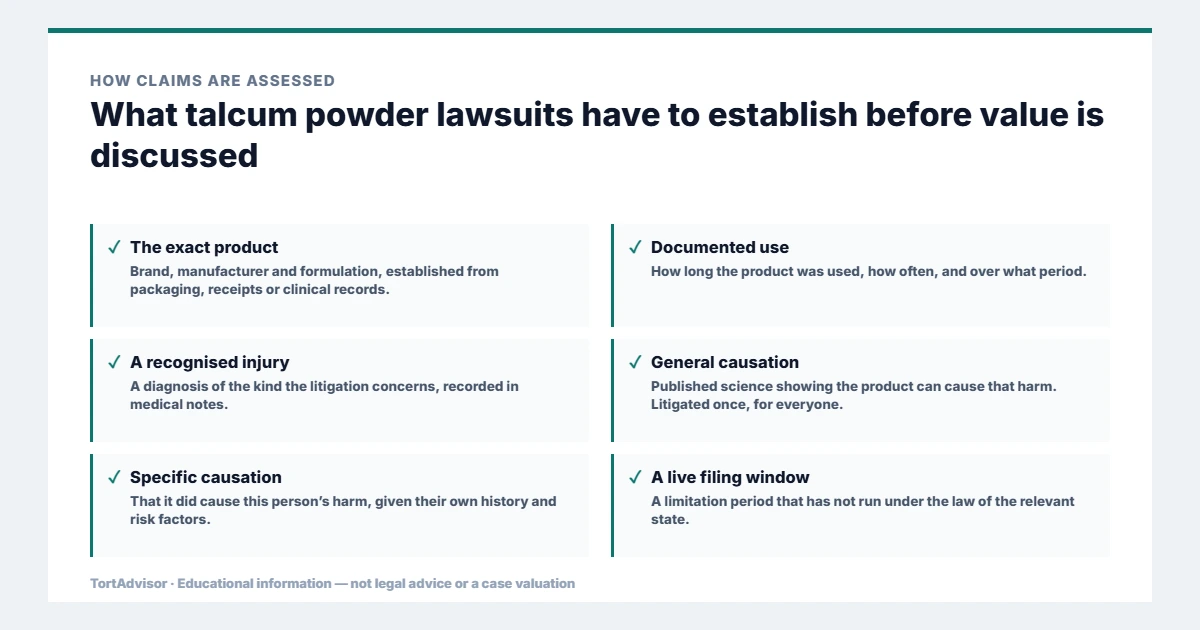
| Medical causation | The plaintiff must connect exposure to the diagnosed disease under the governing legal standard. | Pathology, oncology records, differential diagnosis, epidemiology, expert opinions. |
Talcum Powder Settlement Amounts, Verdicts, and the $700 Million State Settlement
In 2024, Johnson & Johnson agreed to a $700 million multistate settlement with 42 states and the District of Columbia over allegations concerning the marketing of talc-based baby and body powder. That agreement addressed state consumer-protection claims; it was not a global personal-injury settlement for people diagnosed with cancer.
Individual talcum powder lawsuit results have varied widely. Some plaintiffs have received significant jury verdicts or confidential settlements, while other cases have been dismissed, reversed, reduced on appeal, or decided for the defense. A verdict is not the same as a final collectible payment because post-trial motions and appeals can change the result.
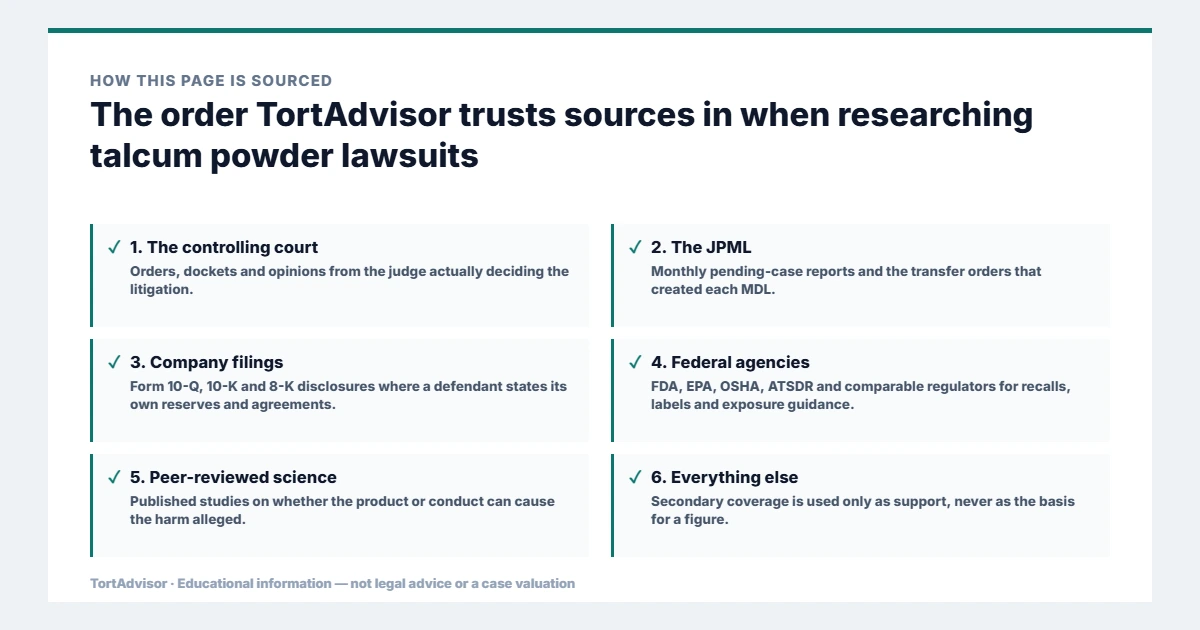
Every status, deadline and figure published on this page about talcum powder lawsuits is traced to a primary source before it appears.
Mesothelioma Claims
These claims often focus on alleged asbestos contamination and may require extensive exposure reconstruction and pathology evidence.
Ovarian and Gynecologic Cancer Claims
These cases commonly examine product-use history, diagnosis, latency, alternative risk factors, and expert causation testimony.
Wrongful Death Claims
Eligible family members or estate representatives may be able to pursue damages when an alleged talc-related disease resulted in death.
Who May Qualify for a Talcum Powder Lawsuit?
A person may be considered for a talcum powder lawsuit when there is a documented history of relevant talc exposure followed by a qualifying diagnosis. Exact screening criteria differ among law firms and can change as medical and legal developments evolve.
- Regular use of Johnson’s Baby Powder, Shower to Shower, or another identified talc-based cosmetic product before diagnosis.
- Diagnosis of ovarian cancer, fallopian tube cancer, primary peritoneal cancer, mesothelioma, or another disease a reviewing attorney considers relevant.
- A timeline showing that talc use or exposure occurred before the disease was diagnosed.
- Medical records capable of confirming the diagnosis, stage, pathology, treatment, and prognosis.
- A claim that remains within the applicable statute of limitations or another legally recognized filing period.
- No prior release or settlement that already resolved the same claim against the relevant defendants.
Evidence Needed for a Talcum Powder Lawsuit
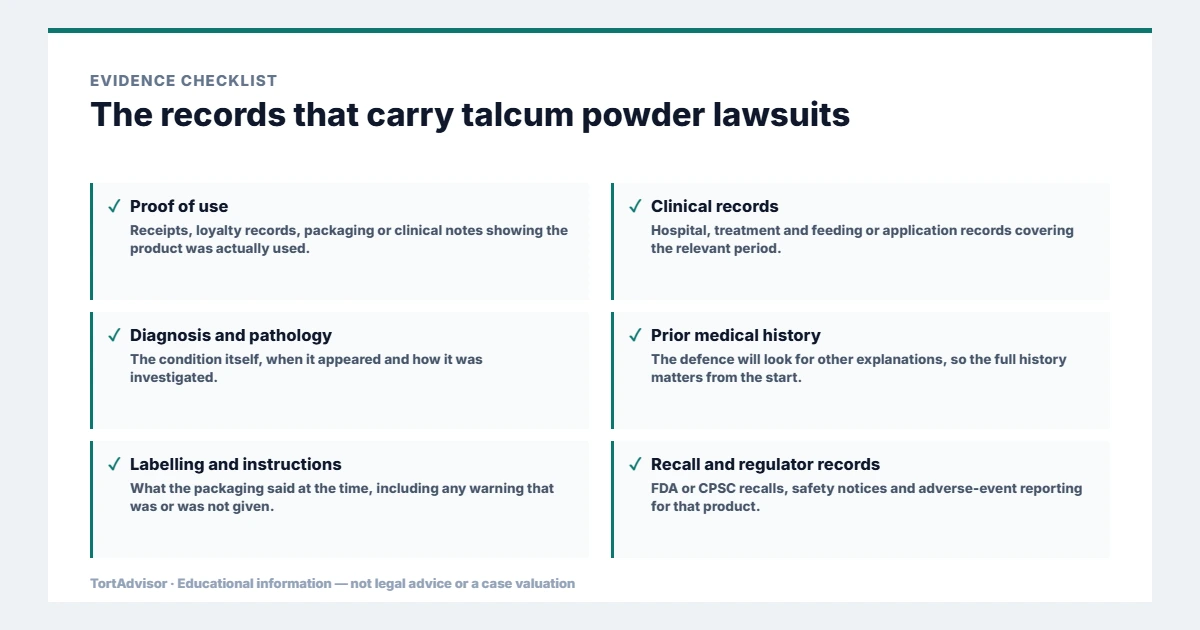
Organized evidence can determine whether a talcum powder lawsuit survives screening, meets filing requirements, and can be supported by qualified experts. Claimants should preserve records before they are lost.
Medical Documentation
Pathology reports, oncology notes, imaging, surgery records, chemotherapy or radiation records, and prognosis information.
Product and Exposure Proof
Photographs, containers, receipts, loyalty records, family testimony, employment records, and a written history of brand, frequency, duration, and method of use.
Damages Documentation
Medical bills, wage loss, tax records, disability evidence, travel costs, caregiving expenses, funeral costs, and records of daily limitations.
Create a Detailed Exposure Timeline
Write down the approximate years of use, the product name, where it was purchased, how often it was used, how it was applied, whether other household members observed the use, and when symptoms or diagnosis occurred. This timeline does not replace evidence, but it helps an attorney identify records and witnesses.
What Determines Talcum Powder Lawsuit Value?
No calculator or article can predict a guaranteed result. A talcum powder lawsuit is valued through a combination of medical, factual, legal, and financial factors.
| Value Factor | Potential Impact |
|---|---|
| Diagnosis and prognosis | Mesothelioma, advanced cancer, recurrence, permanent impairment, and reduced life expectancy may materially affect damages. |
| Strength of exposure proof | Specific brands, long-term use, witnesses, receipts, photographs, or occupational records can strengthen product identification. |
| Medical causation | Pathology and reliable expert testimony are central when defendants dispute whether talc caused the disease. |
| Economic losses | Past and future treatment, lost earnings, reduced earning capacity, caregiving, and funeral expenses may be recoverable where permitted. |
| Non-economic damages | Pain, suffering, emotional distress, loss of enjoyment, disfigurement, and loss of consortium can affect value. |
| State law and venue | Damage caps, evidence rules, filing deadlines, punitive-damage standards, and jury tendencies differ by jurisdiction. |
For an educational estimate, use the TortAdvisor talcum powder settlement calculator. Calculator results are not legal advice and do not guarantee eligibility or compensation.
How to File a Talcum Powder Lawsuit in 2026
- Request a case review. Speak with a lawyer or intake team experienced with talc, asbestos, product liability, or mass tort litigation.
- Confirm the filing deadline. Statutes of limitations vary, and some states apply discovery rules, wrongful-death rules, or other exceptions.
- Collect medical and exposure records. Obtain pathology, oncology, treatment, product-use, employment, and damages documentation.
- Complete attorney screening. The reviewing lawyer will assess diagnosis, product identification, exposure, causation, jurisdiction, and prior settlements.
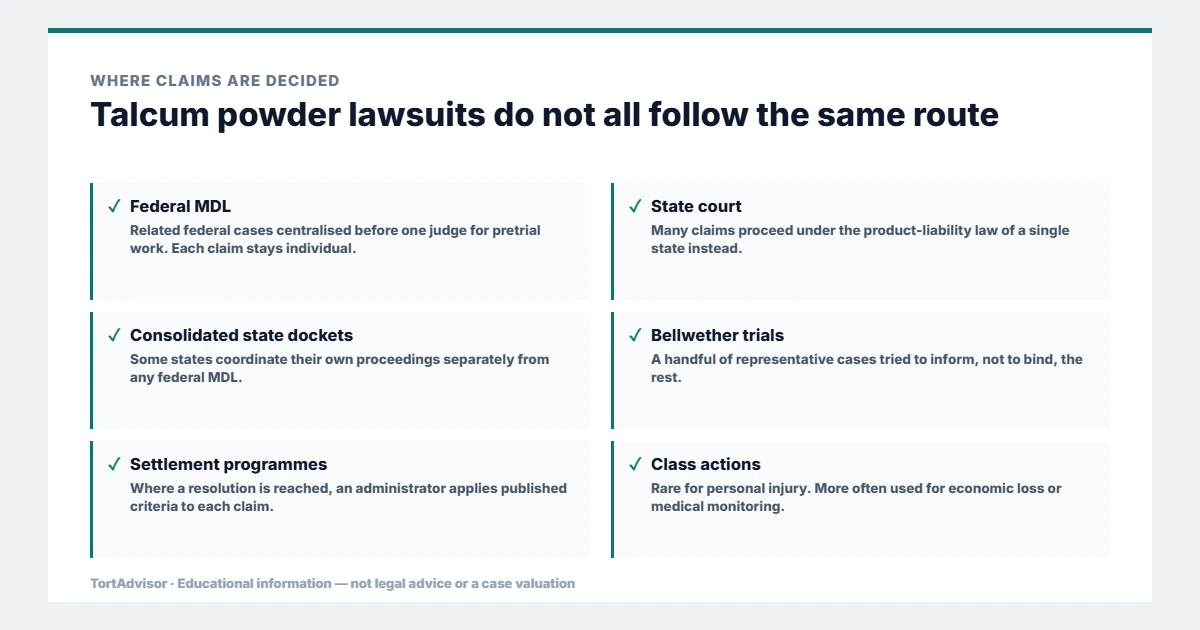
- File in the appropriate court. The correct forum depends on the defendants, where exposure occurred, where the claimant lives, and federal MDL procedures.
- Participate in discovery and case evaluation. This may include questionnaires, document production, medical authorizations, depositions, expert review, settlement discussions, trial, or appeal.
Talcum Powder Lawsuit FAQs
Can I still file a talcum powder lawsuit in 2026?
Potentially. The third bankruptcy was dismissed, and claims continue through civil litigation. Eligibility depends on diagnosis, exposure, evidence, prior releases, and the applicable filing deadline.
Is there an approved global talc settlement?
No single approved global settlement currently resolves all personal-injury talc claims. The 2025 bankruptcy dismissal ended the proposed Red River Talc plan.
Has anyone received money from a talcum powder lawsuit?
Yes. Some cases have produced verdicts or confidential settlements. Other plaintiffs have lost, had awards reduced, or remained in ongoing litigation. Prior outcomes do not predict a new claimant’s result.
What is the average talcum powder settlement?
There is no reliable universal average. Published ranges often mix verdicts, confidential settlements, projections, and claims involving different diseases and evidence.
Does the $700 million state settlement pay cancer claimants?
The 2024 multistate agreement resolved consumer-protection allegations brought by states. It was not a global personal-injury fund for individual cancer claims.
What cancers are commonly included?
The most common allegations involve ovarian and related gynecologic cancers and mesothelioma. Screening criteria differ, so pathology and exposure details should be reviewed individually.
How much does a talcum powder lawyer cost?
Many product-liability lawyers use contingency fees, meaning legal fees are generally paid from a recovery. Read the written agreement carefully because percentages and case expenses can vary.
How long does a talcum powder lawsuit take?
Timing depends on the court, discovery, trial schedule, settlement negotiations, appeals, and the claimant’s medical circumstances. Complex mass tort cases can take years.
Official Sources and Citation References
The following primary and authoritative sources support the current litigation and health-regulatory context summarized on this page.
U.S. District Court — MDL 2738
Official federal court page for the Johnson & Johnson talcum powder products litigation.
FDA Talc Information
FDA background, testing, and regulatory information concerning talc-containing cosmetics and asbestos.
IARC Monograph Volume 136
IARC’s evaluation classifying talc as probably carcinogenic to humans, Group 2A.
2024 Multistate Settlement
Official attorney-general announcement concerning the $700 million consumer-protection settlement.
Red River Talc Case
Bankruptcy case information confirming dismissal of the Chapter 11 proceeding.
FDA Testing Information
Official FDA testing summaries for talc-containing cosmetic products and asbestiform fibers.
Request a Free Talcum Powder Case Review
A talcum powder lawsuit can involve strict deadlines, complex product identification, medical causation disputes, extensive records, and expert testimony. A confidential review can help determine whether your facts may support a claim.
- No upfront fee for the initial review
- Confidential intake
- Nationwide attorney network
- No guarantee of eligibility or compensation