Talcum Powder Lawsuit Update: J&J Trials Resume as Bankruptcy Fails (July 2026)
Diagnosed with cancer after using talc-based baby powder?
With J&J’s bankruptcy shield gone and trials moving again, cases are being evaluated now. A free, no-obligation review takes minutes.
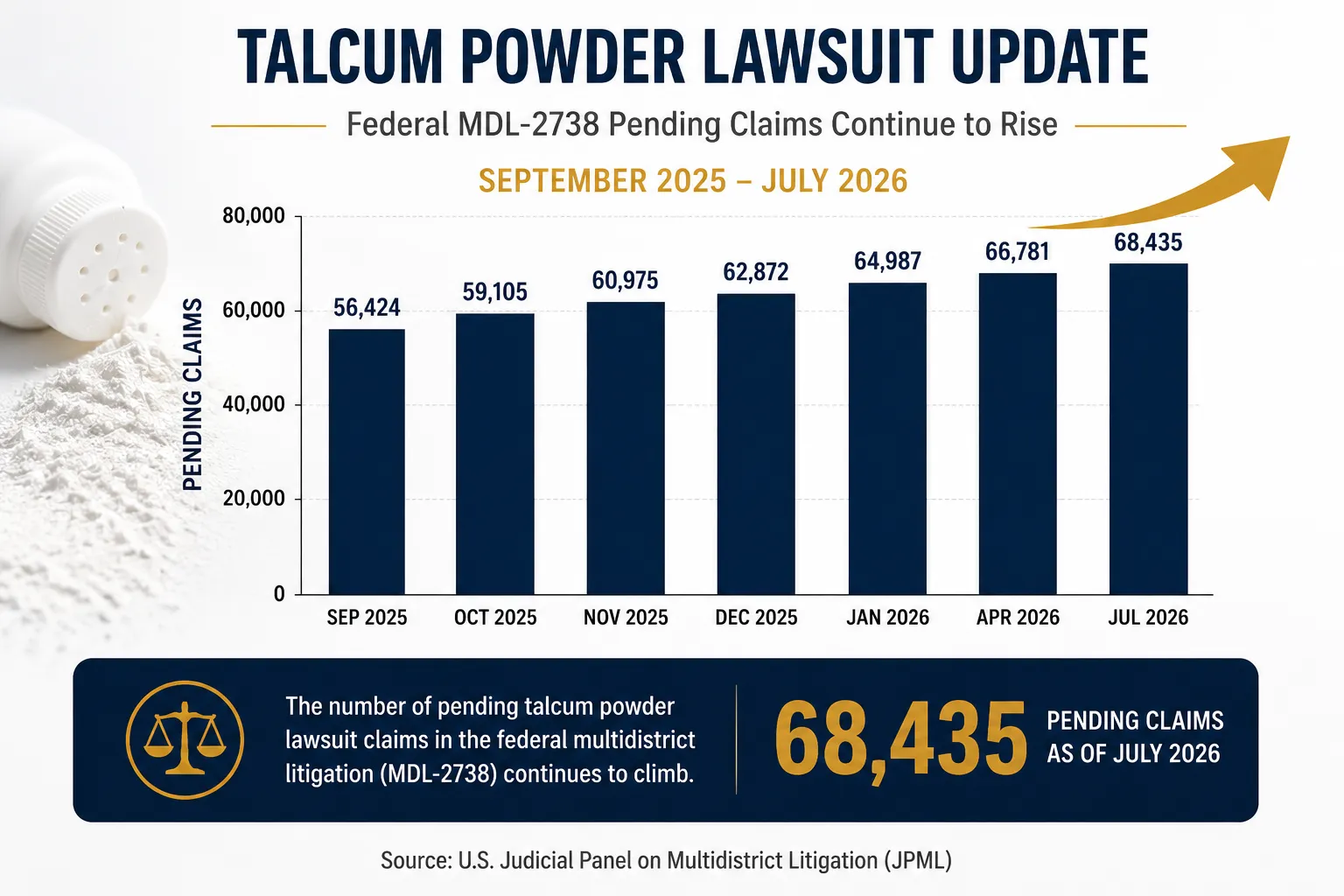
The talcum powder lawsuit against Johnson & Johnson has entered its most active stretch in years. With the company’s third bankruptcy attempt now dismissed and no appeal on the table, tens of thousands of claims are moving back toward juries. As of July 2026, roughly 68,435 cases sit in the federal multidistrict litigation, and fresh trials are already underway in courtrooms from Florida to Texas. Here’s where the talcum powder lawsuit stands right now, what changed this month, and what it means if you or a loved one was diagnosed after using talc-based products.
Find out if you may have a claim
Answer a few questions and a trained case advisor will review your situation — most people finish in about a minute.
- Free — no cost, no obligation
- About a minute to complete
- Reviewed by a trained case advisor
- Nothing you submit is published
Your details are sent over a secure connection and reviewed confidentially.
On this page
Where the talcum powder lawsuit stands in July 2026
The talcum powder lawsuit is the product-liability fight over allegations that Johnson & Johnson’s talc products — including Johnson’s Baby Powder and Shower to Shower — were contaminated with asbestos and caused ovarian cancer and mesothelioma. The bulk of the federal cases are consolidated in MDL-2738, pending before U.S. District Judge Michael A. Shipp in New Jersey, alongside a growing docket of state-court trials.
Two things define this moment. First, the caseload keeps climbing even after years of litigation — new plaintiffs are still coming forward. Second, the legal roadblock that stalled everything for more than a year, J&J’s attempt to route the talcum powder lawsuit through bankruptcy, has been cleared.
The bankruptcy is dead — and not coming back
Johnson & Johnson tried three separate times to push its talc liabilities into Chapter 11 using a maneuver critics call the “Texas Two-Step” — spinning off a subsidiary to absorb the claims and then having that shell entity declare bankruptcy. The most recent version used a subsidiary called Red River Talc LLC to try to force through a settlement plan valued in the billions.
U.S. Bankruptcy Judge Christopher Lopez rejected that plan, finding the pre-filing claimant vote was rushed and flawed and that the company pushed an unreasonably short voting window to reach the 75% approval threshold. The court also faulted the plan’s third-party releases, which would have shielded entities that never filed for bankruptcy at all, including retailers. Motions asking the court to reconsider or to compel mediation were denied. Critically, J&J has said it will not appeal — meaning the bankruptcy path that stalled the talcum powder lawsuit is now closed, and the litigation is back in the trial system for good.
For claimants, the practical effect is straightforward: instead of waiting on a capped trust distribution, individual cases can once again be heard by juries. The long-briefed Rule 702 (Daubert) challenges over expert testimony are back in motion, and both sides agree resolving them is the gate that must be cleared before the first federal bellwether trial is scheduled.
Johnson & Johnson talcum powder trials happening now
With the bankruptcy pause lifted, trials have resumed at a pace not seen in years. In just the past several weeks:
- A new trial opened in Broward County, Florida, brought by the family of a 78-year-old physician who died of mesothelioma after decades of daily talc use. Jurors are weighing whether the talc was truly asbestos-free.
- A separate mesothelioma trial is underway in Boston, following an $8 million verdict against the company in a similar case just weeks earlier.
- A cancer trial proceeded in Dallas, Texas — one of the first talc trials in that state.
- In the federal MDL, the first bellwether trial has now been formally selected, a milestone that typically signals settlement pressure once a verdict lands.
Update (July 17, 2026): Even as these trials move forward, J&J has separately asked the MDL court for an order that could dismiss the bulk of the remaining claims, after plaintiffs’ lawyers withdrew two retained expert witnesses. That request is still pending and does not affect the state-court trials described above; see our full breakdown of the talcum powder lawsuit dismissal request for what is confirmed and what is not.
The verdict history is why this matters. Over the past two years, juries have handed down some of the largest product-liability awards in the country against J&J. The chart below shows a sample of notable recent verdicts.
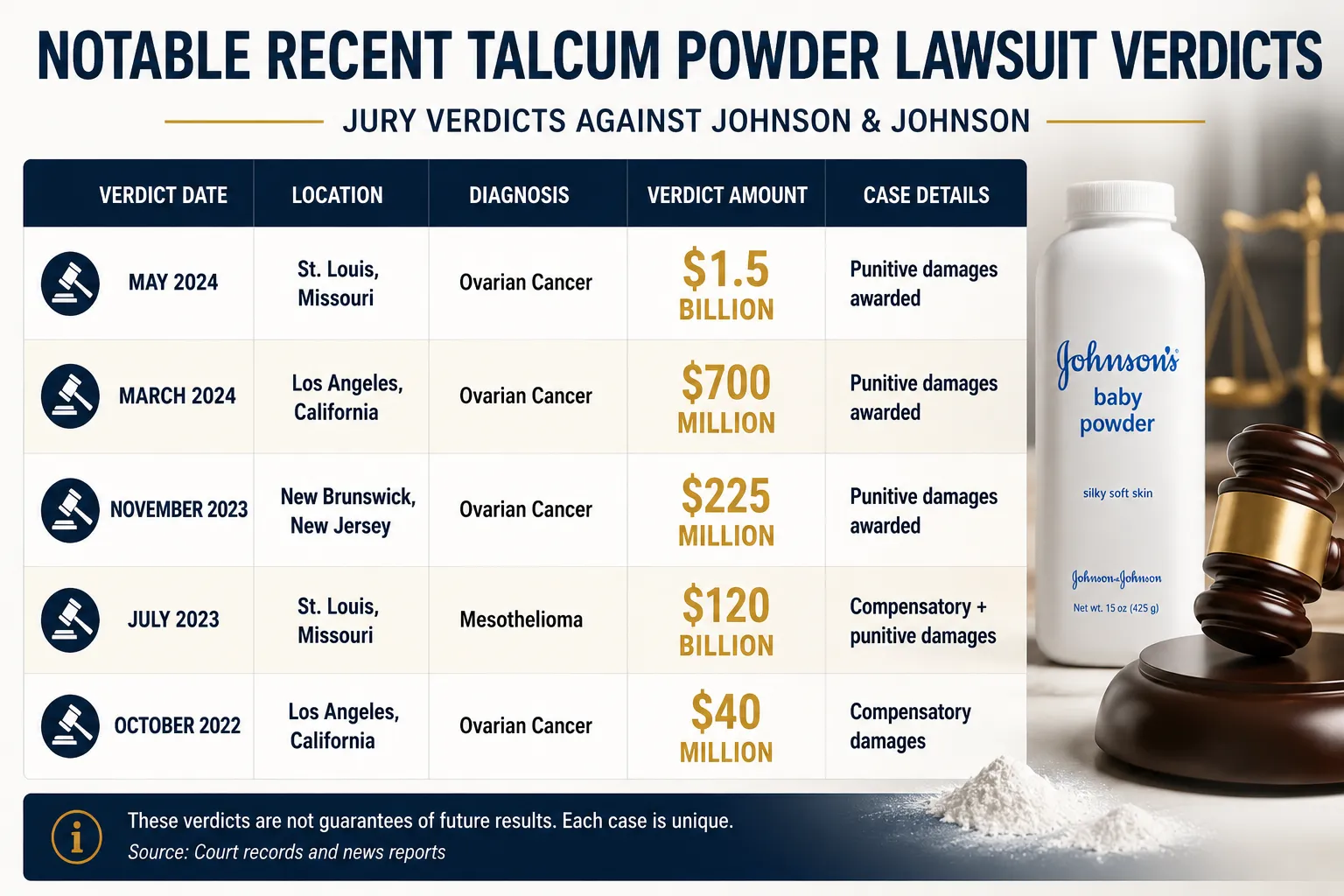
It’s important to read that chart with clear eyes: these are exceptional jury verdicts, several of which were later reduced on appeal. They are not what a typical claim is worth, and they are not settlements. But they do shape the leverage on both sides as bellwether trials approach.
Wondering what a talc claim could be worth?
Our free tool lets you estimate what your case could be worth now based on diagnosis, length of use, and other factors.
Talcum powder lawsuit settlement amounts
There is no single talcum powder lawsuit settlement figure, because every case turns on its own facts. Now that J&J’s global bankruptcy settlement has collapsed, the company is not currently pursuing a blanket resolution and is instead defending — or resolving — cases individually.
Legal-industry estimates for individual talc claims generally fall in a wide range, often cited between roughly $100,000 and $1 million per person, with mesothelioma settlements historically averaging higher than ovarian-cancer claims. Settlement administrators typically use a point-based matrix that weighs the specific diagnosis, the claimant’s age, how long talc products were used, and the strength of the medical and product-use evidence. Younger claimants and those with well-documented, long-term use tend to fall into higher tiers.
Those figures are projections, not promises — actual outcomes vary enormously, and many claims resolve for less. For a category-specific breakdown, you can [see if you may qualify for a similar recovery].
Who qualifies for a talcum powder lawsuit
You may be eligible to file a talcum powder lawsuit if you or a loved one used talc-based products such as Johnson’s Baby Powder or Shower to Shower and were later diagnosed with:
- Ovarian cancer — the most common diagnosis in the federal MDL, typically tied to long-term genital-area use.
- Mesothelioma — a cancer of the lining of the lungs or abdomen caused by asbestos exposure, including secondhand exposure from a household member’s use.
Eligibility also depends on your state’s statute of limitations, which can run anywhere from one to six years from diagnosis or from a loved one’s death, so timing matters. Documentation — medical records, a biopsy or pathology report, and proof of product use — strengthens a claim considerably. Because these deadlines are unforgiving and vary by state, it’s worth having a lawyer confirm where you stand before assuming it’s too late. You can also review the full list of ongoing cases on our Active Lawsuits hub.
What happens next
The near-term signposts to watch are the Rule 702 rulings on expert testimony and the scheduling of that first federal bellwether trial. A plaintiff-favorable verdict there — layered on top of the state-court awards already piling up — would sharpen the pressure on J&J to negotiate a real, court-supervised resolution rather than fighting each case one at a time. For the tens of thousands of people already in the litigation, and the new claimants still filing, the dismissal of the bankruptcy means their day in court is once again a live possibility rather than a deferred one.
Authoritative background is available from the U.S. Food & Drug Administration’s talc safety page and the U.S. Judicial Panel on Multidistrict Litigation, which publishes the official MDL caseload counts.
Find out if you have a talcum powder claim
Free, confidential case review. You pay nothing unless a recovery is made.
This article is for general information only and is not legal or medical advice. Settlement figures are projections and jury verdicts cited are exceptional outcomes, not typical results. Case values depend on individual facts. Consult a licensed attorney about your specific situation.
Related Posts

How VCF registration works: who should register, the two-year deadline and when it starts, how to register online or by phone, and how it fits with the WTC Health Program.
Paraquat exposure explained from EPA, CDC and court records: how it happens, who is most at risk, drift and vapor, the safety rules since 2016, Parkinson’s research, and the records that help show exposure.

The Supreme Court's June 25, 2026 ruling in Monsanto v. Durnell held that FIFRA can preempt state failure-to-warn claims, unsettling a central theory in paraquat cases. With 6,666 actions pending in MDL 3004 and a global settlement agreed in principle but no terms disclosed, here is what is verified and what is not.