Talcum Powder Asbestos Lawsuit 2026: Where the J&J MDL Stands Now
Diagnosed With Mesothelioma or Ovarian Cancer After Talc Use?
You may qualify for a free, no-obligation case review with a mass tort attorney.
The Johnson & Johnson talcum powder litigation is now the largest mass tort docket in the federal court system — larger than the Roundup, hair relaxer, or PFAS dockets — and the summer of 2026 has brought enough developments all at once that anyone following this talcum powder asbestos lawsuit 2026 story needs an updated picture of where things actually stand. In the space of a few months: a Los Angeles jury handed the defense a win, a different Los Angeles jury handed plaintiffs a $32 million loss for the company, one of the world’s most respected medical journals retracted a decades-old safety claim, and a nearly billion-dollar verdict got cut down to a fraction of its headline size. None of that fits neatly into a single narrative, which is exactly why a “where things stand” update is more useful than any single headline. Below is a plain-language rundown of the claim numbers, the courtroom results, and the still-unresolved questions, with sources linked throughout so you can verify anything for yourself.
Find out if you may have a claim
Answer a few questions and a trained case advisor will review your situation — most people finish in about a minute.
- Free — no cost, no obligation
- About a minute to complete
- Reviewed by a trained case advisor
- Nothing you submit is published
Your details are sent over a secure connection and reviewed confidentially.
On this page:
Pending Claims and the Growth Trend
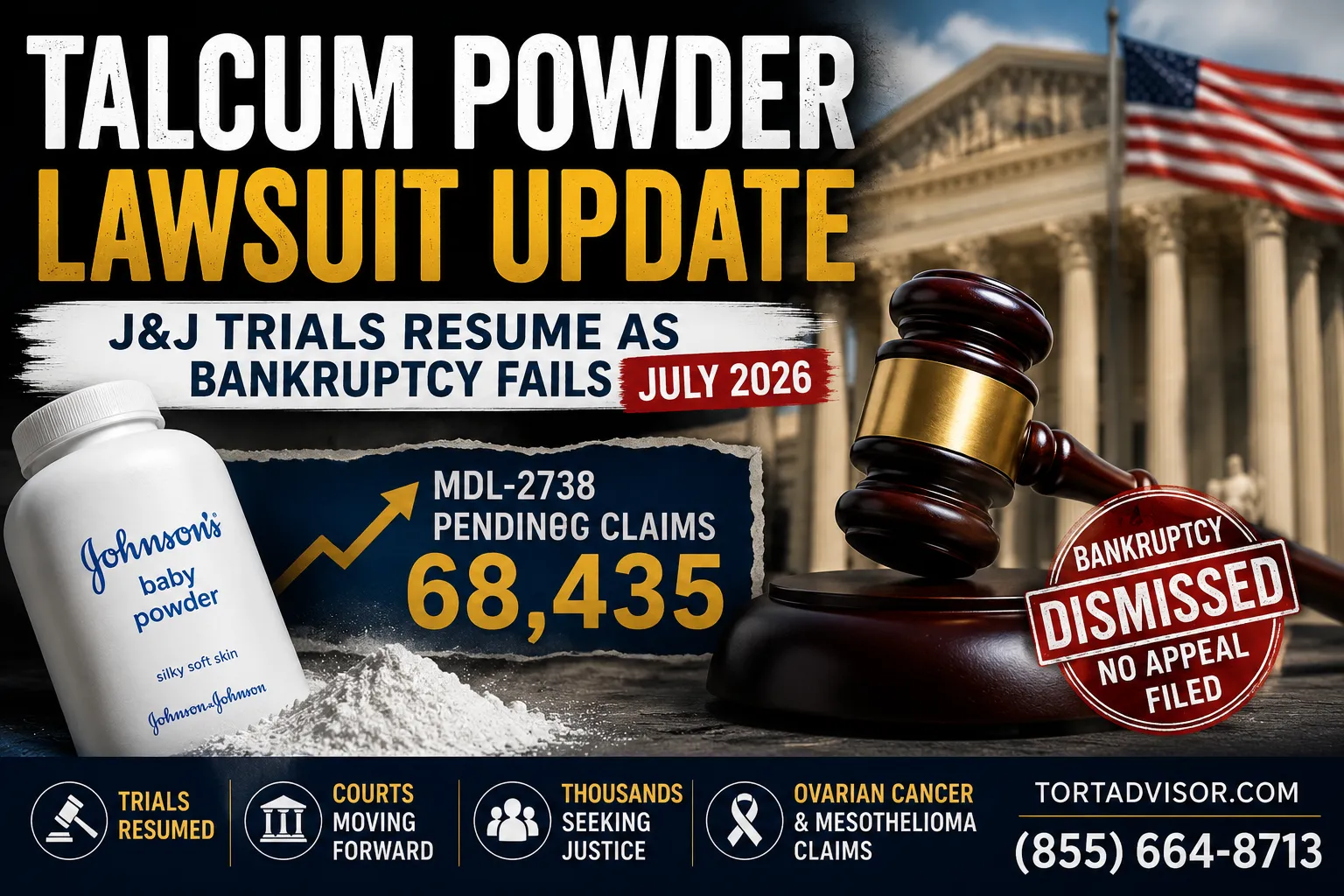
As of July 2026, roughly 68,435 cases are pending in MDL No. 2738 — the consolidated federal talc litigation before Judge Michael A. Shipp in the District of New Jersey — up from about 68,029 the month before, according to multiple litigation-tracking firms that monitor the docket. That makes it the largest actively litigated multidistrict docket in the country by case count, ahead of other major 2026 mass torts. Because these figures come from law-firm and industry trackers rather than a single official tally, treat any specific count as an approximation as of its stated date rather than a fixed number; anyone citing this talcum powder asbestos lawsuit 2026 figure later in the year should re-check it against the current docket before repeating it.
The growth isn’t just about volume of filings — it’s also about what kind of claims are being filed. Court filings reviewed in connection with the litigation indicate that about 40% of mesothelioma lawsuits filed in 2025 included an allegation of asbestos exposure through talc, compared with roughly 17% just a few years earlier. That shift is arguably the more important story in this asbestos MDL news cycle: mesothelioma, historically linked to occupational asbestos exposure in construction, shipbuilding, and industrial trades, is increasingly being alleged as a consequence of everyday consumer talc use, and it’s reshaping the profile of who files these cases — including more women and, in some reported filings, younger claimants than the historical occupational-exposure norm.
The Lancet Retraction: A Half-Century-Old Safety Claim Unravels
In March 2026, one of the world’s most respected medical journals took an unusual step. The Lancet formally retracted an unsigned 1977 commentary that had concluded ordinary consumer exposure to cosmetic talc was unlikely to cause cancer or lung damage — a passage defense attorneys have cited for decades as evidence the medical establishment considered talc safe.
The retraction followed research by Columbia University public health historians David Rosner and Gerald Markowitz, who identified the piece’s author as Francis J.C. Roe, a cancer researcher who was, at the time, a paid consultant to the cosmetics industry. According to reporting from Retraction Watch, correspondence uncovered during litigation discovery shows Roe shared an advance draft of the commentary with a Johnson & Johnson medical affairs director and revised it based on the company’s feedback before publication — without disclosing that relationship to the journal.
The Lancet’s editors addressed the matter directly in the retraction notice itself, stating that had they known of the undisclosed conflict of interest at the time, they would not have published the piece. Johnson & Johnson has publicly disputed that the episode amounts to misconduct warranting retroactive condemnation, and at least one product-liability defense attorney quoted in coverage of the retraction argued a 50-year-old unsigned editorial would carry little weight in court regardless. Regardless of how that dispute is ultimately characterized, the retraction removes a nearly 50-year-old citation that has repeatedly been used in every major talcum powder asbestos lawsuit 2026 defendants have faced to argue the medical field didn’t view asbestos-contaminated talc as dangerous — a meaningful, if largely evidentiary rather than case-determinative, development for pending and future claims.
June 2026 Bellwether Trials: A Split Result
Bellwether trials are test cases used in mass litigation to gauge how juries respond to representative claims, and they shape settlement value for everyone else in the docket. June 2026 produced a genuinely mixed result in the ongoing J&J talc bellwether trial process, which is worth understanding in full rather than through a single headline.
On June 5, 2026, a Los Angeles jury sided with Johnson & Johnson and Red River Talc LLC (the J&J-affiliated entity now handling talc liabilities) in the second ovarian-cancer bellwether, returning a 10-2 defense verdict rejecting three women’s claims that talc products caused their ovarian cancer. That followed an earlier bellwether loss for the company in December 2025, when a different Los Angeles jury awarded $40 million to two women in a comparable ovarian-cancer case — so the ovarian-cancer bellwether track record so far stands at one loss and one win for the defense.
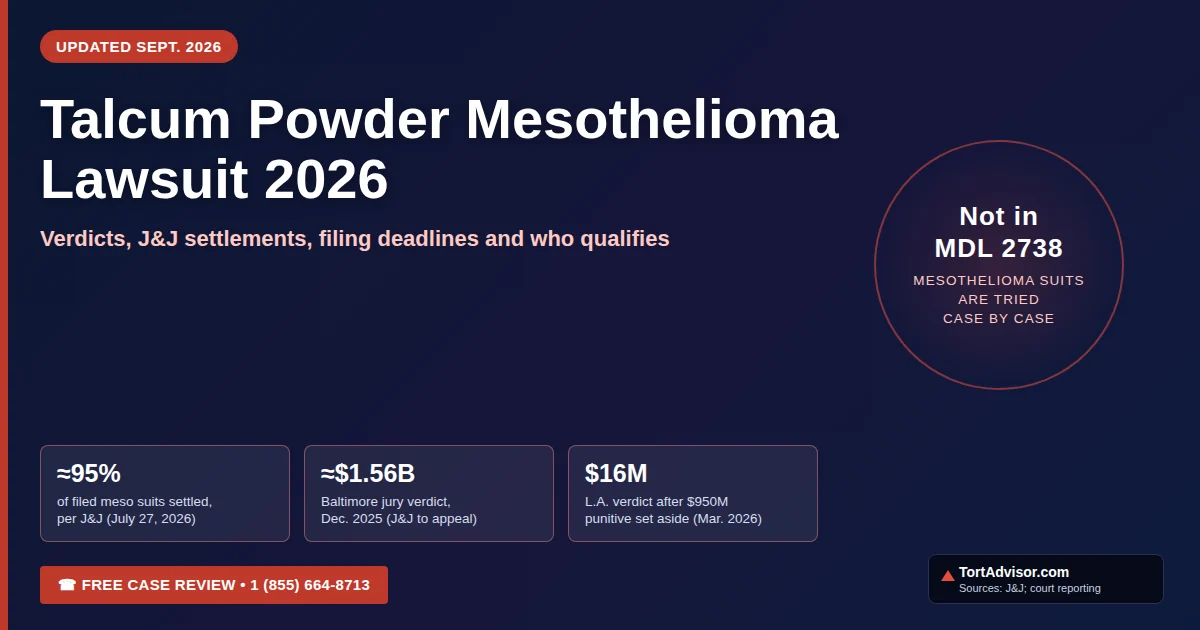
Separately, and on a different legal theory, another Los Angeles jury awarded $32 million on June 10, 2026 to the family of a California woman who died of pleural mesothelioma, finding Johnson & Johnson fully liable for her death after years of talcum powder use. Mesothelioma claims and ovarian-cancer claims proceed on separate causation theories and are being tried separately, and this split result — a defense win and a plaintiff win within days of each other — is a useful reminder that the litigation isn’t moving in one direction only. Anyone evaluating settlement leverage on either side should weigh both outcomes rather than just the one that fits a preferred narrative.
The Punitive Damages Ruling: Numbers That Need Context
In March 2026, a California judge substantially reduced one of the litigation’s largest verdicts. A jury had previously awarded a mesothelioma victim’s family a combined verdict exceeding $960 million, including roughly $950 million in punitive damages, following an October 2025 trial. The judge threw out the punitive portion of that award on post-trial review, per Reuters’ reporting on the ruling, while leaving the underlying $16 million compensatory award intact.
This detail matters for anyone trying to gauge realistic case values. Headline verdict numbers in mass tort coverage are frequently reduced on appeal or post-trial motion, sometimes dramatically, and the compensatory amount that actually survives judicial review is often a small fraction of the number that made headlines. Anyone using a verdict amount to estimate what a claim might be worth should look for the final, post-review figure rather than the initial jury number — a $950 million headline and a $16 million outcome are, legally speaking, very different results.
Where Settlement Talks Actually Stand
This is one of the fastest-moving parts of the story, and it’s worth being precise about it rather than guessing. A mediation session originally scheduled for mid-April 2026 was rescheduled to April 27, 2026, and court-ordered mediation sessions have continued periodically since. As of the most recent reporting available, Johnson & Johnson is not currently pursuing a global settlement of the talc litigation, following the collapse of the company’s third attempted bankruptcy-based resolution (a roughly $8–9 billion proposal) in 2025. Individual case settlements remain possible even without a global deal, and this talcum powder MDL update could shift again quickly — anyone relying on settlement-status information should confirm it against current court filings or recent news before treating it as final, since these talks have stalled and restarted multiple times already and at least one judge overseeing related proceedings has reportedly expressed frustration at the pace of progress.
A Pending Fight Over Expert Testimony
A separate and less publicized dispute could matter as much as any single verdict: Johnson & Johnson has argued that without admissible expert causation testimony, several scheduled bellwether cases — and potentially a much larger share of pending claims — cannot proceed. Court filings show plaintiffs’ counsel withdrew two expert witnesses who had been expected to testify on causation in a group of bellwether cases, and motions challenging the admissibility of plaintiffs’ experts remain active in the MDL docket, with dozens of such motions filed and litigated over the past year. This is exactly the kind of procedural ruling that can change on short notice and reshape the litigation’s trajectory for every pending claim, so treat any characterization of its outcome as provisional until a judge actually rules on the merits.
What This Means If You’re Considering a Claim
If you or a family member were diagnosed with mesothelioma or ovarian cancer after regular talcum powder use, the practical takeaways from this update are fairly straightforward. First, the litigation is large, active, and still growing — you would not be filing into a dying or resolved docket. Second, outcomes so far have gone both ways at trial, so no attorney can honestly promise a specific result; what any group of talc asbestos lawsuit claims is worth depends heavily on diagnosis, exposure history, and jurisdiction, and headline verdicts are not a reliable guide to an individual case’s value. Third, because statutes of limitations for these claims typically run just one to three years from diagnosis (and vary by state), the main risk of waiting isn’t missing a settlement wave — it’s missing your filing deadline entirely.
Anyone researching a talcum powder asbestos lawsuit 2026 filing should also expect this story to keep moving. Between the pending admissibility fight, the unresolved settlement question, and additional bellwether trials still on the calendar, several of the facts in this article could change within weeks. A free case evaluation with an attorney experienced specifically in this docket is generally the fastest way to get a current, case-specific answer rather than relying on any single article, however carefully sourced.
Talk to a Mass Tort Attorney About Your Situation
Free, confidential case reviews. No fee unless you recover compensation.
Still unsure where you stand?
Have a trained case advisor review your own facts — free, confidential, and with no obligation.
- Free — no cost, no obligation
- About a minute to complete
- Reviewed by a trained case advisor
- Nothing you submit is published
Your details are sent over a secure connection and reviewed confidentially.
Frequently Asked Questions
How many talc lawsuits are pending right now?
Tracking sources put the figure at roughly 68,000–68,500 in the federal MDL as of July 2026, though this number changes regularly and should be reconfirmed against current sources before being repeated as fact.
Did Johnson & Johnson lose or win its most recent trial?
Both happened in June 2026: the company won an ovarian-cancer bellwether (10-2 defense verdict) on June 5, and lost a separate mesothelioma case ($32 million verdict) on June 10.
Is there a global settlement?
Not as of the most recent reporting. Mediation sessions have occurred, but Johnson & Johnson has said it is not currently pursuing a global resolution. This status can change quickly and should be reverified before you rely on it.
Does the Lancet retraction mean I automatically qualify for compensation?
No. It removes a piece of evidence defense attorneys have relied on, but eligibility still depends on your diagnosis, exposure history, and other case-specific facts.
Related Resources
- Talcum Powder Mesothelioma Lawsuit 2026: Cases, Verdicts & Settlement Update
- Talcum Powder and Ovarian Cancer: Science, Legal Rights & Settlement Guide
- Mesothelioma Exposed: Causes, Symptoms, Treatment & Legal Rights
- Mesothelioma Settlement Calculator
- Active Personal Injury Lawsuits Hub
Published by Mason Arnao. This article is general information, not legal advice. Case counts, verdict amounts, and settlement status reflect the most recent sourcing available as of publication and are subject to change — consult a licensed attorney about your specific situation.
Related Posts

Quick Answer: The talcum powder lawsuit statute of limitations typically runs one to six years from the date of diagnosis, [...]
Quick Answer: As of July 2026, Johnson & Johnson's talc bankruptcy strategy has failed for a third time, and talcum [...]

Update — September 24, 2026: On July 27, 2026, Johnson & Johnson proposed a $5.5 billion resolution of ovarian cancer [...]