Talcum Powder Lawsuit Update 2026: Latest News, Settlement Amounts & Who Qualifies
Talcum Powder Lawsuit Update 2026: Where Things Stand
The talcum powder lawsuit remains one of the most closely watched mass tort cases in U.S. legal history. As of 2026, tens of thousands of women—and some men—have filed claims against Johnson & Johnson (J&J) alleging that prolonged use of talc-based products like Johnson’s Baby Powder and Shower to Shower caused ovarian cancer, mesothelioma, and other serious conditions.
The case has gone through remarkable twists: jury verdicts awarding billions, J&J’s controversial bankruptcy maneuver, federal court rejections, a dismissed bankruptcy, and now a new $5.5 billion civil settlement proposal (July 2026). If you have been following the talcum powder lawsuit update 2026, this guide gives you the most current information on status, settlements, and how to file. You can also compare this talcum powder lawsuit update with our talcum powder settlement calculator and talcum powder settlement amounts guide.
Key 2026 Developments at a Glance
- $5.5 billion civil settlement proposed by J&J (July 27, 2026); excludes mesothelioma and future claims
- 62,000+ active claimants in the MDL and bankruptcy proceedings
- Claimant vote on settlement approval ongoing in 2025–2026
- Beasley Allen and other top firms actively monitoring payout tiers
- New claimants with qualifying diagnoses may still file
Reputable external resources:
- FDA talc and cosmetic product safety information
- BMJ study on progestogens and intracranial meningioma risk
This talcum powder lawsuit update links to official and medical resources so readers can review the broader talc safety discussion, asbestos-testing context, and related research while comparing those sources with the litigation status described below.
Find out if you may have a claim
Answer a few questions and a trained case advisor will review your situation — most people finish in about a minute.
- Free — no cost, no obligation
- About a minute to complete
- Reviewed by a trained case advisor
- Nothing you submit is published
Your details are sent over a secure connection and reviewed confidentially.
Latest Talcum Powder Lawsuit Update: Johnson & Johnson August 2026 News
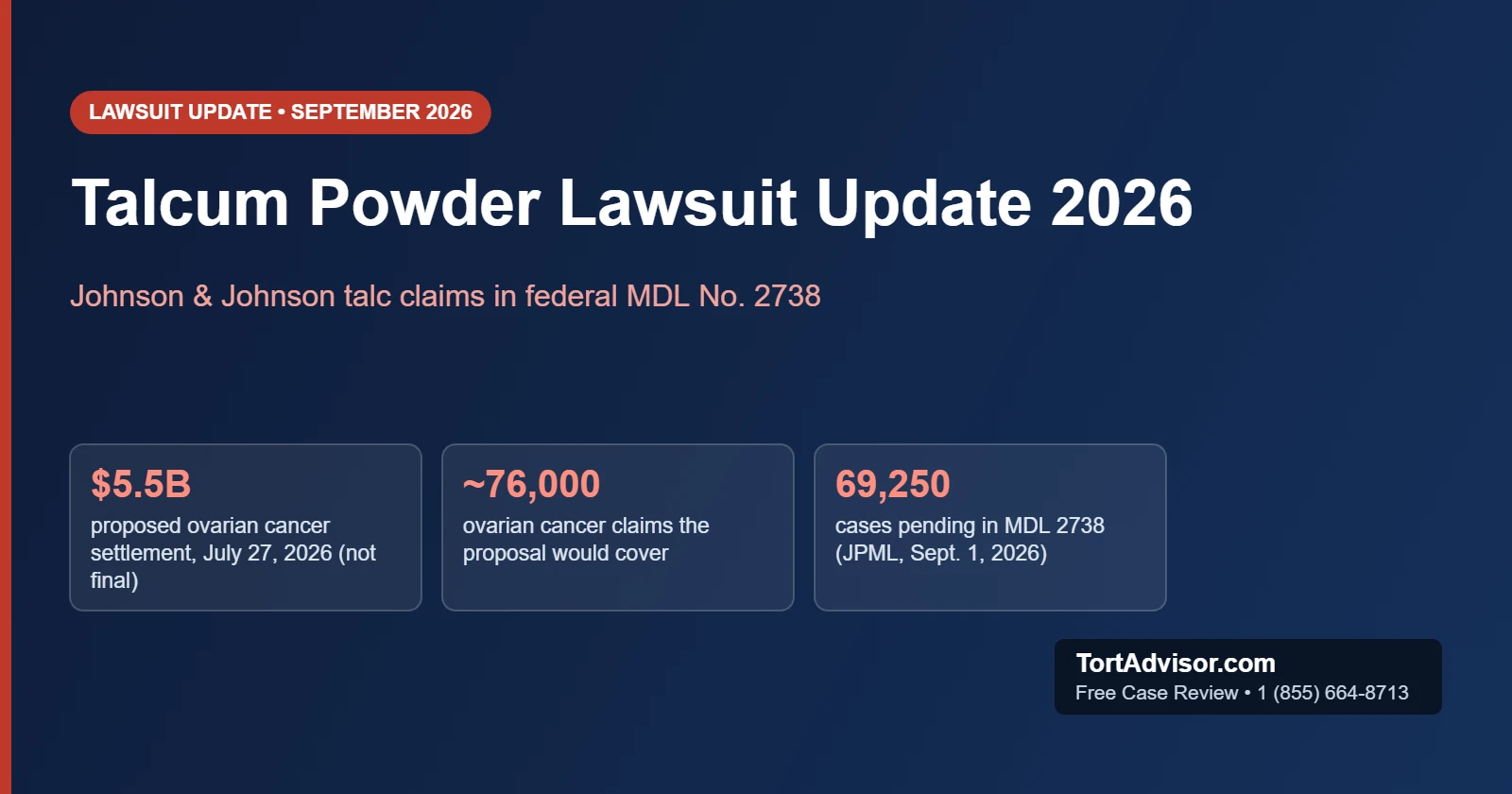
August 2026 Update: On July 27, 2026, Johnson & Johnson announced a new proposed $5.5 billion civil settlement to resolve approximately 76,000 ovarian cancer claims. Unlike previous attempts, this proposal does not involve bankruptcy—J&J’s third bankruptcy filing (Red River Talc LLC) was dismissed March 31, 2025. The deal requires 95% claimant participation; initial payments would not begin until 2027. Separately, on July 22, 2026, MDL-2738 Magistrate Judge Singh issued a show-cause order after plaintiffs withdrew key expert witnesses from bellwether cases. The MDL now contains approximately 69,000 pending cases.
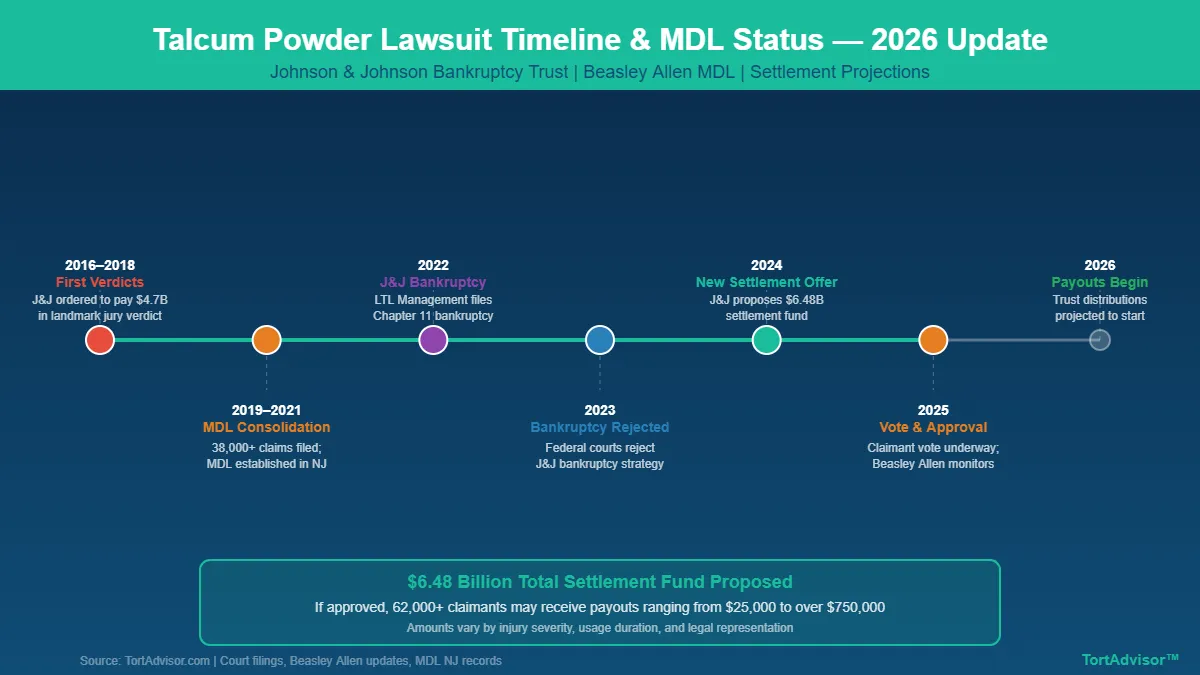
The latest news on Johnson & Johnson talcum powder lawsuit 2026 reflects a dramatic shift from bankruptcy litigation to civil settlement—here’s a timeline of how we got here: Here’s a timeline of how we got here:
2016–2018: Landmark Jury Verdicts
The first wave of cases went to trial with devastating results for J&J. In 2018, a Missouri jury awarded $4.69 billion to 22 women who alleged that asbestos-contaminated talc in J&J products caused their ovarian cancer. This verdict, though later reduced on appeal, signaled that juries were taking these claims seriously.
2019–2021: MDL Consolidation
As the volume of individual lawsuits exploded past 38,000 cases, a Multi-District Litigation (MDL) was established in the District of New Jersey. This allowed pre-trial proceedings to be centralized while preserving each plaintiff’s individual right to trial. J&J settled some cases quietly while fighting others in court.
2022: J&J’s Bankruptcy Gambit
In a controversial legal maneuver, J&J spun off a new subsidiary called LTL Management and pushed all talc liability into it, then immediately filed for Chapter 11 bankruptcy. The strategy—sometimes called the “Texas Two-Step”—was designed to cap payouts and halt thousands of trials. Critics called it an abuse of the bankruptcy system.
2023–2024: Courts Reject Bankruptcy Strategy
Federal appellate courts rejected J&J’s bankruptcy filings twice, ruling that LTL Management was not actually in financial distress and therefore did not qualify for bankruptcy protection. This forced J&J back to the negotiating table. In response, J&J proposed a $5.5 billion civil settlement (July 27, 2026)—a historic offer that would be distributed through a bankruptcy trust to qualifying claimants.
2025–2026: Settlement Vote & Payout Timeline
For the settlement to move forward, a supermajority of claimants must vote in favor of acceptance. Beasley Allen, one of the most prominent law firms in the talcum powder litigation, has provided regular updates to their clients throughout the vote process. As of mid-2026, the vote is still being tallied, and the company’s own disclosure places the first payment, of no more than $3 billion, in 2027.
Has Anyone Received Money from the Talcum Powder Lawsuit?
This talcum powder lawsuit update separates earlier private settlements from the larger unresolved claimant pool still awaiting a global resolution.
This is one of the most common questions from claimants: has anyone received money from the talcum powder lawsuit? The answer is yes—but the full resolution is still pending for most people.
Who Has Been Paid So Far?
Johnson & Johnson has quietly settled thousands of individual cases outside of the MDL over the years, particularly high-value mesothelioma cases and ovarian cancer cases with strong medical evidence. These settlements are typically subject to confidentiality agreements, so exact amounts are rarely disclosed. Additionally, some earlier trial verdicts resulted in payments after appeals were resolved.
However, the majority of the 69,000+ pending claims have NOT yet received money. These claimants are waiting for either J&J’s new $5.5 billion civil settlement to achieve the required 95% participation threshold, or for individual cases to proceed to trial if the settlement falls through.
When Will the Talcum Powder Lawsuit Be Settled?
The question on every claimant’s mind: when will the talcum powder lawsuit be settled? If J&J’s new $5.5 billion civil settlement (announced July 27, 2026) meets its stated condition — participation by lead plaintiff firms representing at least 95 percent of the remaining ovarian claims — then under the company’s own disclosure the first payment of no more than $3 billion would be made in 2027, with no further payments due before 2028. Lead negotiator Christopher Seeger has been reported as saying the total could reach $7 billion or more depending on participation; that is his estimate, not a term of the agreement, and Johnson & Johnson’s announcement puts the commitment at $5.5 billion. Note: mesothelioma claims and future claims are excluded from this proposal.
If the settlement is rejected or challenged further in court, litigation could extend into 2028 or beyond, with individual cases potentially going to trial. Most legal experts believe a settlement is the most likely outcome given J&J’s continued financial motivation to cap liability.
Average Settlement for Talcum Powder Lawsuit: What to Expect
This talcum powder lawsuit update explains why settlement values can differ so widely from one claimant to another.
Understanding the average settlement for talcum powder lawsuit claims is critical to setting realistic expectations. This talcum powder lawsuit update should be read alongside our talcum powder lawsuit payout guide for payout-tier context. The amounts vary significantly based on injury type, severity, usage history, and the strength of your medical evidence.
Why This Page Publishes No Talc Settlement Tiers
This section previously carried projected settlement tiers by injury type, together with a chart of average amounts. Both have been removed, because no source supports them. Johnson & Johnson announced a proposed resolution of the ovarian talc claims on July 27, 2026 in the region of $5.5 billion, and what the company disclosed was a total commitment: no per-claimant allocation, no injury-tier schedule and no matrix has been published by the company or filed with any court. A tier table cannot be derived from a total, and dividing $5.5 billion by roughly 76,000 claimants produces a number that describes nobody.
The structure of the proposal matters as much as its size. The first payment is not due until 2027, and the resolution is conditioned on achieving roughly 95 percent claimant participation — a threshold that has not been met and that the company itself describes as a condition rather than an expectation. Until participation is established and an allocation formula is filed, no claimant can be told what their claim is worth under it, and any page telling them otherwise is describing a document that does not exist.
What the record does contain is verdicts, and they are the opposite of a tier table. The Missouri jury award in Ingham was $4.69 billion for 22 women in 2018; it was reduced on appeal to $2.1 billion and Johnson & Johnson paid about $2.5 billion including interest in June 2021 after the Supreme Court declined to hear the case. Other talc verdicts have gone the other way entirely on appeal. A single verdict, reduced by more than half and then paid, is a recorded outcome for 22 specific women — not a benchmark, and not a tier.
The primary source for every figure above is Johnson & Johnson’s own announcement of a proposed resolution of the ovarian talc litigation, published July 27, 2026, which states the $5.5 billion commitment, the first payment of no more than $3 billion in 2027, the absence of any further payment before 2028, the approximately 76,000 remaining ovarian claims, and the condition that lead plaintiff firms representing at least 95 percent of those claims participate. The same announcement records that the company has won the overwhelming majority of ovarian cases tried to date and characterises the settlement as a business decision rather than an admission of liability. Read the announcement. Case counts come from the Judicial Panel on Multidistrict Litigation’s October 1, 2026 statistics report, which records 69,340 actions pending in MDL 2738 before Judge Michael A. Shipp — the largest MDL in the country.
Factors That Affect Your Payout
- Duration of talcum use: Long-term use (5+ years) strengthens your claim
- Specific diagnosis: Mesothelioma and late-stage ovarian cancer get higher tiers
- Medical records: Pathology reports, oncology notes, and prior diagnostics
- Purchase records or product evidence: Receipts, photos, or witnesses confirming product use
- Age at diagnosis and prognosis: Younger women with severe diagnoses often receive higher awards
Beasley Allen Talcum Powder Update 2026
This talcum powder lawsuit update includes Beasley Allen context because major plaintiffs’ firms can influence claimant communications, objections, and settlement-position analysis.
The Beasley Allen talcum powder update is closely watched by claimants and attorneys nationwide. Beasley Allen, a Montgomery, Alabama-based firm, has been one of the most active firms in talcum powder litigation, representing thousands of ovarian cancer claimants and playing a key role in shaping MDL strategy.
As of 2026, Beasley Allen continues to scrutinize J&J’s new $5.5 billion civil settlement proposal (July 2026), evaluating whether the per-claim payouts are sufficient for clients with the most serious diagnoses. The firm has indicated it will continue to fight for higher tiers and fairer distribution formulas within the trust structure.
Claimants represented by Beasley Allen and similar firms should expect ongoing communications as the vote outcome is finalized. If you have not heard from your attorney recently, it may be worth reaching out directly for a status update on your specific case.
Who Qualifies for the Talcum Powder Lawsuit?
This talcum powder lawsuit update focuses on diagnosis, usage history, product identification, and statute-of-limitations timing because those facts often decide eligibility.
You may have a valid talcum powder claim if you meet the following criteria. For a broader overview, review our main talcum powder lawsuit page after reading this talcum powder lawsuit update:
Primary Eligibility Requirements
- Product use: You used Johnson’s Baby Powder, Shower to Shower, or another talc-based product regularly for at least 1 year (preferably 4+ years for stronger claims)
- Diagnosis: You were diagnosed with ovarian cancer, mesothelioma, fallopian tube cancer, or peritoneal cancer
- Timing: Your diagnosis occurred after a documented period of talcum product use
- No prior settlement: You have not previously settled a talcum powder claim with J&J
Who May Have a Stronger Claim
- Women who used talcum powder for perineal hygiene (genital area) for 5+ years
- Those diagnosed with Stage III or Stage IV ovarian cancer
- Mesothelioma patients (asbestos-contaminated talc exposure)
- Claimants with detailed medical records and a treating oncologist on record
- Individuals who can document specific product use (brand, frequency, duration)
Statute of Limitations Warning
Most states allow 2 to 3 years from the date of diagnosis (or from when you reasonably linked your diagnosis to talcum use) to file a lawsuit. Some states have specific “discovery rule” provisions that may extend this window. Do not wait—filing deadlines are strict, and missing them means permanently forfeiting your right to compensation.
Evidence You Need to File a Claim
This talcum powder lawsuit update recommends gathering records early because strong proof can affect both claim acceptance and settlement tier placement.
Gathering the right documentation early strengthens your case significantly. This talcum powder lawsuit update emphasizes records because documentation is one of the strongest settlement-value factors. Your attorney will typically need:
- Medical records: Pathology report confirming your diagnosis, oncology treatment records
- Product evidence: Photographs of J&J products, old receipts, witness statements from family members who observed your use
- Usage history: A written timeline of when and how frequently you used the product
- Proof of harm: Surgery records, chemotherapy or radiation treatment history, current medical status
- Income documentation: If claiming lost wages or economic damages
How to File a Talcum Powder Lawsuit Claim in 2026
This talcum powder lawsuit update explains the filing process in practical steps, but a case-specific attorney review is still important before relying on any projected settlement amount.
- Contact a mass tort attorney — Choose a firm experienced in talcum powder litigation. Most offer free consultations and work on contingency (no upfront cost).
- Gather your records — Compile medical records, diagnosis reports, and any evidence of product use before your first attorney meeting.
- Complete case intake — Your attorney will collect your information and determine whether your case qualifies based on diagnosis, usage history, and statute of limitations.
- File your claim — Your attorney files the claim within the MDL or directly with the J&J trust, depending on where the proceedings stand at the time.
- Await case evaluation — Your claim will be reviewed and placed into a payout tier based on the strength of your evidence and severity of your injury.
- Receive your settlement — Once the trust is approved and distributions begin, you’ll receive your payout minus attorney fees (typically 33–40% on contingency).
Frequently Asked Questions
These FAQ answers summarize the talcum powder lawsuit update for users comparing settlement timing, payout projections, qualification rules, and whether earlier claimants have already received money.
When will the talcum powder lawsuit be settled?
If J&J’s $5.5 billion civil settlement (proposed July 27, 2026) achieves the required 95% participation threshold, distributions are projected to begin in late 2026 or into 2027. If the settlement is rejected or challenged in court, litigation could extend to 2028 or beyond. Most legal experts believe a settlement is the most probable outcome.
Has anyone received money from the talcum powder lawsuit?
Yes. Johnson & Johnson has quietly settled thousands of individual cases — particularly high-value mesothelioma and advanced ovarian cancer claims — over the years. However, the vast majority of the 62,000+ pending claims have not yet been paid and are awaiting the trust settlement outcome.
What is the average settlement for a talcum powder lawsuit?
There is no published average. Johnson & Johnson’s proposed July 2026 resolution discloses a total commitment of roughly $5.5 billion covering about 76,000 ovarian claims, with no per-claimant allocation, no injury-tier schedule and no matrix filed with any court. Figures circulating as talc “averages” or “tiers” are not drawn from any settlement document, and dividing the total by the claimant count produces a number that applies to no individual claim.
What is the latest news on the Johnson & Johnson talcum powder lawsuit in 2026?
As of August 2026, J&J has proposed a new $5.5 billion civil settlement—its bankruptcy strategy having been dismissed in March 2025. Federal courts previously rejected J&J’s bankruptcy strategy twice. A claimant vote is currently underway. Beasley Allen and other major firms are scrutinizing the payout tiers and pushing for better terms. Final resolution is expected in 2026–2027.
What does the Beasley Allen talcum powder update say?
Beasley Allen, one of the leading firms in the talcum powder MDL, has expressed concerns that J&J’s $5.5 billion civil settlement proposal may undercompensate the most seriously injured claimants. They continue to advocate for higher payout tiers and are actively communicating with their clients throughout the settlement vote process. Clients should contact their attorneys directly for personalized updates.
2026 Talcum Powder Lawsuit Update Summary
This talcum powder lawsuit update tracks Johnson & Johnson settlement negotiations, bankruptcy-trust developments, payout-tier projections, claimant eligibility, evidence requirements, and timing expectations.
The most important takeaway from this talcum powder lawsuit update is that claim value depends on diagnosis, long-term talc use, medical documentation, product evidence, state deadlines, and whether the proposed settlement structure is approved.
Because the litigation is still evolving, this talcum powder lawsuit update should be reviewed with the related TortAdvisor settlement calculator and settlement amount pages before making assumptions about an individual claim.
Related Posts

How VCF registration works: who should register, the two-year deadline and when it starts, how to register online or by phone, and how it fits with the WTC Health Program.
Paraquat exposure explained from EPA, CDC and court records: how it happens, who is most at risk, drift and vapor, the safety rules since 2016, Parkinson’s research, and the records that help show exposure.

The Supreme Court's June 25, 2026 ruling in Monsanto v. Durnell held that FIFRA can preempt state failure-to-warn claims, unsettling a central theory in paraquat cases. With 6,602 actions pending in MDL 3004 as of 1 October 2026 and a global settlement agreed in principle but no terms disclosed, here is what is verified and what is not.