
Hernia Mesh Settlement Amounts 2026: Bard, Covidien & Atrium
There is no single hernia mesh litigation. Three manufacturers sit in three separate MDLs at three different stages, and which device was implanted matters more to a claim’s value than almost anything about the injury.
Free Hernia Mesh Case Review
Wondering how the figures on this page relate to your own situation? Share a few details below — a trained case advisor reviews every submission FREE and with no obligation, and your information stays confidential.
- Free — no cost, no obligation
- About a minute to complete
- Reviewed by a trained case advisor
- Nothing you submit is published
Call 855-664-8713Text 855-664-8713
- Share a few details. It takes about a minute, and only a few fields are required.
- A trained case advisor reviews them. Free and confidential. TortAdvisor is not a law firm.
- You choose what happens next. If you asked for a call, the advisor follows up by phone or text.
Your details are sent over a secure connection and reviewed confidentially.
Latest Hernia Mesh Settlement Amounts and MDL Status
Anyone searching for a hernia mesh settlement amount is really asking three different questions, because the answer depends entirely on whose device was implanted.
Claims are consolidated separately by manufacturer: Atrium in New Hampshire, Bard in Ohio and later Covidien in Massachusetts. They have proceeded on independent timetables ever since.
A qualified settlement fund is approved in MDL 2753. The docket subsequently falls from thousands of pending actions to 127, which is what a resolving MDL looks like on the JPML report.
A framework is reached covering a large share of the Bard claims. No aggregate figure is disclosed by the company or the court, and no per-claim matrix is published.
A jury returns an $88 million verdict against Covidien in the Patterson trial, without punitive damages. It is the largest public hernia mesh outcome and is subject to post-trial and appellate proceedings.
Bard remains enormous and largely unresolved on public terms, Covidien is actively trying cases after a major verdict, and Atrium is nearly wound down.
Hernia Mesh Settlement Amounts: Confirmed Facts vs. Estimates
One number dominates coverage of this litigation, and it is not a disclosed figure.
What Is Confirmed
- Bard MDL 2846 held 23,324 pending actions of 25,217 filed before Judge Edmund A. Sargus Jr.
- Covidien MDL 3029 held 2,479 pending of 2,489 filed before Judge Patti B. Saris.
- Atrium MDL 2753 held 101 pending of 3,592 filed before Judge Landya B. McCafferty.
- A qualified settlement fund was approved in the Atrium litigation in October 2024.
- A settlement framework covering a large share of Bard claims has been in place since late 2024.
- An $88 million verdict was returned against Covidien in August 2026, without punitive damages.
What Is Not Known
- The total value of the Bard settlement framework — no figure has been disclosed.
- Per-claim allocation criteria for any of the three programmes.
- What an individual claim is worth under any framework.
- Whether the Covidien verdict survives post-trial and appellate review.
- Whether Covidien reaches a broader resolution, and on what terms.
Hernia Mesh Settlement Amounts by Claim Profile
No manufacturer has published a matrix, so these profiles describe relative position rather than dollar bands. They are TortAdvisor modelling, not official settlement offers, historical averages or predictions.
Multiple revision surgeries with severe complications
- Explant surgery, sometimes more than once
- Bowel obstruction, perforation, fistula or chronic infection
- Permanent functional impairment or inability to return to work
- Clear implant records identifying the device and manufacturer
- Substantial documented medical costs and lost earnings
Single revision surgery, complication resolved
- One explant or repair procedure with recovery
- Infection, migration or recurrence documented and treated
- Some ongoing symptoms but no permanent disability
- Implant records available
No revision surgery, or the device cannot be identified
- Chronic pain managed without further surgery
- Complications difficult to attribute to the mesh specifically
- Implant records incomplete or the manufacturer unidentified
- Limited documented economic loss
How a hernia mesh settlement payment reaches a claimant
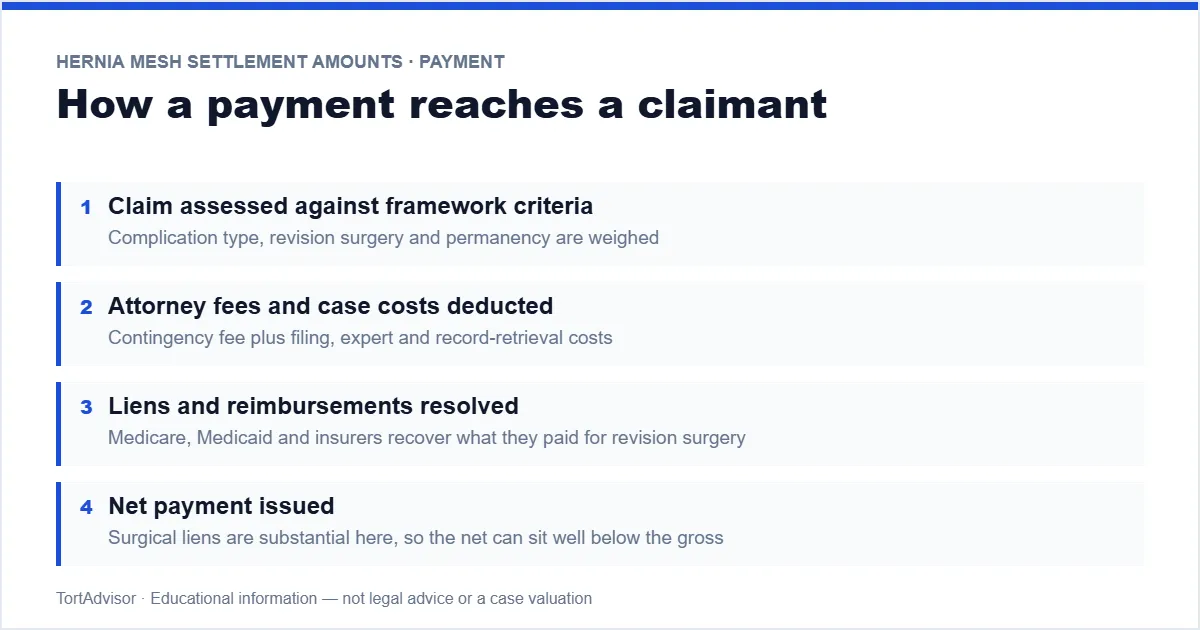
Frameworks exist here, so this sequence is real rather than hypothetical for many claimants. The lien step is unusually significant.
Claim assessed against framework criteria
Complication type, revision surgery and permanency are applied to the agreed criteria.
Attorney fees and case costs deducted
Contingency fee plus filing, expert and record-retrieval costs come out first.
Liens and reimbursements resolved
Medicare, Medicaid and private insurers recover what they paid for revision surgery.
Net payment issued
Because explant and revision surgery is expensive, liens can absorb a large share of a gross allocation.
No per-claim matrix has been published by any of the three manufacturers, so the criteria applied at step one are not publicly known.
How TortAdvisor Handles Hernia Mesh Settlement Amounts
The central discipline on this topic is refusing to convert a company’s financial disclosure into a settlement figure.
Keep the three MDLs separate
Bard, Covidien and Atrium are different defendants at different stages. A single hernia mesh average would describe none of them.
Label analyst estimates
A figure inferred from a company’s accounts is an estimate by a third party. It is reported as that, never as a disclosed settlement total.
Distinguish verdicts from settlements
The $88 million Covidien verdict is a jury award subject to appeal, not a benchmark for what settling claims receive.
Track the current docket
Case counts come from the current month’s JPML report. A collapsing pending count, as in the Atrium docket, is itself informative.
The Three Hernia Mesh MDLs Compared
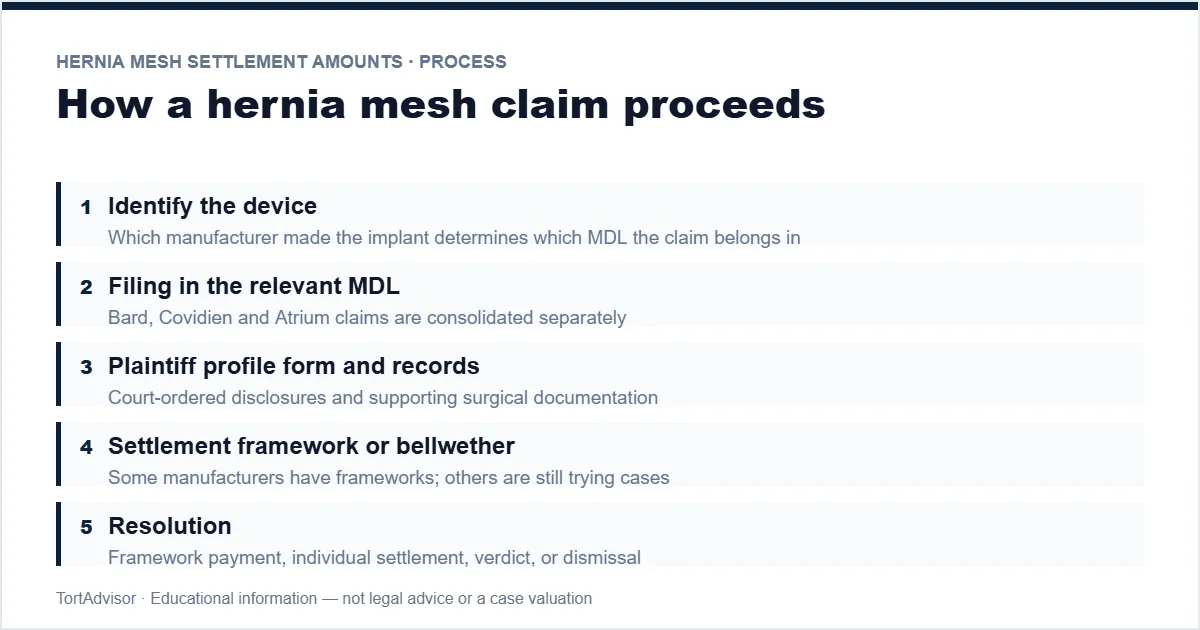
Identifying the manufacturer is the first question in any hernia mesh claim, because it determines everything that follows.
| Manufacturer | MDL, court and judge | Pending / filed | Resolution status |
|---|---|---|---|
| Bard (Becton Dickinson) | MDL 2846, S.D. Ohio, Judge Edmund A. Sargus Jr. | 23,324 / 25,217 | Settlement framework in place since late 2024, no total or matrix disclosed |
| Covidien (Medtronic) | MDL 3029, D. Mass., Judge Patti B. Saris | 2,479 / 2,489 | Actively litigating; $88M plaintiff verdict August 2026, no punitive damages |
| Atrium (Getinge) | MDL 2753, D.N.H., Judge Landya B. McCafferty | 101 / 3,592 | Qualified settlement fund approved October 2024; docket largely wound down |
Read the pending-versus-filed column carefully. Atrium has resolved roughly 96% of the claims ever filed against it, which is what a completed programme looks like. Bard has resolved comparatively few despite having a framework, and Covidien has barely resolved any. Those three positions imply very different timelines for a claimant today.
Who May Qualify for Hernia Mesh Settlement Amounts
Eligibility turns on identifying the device and documenting a complication attributable to it rather than to the surgery generally.
Common Screening Factors
- A hernia repair using surgical mesh from Bard, Covidien or Atrium
- A documented complication — infection, migration, contraction, adhesion, bowel obstruction, perforation or recurrence
- Revision or explant surgery, which is the clearest indicator of a serious claim
- Implant records identifying the manufacturer, product and ideally the lot number
- Ongoing pain or functional impairment attributable to the mesh
- Claims brought by a personal representative where the patient has died
Factors Requiring Closer Review
- Devices from manufacturers outside the three MDLs
- Complications with no revision surgery, which are valued very differently
- Implant records that do not identify the device
- Recurrence attributable to surgical technique rather than the product
- State limitation periods, which usually run from discovery of the complication
For a device litigation at the opposite end of the resolution spectrum, see our Bair Hugger settlement amounts research, and for the wider category our medical device lawsuit research.
Factors That Increase or Reduce Hernia Mesh Settlement Amounts
Across all three programmes, the same factors recur — with manufacturer identity sitting above all of them.
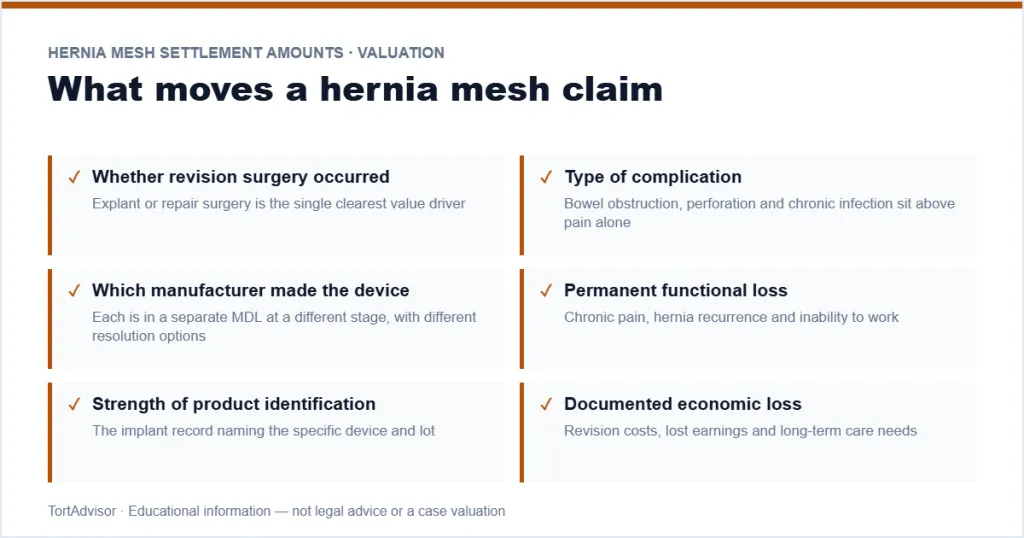
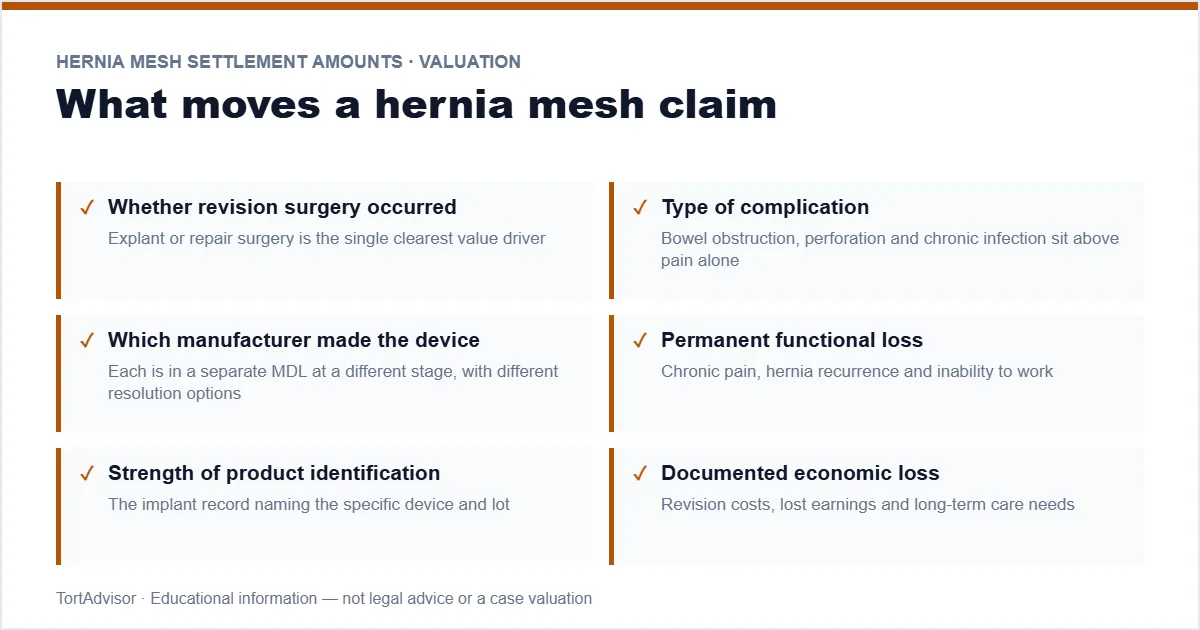
Whether revision surgery occurred
Explant or corrective surgery is the clearest single value driver in mesh litigation. Claims without it sit substantially lower under every framework.
Type and severity of complication
Bowel obstruction, perforation, fistula and chronic infection sit well above chronic pain or recurrence alone.
Number of revision procedures
Multiple explant or repair operations compound both the harm and the documented cost, and indicate a more entrenched problem.
Which manufacturer made the device
A Bard claim, a Covidien claim and an Atrium claim face entirely different resolution landscapes. This is not a detail — it is the framing question.
Permanent functional loss
Chronic pain requiring ongoing management, inability to return to physical work, or permanent restriction on activity.
Strength of product identification
The implant record naming manufacturer, product and lot. Without it a claim may not be assignable to any MDL.
Evidence Supporting Hernia Mesh Settlement Amounts
One document determines whether a claim can proceed at all: the record identifying which device was implanted.
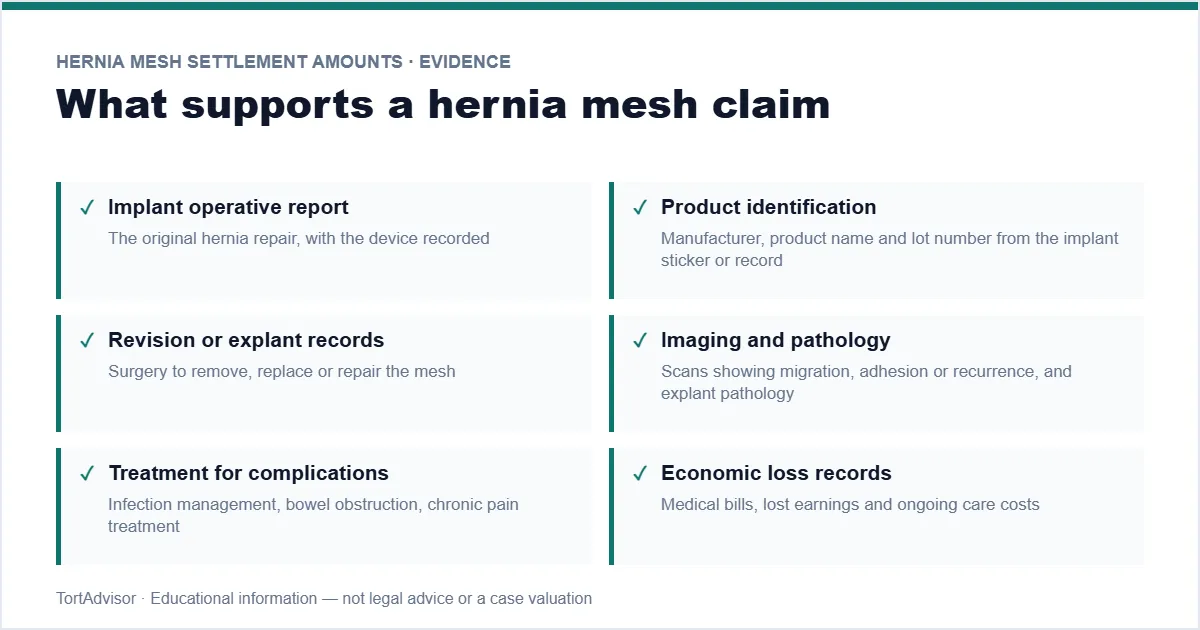
Implant operative report
The original hernia repair record, with the device recorded. This is where product identification usually comes from.
Device sticker or implant log
Hospitals typically record the manufacturer, product name and lot number. Requesting this specifically is more effective than asking for records generally.
Revision or explant records
Operative reports for any surgery to remove, replace or repair the mesh, with findings on migration, adhesion or infection.
Imaging and pathology
Scans documenting migration, contraction, adhesion or recurrence, and pathology on any explanted mesh.
Complication treatment records
Infection management, bowel obstruction admissions, chronic pain treatment and any specialist referrals.
Economic loss records
Medical bills and explanations of benefits, payroll records showing lost earnings, and documentation of ongoing care needs.
Ask for the implant record by name. A general request for medical records often returns clinical notes without the device documentation that a mesh claim depends on.
Filing Deadlines for Hernia Mesh Claims
Because complications can appear years after implantation, the discovery rule is what makes most of these claims possible — and it is also what makes the deadline easy to miss.
What tends to matter
- The date the complication was discovered or attributed to the mesh
- Which state’s law governs
- Whether a revision surgery started the clock
- Whether the implant records still exist
What does not pause the clock
- The existence of a settlement framework or fund
- Waiting for a verdict in another manufacturer’s MDL
- Ongoing treatment for the complication
- Not yet knowing which manufacturer made the device
Take the Hernia Mesh Settlement Calculator Below
The calculator organises what you know about the implant, the complication, any revision surgery and the financial loss, then emails you a free hernia mesh lawsuit report built from public records. It takes a few minutes and asks for no documents.
The report is educational and is not a case valuation or settlement offer.
Before You Start
- Roughly when the hernia repair was done
- Whether you know the manufacturer or product name
- What complication developed, and when
- Whether revision or explant surgery followed
- Any permanent restriction or ongoing pain
- The state where the surgery took place
Answer what you know. You do not need every record or an exact timeline to get started.
Primary Sources for Hernia Mesh Settlement Amounts
Every figure above traces to one of these. Each was checked on Oct. 1, 2026.
JPML pending-actions report
The JPML report dated Oct. 1, 2026 gives all three dockets: Bard MDL 2846 at 23,324 pending of 25,217 filed, Covidien MDL 3029 at 2,479 of 2,459, and Atrium MDL 2753 at 101 of 3,592.
FDA hernia surgical mesh guidance
FDA identifies pain, infection, hernia recurrence, adhesion, obstruction and bleeding as the most common complications of hernia repair, names mesh migration and contraction as mesh-specific risks, and states the literature has consistently shown reduced recurrence with mesh.
The three MDL dockets
The Atrium qualified settlement fund, the Bard settlement framework and the Covidien trial outcomes are recorded on the dockets in New Hampshire, Ohio and Massachusetts respectively. TortAdvisor cites those dockets rather than secondary coverage.
On the Bard settlement figure
No aggregate settlement total has been disclosed by Bard, by Becton Dickinson or by the court. The figure widely repeated online is an analyst estimate derived from company financial disclosures, and TortAdvisor does not present it as a settlement amount.
The Covidien verdict
The $88 million verdict returned in August 2026 is recorded on the District of Massachusetts docket. No punitive damages were awarded, and the verdict is subject to post-trial and appellate proceedings.
Why no per-claim figure is published
None of the three manufacturers has published allocation criteria or a per-claim matrix. TortAdvisor therefore publishes claim profiles describing relative position rather than dollar bands that would have no source.
Frequently Asked Questions About Hernia Mesh Settlement Amounts
What is the average hernia mesh settlement amount?
There is no reliable average. No manufacturer has published allocation criteria or a per-claim matrix, and the three MDLs are at completely different stages. An average across them would describe no actual claimant.
Did Bard settle the hernia mesh cases for $1 billion?
No such figure has been disclosed. A settlement framework covering a large share of Bard claims has been in place since late 2024, but neither the company nor the court has published a total. The billion-dollar figure circulating online is an analyst estimate derived from financial filings.
How many hernia mesh lawsuits are pending?
As of the Oct. 1, 2026 JPML report: 23,324 against Bard in MDL 2846, 2,479 against Covidien in MDL 3029, and 101 against Atrium in MDL 2753.
What was the $88 million verdict?
A jury returned $88 million against Covidien in August 2026, without punitive damages. It is the largest public hernia mesh outcome and remains subject to post-trial and appellate proceedings, so it is not a settlement benchmark.
Does it matter which mesh I had?
More than almost anything else. Bard, Covidien and Atrium claims sit in separate MDLs with separate judges and completely different resolution positions. Identifying the manufacturer is the first step in any hernia mesh claim.
Do I need to have had revision surgery?
Not strictly, but it is the clearest single value driver. Claims involving explant or corrective surgery are treated very differently from claims where the complication was managed without further operation.
What if my records do not identify the mesh?
That is a common obstacle. Ask the hospital specifically for the implant log or device sticker rather than for medical records generally — the manufacturer and lot number are usually recorded separately from the clinical notes.
Is the hernia mesh settlement calculator legally binding?
No. It is an educational questionnaire, and the report it emails you gives no dollar estimate for your claim. It is not a case valuation, not an offer, and binds no manufacturer, court or law firm.
See Which Factors May Affect a Hernia Mesh Settlement
Answer the questions you can about the implant, the complication, revision surgery, records, expenses and long-term impact. When you submit it, we email you a free hernia mesh lawsuit report with real verdicts and settlements from public records. It does not produce a dollar estimate for your claim.
The report is educational and is not a case valuation or settlement offer.
Helpful Information to Have Ready
You do not need every record in hand. Answer what you know; these details make the report more useful.
Reading this page is separate from any request to be contacted. The consent boxes on this form are unchecked unless you tick them yourself.