
Depo-Provera Lawsuit 2026: MDL 3140 Settlement & Meningioma Claims
Depo-Provera lawsuit claims allege that repeated use of injectable medroxyprogesterone acetate was associated with intracranial meningioma and that adequate warnings were not provided during relevant periods. Federal cases are centralized in MDL 3140 in the Northern District of Florida, and the defendants dispute liability and individualized causation.
From here you can work through the Depo-Provera settlement calculator, read the Depo-Provera settlement amounts already on the public record, and read the 2026 Depo-Provera settlement update.
Choose the Depo-Provera Lawsuit Information You Need
Start with eligibility or current MDL status, then move to settlement research, the calculator or the latest dated update.
What Is the Depo-Provera Lawsuit About?
Depo-Provera is an injectable contraceptive containing medroxyprogesterone acetate. Plaintiffs allege that repeated use was associated with intracranial meningioma and that warnings provided during relevant periods were inadequate. The defendants dispute liability and may challenge causation, warning theories, product identification, timing and other elements of individual claims.
Failure to Warn
Plaintiffs allege that relevant labeling and warnings did not adequately communicate the meningioma risk during portions of the exposure period.
Intracranial Meningioma
The federal litigation principally concerns meningioma allegations following depot medroxyprogesterone acetate use.
Liability Is Disputed
Each plaintiff must still establish product use, injury, causation, damages and compliance with applicable filing rules.
Who May Qualify for a Depo-Provera Lawsuit?
Screening standards can change as the litigation and settlement process develop. A case may warrant review when several claim-specific facts are present.
Use & Timing
- Documented use of Depo-Provera or another relevant depot medroxyprogesterone acetate injection.
- Repeated or prolonged injections before the diagnosis.
- Pharmacy, clinic, OB/GYN, insurance or administration records that help establish exposure.
Diagnosis & Treatment
- A confirmed intracranial meningioma diagnosis.
- Monitoring, surgery, radiation, rehabilitation or other documented treatment.
- Neurological symptoms, disability or continuing surveillance.
Damages Evidence
Medical expenses, lost income, permanent deficits, future care, caregiving needs and reduced daily functioning may be relevant to a damages review.
Filing & Settlement Rules
Applicable statutes of limitation, settlement eligibility terms, proof requirements, jurisdiction and other claim-specific rules can affect whether a claim may proceed.
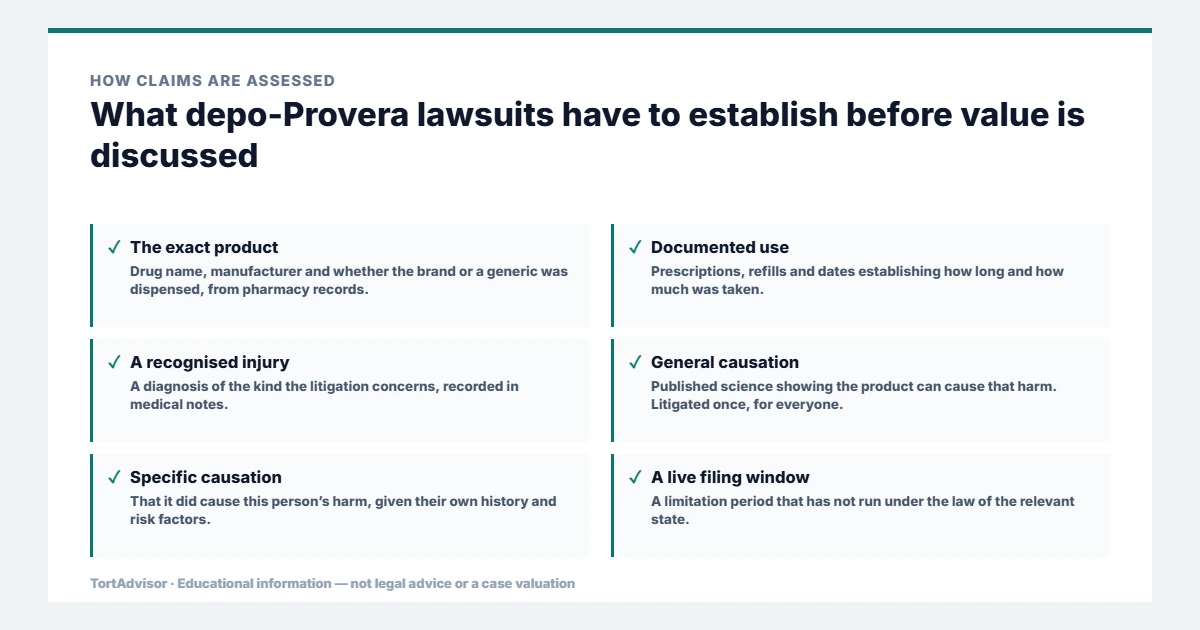
Depo-Provera MDL 3140 Status and 2026 Timeline
Federal Depo-Provera products-liability cases are centralized before Judge M. Casey Rodgers in the Northern District of Florida under MDL No. 3140. The October 1, 2026 JPML report lists 6,412 actions pending and 6,524 historical actions in the proceeding.
March 2024 — BMJ Study
A national case-control study reported an association between prolonged injectable medroxyprogesterone acetate use and intracranial meningioma requiring surgery.
February 7, 2025 — MDL Centralization
JPML transferred federal cases to the Northern District of Florida for coordinated pretrial proceedings.
December 2025 — FDA Label Update
FDA-approved prescribing information added meningioma language to the warnings and precautions section.
June 2026 — Court Recognizes Global Agreement
Pretrial Order No. 30A states that pending MDL plaintiffs who meet agreed eligibility criteria will have an opportunity to resolve their claims. The order does not publish a universal individual payout schedule.
October 1, 2026 — 6,412 Actions Pending
JPML’s monthly report lists 6,412 pending and 6,524 historical actions in MDL 3140.
September 18, 2026 — CMC + Rule 702 Hearing
The court’s current MDL page lists a case-management conference at 9:00 a.m. CT followed by the Rule 702 motions hearing.
Depo-Provera Lawsuit Settlement Agreement and Value Factors
Federal court filings recognize a global agreement involving plaintiffs’ lead counsel and Pfizer-related defendants. Pretrial Order No. 30A states that pending MDL plaintiffs who satisfy agreed eligibility criteria will have an opportunity to resolve their claims. Public court materials available on the court’s MDL page do not provide one universal per-claim payout chart or reliable average settlement amount.
Every status, deadline and figure published on this page about depo-Provera lawsuits is traced to a primary source before it appears.
| Educational Claim Tier | Common Characteristics | Important Value Factors |
|---|---|---|
| Severe injury review | Craniotomy, recurrence, major neurological deficit, substantial disability or wrongful death. | Surgery, pathology, permanent impairment, future care, earning loss, dependency and strong proof of use. |
| Moderate-to-severe review | Radiation, meaningful symptoms, substantial treatment, work limitations or continuing neurological care. | Treatment burden, symptoms, medical expenses, wage loss, prognosis and functional impact. |
| Monitoring / lower-damage review | Confirmed meningioma managed through surveillance, limited symptoms or no invasive treatment to date. | Tumor size/location, monitoring burden, symptoms, future risk and strength of causation evidence. |
What Does the Research Say About Depo-Provera and Meningioma?
A 2024 national case-control study published in The BMJ reported an association between prolonged use of injectable medroxyprogesterone acetate and intracranial meningioma requiring surgery. For prolonged medroxyprogesterone acetate exposure, the study reported an odds ratio of approximately 5.62. Because the research was observational, it identified an association and did not establish that Depo-Provera caused every individual tumor.
Documented Injection History
Pharmacy records, clinic notes, OB/GYN records and administration logs may help establish product use and duration.
Confirmed Meningioma
MRI, CT, operative notes, pathology, radiation records and neurosurgical reports may establish injury and treatment.
Use Before Diagnosis
The sequence and duration of Depo-Provera use relative to tumor detection are central to individualized review.
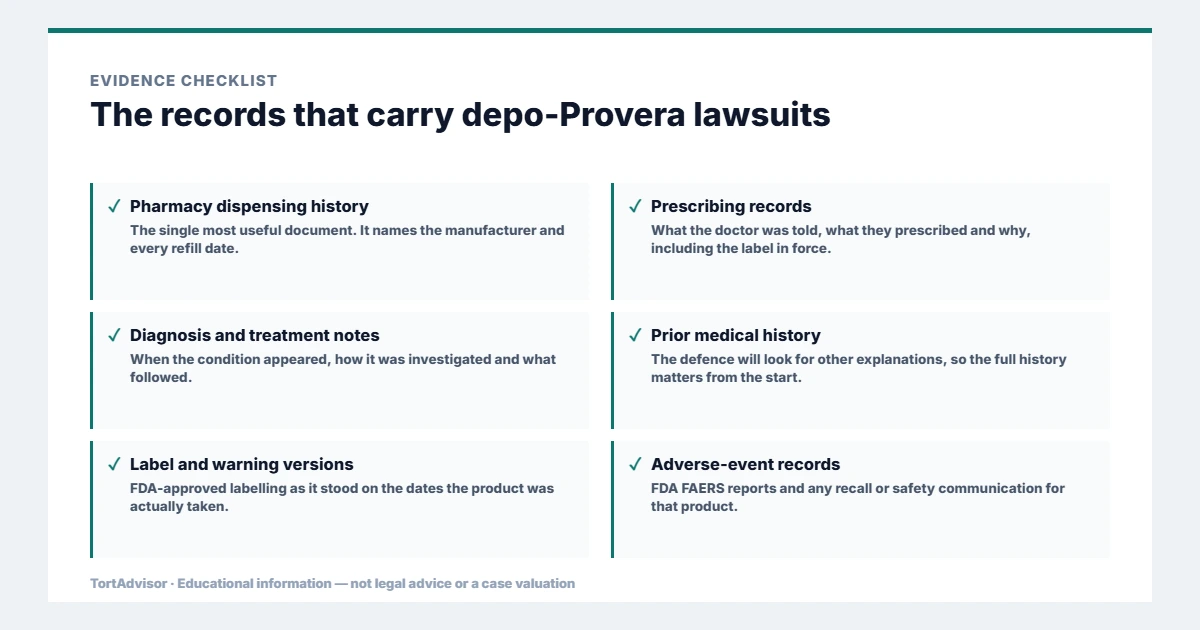
FDA Depo-Provera Meningioma Label Update
The current FDA-approved prescribing information states that meningioma cases have been reported following repeated administration of medroxyprogesterone acetate, primarily with long-term use. The label directs clinicians to monitor for signs and symptoms of meningioma and to discontinue Depo-Provera CI if a meningioma is diagnosed.
What Is a Meningioma?
A meningioma develops from the meninges, the membranes surrounding the brain and spinal cord. Many meningiomas are histologically benign, but size and location can still cause serious neurological problems or require significant treatment.
Possible Symptoms
Headaches, seizures, vision or hearing changes, weakness, memory problems, balance issues or personality changes.
Diagnosis
MRI and CT imaging are commonly used. Pathology may confirm tumor type and grade after surgery.
Treatment
Monitoring, surgery, radiation, medication, rehabilitation or a combination may be considered depending on the tumor.
Long-Term Impact
Some patients experience recurrence, neurological deficits, reduced earning ability, ongoing surveillance or future-care needs.
Evidence Commonly Reviewed in a Depo-Provera Claim
Proof of Use
Pharmacy records, injection logs, clinic records, insurance claims, Planned Parenthood records, OB/GYN records and prescribing-provider notes.
Medical Evidence
MRI and CT reports, pathology, operative notes, radiation records, neurology/neurosurgery notes, medications and rehabilitation records.
Damages Evidence
Medical bills, wage records, disability documentation, travel expenses, caregiving costs and evidence of daily-life limitations.
How a Depo-Provera Lawsuit May Be Evaluated and Filed
Initial Screening
Review product use, diagnosis, treatment, dates, jurisdiction and possible deadlines.
Collect Records
Gather injection, pharmacy, imaging, pathology, surgery, radiation, wage and damages records.
Legal & Medical Review
Evaluate product identification, causation, warning issues, damages and applicable law.
File When Appropriate
A retained attorney may file an individual lawsuit and comply with MDL requirements where applicable.
Discovery & Experts
The parties exchange evidence and litigate common and case-specific scientific or legal issues.
Resolution
A claim may be dismissed, settled, remanded or tried. No particular result is guaranteed.
Depo-Provera Lawsuit Filing Deadlines
Statutes of limitations vary by state and can depend on diagnosis, discovery of a possible connection, product use, residence, prescription location, defendant conduct, minority, incapacity, wrongful death and other facts.
Depo-Provera Lawsuit FAQ
Is there a Depo-Provera class action lawsuit?
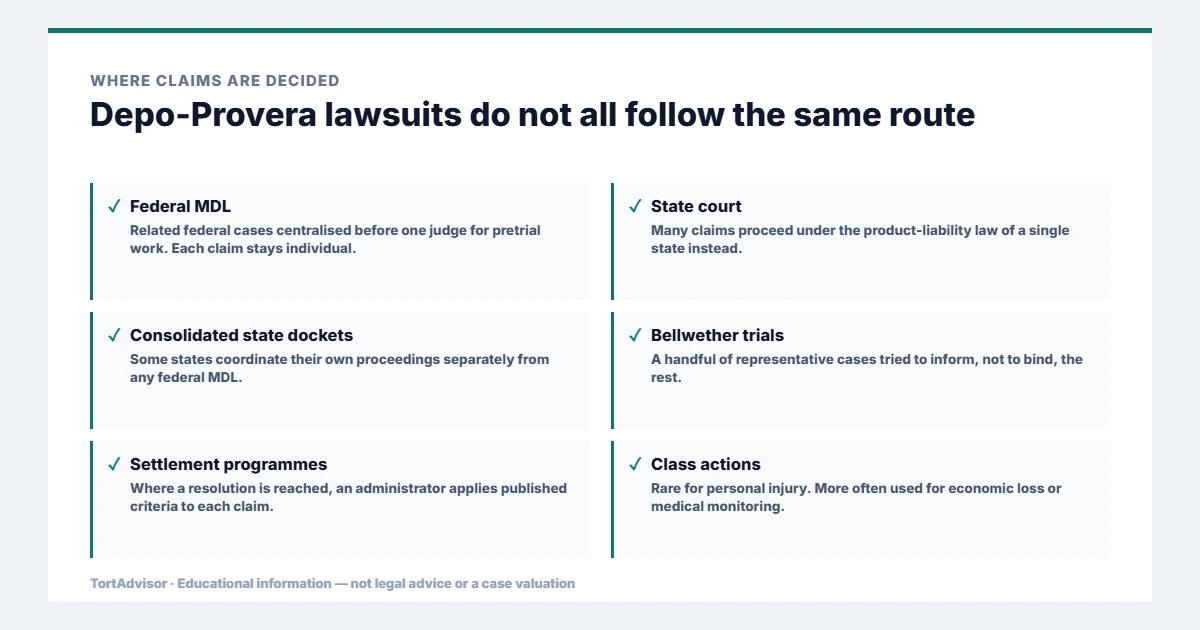
Federal cases are coordinated in MDL 3140, not a traditional class action paying every claimant the same amount. Plaintiffs retain individual claims and must establish their own use, injury, causation, damages and deadlines.
SourceN.D. Fla.MDL 3140
Has the Depo-Provera lawsuit reached a settlement?
Federal court filings recognize a global agreement for pending MDL plaintiffs who meet agreed eligibility criteria. Public court materials do not establish one guaranteed payout or universal average settlement for every claimant.
SourceN.D. Fla.PTO 30A
What diagnosis is central to the litigation?
The federal litigation principally concerns intracranial meningioma allegations following depot medroxyprogesterone acetate use.
SourceJPML7 Feb 2025
How much could a Depo-Provera claim be worth?
Potential value can depend on treatment, surgery, neurological deficits, recurrence, future care, wage loss, age, proof of use, causation evidence, jurisdiction and the actual settlement-program rules.
SourceN.D. Fla.CMO 13
What records help prove Depo-Provera use?
Pharmacy claims, clinic injection logs, OB/GYN records, Planned Parenthood records, insurance records and prescribing-provider notes may help establish use.
SourceN.D. Fla.CMO 14
Should someone stop Depo-Provera without medical advice?
Medical and contraceptive decisions should be discussed with a licensed healthcare professional. The current FDA label directs discontinuation if meningioma is diagnosed.
SourceFDA labelSec. 5.4
What if the injections came from a clinic?
Clinic and provider records may be important proof of use. The proper defendants, theories and evidence still depend on the facts and applicable law.
SourceN.D. Fla.CMO 14
How quickly should a potential claim be reviewed?
Promptly. Filing deadlines vary and can depend on state-specific discovery rules and individual facts. Waiting for a settlement announcement may create deadline risk.
SourceN.Y. CPLRSec. 214-c
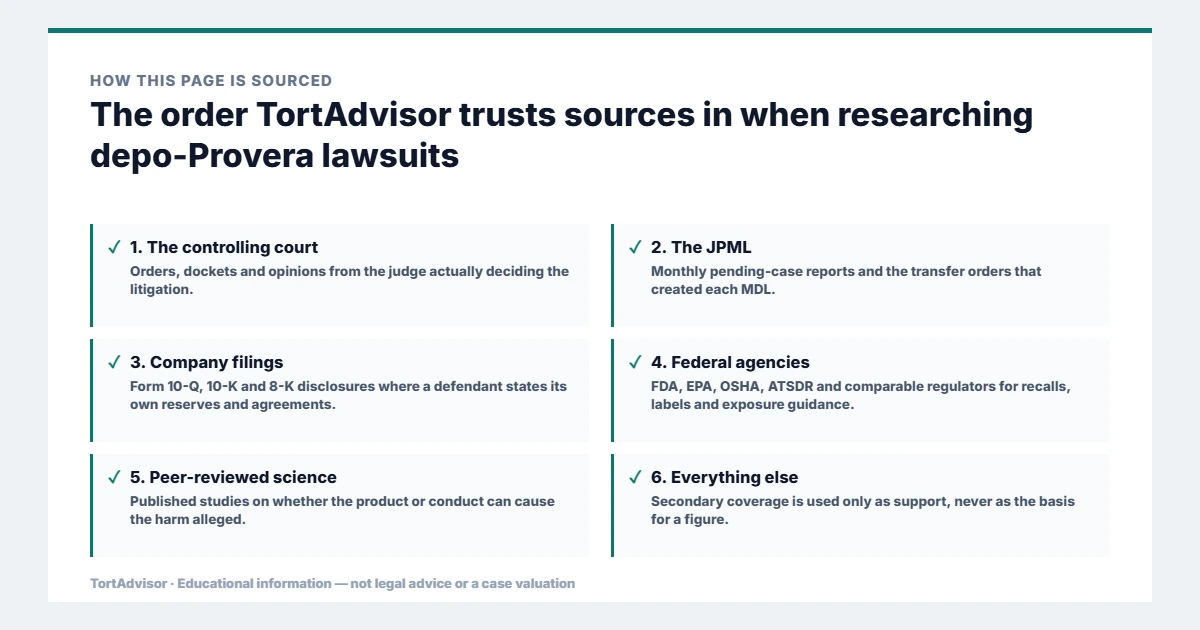
Depo-Provera Lawsuit Sources and Official References
Current litigation claims on this page are tied to primary federal court, JPML and FDA materials. Peer-reviewed research provides medical context and does not establish individualized legal or medical causation.
- U.S. District Court for the Northern District of Florida — Depo-Provera MDL 3140. Official litigation page and current hearing schedule. Accessed September 15, 2026.
- Judicial Panel on Multidistrict Litigation — Pending MDL Reports. October 1, 2026 report lists 6,412 pending actions in MDL 3140. Accessed September 15, 2026.
- Northern District of Florida — Pretrial Order No. 30A. Discusses the global agreement and how pending Rule 702/preemption matters interact with participating and nonparticipating claims. Accessed September 15, 2026.
- Northern District of Florida — MDL 3140 Orders by Date. Official order index. Accessed September 15, 2026.
- FDA-approved Depo-Provera CI and depo-subQ provera 104 prescribing information. Current meningioma warning and precautions. Accessed September 15, 2026.
- FDA supplement approval letter dated December 12, 2025. Approval of meningioma risk information. Accessed September 15, 2026.
- Roland N, et al. Use of progestogens and the risk of intracranial meningioma. The BMJ, 2024. Accessed September 15, 2026.
- PubMed record for the 2024 national case-control study. Bibliographic and study abstract information. Accessed September 15, 2026.
Request a Confidential Depo-Provera Case Review
If you used Depo-Provera and were later diagnosed with a meningioma, submit the injection, diagnosis, treatment and timing information you know now for review.
See Depo-Provera Settlement Amounts 2026 for reported payout ranges, the factors that move claim value, and what the court record actually shows as of August 2026.