
NEC Settlement Amounts: What the Public Record Actually Shows in 2026
Necrotizing enterocolitis, or NEC, is a bowel emergency that strikes premature infants, and it is the injury at the centre of the preterm infant formula litigation. In August 2026 Abbott agreed to pay roughly $670 million to resolve one affirmed verdict and NEC claims brought for about 2,000 additional infants. That is the largest confirmed number in this litigation, and it is still not a settlement matrix. No court, no administrator and no manufacturer has published what an individual NEC claim is worth.
Where NEC Litigation Actually Stands
Every settlement figure in circulation traces back to a small number of documented events. Here they are in order, with the source for each.
The Panel centralised 16 actions from seven districts before Judge Rebecca R. Pallmeyer in the Northern District of Illinois, finding they shared factual questions arising from allegations that cow milk-based formulas marketed as Similac and Enfamil have a higher propensity to cause necrotizing enterocolitis in premature infants. Every preterm infant formula case filed in federal court since then has been routed here. Illinois was chosen because more cases were pending there than anywhere else and the Abbott defendants are based in the district.
A Missouri state jury returned a $495 million plaintiff verdict against Abbott. This is the single largest confirmed award in the litigation, and Abbott confirms the figure in its own SEC filings rather than it coming from a press release.
The appellate court upheld the $495 million judgment. An affirmed judgment is a materially different thing from a headline verdict, because it survived review, and it changed the settlement posture of the whole docket.
In the quarterly report covering the period that ended June 30, 2026, Abbott disclosed that it had prevailed on summary judgment in the first three federal MDL bellwether cases, that state court outcomes had varied, and that no reserves have been recorded because possible losses could not be reasonably estimated.
Seven weeks after reporting no reserves, Abbott announced agreements resolving the Gill lawsuit together with NEC claims brought on behalf of approximately 2,000 additional infants, for an aggregate of about $670 million. Abbott stated the agreements are a compromise of disputed claims and not in any way an admission of liability, and said it stands by the safety of the products.
The JPML report published that morning shows 844 actions pending in MDL 3026 out of 1,064 transferred since the MDL was created. Abbott separately puts the surviving docket at roughly 1,700 lawsuits in federal and state courts on behalf of about 12,700 individual infants.
Confirmed NEC Facts vs. TortAdvisor Editorial Estimates
This distinction matters more on the NEC docket than almost anywhere else, because the one very large public number is easy to mistake for a per-claim value.
Confirmed public facts
- MDL 3026 exists and is active. Created April 8, 2022, before Judge Pallmeyer in the Northern District of Illinois, with 844 actions pending of 1,064 transferred.
- A $495 million verdict was returned in Gill in July 2024 and affirmed by the Missouri Court of Appeals in May 2026.
- Abbott agreed to pay approximately $670 million on Aug. 20, 2026, resolving Gill plus NEC claims for roughly 2,000 additional infants.
- Abbott won summary judgment in the first three federal bellwethers. Abbott disclosed this in its own quarterly filing.
- Roughly 1,700 lawsuits covering about 12,700 infants remain unresolved according to Abbott’s Aug. 20, 2026 filing.
- Abbott had recorded no reserves as of June 30, 2026. Its filing says possible losses could not be reasonably estimated.
Not established, whatever you have read
- How the $670 million was allocated among the infants it covers. No per-claim breakdown has been published.
- What an average NEC settlement is. There is no administrator, no matrix, no grid and no published distribution.
- Whether Mead Johnson will resolve claims on comparable terms. As of Sept. 2, 2026 TortAdvisor found no company announcement of a comparable NEC settlement.
- Whether any claim outside the resolved group will be paid at all. Three federal bellwethers produced no payment.
- How long the remaining NEC lawsuits will take. No global resolution schedule exists.
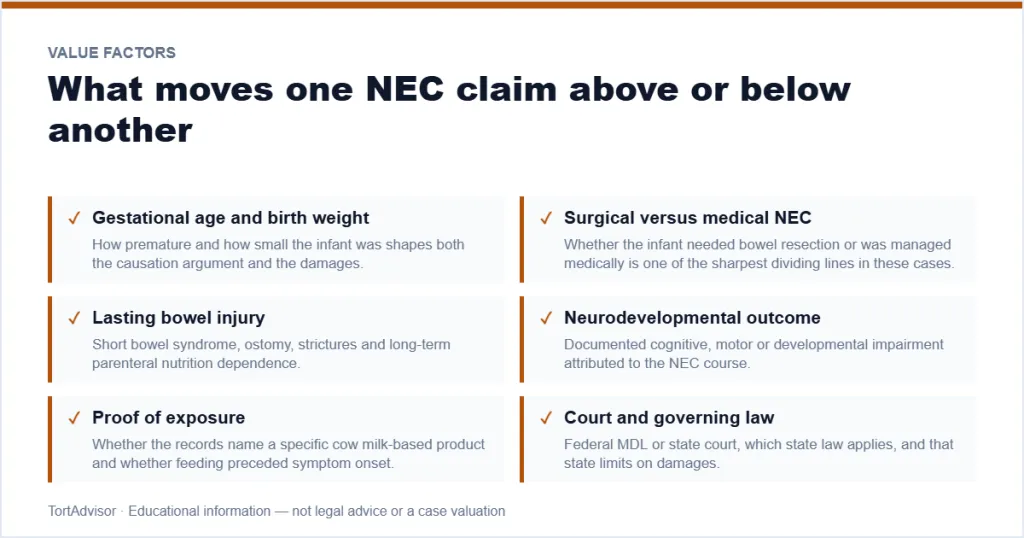
NEC Claim Profiles, Without Invented NEC Settlement Amounts
We publish no dollar range for a NEC claim, because no reliable one exists. Published NEC settlement amounts do not exist, and inventing them would be the easiest way to mislead a family. What we can describe honestly is how these claims differ from one another, and which differences this litigation has actually treated as significant. The profiles below carry no figures on purpose.
Death or catastrophic surgical NEC
- Infant died of NEC or its complications
- Bowel resection with a large length of intestine lost
- Short bowel syndrome and long-term parenteral nutrition
- Permanent ostomy or repeated reconstructive surgery
- Documented severe neurodevelopmental impairment
Surgical NEC with recovery
- Surgery was required but bowel loss was limited
- Ostomy reversed, feeding eventually established
- Extended NICU stay with ongoing follow-up
- Some lasting gastrointestinal or growth effects
Medically managed NEC
- NEC diagnosed and treated without surgery
- Feeds held, antibiotics, decompression, recovery
- Shorter additional NICU stay
- Little or no documented long-term sequela
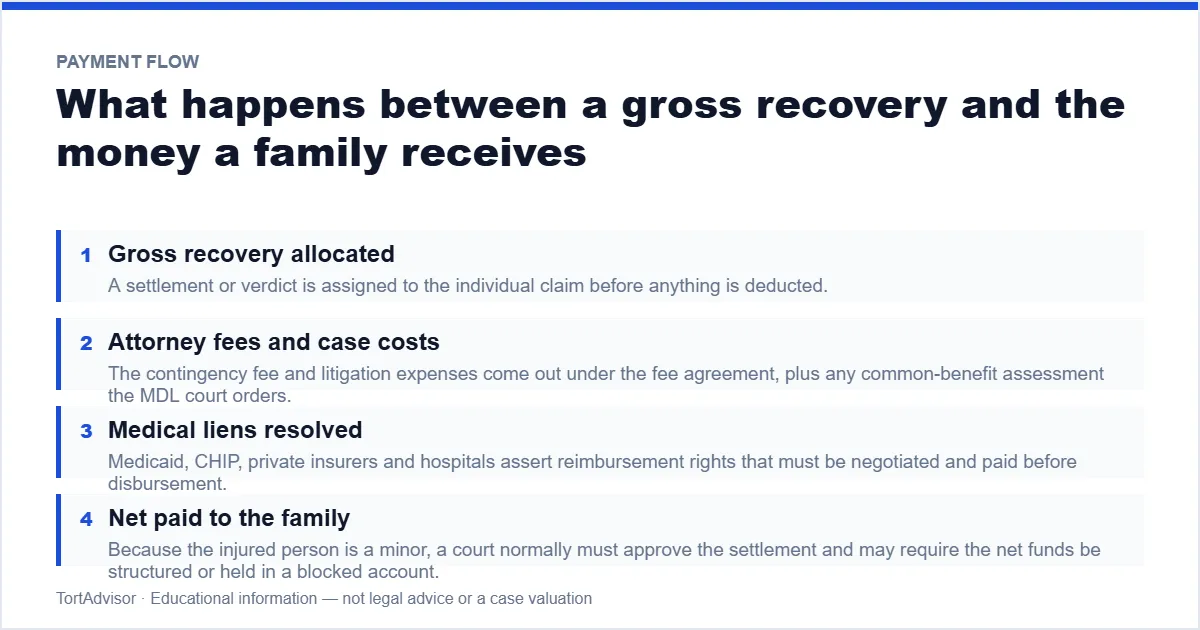
What Happens Between a Gross NEC Recovery and the Money a Family Receives
The gap between a headline number and a deposit is larger in NEC cases than in most, because the injured person is a child.
Allocation
A settlement or verdict is assigned to the individual claim. In an aggregate resolution this is done by agreement or by a court-appointed allocator, and the amounts are rarely made public.
Fees and costs
The contingency fee and litigation expenses come out under the fee agreement, plus any common-benefit assessment the MDL court orders on cases that used the shared work product.
Liens
NEC care is expensive and usually billed to Medicaid or CHIP. Those programmes, private insurers and hospitals assert reimbursement rights that must be resolved before anything is disbursed.
Net to the family
Because the claimant is a minor, a court normally must approve the settlement and may order the net funds into a structured settlement, an annuity or a blocked account the child reaches at majority.
The minor-approval step is the one families are least prepared for. It is not optional, it adds time, and it can mean the money is not spendable when the settlement is signed.
How TortAdvisor Compiles This NEC Page
The method behind our NEC settlement amounts research is deliberately narrow. When a NEC number cannot be traced to a primary document, it does not go on this page.
Controlling court first
Orders and judgments from the MDL court and the state courts hearing NEC cases outrank any commentary about them.
Then the JPML
Case counts come from the Panel’s own monthly report, not from firm websites that round them up.
Then company filings
A settlement figure is only used here if the defendant disclosed it to the SEC or a court, where misstating it carries consequences.
Then peer review
Medical claims come from federal agency reports and systematic reviews, never from litigation advertising.
Every Confirmed NEC Settlement Number, and Where It Came From
This is the complete set of NEC figures that trace to a primary document. Anything not in this table is somebody’s estimate, including every set of NEC settlement amounts published elsewhere.
| Event | Court or filing | Confirmed figure | What it does and does not mean |
|---|---|---|---|
| Gill jury verdict, July 2024 | Missouri state court; affirmed by the Missouri Court of Appeals, May 2026 | $495 million | One family, one trial, one set of facts. Not a benchmark for anyone else. |
| Cook County jury verdict, April 2026 | Illinois state court; Abbott has stated it will appeal | $70 million | $53 million compensatory plus $17 million punitive, against Abbott. Under appeal and unpaid. |
| Watson verdict reversed, June 2026 | Illinois Appellate Court | $60 million, set aside | The court held the trial judge failed to apply the learned intermediary doctrine. The award no longer stands. |
| Abbott agreements, Aug. 20, 2026 | Abbott Form 8-K filed with the SEC | Approximately $670 million aggregate | Covers Gill plus NEC claims for about 2,000 additional infants. No per-infant allocation was published. |
| First three federal bellwethers | MDL 3026, Northern District of Illinois | No payment | Abbott prevailed on summary judgment in all three, by its own disclosure. |
| Remaining docket | Federal and state courts, per Abbott’s Aug. 2026 filing | No figure announced | About 1,700 lawsuits covering roughly 12,700 infants, with no settlement programme covering them. |
The arithmetic trap worth naming. Dividing $670 million by the roughly 2,001 infants it covers gives about $335,000 each, and that number is meaningless. One affirmed $495 million judgment sits inside the total, so the remainder spread across the other claims is a far smaller figure, and neither number tells you what any particular NEC claim was actually allocated. Averages built on an aggregate that contains a single outlier judgment describe nothing.
Free NEC Baby Formula Case Review
Wondering how the figures on this page relate to your own situation? Share a few details below — a trained case advisor reviews every submission FREE and with no obligation, and your information stays confidential.
- Free — no cost, no obligation
- About a minute to complete
- Reviewed by a trained case advisor
- Nothing you submit is published
Your details are sent over a secure connection and reviewed confidentially.
Five Trial Results, Four Directions, and One Aggregate
Five trial results now exist in the preterm formula litigation and they point in four different directions, which is the clearest possible argument against quoting an average. A Missouri jury returned $495 million against Abbott in the Gill case in July 2024, split $95 million compensatory and $400 million punitive, and the Missouri Court of Appeals upheld it in May 2026. A Cook County jury returned $70 million against Abbott in April 2026, $53 million compensatory and $17 million punitive, and Abbott has said it will appeal. A Madison County jury returned $60 million against Mead Johnson in March 2024, and in June 2026 the Illinois Appellate Court set that award aside for failure to apply the learned intermediary doctrine. A St. Louis defence verdict was vacated by the trial judge. Abbott prevailed outright on the first three federal bellwethers.
Against that record, the August 2026 agreements are best read as a partial exit rather than a resolution of the litigation. Abbott announced on August 20, 2026 that it would pay approximately $670 million to resolve the Gill case and NEC claims involving roughly 2,000 other individuals, stating in the same announcement that the agreements are “a compromise of disputed claims and not in any way an admission of liability.” By Abbott’s own account roughly 1,700 lawsuits covering about 12,700 infants remain outside the agreements. Most of the litigation, measured by infants, is still live, and no figure has been announced for any part of it.
Dividing the aggregate by the covered population is the mistake this page exists to prevent. Roughly $670 million across about 2,001 infants averages about $335,000 each, and that number describes nobody. One affirmed $495 million judgment sits inside the aggregate, which means a single family accounts for the majority of it before any other claim is paid; the remaining money is then allocated by an administrator against injury severity, surgical history, mortality and the strength of the formula-exposure record, and the allocation formula has not been published. A claim involving a surviving infant with a short bowel resection and a claim involving a death do not share a value, and no arithmetic performed on a headline total can tell you which side of that line a claim falls on.
What the record supports, and all it supports, is an understanding of the variables. Our NEC baby formula lawsuit guide sets out who may qualify and on what theories, the NEC settlement calculator organises the medical records an administrator would assess, and the rest of the settlement amounts library follows the same rule everywhere: a figure appears only where a primary document puts it, and an aggregate is never divided to manufacture a per-claim number.
Who May Have a NEC Claim
Eligibility for a NEC lawsuit is unusually document-driven. These are the criteria the litigation has actually turned on, not a promise that any claim will be accepted or paid.
Commonly present in these claims
- The infant was born prematurely, usually well before 37 weeks, and typically at very low birth weight
- The medical record contains a NEC diagnosis, ideally with the modified Bell stage the treating team assigned
- The NICU record shows a cow milk-based preterm formula or human milk fortifier was given
- Feeding of that product preceded the onset of NEC symptoms
- Imaging, operative or pathology findings support the diagnosis rather than a clinical suspicion alone
- The claim is brought within the limitation period that the relevant state applies
What weakens or defeats a claim
- No record identifying which product was fed, which is the single most common gap
- Exclusive feeding with mother’s own milk throughout the relevant period
- A term or near-term birth, where NEC is rare and causation arguments are much harder
- An alternative diagnosis in the chart, such as spontaneous intestinal perforation
- A limitation period that has already run under the applicable state’s rule
Eligibility is a legal question that depends on the medical records and the law of the state involved, and only an attorney reviewing the actual chart can answer it. Our NEC baby formula lawsuit guide covers the claims and defendants in more detail, and the NEC settlement calculator organises these factors without deciding any of them.
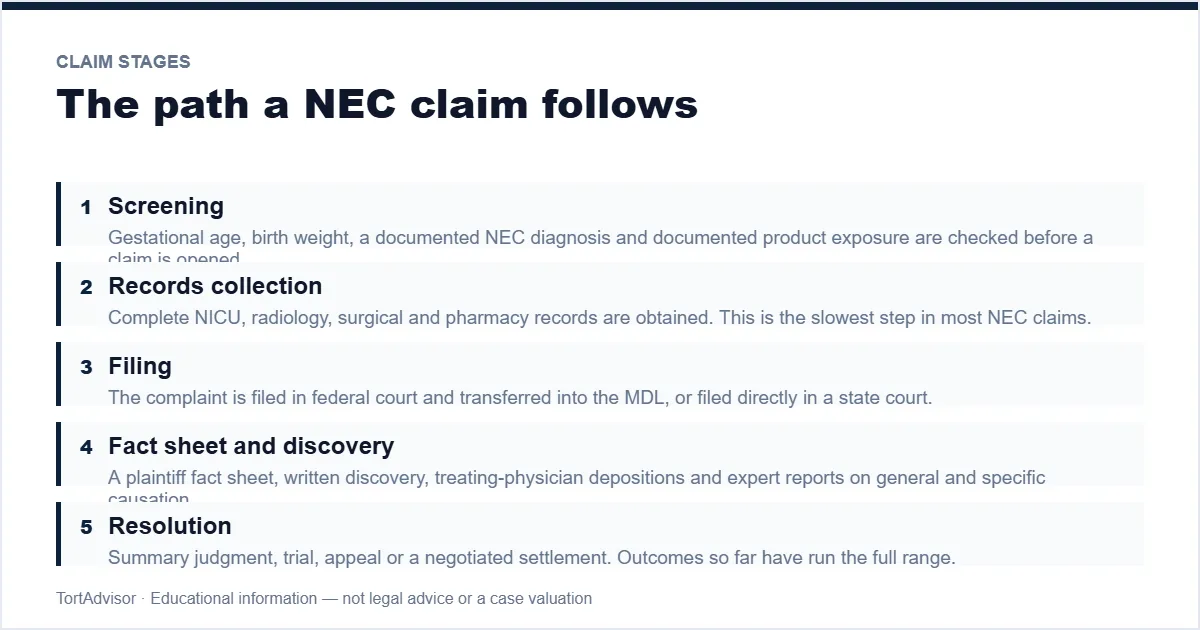
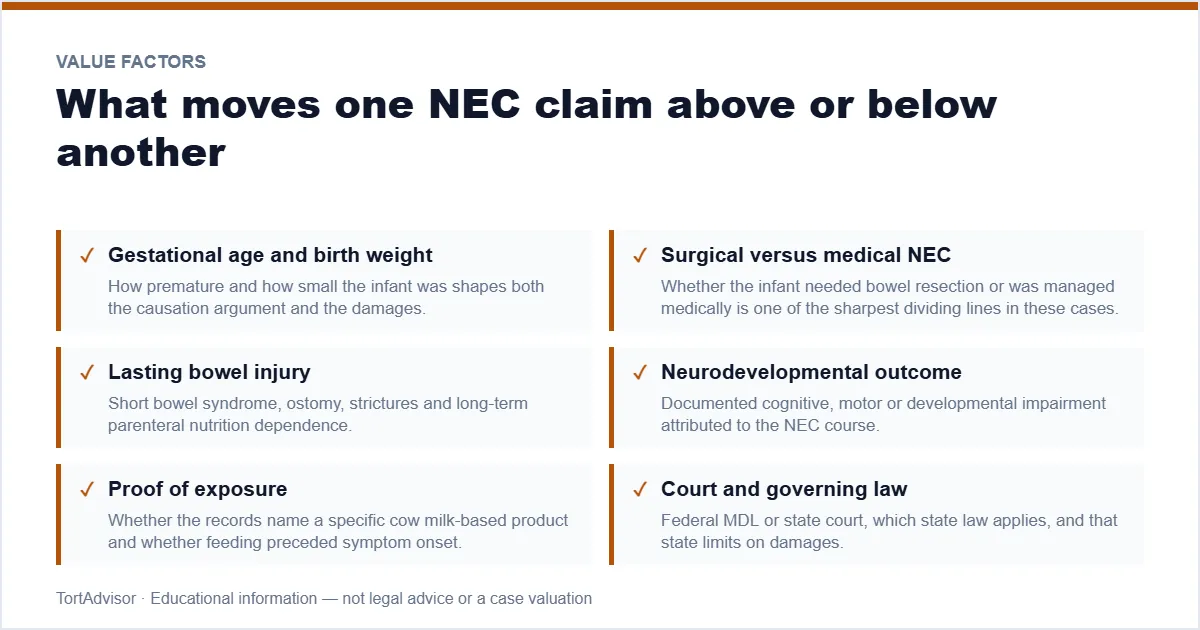
What Moves the Value of a NEC Claim
These are the differences the preterm infant formula litigation has treated as material. None of them produces a number, and none is a guarantee.
Gestational age and birth weight
How premature and how small the infant was sits at the centre of both sides’ arguments. Federal agency review finds more than 90 percent of NEC occurs in very low birth weight preterm infants, which is why the smallest, earliest babies dominate this docket.
Surgical versus medical NEC
Whether the infant needed bowel resection or was managed with feeds held and antibiotics is the sharpest dividing line in a NEC claim, because it separates a defined operative record from a clinical judgement call.
Lasting bowel injury
Short bowel syndrome, a permanent ostomy, strictures and long-term dependence on parenteral nutrition carry decades of future care, and future care is where damages in a NEC claim accumulate.
Neurodevelopmental outcome
Documented cognitive, motor or developmental impairment attributed to the NEC course changes the shape of a claim entirely, because it converts an acute injury into a lifetime one.
Proof of exposure
Whether the chart names a specific cow milk-based product, and whether feeding preceded symptom onset, is what separates a NEC claim that can be worked up from one that cannot.
Court and governing law
Federal MDL or state court, which state’s law applies, and that state’s rules on damages and limitations. Two identical NEC injuries in two states are not two identical claims.
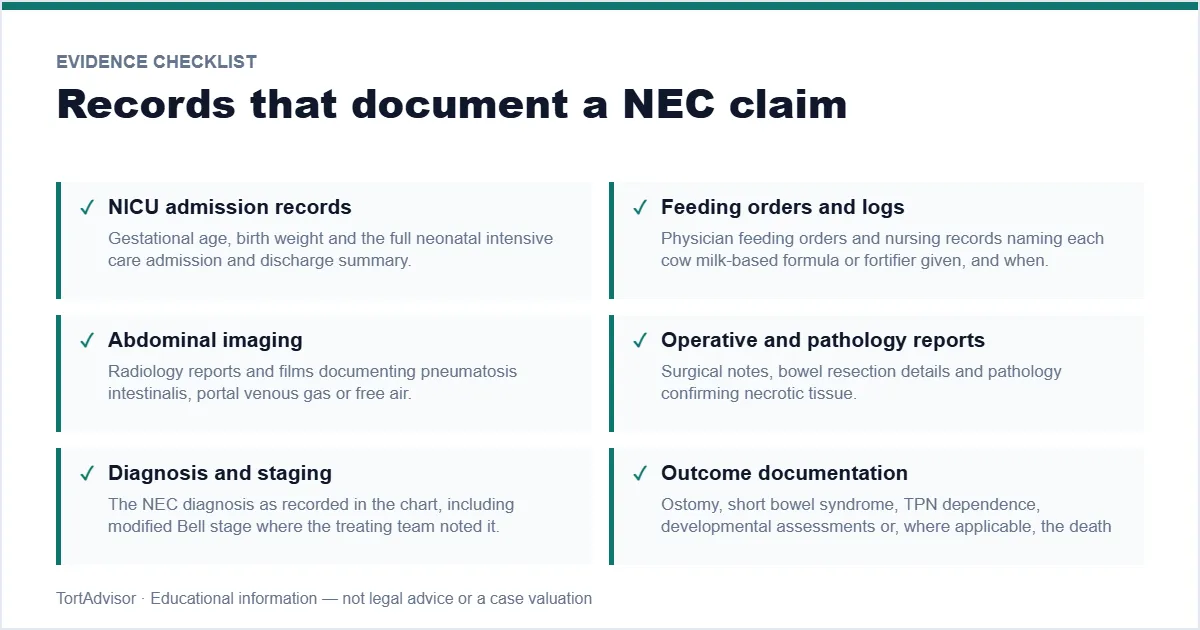
The Records a NEC Claim Is Built From
Almost everything that determines a NEC lawsuit sits in one place: the neonatal intensive care chart. Requesting it is free and commits you to nothing.
NICU admission and discharge summary
Gestational age, birth weight, the course of the stay and the discharge diagnoses. This is the spine of the record and the first thing any reviewer reads.
Feeding orders and nursing logs
The physician orders and the nursing administration records that name each formula or human milk fortifier given, and when. Without this, exposure in a NEC claim cannot be proven.
Abdominal imaging
Radiology reports and the films themselves, documenting pneumatosis intestinalis, portal venous gas or free air. These findings are what make a NEC diagnosis defensible.
Operative and pathology reports
Surgical notes, the length of bowel resected and pathology confirming necrotic tissue. Surgical cases leave the clearest documentary trail of any profile.
Diagnosis and staging
The NEC diagnosis as the treating team recorded it, including the modified Bell stage where they used one, and any differential such as spontaneous intestinal perforation.
Outcome documentation
Ostomy and reversal records, short bowel syndrome and parenteral nutrition history, developmental assessments and, where the infant died, the death certificate.
Request the complete record, not a summary. Hospitals frequently send a discharge summary when asked for a chart. The feeding orders and nursing flow sheets are the part a NEC claim depends on, and they are often the part omitted.
Deadlines in a NEC Claim
Deadlines in a NEC lawsuit are genuinely complicated, because the injured person is a child and the people who would sue on the child’s behalf may be on a different clock.
Why time may still be available
- Many states pause, or toll, the limitation period on a minor’s own injury claim until the child reaches the age of majority
- Some states apply a discovery rule where the connection between the product and the injury was not reasonably knowable
- Cases can in some circumstances be filed directly into the MDL rather than filed and transferred
- An affirmed judgment and a large aggregate settlement have kept this litigation active rather than winding it down
Why time may already have run
- A parent’s own derivative claim, for medical expenses or loss of services, is frequently not tolled by the child’s age
- Wrongful death claims usually run from the date of death and are often much shorter
- Some states impose a statute of repose that can cut off a claim regardless of tolling
- Tolling rules for minors differ substantially between states, and a few are far narrower than families expect
Take the NEC Settlement Calculator Below
The calculator organises what you know about the birth, the NICU stay, which formula or fortifier appears in the chart, the NEC diagnosis and any surgery, then shows which factors carry the most weight in a claim. It takes a few minutes and asks for no documents.
The result is educational and is not a guaranteed case value or settlement offer.
Before You Start
- Gestational age and birth weight, even approximately
- Whether the chart names a formula or fortifier
- When the NEC diagnosis was made
- Whether surgery or a bowel resection followed
- Any lasting effects and ongoing care
Primary Sources for This Page
Every figure above, and every statement we make about NEC settlement amounts, traces to one of these. We link them so you can check the page rather than trust it.
JPML transfer order creating MDL 3026
The April 8, 2022 order centralising the preterm infant nutrition cases, naming the transferee judge and district and setting out the common questions. Read the transfer order (PDF)
JPML pending MDL report
The Panel’s monthly statistics, which is where the 844 pending and 1,064 total figures for MDL 3026 come from. See the pending MDL statistics
Abbott Form 8-K, Aug. 20, 2026
Abbott’s own disclosure of the approximately $670 million agreements, the affirmed $495 million Gill judgment, and the roughly 1,700 remaining lawsuits covering about 12,700 infants. Read the 8-K on EDGAR
Abbott Form 10-Q, quarter ended June 30, 2026
The quarterly filing disclosing that Abbott prevailed on summary judgment in the first three federal bellwethers and that no reserves had been recorded. Read the 10-Q on EDGAR
NICHD NEC Working Group report to the Secretary of HHS
The September 16, 2024 federal report on NEC: more than 90 percent of NEC occurs in very low birth weight preterm infants, mortality runs 15 to 40 percent, donor milk from the start of feeding is associated with roughly a 50 percent reduction in NEC risk, and much of the evidence shows association rather than causation. Read the NICHD report (PDF)
Cochrane systematic review, 2024
Quigley, Embleton, Meader and McGuire, Donor human milk for preventing necrotising enterocolitis in very preterm or very low birthweight infants. Twelve trials, 2,296 infants, risk ratio 0.53 with a 95 percent confidence interval of 0.37 to 0.76, graded high certainty. Read the Cochrane review
Questions Families Ask
What are the average NEC settlement amounts?
There isn’t one, and any page that gives you a figure is estimating. No court, settlement administrator or manufacturer has published average NEC settlement amounts or a per-claim matrix for necrotizing enterocolitis claims. The only aggregate figure on the public record is Abbott’s approximately $670 million, and that covers a specific closed group of claims that included one affirmed $495 million judgment.
Does the $670 million mean my NEC claim is worth about $335,000?
No. That arithmetic divides an aggregate by a headcount and ignores that a single affirmed judgment sits inside the total. It also describes claims that were already resolved. It says nothing about what a claim outside that group would be allocated, or whether it would be paid at all.
Has Abbott admitted the formula causes NEC?
No. Abbott’s filing states the agreements are a compromise of disputed claims and not in any way an admission of liability, and the company says it stands by the safety of the products. Settling a group of claims and conceding causation are different things.
What does the science actually show?
A 2024 Cochrane review of 12 trials covering 2,296 infants found donor human milk roughly halves the risk of NEC compared with formula, a risk ratio of 0.53, graded high certainty. The federal NICHD working group reports the same roughly 50 percent reduction, while also cautioning that much of the evidence shows association rather than proven causation, and that infants fed only human milk still develop NEC. Both statements are true at once, and the litigation is largely a fight over the distance between them.
Why did Abbott win the first three federal cases?
Abbott disclosed that it prevailed on summary judgment in the first three MDL 3026 bellwethers, meaning those cases were resolved by the judge before reaching a jury. Abbott’s filing does not set out the reasoning. What the outcome establishes is that a claim here is not automatically a paying claim.
Is there still time to file a NEC lawsuit?
It depends entirely on the state and on who is bringing it. Many states pause the limitation period on a child’s own claim until majority, but a parent’s derivative claim and a wrongful death claim frequently are not paused and can expire much sooner. This is the single most important thing to have checked, and it cannot be answered from a web page.
What about Mead Johnson and Enfamil?
A NEC lawsuit can name either manufacturer. MDL 3026 covers cow milk-based preterm infant formula marketed under both the Similac and Enfamil names, and the JPML said so when it created the MDL. As of September 2, 2026 TortAdvisor found no company announcement of a NEC settlement by Mead Johnson or its parent comparable to Abbott’s. The absence of an announcement is not evidence of anything either way.
Does TortAdvisor handle NEC claims?
No. TortAdvisor is a legal research publisher. We do not represent claimants, give legal advice, accept cases or review claims, and using this page or the calculator does not create an attorney-client relationship. Our purpose is to show you what the public record says before you speak with an attorney of your own choosing.
See Which Factors May Affect a NEC Claim
Answer the questions you can about the birth, the NICU stay, the formula or fortifier named in the chart, the NEC diagnosis, any surgery and the long-term impact. The calculator organizes those inputs into an educational settlement range and highlights the factors that may matter most when a claim is reviewed.
The result is educational and is not a guaranteed case value or settlement offer.
Helpful Information to Have Ready
You do not need every record in hand. Answer what you know; these details can make the estimate more useful.
Reading this page is separate from any request to be contacted. The consent boxes on this form are unchecked unless you tick them yourself.