
Tylenol Autism Lawsuit 2026: MDL 3043 Appeal & FDA Update
Tylenol autism lawsuit claims allege that prenatal exposure to acetaminophen contributed to autism spectrum disorder or attention-deficit/hyperactivity disorder and that manufacturers or retailers failed to provide adequate warnings. The litigation remains scientifically and legally contested. In July 2026, the U.S. Court of Appeals for the Second Circuit vacated federal judgments that had followed exclusion of plaintiffs’ causation experts and remanded the cases for further proceedings.
Choose the Tylenol Autism Lawsuit Information You Need
Start with potential eligibility or the July 2026 appeal, then review the FDA action, scientific evidence, documentation and settlement factors.
What Is the Tylenol Autism Lawsuit About?
The federal acetaminophen litigation involves state-law failure-to-warn claims brought by parents, guardians and children who allege that prenatal acetaminophen exposure caused or contributed to ASD or ADHD. Defendants include companies involved in manufacturing, marketing or selling acetaminophen products. They dispute causation and liability.
Failure to Warn
Plaintiffs allege that warnings did not adequately address alleged neurodevelopmental risks associated with prenatal acetaminophen exposure.
General Causation
A central issue is whether plaintiffs can present admissible scientific evidence supporting a general causal relationship between prenatal acetaminophen exposure and ASD or ADHD.
Causation Is Contested
Defendants challenge the scientific basis, confounding, exposure proof, warning theories and individualized causation.
Who May Qualify for a Tylenol Autism Lawsuit?
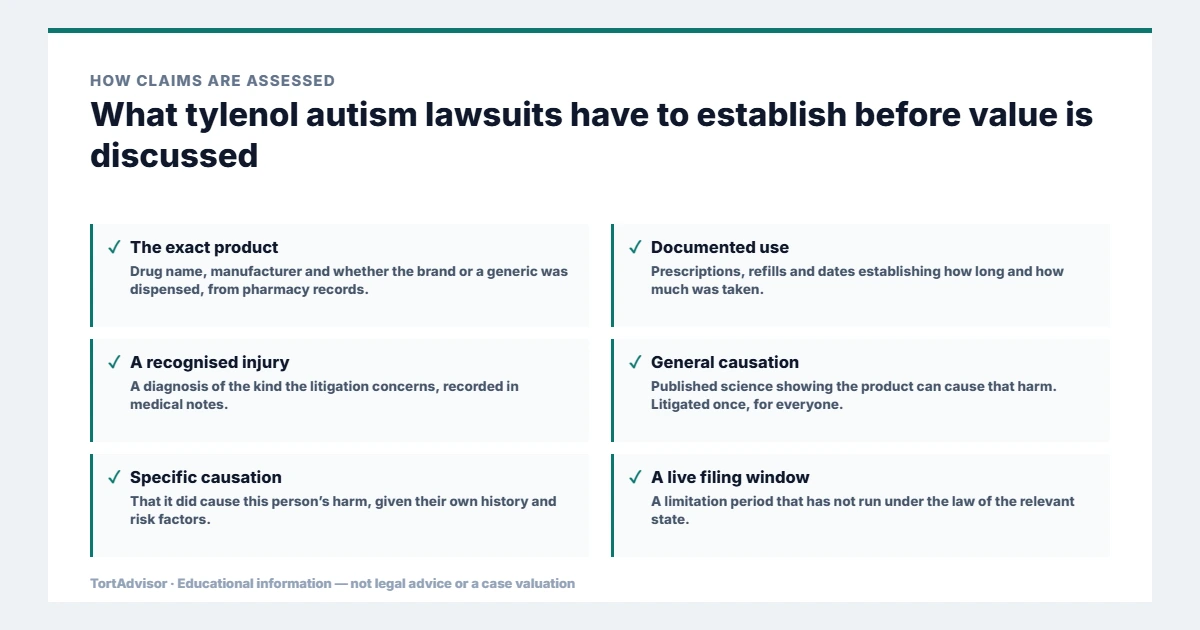
There is no universal court-approved exposure threshold that automatically makes a family eligible. A case-specific review typically considers prenatal acetaminophen use, the child’s diagnosis, exposure documentation, alternative risk factors, applicable defendant, damages and state filing rules.
Prenatal Acetaminophen Exposure
- Tylenol or another acetaminophen-containing product used during pregnancy.
- Approximate timing, frequency, dose and reason for use where known.
- Records or other evidence that can support the exposure history.
Documented Diagnosis
- Formal autism spectrum disorder diagnosis.
- Formal ADHD diagnosis.
- Developmental, neuropsychological, pediatric or educational records supporting diagnosis and functional impact.
Causation & Confounding
Review may include genetics, family history, maternal illness or fever, other medications, prematurity, environmental factors and other possible explanations for neurodevelopmental outcomes.
Damages & State Law
Therapy, education, caregiving, lost parental income, future support needs and state-specific legal rules may affect claim viability and damages.
Tylenol Autism MDL 3043: Second Circuit Reversal and 2026 Status
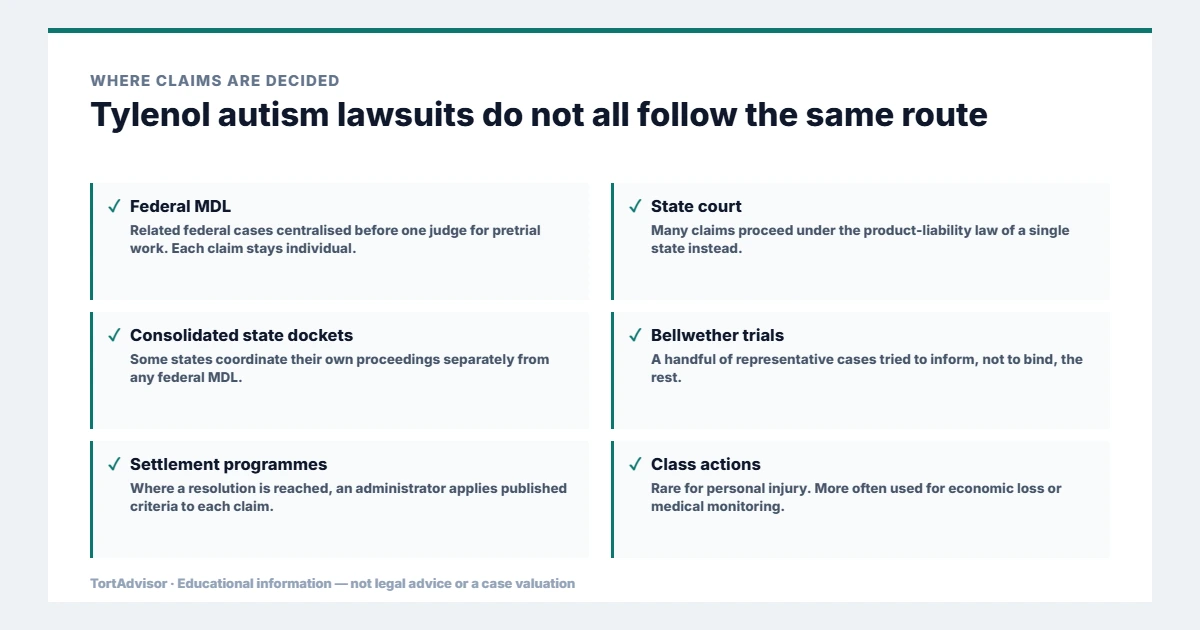
MDL 3043 is assigned to Judge Denise L. Cote in the Southern District of New York. In 2023 and 2024, the district court excluded plaintiffs’ general-causation experts and entered judgment for defendants in pending member cases. Plaintiffs appealed.
On July 13, 2026, the Second Circuit vacated the judgments in Rutledge v. Walgreen Co. and Phippen v. Walgreen Co. and remanded for further proceedings. The appellate court concluded that portions of the district court’s expert-admissibility analysis were too restrictive under Rule 702. The decision did not determine whether prenatal acetaminophen causes ASD or ADHD, whether the evidence ultimately survives summary judgment after the full record is considered, or whether any plaintiff is entitled to compensation.
October 5, 2022 — MDL 3043 Assigned
Federal acetaminophen ASD/ADHD cases were centralized in the Southern District of New York.
December 18, 2023 — First Expert Exclusion
The district court excluded plaintiffs’ initial general-causation expert opinions after Rule 702 review.
July–August 2024 — Additional Exclusion and Judgments
The district court excluded an additional ADHD causation expert and entered judgments for defendants in pending member cases.
September 22, 2025 — FDA Pregnancy Action
FDA initiated a label-change process to reflect evidence suggesting a possible association between prenatal acetaminophen use and autism/ADHD, while stating that causation had not been established.
July 13, 2026 — Second Circuit Vacates Judgments
The appellate court vacated the Rutledge and Phippen judgments and remanded. It emphasized that it was addressing expert admissibility, not deciding the scientific merits.
October 1, 2026 — 58 Actions Pending
JPML lists 58 pending and 722 historical actions in MDL 3043.
FDA’s 2025 Acetaminophen Pregnancy Label Action
On September 22, 2025, FDA announced that it had initiated a process to change acetaminophen labeling to reflect evidence suggesting that use during pregnancy may be associated with an increased risk of neurological conditions such as autism and ADHD. FDA also sent a notice to physicians.
FDA’s physician notice is equally important for context: the agency stated that although an association has been described in many studies, a causal relationship has not been established and contrary studies exist. FDA also noted that acetaminophen remains the safest over-the-counter alternative in pregnancy among common analgesic and antipyretic options, because alternatives such as aspirin and ibuprofen have documented fetal risks in certain circumstances.
Every status, deadline and figure published on this page about tylenol autism lawsuits is traced to a primary source before it appears.
Label-Change Process Initiated
FDA began a regulatory process in September 2025 to communicate evidence suggesting a possible association.
Causation Not Established
The agency expressly acknowledged contrary studies and ongoing scientific debate.
Risk–Benefit Still Matters
Untreated fever and pain can also pose pregnancy risks, and medication decisions should be individualized with a healthcare professional.
What Does the Research Say About Prenatal Acetaminophen, Autism and ADHD?
The scientific literature is mixed. Some observational studies report associations between prenatal acetaminophen exposure and later neurodevelopmental diagnoses. Other studies that more aggressively address familial and genetic confounding have not found increased risk. Association studies can identify patterns, but they cannot by themselves establish that acetaminophen caused an individual child’s diagnosis.
2.48 Million Children
A nationwide Swedish cohort initially found small associations in conventional models, but sibling-control analyses found no increased risk of autism, ADHD or intellectual disability associated with prenatal acetaminophen use.
Possible Association
FDA said evidence had accumulated suggesting an association and initiated a label-change process, while explicitly stating that causation was unproven.
No Causal Link Supported
ACOG said the current weight of evidence does not support a causal relationship and continued to identify acetaminophen as the analgesic and antipyretic of choice during pregnancy when used appropriately.
Autism Spectrum Disorder and ADHD in Tylenol Lawsuit Claims
ASD and ADHD are neurodevelopmental conditions with complex and multifactorial causes. A legal claim typically requires both a professionally documented diagnosis and admissible evidence supporting general and specific causation. A diagnosis alone does not identify its cause.
Autism Spectrum Disorder
ASD involves persistent differences in social communication and interaction together with restricted or repetitive behaviors or interests. Support needs vary substantially among individuals.
Attention-Deficit/Hyperactivity Disorder
ADHD involves persistent patterns of inattention and/or hyperactivity-impulsivity that interfere with functioning or development. Diagnosis requires clinical evaluation rather than a single symptom or test.
Tylenol, Generic Acetaminophen and Retailer Products
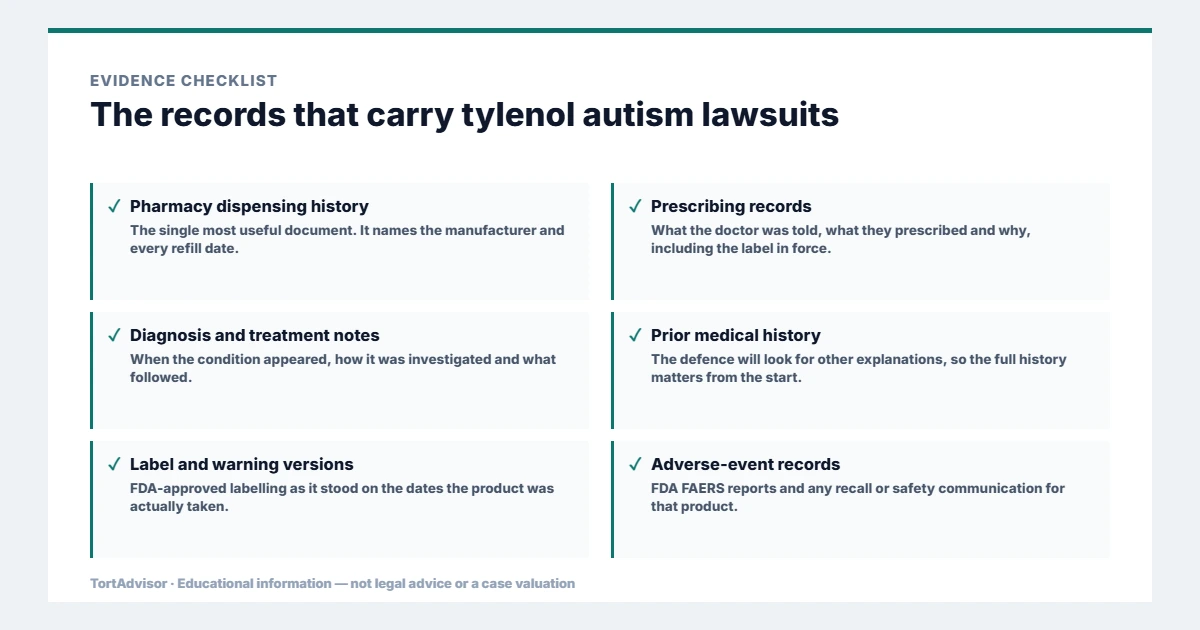
MDL 3043 has involved acetaminophen manufacturers, pharmacies and retailers. The proper defendant can depend on the exact product, brand, store label, manufacturer, retailer and exposure date. A claimant should not assume that every acetaminophen product maps to the same company or legal theory.
| Exposure Evidence | Examples | Why It Matters |
|---|---|---|
| Brand-name product | Tylenol or another identified branded acetaminophen product | Brand and exposure date can affect manufacturer and warning analysis. |
| Store-brand / generic product | Retailer-labeled acetaminophen or another generic product | Retailer, supplier and manufacturer identity can differ from brand-name Tylenol. |
| Combination medication | Cold, flu, headache or prescription products containing acetaminophen | Ingredient confirmation, dose and timing may require medication records or packaging. |
Evidence Commonly Reviewed in a Tylenol Autism or ADHD Claim
Prenatal Records
OB/GYN notes, hospital records, medication lists, fever or pain diagnoses and other pregnancy documentation.
Exposure Evidence
Receipts, pharmacy records, loyalty history, journals, household testimony, product packaging or other proof of acetaminophen use.
Diagnosis & Treatment
Developmental evaluations, pediatric records, neuropsychological assessments, therapy records, IEPs or related education records.
Alternative Factors & Damages
Family medical history, maternal illness, other medications, prematurity, therapy costs, caregiving and economic-loss records.
Tylenol Autism Lawsuit Settlement Status and Value Factors
No court-approved global settlement program, universal payout chart or reliable average settlement exists for MDL 3043 as of this update. The litigation has only recently returned from a major appellate ruling, and key causation, summary-judgment and case-specific issues remain unresolved.
Diagnosis & Support Needs
ASD or ADHD severity, functional limitations, therapy and educational needs may affect claimed damages.
Exposure Documentation
Reliable evidence of prenatal acetaminophen use, timing and frequency can affect both causation and defendant identification.
Scientific Causation
The admissibility and weight of general- and specific-causation evidence remain central litigation issues.
Economic Loss
Therapy, medical care, special education, caregiving and lost parental earnings may be relevant where recoverable.
Alternative Risk Factors
Genetic, familial, medical and environmental factors can affect specific-causation analysis.
State Law & Defenses
Warning law, seller liability, preemption arguments, statutes of limitation and damages rules vary by jurisdiction.
How a Tylenol Autism Lawsuit May Be Evaluated
Confirm Prenatal Exposure
Identify acetaminophen product, timing, frequency and available proof.
Document Diagnosis
Collect formal ASD or ADHD evaluations and treatment records.
Build Pregnancy Timeline
Review the reason for acetaminophen use, fever or illness and other medications or exposures.
Evaluate Causation
Assess current scientific evidence, alternative factors and expert requirements.
Identify Defendants & Law
Review brand, retailer, manufacturer, applicable state law and filing deadlines.
Document Damages
Preserve therapy, medical, education, caregiving and economic-loss records.
Tylenol Autism Lawsuit Statute of Limitations
There is no single nationwide deadline for every acetaminophen ASD/ADHD claim. State law can make timing depend on diagnosis, discovery of a possible connection, the child’s age, tolling rules for minors, product purchase or use, defendant identity and other facts.
Tylenol Autism Lawsuit FAQ
How many Tylenol autism cases are pending in MDL 3043?
JPML’s October 1, 2026 report lists 58 pending actions and 722 historical actions in MDL 3043.
SourceJPML1 Sep 2026
Did the Second Circuit rule that Tylenol causes autism or ADHD?
No. The court expressly said it was deciding expert-admissibility issues, not whether prenatal acetaminophen causes ASD or ADHD. It vacated the judgments and remanded for further proceedings.
Source2d Cir.13 Jul 2026
What did FDA do in September 2025?
FDA initiated a process for a label change reflecting evidence suggesting a possible association between prenatal acetaminophen use and autism/ADHD and notified physicians. FDA also stated that causation has not been established and contrary studies exist.
SourceFDA22 Sep 2025
What does ACOG say about acetaminophen use in pregnancy?
ACOG says the current weight of evidence does not support a causal link and continues to consider acetaminophen the preferred analgesic and antipyretic during pregnancy when used judiciously at the lowest effective dose for the shortest necessary duration in consultation with an obstetric clinician.
SourceACOGSep 2025
Does a child’s autism or ADHD diagnosis prove a Tylenol claim?
No. A legal claim requires much more than temporal sequence. Exposure, diagnosis, general causation, specific causation, defendant identity, state law and damages all require evidence.
Source2d Cir.13 Jul 2026
Can generic acetaminophen be relevant?
Potentially. The MDL has involved manufacturers, pharmacies and retailers associated with different acetaminophen products. The exact product and exposure date matter for identifying the proper defendant and legal theory.
Source2d Cir.13 Jul 2026
Is there a global Tylenol autism settlement?
No court-approved global settlement or universal payout matrix has been established for MDL 3043 as of this update.
SourceJPML1 Sep 2026
Should a pregnant person stop using acetaminophen because of the lawsuit?
Medication decisions should be made with a healthcare professional. FDA and ACOG both emphasize the need to consider the risks of untreated fever or pain as well as medication risks; lawsuit information should not substitute for medical advice.
Tylenol Autism Lawsuit Sources and Official References
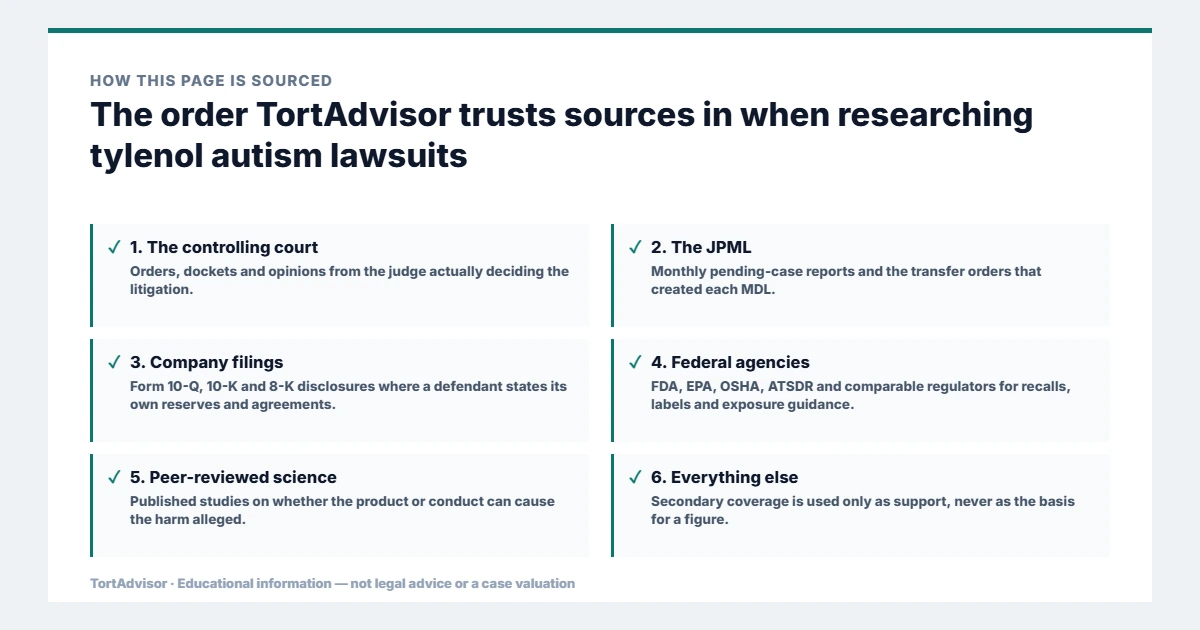
Source standard: federal court records, the JPML’s own statistics reports and FDA material first, then peer-reviewed research. Science standard: association and causation are kept separate throughout this page.
- JPML — Pending MDLs by Actions Pending, October 1, 2026. Lists 58 pending and 722 historical actions in MDL 3043.
- Southern District of New York — MDL 3043. Official federal MDL information and selected orders.
- Rutledge v. Walgreen Co.; Phippen v. Walgreen Co.. Second Circuit, July 13, 2026. Vacated judgments and remanded for further proceedings.
- FDA — September 22, 2025 acetaminophen pregnancy action. Initiated a label-change process concerning a possible association.
- FDA — Notice to Physicians on the Use of Acetaminophen During Pregnancy. States that causation has not been established and contrary studies exist.
- Ahlqvist VH, et al. Acetaminophen Use During Pregnancy and Children’s Risk of Autism, ADHD, and Intellectual Disability. JAMA, 2024. Sibling-control analysis found no increased risk.
- American College of Obstetricians and Gynecologists — Practice Advisory. September 2025 guidance on acetaminophen use in pregnancy and neurodevelopmental outcomes.
Request a Confidential Tylenol Autism Case Review
If acetaminophen was used during pregnancy and a child was later diagnosed with ASD or ADHD, submit the exposure, diagnosis, treatment and timing information you know now for a case-specific review.