
Oxbryta Lawsuit 2026: FDA Withdrawal, Court Cases & Who May Qualify
Oxbryta lawsuit claims allege that voxelotor contributed to serious complications such as increased vaso-occlusive crises, stroke, organ injury or death and that Pfizer and Global Blood Therapeutics failed to provide adequate warnings during relevant periods. Pfizer voluntarily withdrew Oxbryta worldwide in September 2024 after clinical and real-world data raised safety concerns, and individual product-liability cases are now proceeding in federal and state courts.
From here you can work through the Oxbryta settlement calculator, compare reported settlement amounts across torts, and see how we source and check every figure.
Choose the Oxbryta Lawsuit Information You Need
Start with potential eligibility or current litigation status, then review the FDA withdrawal, serious injuries, evidence and settlement factors.
What Is the Oxbryta Lawsuit About?
Oxbryta (voxelotor) was developed by Global Blood Therapeutics and later became part of Pfizer’s portfolio after Pfizer acquired GBT in 2022. Plaintiffs in personal-injury and wrongful-death cases allege that Oxbryta caused or contributed to serious complications and that the companies failed to adequately warn patients and prescribing physicians about risks that later led to the worldwide withdrawal.
Failure to Warn
Claims commonly allege that labeling and promotional communications did not adequately disclose the risk of increased VOCs, fatal events or other serious complications during relevant periods.
Worldwide Withdrawal
Pfizer voluntarily withdrew all Oxbryta lots in September 2024 and discontinued clinical trials and expanded-access programs.
Liability Is Disputed
Pfizer and GBT have raised federal preemption, warning, causation and other defenses in individual cases.
Who May Qualify for an Oxbryta Lawsuit?
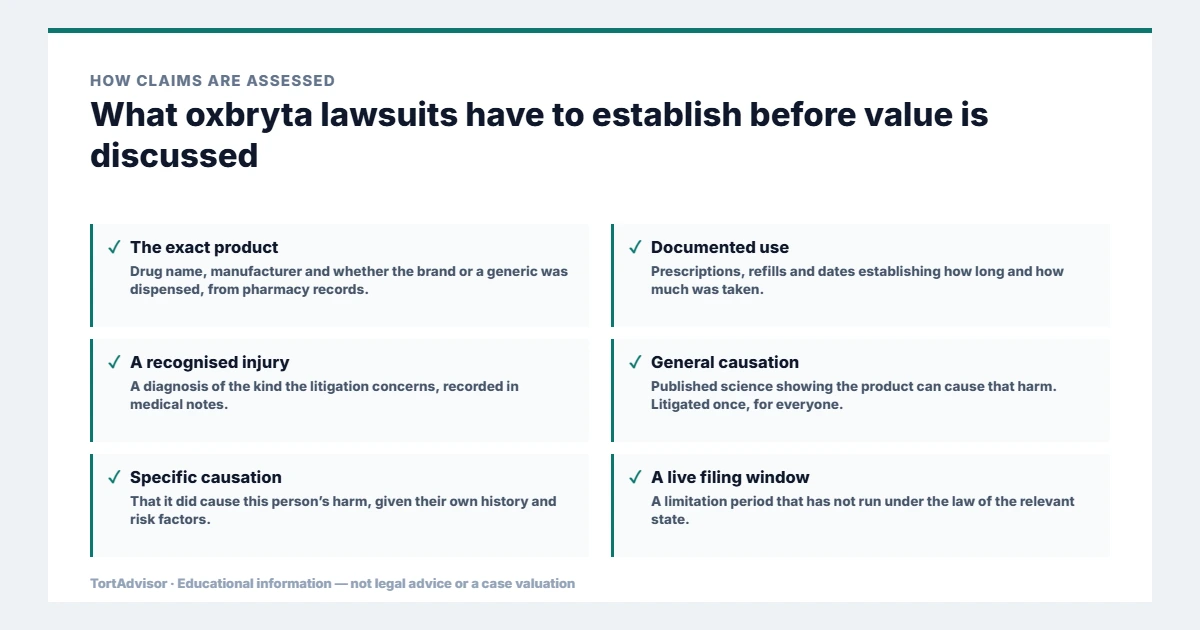
TortAdvisor’s current intake screening is generally focused on people who used Oxbryta for a meaningful period and then experienced a serious adverse outcome. The criteria below are screening considerations rather than a universal court rule, and different law firms may use different thresholds.
Oxbryta Exposure
- Prescription or pharmacy records identifying Oxbryta (voxelotor).
- Approximate start and stop dates, dose and treating hematologist.
- Use before the serious medical event at issue.
Serious Outcome
- Severe or increased vaso-occlusive crisis requiring treatment.
- Stroke or significant neurologic injury.
- Organ damage, organ failure or other serious documented complication.
- Death of a patient after Oxbryta use, subject to causation and state wrongful-death law.
Timing & Causation
Medical records should allow reviewers to compare the patient’s SCD history before and during Oxbryta treatment, including prior VOC frequency, prior strokes, organ disease and other risk factors.
Damages & Legal Timing
Hospitalization, permanent injury, lost income, future medical care, death-related losses and state-specific filing deadlines can materially affect a claim.
Oxbryta Lawsuits Are Not in a Federal MDL as of October 2026
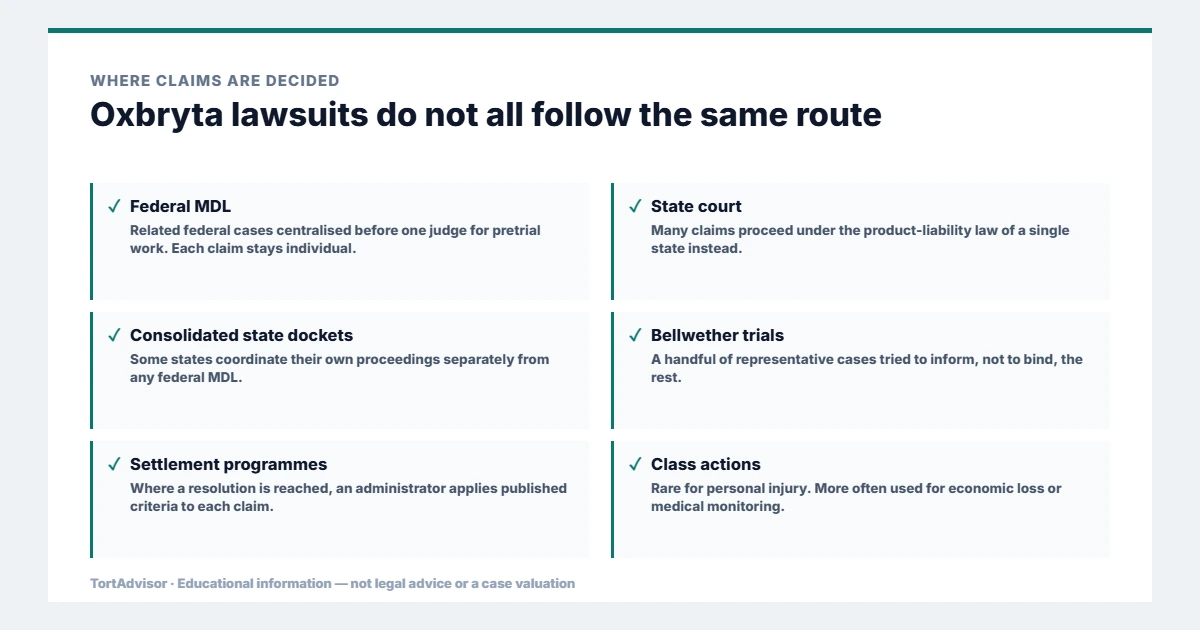
The Judicial Panel on Multidistrict Litigation’s October 1, 2026 active-MDL report does not list an Oxbryta or voxelotor MDL. Several Oxbryta matters have been filed as individual federal and state cases. Some Northern District of California cases were treated as related—but not consolidated into a JPML MDL—and some have entered private mediation or settlement.
September 25–26, 2024 — Worldwide Withdrawal
Pfizer announced worldwide withdrawal of Oxbryta, and FDA alerted patients and healthcare professionals that the drug was being removed from the market because of safety concerns.
May 2025 — Related Northern California Cases
Federal dockets in the Northern District of California identified several Oxbryta matters as related to the Allen case before Judge Trina L. Thompson. “Related” does not mean a JPML-created MDL.
October 2025–February 2026 — Settlement Activity
Public filings in individual Northern California Oxbryta cases reported settlement activity, including a settlement notice and a separate status report describing a settlement in principle that was still being finalized. The terms were not published as a global program.
July 27, 2026 — Cosey Motion-to-Dismiss Ruling
In Cosey v. Global Blood Therapeutics, Inc., the Northern District of Illinois dismissed the plaintiff’s design-defect claim with prejudice and dismissed the remaining claims without prejudice, allowing 30 days to amend if the plaintiff could cure identified pleading deficiencies.
October 1, 2026 — Still No Active Oxbryta MDL
JPML’s official list of active multidistrict litigations does not include an Oxbryta or voxelotor products-liability proceeding.
What Comes Next
Future filings, amended complaints, individual settlements, dispositive motions or a later request for MDL centralization could change the landscape. None should be assumed before an official filing or order exists.
Why Was Oxbryta Withdrawn From the Market?
On September 25, 2024, Pfizer announced that it was voluntarily withdrawing all Oxbryta lots from worldwide markets and discontinuing active voxelotor clinical trials and expanded-access programs. The next day, FDA issued a public alert stating that recent data indicated the benefit of Oxbryta did not outweigh the risks for the sickle cell patient population.
FDA stated that Pfizer reported a higher rate of vaso-occlusive crises in postmarketing clinical trials among patients receiving Oxbryta compared with placebo, along with more deaths in the Oxbryta treatment group. Pfizer also observed higher VOC rates in two real-world registry studies.
Every status, deadline and figure published on this page about oxbryta lawsuits is traced to a primary source before it appears.
More Vaso-Occlusive Crises
FDA summarized an increased VOC signal in postmarketing Oxbryta clinical trials.
More Deaths Than Placebo
FDA stated that there were more deaths in the Oxbryta treatment groups than in placebo groups in the postmarketing studies reviewed.
Registry Findings
Pfizer also observed higher VOC rates after Oxbryta initiation in two real-world registry studies.
What Regulators Said About the Oxbryta Safety Signal
European regulators reviewed the same emerging safety concerns. EMA’s human medicines committee noted increased numbers of vaso-occlusive crises and deaths with voxelotor compared with placebo in studies GBT440-032 and GBT440-042. In its later scientific conclusions, EMA said the mechanism explaining the excess VOCs and deaths had not been established and recommended continued suspension of the marketing authorization unless robust evidence could identify a patient group with a favorable benefit-risk balance.
Pediatric Stroke-Risk Study
European regulators cited an imbalance in deaths between voxelotor and placebo in this study.
Leg-Ulcer Study
EMA cited a higher number of deaths than anticipated in this study as part of the safety review.
Not Yet Established
EMA stated that the underlying mechanism that could explain the increased VOCs and deaths had not been established.
Serious Injuries Alleged in Oxbryta Lawsuits
Current Oxbryta personal-injury claims commonly focus on severe outcomes that occurred after treatment. Because many of these events are also recognized complications of sickle cell disease, a strong claim generally requires careful comparison of the patient’s condition before Oxbryta, the treatment period and the event itself.
Severe or Increased VOCs
Hospital-treated vaso-occlusive crises, increased crisis frequency or greater severity may be relevant where records establish a meaningful change after Oxbryta initiation.
Stroke
Imaging, neurology records, functional deficits and timing can be important in stroke-related claims.
Organ Injury
Kidney, lung, liver or other organ complications require diagnosis-specific records and individualized causation review.
Wrongful Death
Death-certificate information, hospital records, autopsy evidence where available and state wrongful-death law may be important.
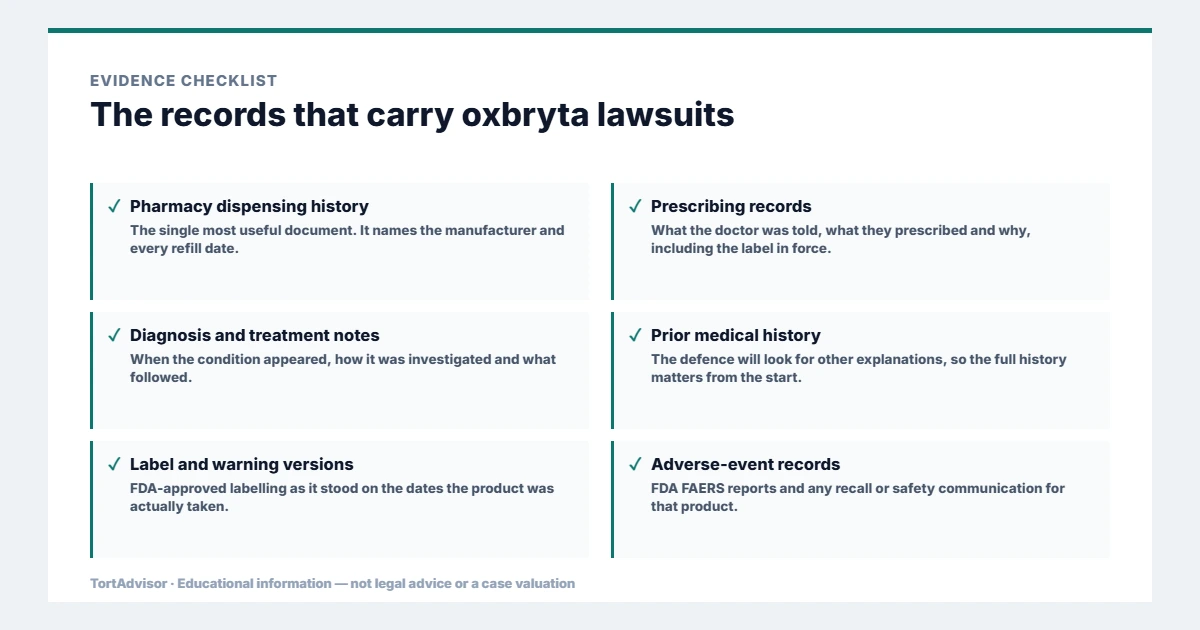
Evidence Commonly Reviewed in an Oxbryta Claim
Prescription Proof
Pharmacy records, hematology notes, insurance claims and Oxbryta treatment dates.
Pre-Oxbryta Baseline
Prior VOC frequency, stroke history, organ disease, hospitalizations, laboratory data and other SCD complications before treatment.
Event & Treatment Records
Emergency care, admission notes, imaging, ICU records, hematology records, surgery, rehabilitation and discharge summaries.
Damages Records
Medical expenses, wage loss, disability, future care, caregiving needs and wrongful-death losses where permitted.
Oxbryta Lawsuit Settlement Status and Value Factors
There is no verified global Oxbryta settlement program, court-approved payout matrix or reliable “average settlement” for Oxbryta product-liability claims. Public dockets show individual settlement activity in some cases, but those case-specific agreements do not establish a universal claim value.
Wrongful Death
Age, dependency, earnings, medical expenses, causation evidence and state wrongful-death rules can materially affect potential damages.
Stroke or Permanent Neurologic Injury
Permanent deficits, rehabilitation, future care, lost earning capacity and imaging evidence can significantly affect valuation.
Severe VOC Burden
Hospitalization frequency, ICU treatment, transfusions, length of stay and change from the patient’s prior SCD baseline can matter.
Organ Damage
Diagnosis, permanency, future treatment, transplant risk and functional limitations can shape damages.
Causation Strength
The overlap between Oxbryta allegations and underlying SCD complications makes patient-specific medical evidence especially important.
Legal Defenses
Federal preemption, learned-intermediary rules, warnings evidence, state law and filing deadlines can materially affect viability and value.
How an Oxbryta Lawsuit May Be Evaluated
Confirm Oxbryta Use
Collect prescription, pharmacy, hematology and insurance records.
Establish Baseline
Document the patient’s SCD severity, prior VOCs, prior strokes and organ status before Oxbryta.
Document the Event
Obtain hospital, imaging, specialist and treatment records for the serious complication.
Review Causation
Compare timing, alternative explanations, regulatory safety evidence and expert analysis.
Review Legal Defenses
Evaluate warnings, preemption, learned-intermediary law, jurisdiction and statutes of limitation.
Document Damages
Preserve bills, disability evidence, wage loss, future-care needs and wrongful-death evidence where applicable.
Oxbryta Lawsuit Statute of Limitations
There is no single nationwide deadline for every Oxbryta claim. Product-liability and wrongful-death statutes vary by state and may depend on the injury date, when a patient reasonably discovered a possible connection, Oxbryta treatment dates, residence, prescription location and other facts.
Oxbryta Lawsuit FAQ
Is there an Oxbryta MDL?
No Oxbryta or voxelotor MDL appears on JPML’s active-MDL report dated October 1, 2026. Oxbryta claims are proceeding as individual federal and state cases.
SourceJPML1 Sep 2026
Why was Oxbryta withdrawn?
Pfizer said the totality of clinical data indicated that Oxbryta’s benefits no longer outweighed its risks. FDA summarized higher VOC rates and more deaths in postmarketing trials, along with higher VOC rates in two real-world registry studies.
SourceFDA26 Sep 2024
Has the Oxbryta litigation reached a global settlement?
No public global settlement or court-approved Oxbryta payout matrix has been established. Some individual cases have reported settlement activity, but those agreements do not determine the value of other claims.
SourceJPML1 Sep 2026
What happened in the July 2026 Cosey case?
The Northern District of Illinois dismissed the design-defect claim with prejudice and dismissed the other claims without prejudice, giving the plaintiff 30 days to amend if she could cure the pleading deficiencies identified by the court.
SourceN.D. Ill.27 Jul 2026
Can a severe VOC support an Oxbryta claim?
A severe or increased VOC after Oxbryta use may warrant review, but sickle cell disease itself causes VOCs. A viable claim requires individualized timing, baseline and causation evidence.
SourceNHLBI20 Aug 2024
Can stroke or organ damage be part of an Oxbryta case?
Those injuries may be alleged in individual cases when they occurred after Oxbryta use, but the legal analysis must account for the patient’s underlying sickle cell disease and other possible causes.
SourceNHLBI20 Aug 2024
What records help evaluate an Oxbryta claim?
Prescription and pharmacy records, pre-Oxbryta hematology records, VOC history, imaging, hospitalizations, stroke or organ-injury records, disability evidence and damages records may all be relevant.
SourceN.D. Ill.27 Jul 2026
How much is an Oxbryta lawsuit worth?
There is no reliable universal average. Injury severity, permanence, causation proof, underlying SCD history, economic losses, state law and litigation defenses can all materially affect value.
SourceJPML1 Sep 2026
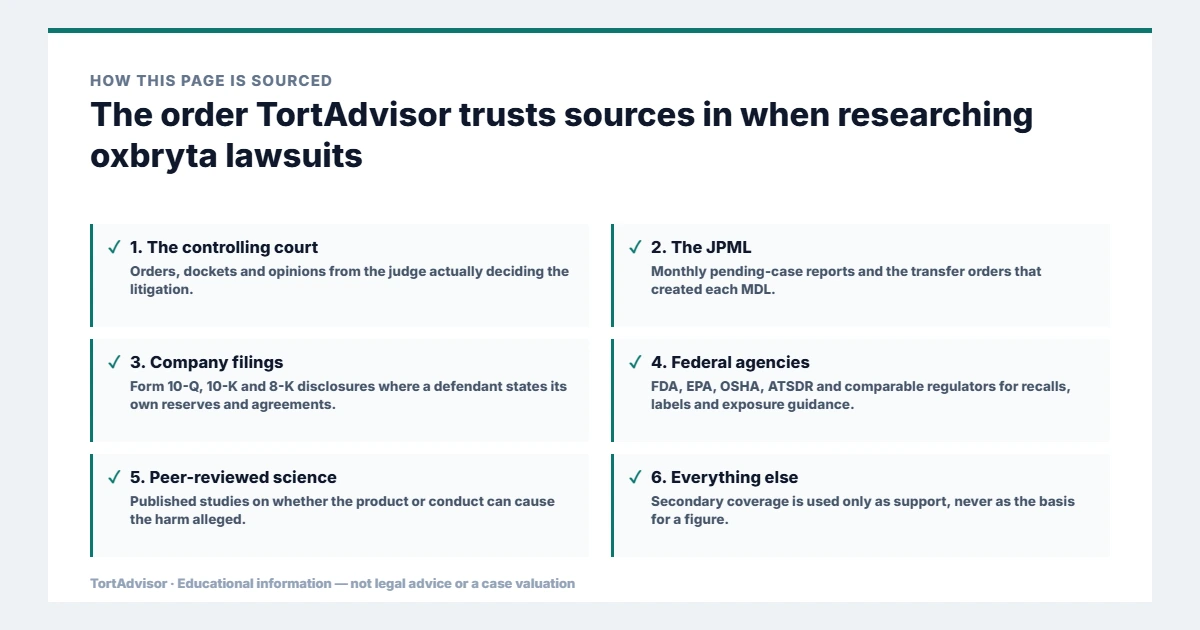
Oxbryta Lawsuit Sources and Official References
- FDA — Voluntary withdrawal of Oxbryta due to safety concerns. September 26, 2024 safety alert describing higher VOC rates and more deaths in postmarketing clinical trials.
- Pfizer — Worldwide Oxbryta withdrawal announcement. September 25, 2024.
- Judicial Panel on Multidistrict Litigation — Active MDL reports. September 1, 2026 report does not list an Oxbryta or voxelotor MDL.
- Cosey v. Global Blood Therapeutics, Inc. et al.. Northern District of Illinois, July 27, 2026 motion-to-dismiss opinion.
- EMA — Oxbryta Article 20 scientific conclusions. Continued suspension recommendation after review of VOC and mortality signals.
- FDA — Original accelerated approval of voxelotor. November 25, 2019.
- FDA — 2021 pediatric age expansion. Accelerated approval for patients ages 4–11.
Request a Confidential Oxbryta Case Review
If you used Oxbryta and later experienced a severe VOC, stroke, serious organ injury or another major complication—or if a family member died after treatment—submit the treatment, injury and timing information you know now for review.