
Talcum powder lawsuit claims allege that Johnson & Johnson talc products caused ovarian cancer or mesothelioma. Federal cases are centralized in MDL 2738 in New Jersey, the largest federal MDL with 69,376 pending actions on November 2, 2026. On July 27, 2026, J&J proposed a $5.5 billion resolution of ovarian claims that requires at least 95% participation.
Updates on Talcum Powder Lawsuit
Quick Answer: The talcum powder lawsuit statute of limitations typically runs one to six years from the date of diagnosis, depending on your state and whether that state applies a "discovery rule." Missing your state's deadline can bar your claim entirely, so confirming your exact filing window with an attorney as soon as possible is [...]
An updated look at the J&J talcum powder MDL: pending claim counts, the March 2026 Lancet retraction, June 2026's split bellwether verdicts, the reduced punitive damages ruling, and where settlement talks stand.
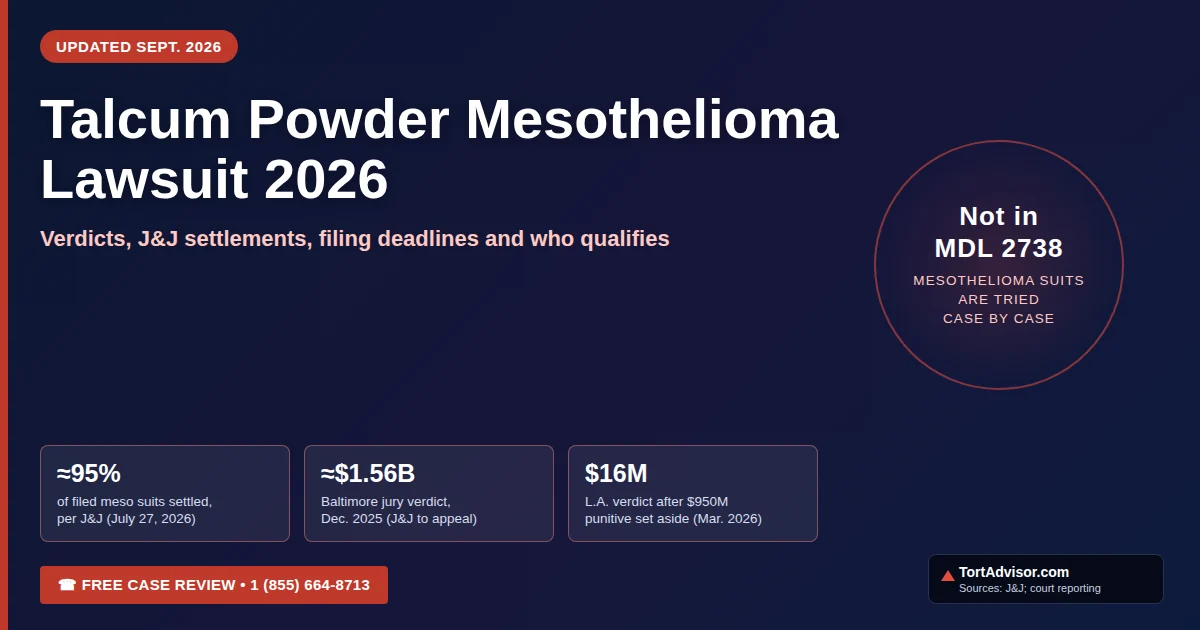
Update — September 24, 2026: On July 27, 2026, Johnson & Johnson proposed a $5.5 billion resolution of ovarian cancer talc claims, conditioned on participation by claimants representing at least 95% of the remaining claims. It does not cover mesothelioma: J&J says it has already settled about 95% of filed mesothelioma lawsuits. The Red River [...]

Talcum powder and ovarian cancer in 2026: what the science actually shows (including the IARC’s 2024 “probably carcinogenic” classification), J&J’s proposed $5.5 billion resolution, who qualifies and how to file.
-
Quick Answer: The talcum powder lawsuit involves claims that Johnson & Johnson's talc-based products caused ovarian cancer or mesothelioma. Settlement amounts vary widely by diagnosis severity, and eligibility generally requires documented long-term product use plus a qualifying cancer diagnosis. Johnson & Johnson’s third bankruptcy attempt ended in March 2025, and on July 27, 2026 [...]
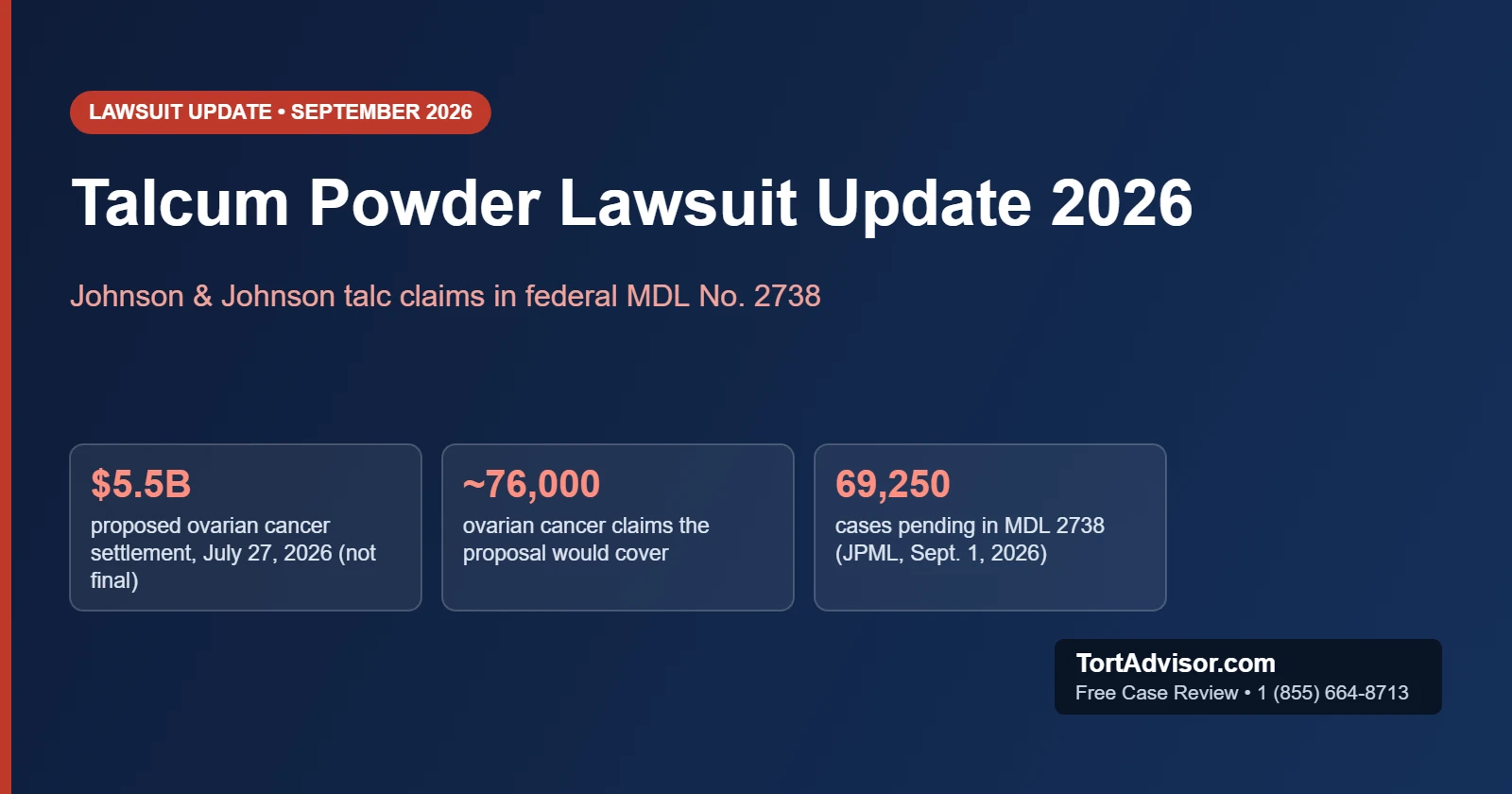
Quick Answer: As of November 6, 2026, Johnson & Johnson's proposed $5.5 billion resolution of roughly 76,000 ovarian talc claims (announced July 27, 2026) is still a proposal. It needs express participation from at least 95% of the remaining claims, and J&J has not announced that this threshold has been met. The federal MDL 2738 [...]
Key facts (as of November 2026)
- Oct. 4, 2016: The JPML centralized federal talc cases in the District of New Jersey.
- July 5, 2024: IARC published its classification of talc as probably carcinogenic to humans (Group 2A).
- Mar. 31, 2025: A Texas bankruptcy court declined to confirm the Red River Talc plan; J&J said it would return to the tort system.
- July 27, 2026: J&J proposed a $5.5 billion ovarian resolution, with a first payment of no more than $3 billion in 2027.
- Sept. 27, 2026: J&J reported about 76,500 U.S. plaintiffs with direct talc claims in pending lawsuits.
- Nov. 2, 2026: MDL 2738 listed 69,376 pending actions, out of 72,060 filed.
What the talcum powder lawsuits claim
According to the JPML's 2016 transfer order, plaintiffs alleged that they or their decedents developed ovarian or uterine cancer following perineal application of Johnson's Baby Powder and Shower to Shower. A separate group of claims alleges that asbestos in talc products caused mesothelioma. In June 2024 an IARC working group classified talc as probably carcinogenic to humans (Group 2A), finding limited evidence in humans for ovarian cancer. J&J disputes the claims and has called them meritless.
Where the litigation stands
MDL 2738 is before Judge Michael A. Shipp in the District of New Jersey. After the bankruptcy court in the Southern District of Texas declined to confirm the Red River Talc plan on March 31, 2025, J&J said it would litigate rather than appeal. On July 27, 2026, it announced a proposed $5.5 billion resolution of the remaining ovarian claims: a first payment of no more than $3 billion in 2027, no further payments before 2028, and a condition that at least 95% of remaining claims expressly participate. J&J's Form 10-Q for the period ended September 27, 2026 reports about 76,500 U.S. plaintiffs with direct talc claims and a talc reserve with a present value of about $9.0 billion. No per-claimant amounts have been published.
Who may qualify
Ovarian cancer claims generally depend on an ovarian cancer diagnosis and evidence of regular genital use of J&J talc products, supported by medical records. Mesothelioma claims generally depend on a mesothelioma diagnosis and evidence of talc exposure. The $5.5 billion proposal covers ovarian claims only; J&J says it has resolved about 95% of filed mesothelioma lawsuits separately. Eligibility for any program depends on terms that have not been published.
Deadlines and next steps
Statutes of limitations vary by state and usually run from diagnosis or discovery of a possible link. J&J's announcement does not set a public participation deadline. Our talcum powder statute of limitations guide covers state rules, and the talcum powder settlement amounts page covers reported figures.
Frequently asked questions
Is the $5.5 billion talc settlement final?
No. J&J announced the proposal on July 27, 2026, and it requires the express participation of at least 95% of the remaining ovarian claims. J&J's third-quarter 2026 Form 10-Q still describes it as conditioned on that threshold and reports no completed participation figure. The first payment, of no more than $3 billion, is planned for 2027.
How much will each talc claimant receive?
That has not been published. J&J describes a $5.5 billion total commitment for roughly 76,000 remaining ovarian claims, but no payout matrix or per-claim value is public. Dividing the total by the number of claims does not produce a meaningful estimate, because allocation rules, fees, liens and the final participation rate are unknown.
Does the proposal cover mesothelioma?
No. The July 2026 proposal addresses ovarian talc claims. J&J states that it previously settled about 95% of filed mesothelioma lawsuits on separate terms. Mesothelioma claims rest on alleged asbestos exposure and follow a different path; see TortAdvisor's talcum powder mesothelioma guide.
What did IARC conclude about talc?
An IARC Monographs working group met in Lyon in June 2024 and classified talc as probably carcinogenic to humans (Group 2A), with limited evidence in humans for ovarian cancer; the summary appeared in The Lancet Oncology on July 5, 2024. A hazard classification does not establish that talc caused any individual's cancer.
Sources
- JPML – Pending MDL Dockets by Actions Pending (November 2, 2026)
- JPML – MDL 2738 transfer order (Oct. 4, 2016)
- Johnson & Johnson – Proposed resolution of ovarian talc litigation (July 27, 2026)
- SEC – Johnson & Johnson Form 10-Q, period ended Sept. 27, 2026, legal proceedings note
- IARC – Monographs Volume 136 Q&A on talc (July 2024)
- Johnson & Johnson – Return to tort system after Red River Talc ruling (Mar. 31, 2025)
Your deadline runs even while an MDL is pending
Joining a mass tort still requires filing your own case on time. State statutes of limitations usually keep running while bellwether trials and settlement talks go on.
Free · Confidential · No obligation
Free Talcum Powder Case Review
Tell us what happened and a trained case advisor will review it. You choose whether you want to be contacted.
- 1Share the basicsThe product, your injury and the dates.
- 2A case advisor reviews itAgainst the criteria in active mass torts.
- 3You decide what happens nextNo cost and no obligation.
- Live case countsFrom the JPML monthly report
- Every answer is citedEach answer links its primary source
- Free and confidentialNo cost and no obligation to continue
- Not a law firmA trained case advisor makes the first contact
Prefer to talk it through?
TortAdvisor is not a law firm and does not give legal advice. A trained case advisor, not an attorney, may make the first contact. See our partner list and privacy policy.
Filter Posts
Browse by Category