
Car Accident Lawsuit 2026: Injury Claims, Fault & Settlements
A serious crash can create several problems at once: medical treatment, missed work, insurance questions, evidence that may disappear, and state-law deadlines. This guide explains what can matter before a claim becomes a lawsuit and where to go next.
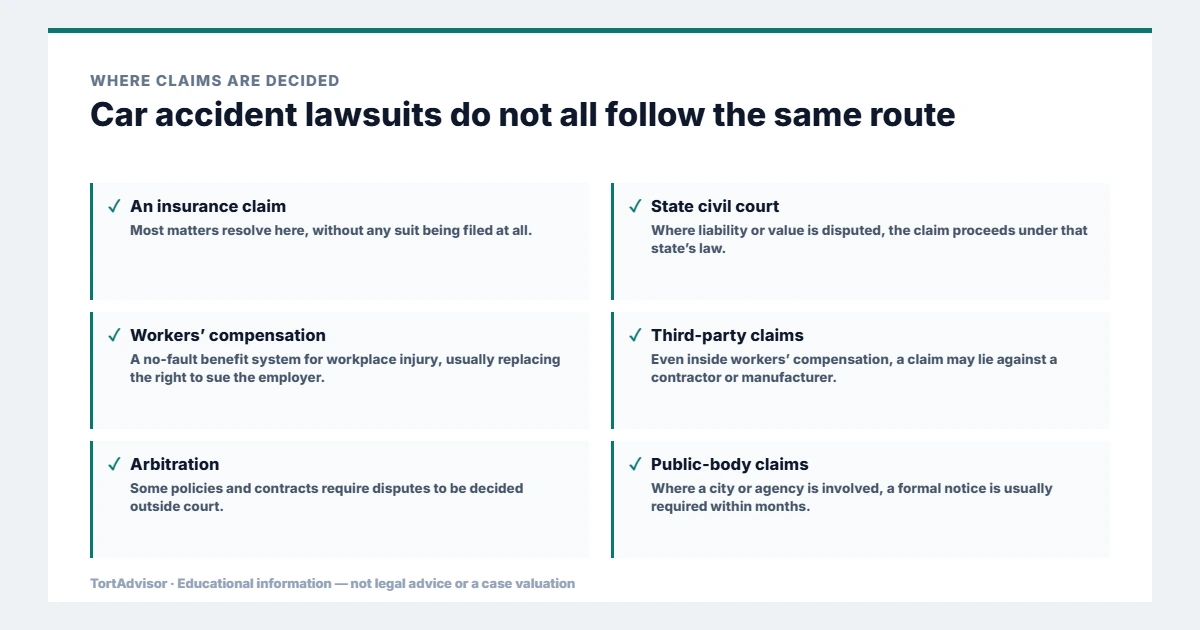
Most car accident matters begin as insurance claims, not lawsuits. A lawsuit may become relevant when fault, injury causation, coverage, or compensation remains disputed, or when filing is necessary to preserve a claim before the controlling deadline.
Tell Us About Your Car Accident
Answer the questions you can. You do not need every record or a perfect timeline before starting.
What to Check First After a Serious Car Accident
The correct path depends on the crash facts, the injuries, available insurance, the parties involved, and the law that governs the claim. These four steps organize the first review without assuming every collision requires a lawsuit.
Car Accident Insurance Claim vs. Car Accident Lawsuit
After a collision, an injured person may first pursue benefits or compensation through one or more insurance policies. Depending on the state and the facts, those sources can include liability coverage, personal injury protection, medical-payments coverage, uninsured or underinsured motorist coverage, commercial coverage, or other applicable policies.
A lawsuit is a separate court process. It may become relevant when liability is disputed, injuries or damages are substantial, insurance coverage is contested, multiple defendants are involved, a claim is denied, or the parties cannot resolve the dispute before the applicable filing deadline.
Claim Investigation
Insurers may review statements, medical records, crash evidence, coverage, fault, bills, wage loss, and other claimed damages.
Negotiation or Denial
The parties may disagree about fault, medical causation, coverage, treatment, future loss, or the amount of compensation.
Civil Lawsuit
If a claim cannot be resolved, a lawsuit may be filed before the governing deadline. Filing does not guarantee settlement or recovery.
When a Car Accident Lawsuit May Be Worth Evaluating
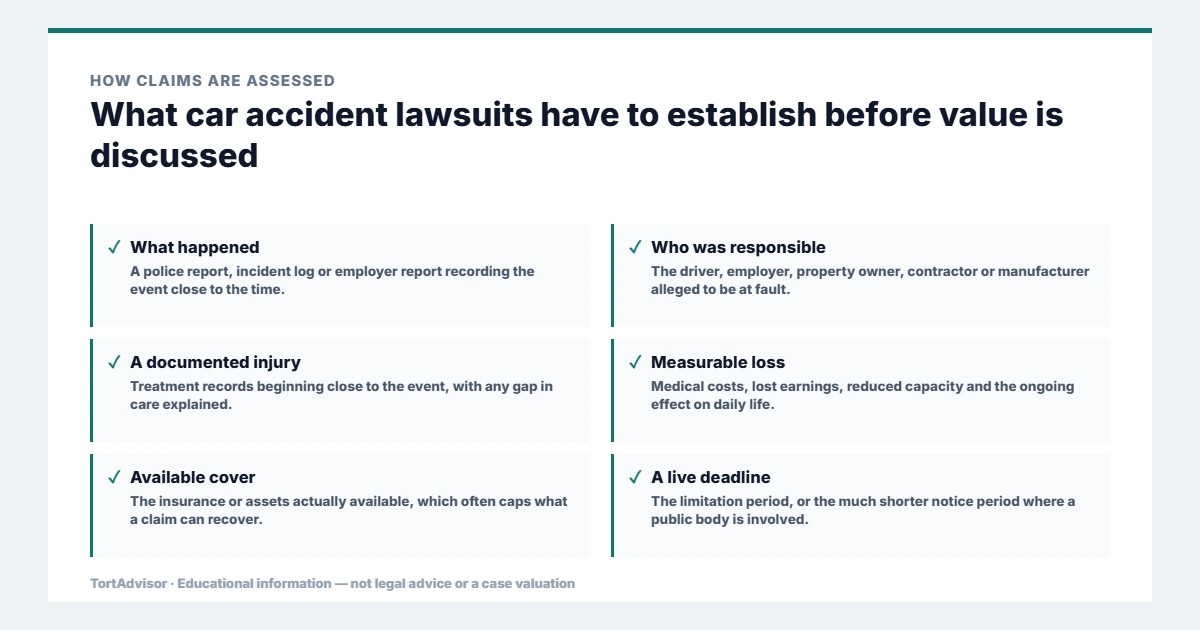
No website can determine legal eligibility from a short checklist. A potential car accident lawsuit may warrant further review when the available facts indicate a compensable injury or loss and another party may be legally responsible.
Every status, deadline and figure published on this page about car accident lawsuits is traced to a primary source before it appears.
Factors that may support further review
- A crash caused a documented physical injury, medical treatment, disability, death, property loss, or other compensable damages.
- Evidence may support negligence, product liability, employer responsibility, dangerous road conditions, or another recognized basis for liability.
- Insurance coverage, assets, or another potential recovery source may exist.
- The applicable filing and notice deadlines have not expired.
Issues that can change the analysis
- Shared fault or a disputed account of how the collision occurred.
- Questions about whether the crash caused or worsened the claimed injury.
- Prior injuries, treatment gaps, liens, coverage exclusions, or policy limits.
- Claims involving a government entity, minor, wrongful death, commercial vehicle, rideshare trip, defective product, or out-of-state parties.
No-Fault vs. At-Fault States: Where a Car Accident Claim Starts
Most states use an at-fault system: an injured person makes a claim against the liability insurance of the driver who caused the crash and can sue that driver if the claim does not resolve. Twelve states and Puerto Rico use no-fault auto insurance laws instead: Florida, Hawaii, Kansas, Kentucky, Massachusetts, Michigan, Minnesota, New Jersey, New York, North Dakota, Pennsylvania and Utah. In those states, a person’s own personal injury protection (PIP) coverage pays initial medical and wage-loss benefits regardless of who caused the crash, and a lawsuit against the other driver for pain and suffering is limited until the injury meets a threshold set by state law.
No-fault thresholds take two forms. Florida, Michigan, New Jersey, New York and Pennsylvania use verbal thresholds that describe the injuries that qualify. Hawaii, Kansas, Kentucky, Massachusetts, Minnesota, North Dakota and Utah use monetary thresholds alongside listed serious injuries, such as medical expenses above $2,000 in Massachusetts or above $4,000 in Minnesota. New Jersey, Pennsylvania and Kentucky are choice states, where policyholders can accept or reject the lawsuit limitation. The defaults differ: New Jersey applies the Limited Right to Sue option when no choice is made, while Pennsylvania treats an insured who does not answer the tort-option notice as having chosen full tort.
SourceInsurance Info. InstituteNo-fault backgroundMass. G.L. c. 231Sec. 6DMinn. Stat.Sec. 65B.51NJ DOBIBuyer’s Guide 202675 Pa.C.S.Sec. 1705
PIP and the 14-Day Rule
Florida PIP pays up to $10,000 in medical and disability benefits and $5,000 in death benefits. Medical benefits are payable only if the injured person receives initial care within 14 days after the crash, and they are limited to $2,500 if a qualifying provider determines there was no emergency medical condition.
SourceFla. Stat.Sec. 627.736
$50,000 of Basic Economic Loss
New York no-fault benefits cover basic economic loss of up to $50,000 per person. Written notice of the claim is due within 30 days of the accident, and medical bills generally must be submitted within 45 days of the date of service.
Six PIP Medical Choices
Michigan drivers choose among six PIP medical coverage levels, ranging from unlimited coverage to an opt-out tied to Medicare coverage. The level on the policy can decide how much of a crash injury’s medical cost the auto insurer pays.
What Can Affect Car Accident Settlement Value in 2026?
There is no reliable national average that predicts an individual car accident settlement. Potential value can change materially based on the strength of the proof, the seriousness and duration of the losses, the law that applies, and the practical sources from which compensation could be collected.
A stronger evaluation usually requires proof of harm, proof of responsibility, and realistic recovery sources. Missing documentation, shared fault, policy limits, causation disputes, liens, or state-law restrictions can materially change the analysis.
Injury Severity & Prognosis
Surgery, hospitalization, permanent impairment, scarring, future care, disability, and long-term restrictions can change the loss profile.
- Diagnosis and imaging
- Procedures and rehabilitation
- Future-care or impairment evidence
Medical Proof & Causation
Records can help connect the collision to the claimed injury and document treatment timing, symptoms, restrictions, prognosis, and expenses.
- Treatment consistency
- Prior-condition analysis
- Provider documentation
Fault & Liability Evidence
Police records, photographs, video, witnesses, vehicle data, admissions, and other proof can affect how responsibility is evaluated.
- Comparative fault
- Multiple responsible parties
- Disputed collision accounts
Insurance & Collectability
Liability limits, UM/UIM, PIP, commercial coverage, employer policies, multiple defendants, and available assets can affect practical recovery.
- Policy limits
- Coverage exclusions
- Additional defendants
Economic & Future Loss
Documented medical expenses, lost wages, reduced earning capacity, out-of-pocket costs, rehabilitation, and future financial loss may be relevant.
- Pay and tax records
- Work restrictions
- Future earning impact
Jurisdiction, Liens & Legal Rules
State law can affect fault allocation, damages, insurance requirements, evidentiary issues, liens, notice requirements, and filing deadlines.
- Governing state law
- Government claims
- Liens and offsets
Consider whether treatment is complete enough to evaluate future needs, whether wage loss or permanent impairment remains unresolved, whether all potentially available coverage and responsible parties have been identified, and whether liens or state-law issues could affect the net result. An online estimate is not a settlement offer or legal opinion.
How Fault and Liability Can Affect a Car Accident Lawsuit
Liability is fact-specific. Depending on the collision, potential defendants can include another driver, a vehicle owner, an employer, a commercial carrier, a rideshare or delivery-related entity, a manufacturer, a maintenance provider, a road contractor, or a government entity. The governing law determines which theories are available.
States also use different systems for allocating a claimant’s own fault, including pure comparative negligence, modified comparative negligence, and contributory negligence. Those rules can reduce or, in some jurisdictions, bar recovery.
For a state-by-state research starting point, use TortAdvisor’s Car Accident Fault Rules & Statute of Limitations by State guide and verify the current governing statute before relying on a deadline or fault threshold.
Police or Incident Records
Reports can document parties, vehicles, statements, witnesses, citations, diagrams, and observed scene conditions. Their legal effect varies by jurisdiction and purpose.
Video & Witness Evidence
Dashcam footage, traffic or business video, photographs, vehicle data, and independent witnesses can help reconstruct what occurred.
Commercial, Product & Roadway Issues
Employment, vehicle ownership, defective components, maintenance, road work, or government responsibility can require a separate liability analysis.
Evidence That May Matter in a Car Accident Claim
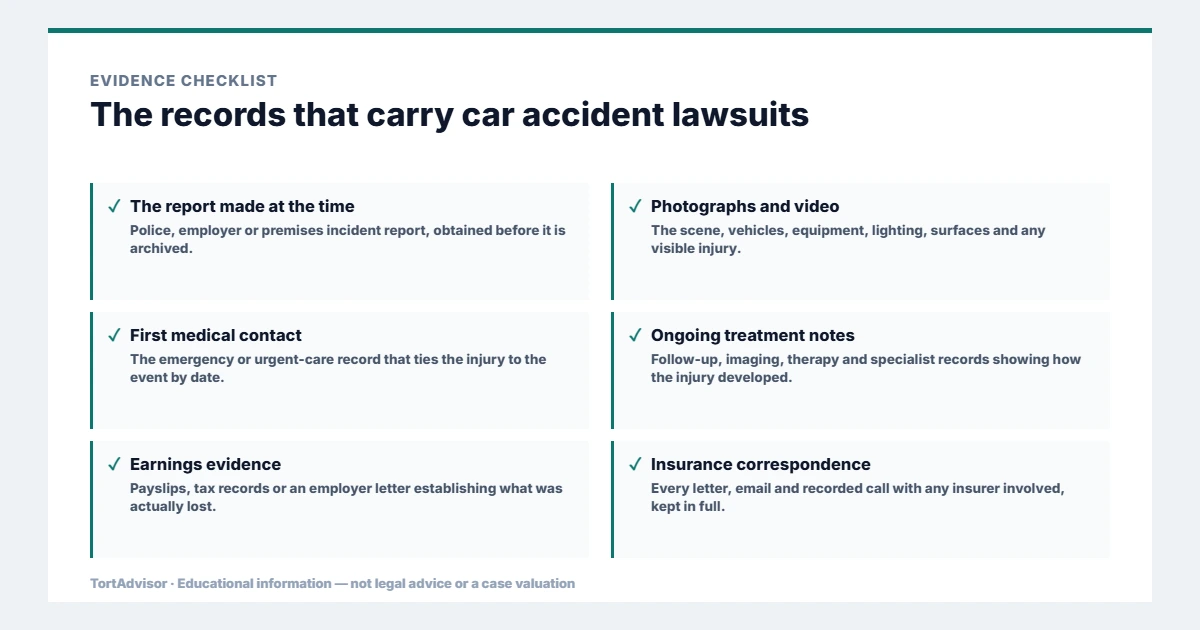
Evidence should be preserved early when it can be done safely and lawfully. The usefulness and admissibility of any item depends on the facts and jurisdiction.
Crash Evidence
- Police or incident report
- Scene, roadway, and vehicle photographs
- Dashcam, traffic-camera, or nearby business video
- Witness names and statements
- Vehicle data or reconstruction material, when relevant
Medical Evidence
- Emergency, hospital, specialist, and therapy records
- Imaging and diagnostic testing
- Bills and out-of-pocket expenses
- Work restrictions and prognosis
- Future-care or impairment documentation, when applicable
Financial & Insurance Evidence
- Pay records and employer wage-loss documentation
- Repair estimates and rental expenses
- Insurance declarations and coverage letters
- Claim correspondence and settlement offers
- Records of other documented crash-related losses
What to Do After a Car Accident
- Address immediate safety and medical needs. Call emergency services when appropriate and do not delay necessary medical care for legal or insurance reasons.
- Report the collision as required. Police-reporting and insurer-notice duties can vary by state, policy, crash severity, and parties involved.
- Preserve available evidence. Keep photographs, video, witness information, vehicle records, medical records, bills, and insurance communications.
- Be accurate in insurance communications. Do not speculate about facts you do not know. Review policy duties before refusing required cooperation.
- Identify the governing law and deadline early. Special notice periods can apply to government defendants and other claim types.
- Review unresolved losses before signing a release. A release can affect future rights, so understand what claims and parties it covers before accepting a final resolution.
For a fuller checklist, see what to do after a car accident, step by step.
Car Accident Lawsuit Filing Deadlines Vary by State
There is no single national statute of limitations for car accident lawsuits. The controlling period can depend on the state, type of defendant, type of claim, injury or death, applicable discovery rules, the claimant’s age or legal status, contractual insurance deadlines, and special notice requirements.
The examples below show how much general personal-injury deadlines differ. Each has exceptions, and claims against public entities often have much shorter notice requirements.
- California: 2 years (Code Civ. Proc. § 335.1); a claim against a public entity generally must be presented within 6 months (Gov. Code § 911.2).
- Texas: 2 years (Civ. Prac. & Rem. Code § 16.003).
- Florida: 2 years for negligence claims accruing after March 24, 2023, and 4 years for claims that accrued earlier (Fla. Stat. § 95.11(5)(a); ch. 2023-15).
- New York: 3 years for personal injury (CPLR 214(5)) and 2 years from death for wrongful death (EPTL 5-4.1).
- Georgia: 2 years (O.C.G.A. § 9-3-33).
- Pennsylvania: 2 years (42 Pa.C.S. § 5524(2)).
- Illinois: 2 years (735 ILCS 5/13-202).
- Ohio: 2 years (R.C. 2305.10(A)).
- North Carolina: 3 years for personal injury (G.S. 1-52(16)) and 2 years for wrongful death (G.S. 1-53(4)).
- Arizona: 2 years (A.R.S. § 12-542).
- Louisiana: 2 years for delictual actions arising after July 1, 2024, replacing the former 1-year period (C.C. art. 3493.1); wrongful-death and survival claims: 1 year from death or 2 years from the injury, whichever is longer (C.C. art. 2315.2).
- Tennessee: 1 year, extended to 2 years in limited situations where criminal charges are brought against the person sued (T.C.A. § 28-3-104).
Claims involving a city, county, state agency, public vehicle, or other government entity can have notice requirements that are much shorter than the ordinary personal-injury limitations period. Wrongful-death, UM/UIM, product-liability, and out-of-state claims can also require separate analysis.
2025–2026 Law Changes That Can Affect a Car Accident Claim
Several states changed the rules for crash claims in 2025 and 2026. Each change applies only in the state that made it, and many apply only to claims that arose, or lawsuits that were filed, after a set date. The crash date and the filing date both matter when reading the list below.
Fault Bar, Serious Injury and a $100,000 Cap
New York’s 2026 budget law (Laws of 2026, chapter 58, Part EE) bars recovery in no-fault motor-vehicle injury suits when the claimant’s culpable conduct is greater than the defendants’. It removes the “90/180-day” category from the serious-injury definition and caps non-economic damages at $100,000 for a non-fatal serious injury when the at-fault claimant was driving uninsured, or was driving impaired or committing a felony and was convicted. It applies to actions commenced on or after May 26, 2026.
A Package of Tort Changes
Act 15 replaced pure comparative fault with a 51% bar from January 1, 2026. Act 16 bars uninsured claimants from recovering the first $100,000 of bodily-injury damages and the first $100,000 of property damage (August 1, 2025). Act 18 ended, from May 28, 2025, the presumption that an injury was caused by the accident simply because the person had no prior history of the condition. Act 466 limits recovery of medical expenses paid by a health insurer or Medicare to the amounts actually paid, for causes of action filed on or after January 1, 2026.
SourceLa. Act 152025, eff. 1 Jan 2026La. Act 162025, eff. 1 Aug 2025La. Act 182025La. Act 4662025, eff. 1 Jan 2026
Senate Bill 68
Georgia now allows evidence that a person was not wearing a seat belt. For claims arising on or after April 21, 2025, special damages for medical care are limited to the reasonable value of necessary care, and when the claimant has health insurance or workers’ compensation, juries can hear both the amounts charged and the amounts actually needed to satisfy them. Lawyers may argue a dollar figure for pain and suffering only after the close of evidence, and either side can demand a trial in which fault is decided before damages.
Higher Minimum Insurance Limits
California raised its minimum liability limits to 30/60/15 on January 1, 2025, with a further step to 50/100/25 scheduled for 2035. Virginia moved to 50/100/25 and Utah to 30/65/25 for policies effective in 2025. North Carolina moved to 50/100/50 for policies issued or renewed on or after July 1, 2025, and stopped reducing underinsured motorist coverage by the at-fault driver’s liability payment. New Jersey’s Standard Policy bodily-injury minimum rose to $35,000/$70,000 on January 1, 2026.
SourceCal. SB 1107Ch. 717, Stats. 2022Va. CodeSec. 46.2-472Utah Code31A-22-304N.C. S.L. 2023-133Sec. 12N.J. P.L.2022c.87
Insurance Coverage, Policy Limits and Uninsured Drivers
Liability insurance pays for injuries the insured driver causes to other people, up to the policy’s limits. State minimum limits are written as three numbers in thousands of dollars — per person, per crash and property damage — and they vary widely: 30/60/25 in Texas, 15/30/5 in Pennsylvania and 30/60/15 in California since January 1, 2025. Florida does not require bodily-injury liability coverage for ordinary private passenger vehicles; it requires $10,000 of PIP and $10,000 of property damage liability.
SourceTexas Dept. of InsuranceAuto guidePennDOTInsurance law fact sheetCal. SB 1107Ch. 717, Stats. 2022FLHSMVInsurance requirements
When the driver at fault has no insurance, or less coverage than the injuries are worth, uninsured and underinsured motorist (UM/UIM) coverage on the injured person’s own policy may pay the difference, and it can also apply to hit-and-run crashes depending on the policy. In Texas, insurers must offer UM/UIM coverage, and a policyholder who does not want it must reject it in writing. The Insurance Research Council estimated that 15.4% of U.S. motorists were uninsured in 2023, with state rates ranging from 5.7% in Maine to 28.2% in Mississippi, as reported by the Insurance Information Institute.
SourceTexas Dept. of InsuranceAuto guideInsurance Info. InstituteUninsured motorists
Coverage rules can change a result as much as fault does. Louisiana now bars uninsured drivers from recovering the first $100,000 of bodily-injury damages and the first $100,000 of property damage, North Carolina no longer reduces UIM coverage by the at-fault driver’s liability payment, and New York caps non-economic damages for certain uninsured at-fault claimants. A judgment larger than the at-fault driver’s policy limits is generally collectible only from other coverage, such as UIM or an umbrella policy, or from the defendant’s own assets.
SourceLa. Act 162025, eff. 1 Aug 2025N.C. S.L. 2023-133Sec. 12N.Y. S.9008-CPart EE, 26 May 2026
Damages in a Car Accident Claim
Damages are the losses a car accident claim asks to be paid for. They fall into three groups, and the governing state’s law decides which are available and how they must be proved.
Economic (Special) Damages
Losses with a documented dollar value: medical bills, future care, lost wages, reduced earning capacity, property damage and out-of-pocket costs. Bills, pay records and treatment plans usually carry this part of a claim.
Non-Economic (General) Damages
Pain and suffering, emotional distress, loss of enjoyment of life and disfigurement. In no-fault states, these damages can be pursued against the other driver only when the injury meets the state’s threshold.
Punitive Damages
Damages meant to punish rather than compensate. They are not available in every state or every case, and they generally require conduct well beyond ordinary carelessness under the governing state’s standard.
How medical bills are proved is changing in some states. In Georgia, for claims arising on or after April 21, 2025, special damages for medical care are limited to the reasonable value of medically necessary care, and when the claimant has health insurance or workers’ compensation the jury can hear both the amounts charged and the amounts actually needed to satisfy them. In Louisiana, for causes of action filed on or after January 1, 2026, recovery of medical expenses paid by a health insurer or Medicare is limited to the amounts actually paid, and the jury is told both the billed and the paid amounts. New York’s 2026 law caps non-economic damages at $100,000 for certain at-fault claimants who were driving uninsured, or were driving impaired or committing a felony and were convicted.
SourceGa. SB 68Act 9, 21 Apr 2025La. Act 4662025, eff. 1 Jan 2026N.Y. S.9008-CPart EE, 26 May 2026
Serious and Catastrophic Car Accident Injuries
Traumatic brain injuries, spinal cord injuries, amputations, severe burns and complex fractures change the scope of a claim because the losses continue long after the crash: future surgery, rehabilitation, home care, lost earning capacity and permanent limitations. These claims usually depend on medical opinions about prognosis and future needs, so treatment records and specialist evaluations matter more than in a short soft-tissue claim. Some concussion symptoms do not appear for hours or days after the injury, which is one reason prompt medical evaluation matters even when a person feels fine at the scene.
SourceCDCReviewed 15 Sep 2025
NHTSA’s latest annual report counted 39,254 traffic deaths and an estimated 2.42 million people injured in police-reported crashes in 2024. When a crash is fatal, the claim usually becomes a wrongful-death or survival action brought by the family or the estate under state law, often with its own deadline.
From Insurance Claim to Car Accident Lawsuit
Facts, Injury & Coverage
The parties collect crash evidence, medical documentation, insurance information, and records of claimed financial loss.
Liability & Damages
Fault, causation, coverage, damages, comparative negligence, liens, and unresolved future losses may be evaluated.
Demand, Response & Resolution
The parties may exchange settlement positions. A claim can resolve, remain disputed, or proceed toward litigation.
Civil Complaint
If litigation is appropriate, a complaint must generally be filed in the proper court before the controlling limitations period expires.
Discovery & Motions
The parties can exchange evidence, take testimony, retain experts, litigate legal issues, and continue settlement discussions.
Settlement, Dismissal or Trial
A case may settle, be dismissed, or proceed to trial. No particular process or outcome is guaranteed.
What discovery involves. After a lawsuit is filed, each side can use written interrogatories answered under oath, depositions (sworn testimony recorded by a court reporter), requests for documents, requests for admission and, when a physical or mental condition is in dispute, a court-ordered examination. In federal court these tools are governed by Rules 26 through 37 of the Federal Rules of Civil Procedure, and state courts have their own versions. Parties can also use mediation, in which a neutral mediator helps the sides negotiate but cannot impose a settlement.
SourceFed. R. Civ. P.Eff. 1 Dec 2025
How long a claim can take. Timing depends on how long medical treatment lasts, whether fault and coverage are disputed, the court’s schedule and whether a lawsuit is filed at all. A signed release usually ends the claim, so settling before the treating providers can describe the long-term outlook can leave future care uncompensated.
Working With a Car Accident Attorney
Not every crash claim needs a lawyer. Independent legal advice tends to matter most when an injury is serious or permanent, fault is disputed, a commercial vehicle or government entity is involved, an insurer denies coverage, a death occurred, or a filing deadline is approaching.
Personal-injury lawyers often work on a contingent fee, which depends on the outcome of the case. Rule 1.5(c) of the American Bar Association’s Model Rules of Professional Conduct says a contingent fee agreement must be in a writing signed by the client and must state how the fee is determined, including the percentage that applies at settlement, trial or appeal and the litigation expenses deducted from the recovery. Each state’s own ethics rules control, and some states add rules of their own.
SourceABA Model Rule 1.5Fees
- Ask for the fee agreement in writing before signing, and confirm the percentage at each stage of the case.
- Ask whether case costs are deducted before or after the fee is calculated, and who pays them if there is no recovery.
- Ask who will handle the case day to day and how often you will receive updates.
What Type of Motor Vehicle Accident Are You Researching?
Different crash types can involve different defendants, insurance layers, regulations, evidence, and deadlines. Start with the page that matches the collision rather than forcing every motor-vehicle claim into the same template.
Passenger-Vehicle Crash
Standard car and SUV collisions involving drivers, passengers, intersection crashes, rear-end collisions, and disputed fault.
Continue with this guide ↓
Truck / 18-Wheeler
Commercial-carrier records, FMCSA issues, employer liability, larger insurance programs, and additional defendants may matter. In 2024, 5,340 people died in crashes involving large trucks (NHTSA).
Motorcycle Crash
Rider visibility, lane position, helmet issues, roadway evidence, serious injuries, and motorcycle-specific insurance questions. NHTSA counted 6,228 motorcyclist deaths in 2024, 16% of all traffic deaths (NHTSA).
Uber / Lyft Accident
Trip status and app activity can affect which rideshare insurance layer may apply and which parties need investigation.
Pedestrian / Bicycle
Crosswalks, right-of-way, visibility, roadway design, camera evidence, and severe-injury issues can drive the analysis. NHTSA counted 7,080 pedestrian deaths in 2024 (NHTSA).
Wrongful Death
Fatal-crash claims can involve estate and family rights, economic dependency, funeral losses, beneficiaries, and state-specific damages.
Common Factors in Car Accident Claims
The cause of a crash affects the evidence and liability analysis. A collision can involve more than one contributing factor, and the existence of a traffic violation does not by itself decide every civil-liability issue.
Distracted Driving
Phone use, inattention, navigation, passengers, or other distractions may be relevant when supported by admissible evidence.
Speeding or Aggressive Driving
Speed can affect stopping distance, reaction time, crash forces, and injury severity. NHTSA reported 11,288 speeding-related traffic deaths in 2024.
Impairment
Alcohol, drugs, or other impairment may affect civil liability and, in some jurisdictions and fact patterns, punitive-damages analysis.
Rear-End & Intersection Crashes
Following distance, signals, right-of-way, turning movements, and available camera evidence can be central to fault disputes. See the rear-end collision guide.
Hit-and-Run or Uninsured Driver
UM/UIM, PIP, medical-payments coverage, and other policies may matter depending on the state and policy language. See how UM and UIM claims work.
Vehicle, Employer or Roadway Factors
Defective parts, poor maintenance, on-the-job driving, road construction, or dangerous roadway conditions can create additional issues and defendants.
Car Accident Lawsuit FAQ
Do all car accident claims require a lawsuit?
No. Many claims are handled through insurance without a lawsuit. Litigation may become relevant when liability, coverage, injury causation, damages, or settlement value remain disputed or when filing is necessary to preserve a claim before the deadline.
How long do I have to file a car accident lawsuit?
There is no nationwide deadline. The limitation period and any required pre-suit notice depend on the governing state law, defendant, claim type, and facts. Government-entity claims can have especially short notice periods.
SourceN.Y. CPLRSec. 214
What if I was partly at fault?
The effect depends on the jurisdiction. States use different comparative- and contributory-negligence rules, and those rules can reduce or sometimes bar recovery. Review the current law that governs the crash.
SourceN.Y. CPLRSec. 1411
What damages may be available?
Depending on state law and proof, a claim can involve medical expenses, lost income, reduced earning capacity, property damage, pain and suffering, future care, disability, and other legally recognized losses. Wrongful-death and punitive-damages rules are jurisdiction-specific.
SourceN.Y. EPTLSec. 5-4.1
What if the at-fault driver had no insurance?
Potential recovery may involve uninsured/underinsured motorist coverage, PIP, medical-payments coverage, health insurance, another responsible party, or other sources depending on the policy language, state law, and facts.
Should I use an online settlement calculator?
A calculator can help organize injury, treatment, wage-loss, fault, insurance, and damages factors. It cannot determine controlling law, predict an insurer or jury, identify every defendant, or guarantee a settlement.
Do I need a car accident attorney?
Not every insurance claim requires counsel. Serious injury, disputed fault, denied coverage, multiple defendants, permanent impairment, wrongful death, government liability, commercial vehicles, or an approaching deadline can make independent legal advice especially important.
Does submitting TortAdvisor’s form create an attorney-client relationship?
No. TortAdvisor is not a law firm. Submitting information is an intake request and does not guarantee representation. An attorney-client relationship is created only if a licensed attorney or law firm separately agrees to representation under an engagement agreement.
Do I need to see a doctor within a certain time after a crash?
Prompt treatment matters for health and for proof, and some states set firm deadlines. In Florida, PIP medical benefits are payable only if initial care is received within 14 days after the crash. In New York, written notice of a no-fault claim is due within 30 days of the accident.
What changed for car accident claims in 2026?
New York (for actions commenced on or after May 26, 2026) and Louisiana (from January 1, 2026) both moved to rules that bar recovery when the claimant is more at fault than the defendants. Louisiana also limits recovery of medical expenses paid by a health insurer or Medicare to the amounts actually paid, for causes of action filed on or after January 1, 2026.
SourceN.Y. S.9008-CPart EE, 26 May 2026La. Act 152025, eff. 1 Jan 2026La. Act 4662025, eff. 1 Jan 2026
How do car accident lawyers charge?
Many personal-injury lawyers work on a contingent fee that depends on the outcome. Under ABA Model Rule 1.5(c), a contingent fee agreement must be in a writing signed by the client and must explain how the fee is calculated, including the percentage at settlement, trial or appeal and the expenses deducted from the recovery. State ethics rules control in each state.
SourceABA Model Rule 1.5Fees
Sources for 2026 Car Accident Research
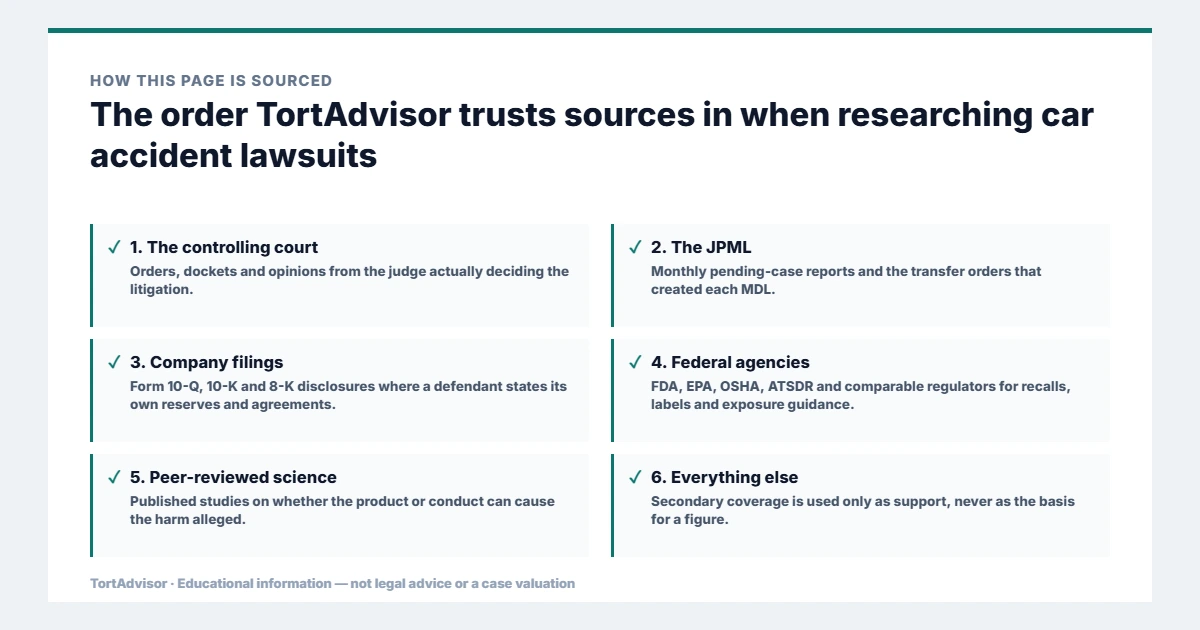
National traffic statistics provide safety context only. They do not establish negligence, legal eligibility, a filing deadline, or the value of an individual claim. State-law questions require the authority that governs the actual collision and defendant.
- NHTSA — 2025 Traffic Death Estimates & 2024 Annual Data. Official April 1, 2026 release reporting an estimated 36,640 U.S. traffic fatalities in 2025 and 39,254 deaths in 2024 from the Annual Report File, which NHTSA finalizes in a later release.
- NHTSA — Q1 2026 Early Traffic Fatality Estimates. Official July 2, 2026 release reporting an estimated 7,770 traffic deaths and a 0.99 fatality rate per 100 million vehicle miles traveled for the first quarter of 2026.
- NHTSA — Fatality Analysis Reporting System (FARS). Official methodology and data source for qualifying fatal motor-vehicle traffic crashes.
- NHTSA — Speeding Safety Data. Official 2024 speeding-related fatality and injury statistics and safety information.
- TortAdvisor Settlement & Legal-Rule Methodology. Explains how TortAdvisor labels editorial estimates and verifies state-law and settlement research.
- NHTSA — Overview of Motor Vehicle Traffic Crashes in 2024 (DOT HS 813 791). April 2026 research note: 39,254 deaths and an estimated 2.42 million people injured in 2024, 6.18 million police-reported crashes, and a final 2023 count of 41,025 deaths.
- Insurance Information Institute — Background on No-Fault Auto Insurance. Industry research listing the 12 no-fault states and Puerto Rico; each state was checked against its own statute or insurance regulator.
- Florida Statutes § 627.736. PIP benefit amounts, the 14-day initial-treatment rule and the emergency-medical-condition limit.
- New York DFS Regulation 68 (11 NYCRR Part 65). No-fault benefits of up to $50,000 of basic economic loss and the 30-day notice requirement.
- New York S.9008-C / A.10008-C, Part EE (Laws of 2026, chapter 58). Signed May 26, 2026: fault bar for no-fault motor-vehicle injury suits, serious-injury definition and the $100,000 non-economic cap.
- Louisiana Act 15 of 2025. 51% comparative-fault bar effective January 1, 2026; related Acts 16, 18, 176 and 466 of the 2025 Regular Session are linked where cited above.
- Georgia Senate Bill 68 (Act 9 of 2025). Effective April 21, 2025: seat-belt evidence, medical special damages, non-economic damages arguments and bifurcated trials.
- Maryland Department of Legislative Services — Fiscal and Policy Note, HB 712 (2026). Confirms Maryland, three other states and the District of Columbia retain contributory negligence.
- Laws of Florida, Chapter 2023-15 (HB 837). Two-year negligence deadline for claims accruing after March 24, 2023, and the greater-than-50% fault bar.
- California SB 1107 (Chapter 717, Statutes of 2022). Minimum liability limits of 30/60/15 from January 1, 2025, and 50/100/25 from January 1, 2035.
- North Carolina Session Law 2023-133. 50/100/50 minimum limits and the end of the UIM liability setoff for policies issued or renewed on or after July 1, 2025.
- Insurance Information Institute — Facts + Statistics: Uninsured Motorists. Reports the Insurance Research Council estimate that 15.4% of motorists were uninsured in 2023.
- ABA Model Rules of Professional Conduct, Rule 1.5 (Fees). Written-agreement requirements for contingent fees.
- Federal Rules of Civil Procedure (U.S. Courts). Current rules effective December 1, 2025; Rules 26–37 govern discovery in federal court.
- CDC — Symptoms of Mild TBI and Concussion. Notes that some symptoms may not appear for hours or days after the injury (last reviewed September 15, 2025).
What Happens After You Submit a Car Accident Case Review?
This is an intake process—not an attorney-client engagement. The goal is to make the next step clear before you share information.
The submission can be reviewed for the crash type, injury, timing, location, treatment, representation status, and other screening information.
If appropriate, information may be provided to an independent licensed attorney, law firm, or service provider. A match or response is not guaranteed.
No attorney-client relationship exists merely because you used this website, called, or submitted information. Representation begins only if a licensed attorney or law firm separately agrees in writing.
Request a Confidential Car Accident Case Review
If you want an intake review, use the claim-specific form above or call TortAdvisor. There is no fee to submit information, no guarantee of representation, and no guarantee of compensation or outcome.
