Sexual Abuse Lawsuit 2026: Survivor Rights, Claims & Deadlines
Sexual abuse lawsuit claims are civil actions that may seek compensation and accountability from an alleged perpetrator, institution, employer, organization, platform or another potentially responsible party. Start with the setting, age and jurisdiction involved, then continue to the matching claim guide, deadline research, evidence resource or settlement tool.
A civil claim can depend on the survivor's age, where and when the alleged abuse occurred, potential defendants, filing rules, available evidence and privacy protections. There is no single nationwide filing deadline or standard payout.
U.S. DOJ Office on Violence Against Women • Federal Rules of Civil Procedure • EEOC filing deadlines
This pillar sits under Personal Injury Lawsuits. Childhood sexual abuse claims are covered on this page in Childhood Sexual Abuse Claims. Claim-specific intent continues on dedicated pages for Clergy Abuse, Rideshare Sexual Assault, Roblox Sexual Abuse and other survivor claim types.
Key Facts About Sexual Abuse Civil Claims
Every sexual abuse lawsuit is fact-specific. The age of the survivor, location of the alleged conduct, identity of the responsible parties, institutional involvement, available evidence and filing deadlines may all affect the claim.
Current Survivor-Claim Developments
Recent public developments show why sexual abuse civil claims should be evaluated by jurisdiction and claim type. The items below describe procedural or public-program status and should not be treated as proof of liability, individual eligibility or an average settlement value.
Primary-source status: Los Angeles County FY 2026–27 Final Changes • Los Angeles County DA — June 11, 2026 • U.S. Supreme Court Docket 25-490 • N.D. California MDL Cases • JPML — October 2026 Pending MDLs
Types of Sexual Abuse Lawsuits in 2026
A sexual abuse lawsuit may involve an individual perpetrator, institution, school, religious organization, workplace, rideshare company, online platform or another party depending on the allegations and applicable law. Select a guide below for claim-specific information.
Child-on-Child Sexual Abuse (COCSA)
Abuse between children, which clinicians call problematic sexual behavior, and claims against the schools, camps and facilities responsible for supervision. Read COCSA guide →Clergy Sexual Abuse Lawsuit
Claims involving clergy members, religious organizations, alleged institutional negligence, supervision and concealment issues. Read Clergy Abuse guide →Boy Scouts Sexual Abuse Lawsuit
Latest Boy Scouts sexual abuse lawsuit updates, Scouting Settlement Trust payments, claim status, deadlines and survivor legal options. Read Boy Scouts lawsuit guide →Teacher Sexual Abuse Lawsuit
Claims involving teachers, coaches, administrators, school supervision and potential institutional responsibility. Read Teacher Abuse guide →University Sexual Assault Lawsuit
Claims involving campus sexual assault, institutional conduct and university-related legal options. Read University Assault guide →Athlete Sexual Abuse Lawsuit
Claims involving coaches, trainers, athletic organizations and alleged failures to protect athletes. Read Athlete Abuse guide →Rideshare Sexual Assault Lawsuit
Uber and Lyft sexual assault claims involving allegations concerning drivers, screening, safety practices and company responsibility. Read Rideshare Assault guide → Use the Rideshare Sexual Assault Settlement Calculator → Read the August 2026 Uber & Lyft litigation update →Review rideshare settlement research →Snapchat Sexual Abuse Lawsuit
Claims alleging child grooming, sextortion or exploitation facilitated through Snapchat and related platform-safety allegations. Read Snapchat guide → Use the Snapchat Settlement Calculator →Roblox Sexual Abuse Lawsuit
Claims involving alleged child exploitation, grooming or unsafe interactions connected to the Roblox platform. Read Roblox Abuse guide → Use the Roblox Sexual Abuse Settlement Calculator → Read the latest Roblox lawsuit update →Detention Center Sexual Abuse Lawsuit
Claims involving alleged abuse in detention, correctional or custodial settings and potential institutional responsibility. Read Detention Center guide →Workplace Sexual Harassment Lawsuit
Workplace harassment or assault may involve employment-law claims under federal or state law and other potential claims depending on the facts. Read Workplace Harassment guide →Church & Religious Organization Abuse
Claims involving religious institutions, employees, volunteers, supervision practices and alleged institutional responsibility. Read Religious Organization guide →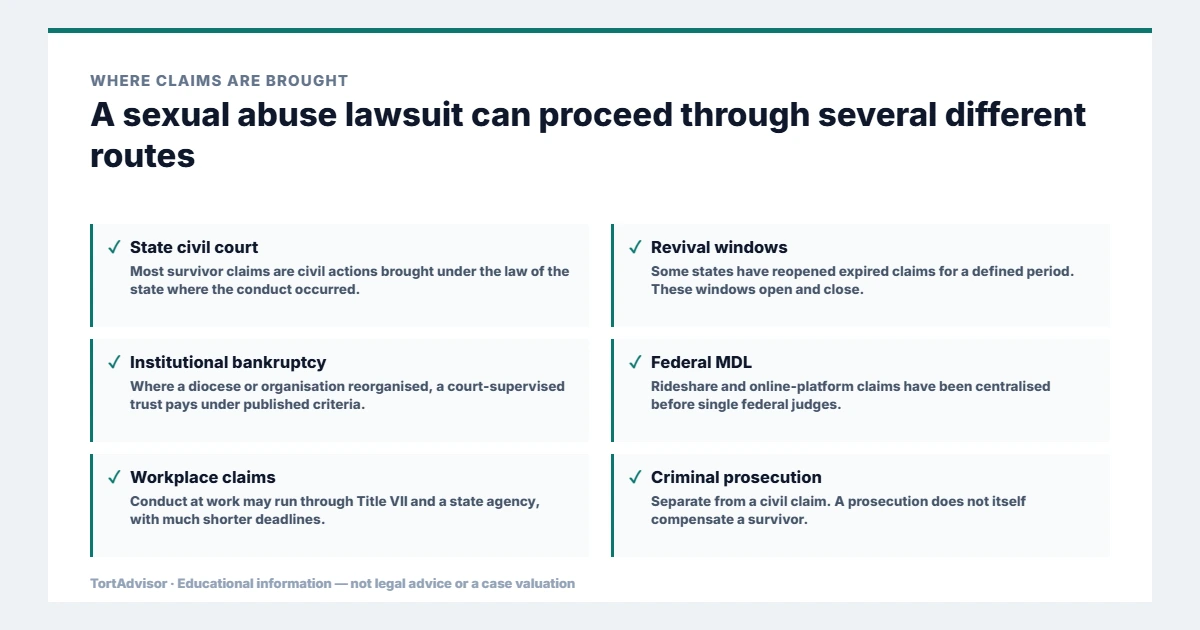
Childhood Sexual Abuse Claims: Who Can Be Sued, Revival Laws and Deadlines
A child sexual abuse lawsuit is a civil claim for sexual abuse or exploitation that happened before the survivor turned 18. Many survivors first look into a claim as adults, sometimes decades later, and the law in a growing number of states reflects that: higher age limits, discovery rules and revival windows can keep a claim open or reopen one that had expired. A criminal conviction is not required for a civil claim to be reviewed, and the age of the abuse alone does not decide whether it is too late.
Who May Be Liable for Childhood Sexual Abuse
Many childhood abuse lawsuits turn on what an institution knew and did, not only on what the person accused did. Our institutional sexual abuse lawsuit guide covers that duty in detail. Depending on state law and the evidence, potential defendants can include:
- The individual who committed the abuse, or that person's estate
- Churches, dioceses and religious orders (see the clergy sexual abuse lawsuit guide)
- Schools, school districts and their staff (see the teacher sexual abuse lawsuit guide)
- Youth and sports organizations, including the Boy Scouts of America, where abuse claims now run through the Scouting Settlement Trust created in its bankruptcy
- Foster care agencies, group homes, camps, medical settings and juvenile detention facilities
- Online platforms where grooming or exploitation began, such as Roblox and Snapchat
Revival Laws and Court Rulings, 2025 to 2026
Legislatures keep changing these rules, and courts do not always uphold them. Each change below was checked against the court opinion, session law or official release linked under it.
Maryland's Supreme Court upheld the Child Victims Act of 2023, which removed the time limit even for older claims, on February 3, 2025. For previously time-barred claims filed on or after June 1, 2025, HB 1378 (Chapter 104 of 2025) lowered the caps to $400,000 per claimant against public entities and $700,000 in noneconomic damages against private defendants, and limited lawyer fees to 20% of a settlement or 25% of a judgment.
Maryland Supreme Court opinion → HB 1378 fiscal note →On January 28, 2025, Maine's highest court held in Dupuis v. Roman Catholic Bishop of Portland that the state's 2021 revival law could not bring back claims whose deadline had already passed before it took effect.
Maine Supreme Judicial Court opinion →Oregon removed the civil deadline for child sexual abuse claims, and for adult sexual assault claims, that arise on or after June 26, 2025 (HB 3582). Claims based on earlier conduct remain subject to the prior rules.
Oregon Laws 2025, chapter 447 →A two-year revival window opened on July 1, 2026, and revived claims must be filed by June 30, 2028. The Governor's office describes it as covering claims against institutions and supervisors accused of enabling or covering up abuse.
Rhode Island Governor's release → Bill text, H 7200A →The Child Victims Act revival window ran from August 14, 2019 to August 14, 2021, and the Adult Survivors Act window from November 24, 2022 to November 24, 2023. Bills to remove the civil deadline for child sexual assault, including S9781, were still in Senate committee when this page was reviewed on October 1, 2026.
CPLR 214-g → CPLR 214-j → Senate bill S9781 →Michigan's Justice for Survivors package, which includes a one-year revival window, passed the state Senate in May 2025 but had not passed the House as of July 29, 2026. On September 30, 2026, the Massachusetts Attorney General recommended ending the civil deadline and creating an indefinite lookback period. Neither change is in effect.
Michigan Senate release → Massachusetts AG release →Child-on-Child Sexual Abuse
Abuse does not have to involve an adult. The National Child Traumatic Stress Network defines child sexual abuse as an interaction between a child and an adult or another child, and the federally funded National Center on the Sexual Behavior of Youth calls this kind of conduct problematic sexual behavior. Civil claims in these cases often focus on the school, camp, facility or other organization that was responsible for supervising the children. Our guide to child-on-child sexual abuse (COCSA) explains how these claims differ.
SourcesNCTSNSexual AbuseNCSBYProfessionals
How Sexual Abuse Civil Claims Work
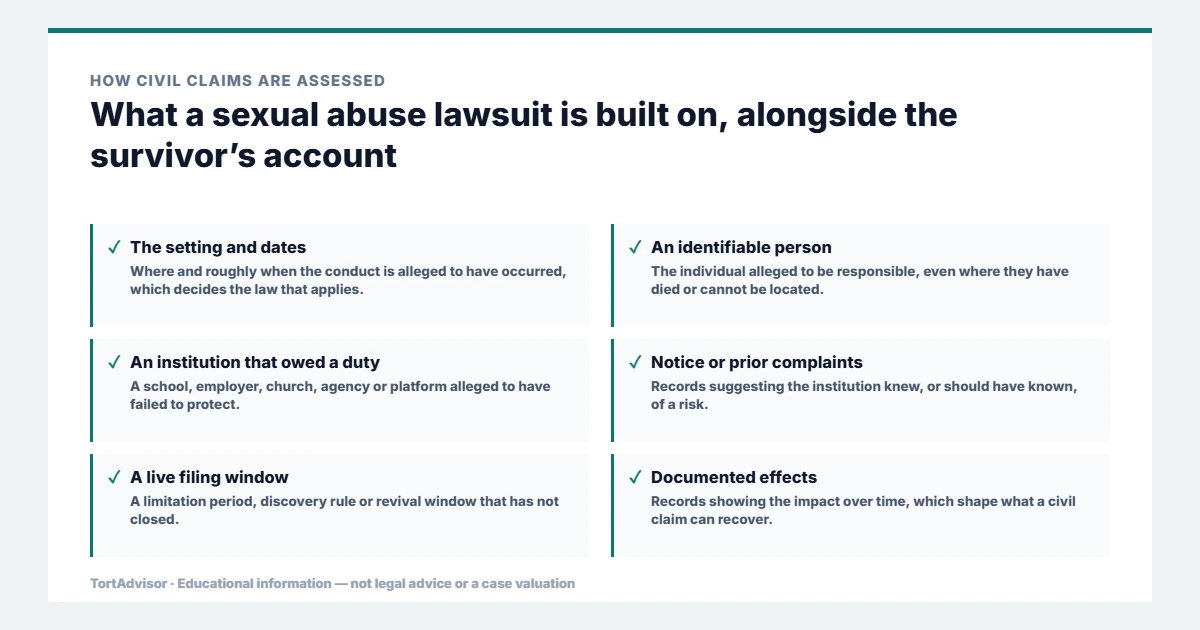
An attorney reviewing a sexual abuse lawsuit will generally examine what allegedly occurred, when and where it occurred, who may be legally responsible, whether an institution was involved, what evidence remains available and which filing deadlines apply.
Evidence That May Support a Civil Abuse Claim
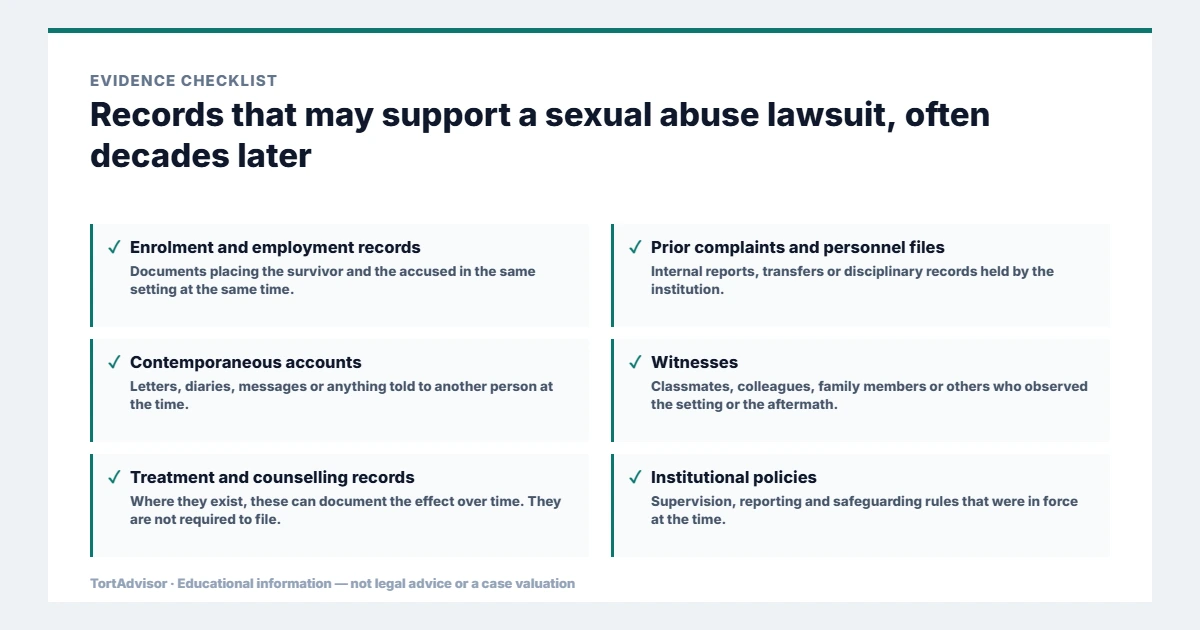
There is no single document required in every sexual abuse lawsuit. Evidence may come from the survivor, witnesses, medical providers, digital records, institutions or other sources.
Incident & Communication Evidence
- Text messages or emails
- Social media or platform communications
- Photographs or videos
- Police or incident reports
- School, church or employer complaints
- Witness names and contact information
- Personal timelines or contemporaneous notes
Medical & Damages Evidence
- Medical treatment records
- Therapy or counseling records where relevant
- Medication history
- Employment and wage-loss records
- Education-related records where relevant
- Documentation of out-of-pocket costs
- Evidence of ongoing effects or treatment
Compensation in Sexual Abuse Civil Claims
There is no standard settlement value for a sexual abuse lawsuit. Potential compensation depends on the facts, severity and duration of harm, available defendants, evidence, insurance or other financial resources, jurisdiction and applicable law.
Economic Damages
- Past medical expenses
- Future treatment expenses
- Therapy and mental-health treatment costs
- Lost wages
- Reduced earning capacity
- Other documented financial losses
Other Potential Damages
- Emotional distress
- Pain and suffering
- Loss of enjoyment of life
- Psychological injuries
- Wrongful-death damages where applicable
- Punitive damages where legally available
For additional information about potential compensation, visit TortAdvisor's Sexual Abuse Compensation guide and Lawsuit Settlement Amounts hub .
What Institutional Abuse Programmes Have Actually Distributed
The single most useful number in institutional abuse litigation is not a settlement total. It is the payment percentage — the fraction of an allowed claim that a bankruptcy trust actually distributes — and the Boy Scouts of America case shows why. The Scouting Settlement Trust was funded with roughly $2.48 billion in noncontingent assets against abuse claims the Third Circuit recorded as estimated at $2.4 billion to $3.6 billion, from 82,209 unique timely claims. Those are the headline figures. The figure that decides what a survivor receives is that the Trust is currently paying 4.7 percent of an allowed claim.
The arithmetic is stark and it is public. A Tier 3 claim under the Trust’s own Calculation Explanation Booklet carries a base value of $300,000 and a maximum of $1,350,000 after multipliers for the nature of the abuse, the abuser’s profile and the impact on the survivor. An allowed claim of $2.7 million therefore produces about $126,900 at 4.7 percent, and about $81,000 in hand once the Trust’s 1.7 percent healthcare lien holdback is reserved. Matrix values are allowed-claim values, not payments, and treating them as payments is the error almost every competing page makes.
What the Trust has actually distributed is reported monthly. As of September 1, 2026 it had issued 52,513 claim disbursements totalling $1,282,024,931: 5,660 expedited payments totalling $19,738,458, 46,696 matrix payments totalling $1,256,594,669, and 157 independent review payments totalling $5,691,804. Dividing the matrix total by the matrix claim count gives roughly $26,910 per paid matrix claim — our own arithmetic on the Trust’s reported totals, gross of contingency fees and before lien resolution, and not a final recovery for anyone. It is, however, a real number derived from a filed document, which is more than any published “average abuse settlement” can say.
Diocesan and institutional settlements follow the same pattern: the totals are public and the per-claimant allocation almost never is. The Los Angeles Archdiocese settled for $880 million across 1,353 claims in October 2024; Rockville Centre for $323 million across more than 600; New Orleans for $230 million across roughly 600 under a point system; Rochester for $246.35 million across more than 500. Los Angeles County committed $4 billion across more than 11,000 claims in April 2025, with payments running through fiscal year 2050–51, and its own budget documents now identify roughly $4.8 billion in AB 218 agreements. Our settlement amounts library records each of those with its source, and the sexual abuse settlement calculator organises the evidence a claim turns on.
Filing Deadlines for Sexual Abuse Civil Claims in 2026
The deadline for filing a sexual abuse lawsuit varies substantially by state, the survivor's age when the alleged abuse occurred, the incident date, the type of defendant and other facts. The examples below were rechecked against official state sources on September 11, 2026. They are examples only, not a national limitations chart. Revival laws and court rulings from 2025 and 2026 are summarized in Childhood Sexual Abuse Claims.
Privacy in Sexual Abuse Civil Litigation
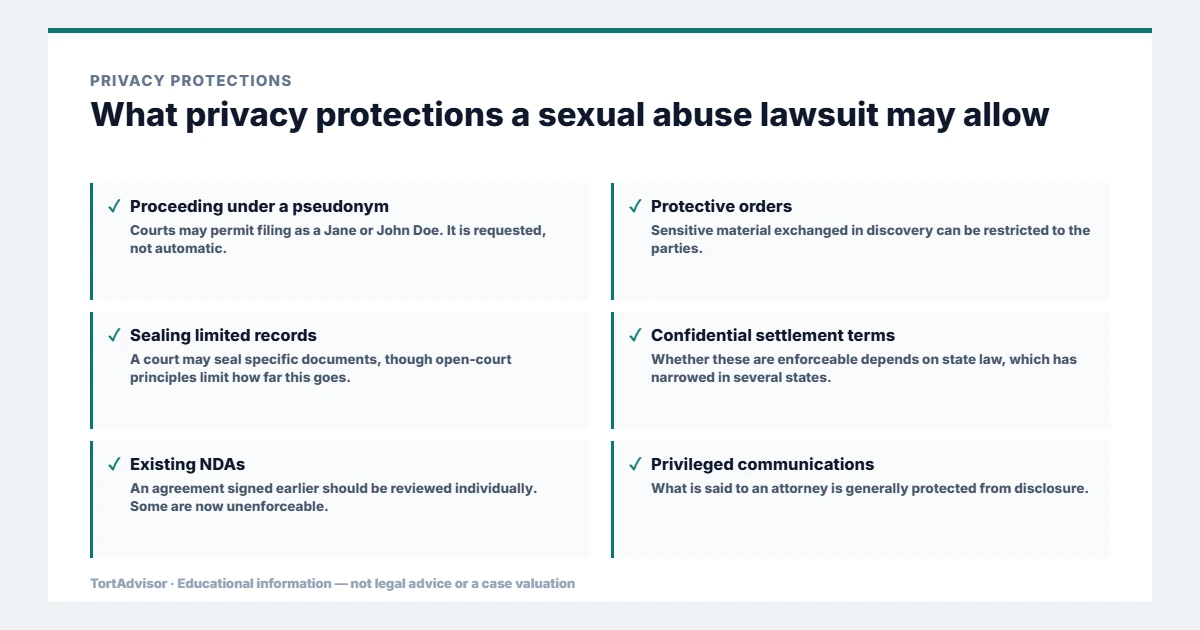
Privacy concerns are common when considering a sexual abuse lawsuit. Available protections depend on the court, jurisdiction, procedural rules and circumstances of the case.
Potential Court Protections
- Requests to proceed under a pseudonym
- Protective orders for sensitive discovery
- Requests to seal limited sensitive materials
- Limits on unnecessary disclosure of private information
Attorney & Settlement Issues
- Attorney-client communications are generally privileged
- Settlement confidentiality depends on applicable law
- Existing NDAs should be reviewed individually
- State law may restrict certain confidentiality terms
Workplace Sexual Harassment & Assault Claims
Workplace misconduct can involve a different legal framework from other sexual abuse lawsuits. The EEOC states that federal Title VII sexual-harassment protections generally apply to employers with 15 or more employees, while state and local laws may provide additional rights. EEOC source Employment claims can also have administrative deadlines that are much shorter than some childhood-abuse filing periods. The EEOC generally requires a charge within 180 calendar days for covered private-sector claims, with the deadline extended to 300 days where a state or local agency enforces a law prohibiting the same type of discrimination. Federal employees generally have 45 days to contact an agency EEO Counselor. EEOC deadlinesOfficial Sources for Survivor-Claim Research
TortAdvisor prioritizes courts, legislatures and government agencies when reviewing statutes of limitation, workplace rights, survivor protections and changes affecting a sexual abuse lawsuit. For this September 11, 2026 review, the state-law examples, current federal litigation references and federal workplace guidance were rechecked against the primary sources linked on this page.
Source review date: October 1, 2026 for the childhood-abuse, revival-law, Roblox and federal-resource updates; September 15, 2026 for the rest of the page. State statutes, revival windows, court procedures, workplace filing deadlines and public settlement administration can change after publication. Use the linked primary sources for the newest rule or docket status.
Start a Free, Private Case Review Focused on Sexual Abuse & Survivor Claims
You deserve a review process that feels respectful, calm and in your control. This intake is designed specifically for sexual abuse civil claims and survivor-rights questions, so you can begin with only the basic information you feel comfortable sharing.
Your story. Your pace. Your choice. You do not need to provide graphic details, remember every date exactly or have every record ready before starting.
You can stop at any time. If a question feels uncomfortable, answer only what you know and what you are willing to share. Approximate dates are acceptable when exact dates are unclear.
Begin With Only What You Feel Comfortable Sharing
This short intake is designed to identify the claim type, timing, setting and available evidence without asking you to tell the entire story at once. Brief answers are enough to begin.
- Use approximate dates if exact dates are uncertain.
- Do not include graphic descriptions unless you choose to and they are necessary.
- Share only the information requested and relevant to the potential claim.
Your information can be reviewed to determine whether it may match a claim type or whether additional information may be needed. Submitting this form does not create an attorney-client relationship and does not guarantee representation, eligibility, compensation or any outcome.
RAINN’s National Sexual Assault Hotline offers free, confidential, 24/7 support from trained specialists.
Sexual Abuse Civil Claim FAQ
Do I need a criminal conviction to file a sexual abuse lawsuit?
SourceU.S. CourtsCivil Cases
Who can be sued in a sexual abuse lawsuit?
SourceCal. CCPSec. 340.1
Can I file a sexual abuse lawsuit years after the abuse occurred?
SourceCal. CCPSec. 340.16
What is a revival window for sexual abuse claims?
Can I keep my name private in a sexual abuse lawsuit?
What if I previously signed a settlement or NDA?
How long does a sexual abuse lawsuit take?
Can a claim be filed if the alleged abuser has died?
SourceCal. CCPSec. 377.40