
California detention center sexual abuse lawsuit claims can involve state prisons, county jails, juvenile facilities and private detention operators, with different rights, evidence requirements and filing rules depending on the facility and defendant.
California Detention Center Sexual Abuse Lawsuit 2026: Survivor Rights, Claims & Filing Deadlines
A California detention center sexual abuse lawsuit may involve sexual assault, staff sexual misconduct, coercion, exploitation, retaliation or a facility’s alleged failure to protect a person held in a California state prison, county jail, juvenile facility or detention setting.
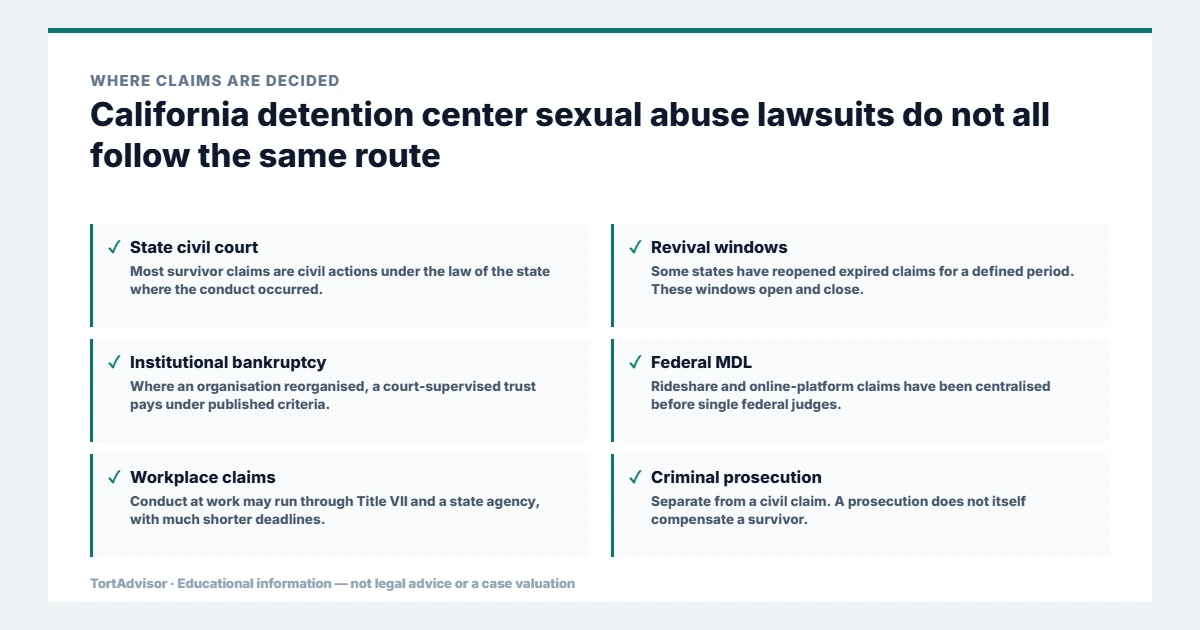
These cases are not one single California class action or MDL. Potential claims are highly fact-specific and may involve constitutional civil-rights theories, California tort law, claims against individual staff members, public-entity rules, private detention operators, administrative exhaustion requirements and strict filing deadlines.
You can begin with basic information without describing every detail of the abuse.
The first review can start with the facility, approximate dates and type of misconduct alleged.
The intake is designed to remain clear, respectful and manageable for survivors and families.
Submitting the form does not require you to hire an attorney or proceed with a lawsuit.
A Private First Step — On Your Terms
Detention-related sexual abuse can involve fear of retaliation, institutional power imbalances and difficult memories. You do not need to explain everything at once.
- Start with the facility name, approximate timeframe and whether the alleged abuser was staff or another detained person.
- You do not need a criminal conviction or completed PREA investigation just to request an initial civil-claim review.
- You can identify whether grievances, PREA reports, medical records, witnesses, housing records or other evidence may exist.
- Submitting the form does not create an attorney-client relationship or require you to continue.
Check Whether the Claim May Qualify
If you are comfortable doing so, provide a few basic details about the California facility, approximate dates, whether the alleged misconduct involved staff or another detained person, whether it was reported and the harm that followed.
If describing what happened feels difficult, start with the facility, approximate date and basic claim type. A more detailed conversation can happen later if you choose to continue.
Submitting this form does not create an attorney-client relationship and does not guarantee that an attorney will accept or file a claim.
Who May Have a California Detention Center Sexual Abuse Lawsuit?
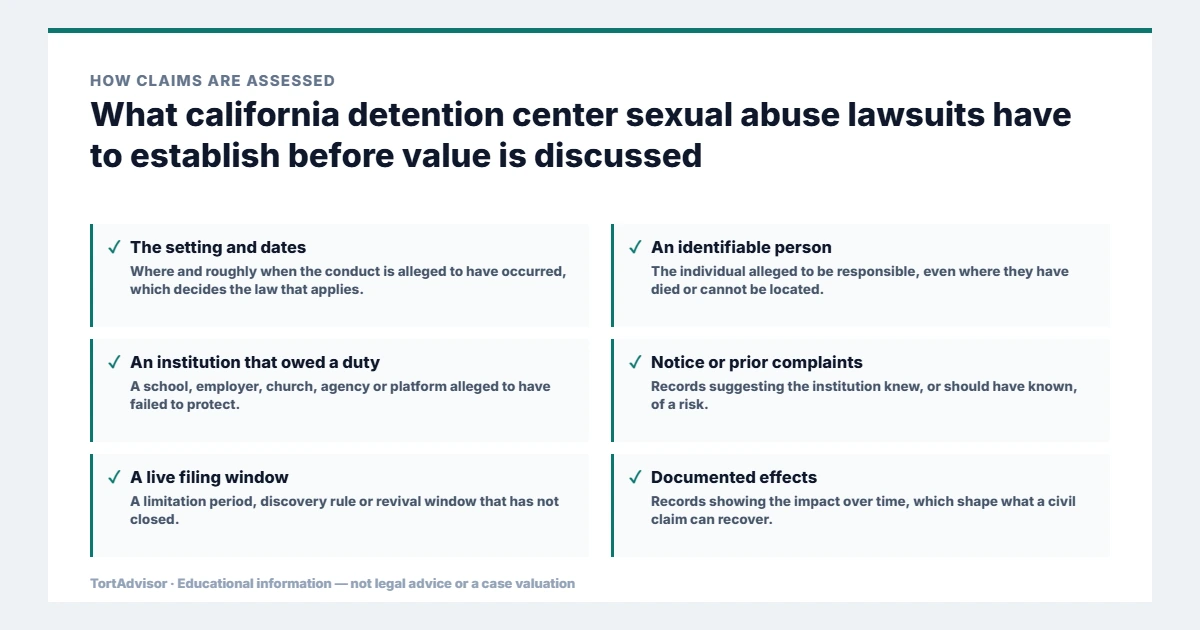
A California detention center sexual abuse lawsuit requires individualized review. Relevant factors include where the abuse occurred, who allegedly committed it, what the facility knew, whether reports existed, whether retaliation followed, the survivor’s age, resulting harm and applicable deadlines.
The allegations may involve sexual assault, coercion, sexual contact, voyeurism, exploitation, harassment or other staff sexual misconduct.
The conduct occurred in a state prison, county jail, juvenile hall, probation camp, correctional facility or other California detention setting.
Evidence may show ignored complaints, unsafe housing, inadequate supervision, retaliation, failure to investigate or other institutional failures.
Public-entity claim presentation, statutes of limitation, childhood-abuse rules and federal exhaustion requirements can all affect timing.
California Detention Center Sexual Abuse Lawsuit Status in 2026
There is no single statewide settlement program or consolidated MDL for every California detention center sexual abuse lawsuit. Claims generally proceed according to the facility, defendant, legal theory and survivor’s individual facts.
What Is Confirmed for 2026
DOJ’s PREA standards remain the national framework for preventing, detecting and responding to sexual abuse in prisons, jails and juvenile facilities.
CDCR continues to publish PREA annual reports and facility audit reports, including 2025 audit reports for multiple California prisons.
California Penal Code section 289.6 criminalizes sexual activity between specified detention staff and confined persons, including conduct involving private entities that provide detention facilities or staff.
CDCR’s own staff-misconduct definition states that the legal concept of consent does not exist between departmental staff and incarcerated people for this purpose.
Types of California Detention Center Sexual Abuse Lawsuit Claims
The legal analysis in a California detention center sexual abuse lawsuit changes with the facility type, alleged perpetrator and conduct the institution allegedly knew about or failed to stop.
CDCR Staff Sexual Misconduct
Claims may involve correctional officers, medical personnel, contractors or other staff allegedly engaging in sexual activity, coercion, voyeurism, harassment or retaliation.
California County Jail Sexual Abuse
Pretrial detainees and other people held in county jails may have claims involving staff misconduct, failure to protect, unsafe housing, ignored complaints or retaliation.
Juvenile Hall & Probation Camp Abuse
Youth in juvenile halls, camps and related facilities may have claims against individual perpetrators and responsible entities, with special childhood-sexual-assault filing rules potentially applying.
Immigration Detention Sexual Abuse
Claims involving federal immigration detention or privately operated facilities require careful review of the operator, contracting agency, applicable federal law and available state-law remedies.
Detainee-on-Detainee Sexual Abuse
A facility may face scrutiny when officials allegedly knew of a substantial risk, received warnings or failed to take reasonable protective steps before abuse by another detained person.
Retaliation, Cover-Up & Ignored Reports
Threats, discipline, housing changes, intimidation, suppressed complaints or interference with reporting can become important evidence and may support additional legal theories.
Legal Rights in a California Detention Center Sexual Abuse Lawsuit
The legal basis of a California detention center sexual abuse lawsuit depends on custody status and the defendant. Convicted prisoners, pretrial detainees, juveniles and immigration detainees do not always proceed under the same constitutional framework.
Eighth Amendment
Convicted prisoners may assert constitutional claims involving sexual abuse, excessive force or deliberate indifference to a substantial risk of serious harm.
Fourteenth Amendment
Pretrial detainees are protected by due-process principles and cannot be subjected to punishment before conviction. The governing standard can depend on the type of claim.
PREA Standards
PREA requires covered facilities to maintain prevention, reporting, investigation, medical-response and anti-retaliation systems. PREA does not generally create a standalone damages claim.
California Penal Code § 289.6
California criminal law prohibits specified detention staff from engaging in sexual activity with confined persons even where the adult confined person is described as consenting.
California Tort Claims
Depending on immunity and the facts, claims may involve assault, battery, negligence, negligent supervision or other California causes of action.
Private Operators
Claims involving private detention companies can follow different immunity, state-action, contract and tort rules than claims against California public entities.
What Evidence Can Support a California Detention Sexual Abuse Claim?
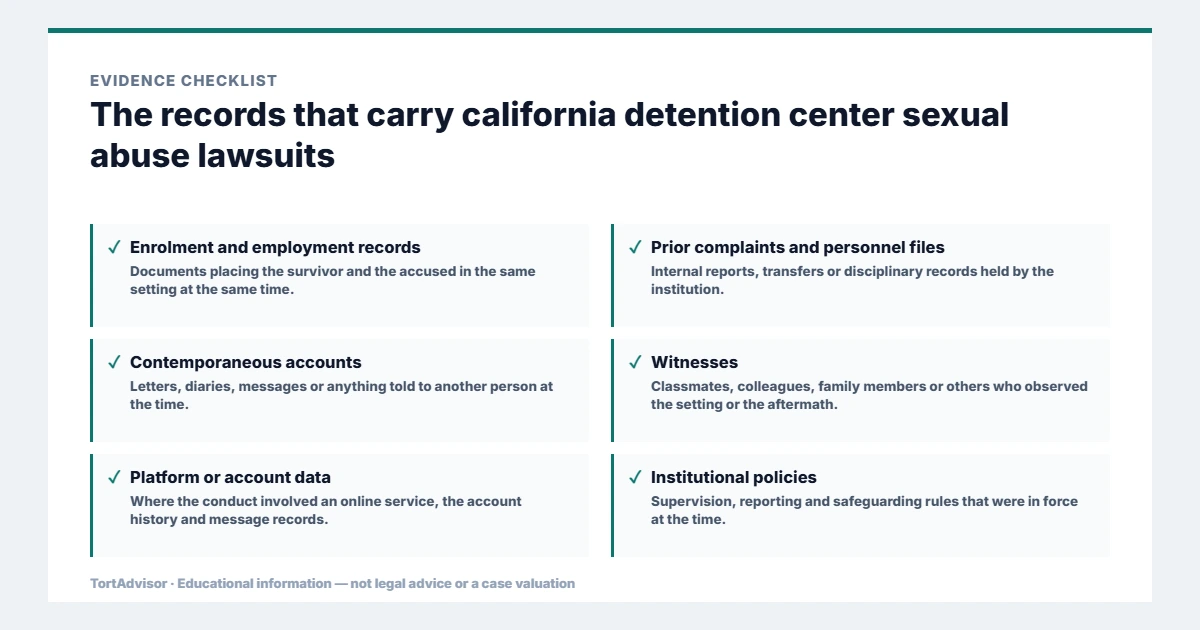
A survivor does not need every document before requesting review of a California detention center sexual abuse lawsuit. Attorneys can often seek records through preservation letters, public-record procedures, subpoenas and discovery.
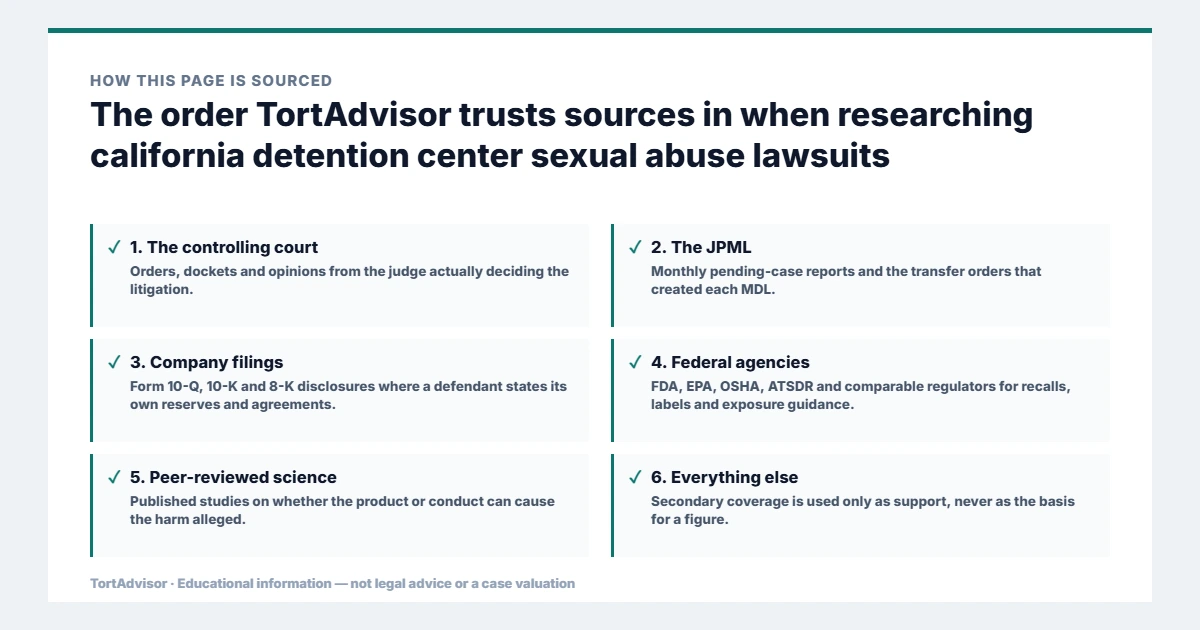
Every status, deadline and figure published on this page about california detention center sexual abuse lawsuits is traced to a primary source before it appears.
Evidence You May Already Know About
- PREA reports, grievances, appeals or written complaints
- Medical examinations, treatment records and mental-health records
- Names of staff members, witnesses or other detained people
- Dates, housing units, work assignments and movement records
- Letters, messages, calls or communications discussing the abuse
- Photographs of injuries when safely and lawfully available
Evidence an Attorney May Investigate
- Video surveillance and preservation logs
- Staff schedules, assignments and access records
- Prior complaints involving the same employee or unit
- Internal-affairs, PREA and administrative investigation records
- Training, staffing and policy records
- Documents showing what supervisors knew and when they knew it
California Detention Sexual Abuse Filing Deadlines Can Be Short — But the Rules Have Important Exceptions
The six-month public-entity rule is not a universal deadline for every California detention center sexual abuse lawsuit. California has overlapping statutes that can change the analysis based on age, abuse date and whether the defendant is public or private.
Claims Against California Public Entities
- Government Code § 911.2: claims for injury to a person against a public entity generally must be presented within six months after accrual.
- Government Code § 911.4: a late-claim application may be available in some circumstances and generally must be presented within a reasonable time not exceeding one year after accrual.
- Childhood sexual assault: special statutes can displace ordinary claim-presentation rules for claims they cover; the applicable law depends in part on when the childhood abuse occurred.
- Do not assume a six-month deadline automatically bars a detention-related childhood sexual-abuse claim.
Sexual Assault Statutes & 2026 Revival Rules
- Adult sexual assault — CCP § 340.16: generally the later of 10 years from the last act or three years from discovery of the resulting injury or illness.
- 2026–2027 revival window: current § 340.16 revives certain otherwise time-barred adult sexual-assault claims during 2026 and 2027.
- Public-entity exclusion: the new revival provision expressly excludes claims against public entities.
- Private detention defendants: the revival provision may be relevant to some non-public entity claims, but eligibility depends on the statute and individual facts.
Current Prisoners: Federal Exhaustion May Also Matter
Under 42 U.S.C. § 1997e(a), a prisoner confined in a jail, prison or correctional facility generally must exhaust administrative remedies that are available before bringing a federal action about prison conditions.
Grievance and PREA reporting procedures can therefore be important. Whether an administrative remedy was actually available can be a fact-specific legal question.
How a California Detention Center Sexual Abuse Lawsuit Is Reviewed
A careful California detention center sexual abuse lawsuit review separates immediate safety concerns from civil filing requirements and identifies the correct defendants before deadlines are calculated.
Identify the Facility & Custody Type
Determine whether the setting was CDCR, a county jail, juvenile facility, federal immigration detention or a privately operated detention facility.
Preserve Reports & Evidence
Identify PREA reports, grievances, medical records, witnesses, housing information and other records that may need preservation.
Check Exhaustion & Claim Presentation
Review whether federal administrative exhaustion, California government claim presentation or a statutory exception applies.
Evaluate Defendants & Causes of Action
Assess potential claims against individuals, public entities, municipalities, supervisors or private operators under the law that applies.
Compensation in a California Detention Center Sexual Abuse Lawsuit
There is no reliable standard settlement amount for a California detention center sexual abuse lawsuit. Potential damages depend on the defendant, legal theory, documented harm, evidence, immunity, insurance or indemnity issues and how the case resolves.
Potential Compensatory Damages
- Medical and mental-health treatment expenses
- Future therapy or treatment needs
- Emotional distress, trauma, PTSD, anxiety or depression
- Physical pain and injury
- Lost income or diminished earning capacity when supported
- Other proven economic and non-economic losses
Other Relief That May Be Available
- Punitive damages against certain individual or private defendants when legally permitted
- Attorney’s fees in qualifying federal civil-rights actions where authorized by law
- Injunctive or policy-related relief in appropriate cases
- Damages against responsible entities where liability and immunity rules permit
- Estate or wrongful-death related damages when legally applicable
- Other remedies based on California or federal law
Can a Detention Sexual Abuse Claim Be Handled Privately?
A survivor considering a California detention center sexual abuse lawsuit may be concerned about retaliation or disclosure of sensitive information. Privacy protections depend on the court, facility and procedural stage, but protective measures may be available.
Possible Privacy Measures
- Confidential attorney communications after representation begins
- Requests for protective orders limiting disclosure of sensitive records
- Requests to proceed under initials or a pseudonym where court rules and circumstances permit
- Careful handling of therapy, medical and sexual-assault records
If Retaliation Is a Concern
- Document dates, names and the type of retaliatory conduct when safely possible
- Preserve grievance and PREA report numbers
- Tell counsel about housing changes, discipline, threats or loss of privileges after reporting
- Do not take steps that could increase immediate danger just to create evidence
What Current Government Data Shows About Sexual Victimization in Custody
Adult Prison Inmates Reporting Sexual Victimization, 2023–24
The U.S. Bureau of Justice Statistics reported an overall national rate of 4.1% among adult prison inmates in its 2023–24 National Inmate Survey. This is national data and should not be interpreted as a California-specific prevalence rate.
Adult Local-Jail Inmates Reporting Sexual Victimization, 2023–24
BJS reported a national overall rate of 4.0% among adult local-jail inmates in 2023–24, including reported victimization by other inmates and facility staff. Again, this is national rather than California-specific data.
Official Sources for California Detention Sexual Abuse Claims
California Detention Center Sexual Abuse Lawsuit FAQ
Can I file a California detention sexual abuse lawsuit while I am still incarcerated?
Potentially, yes. Current incarceration does not erase constitutional protections. A California detention center sexual abuse lawsuit involving federal prison-conditions claims may also require exhaustion of available administrative remedies before filing. Timing and grievance procedures should be reviewed individually.
Source42 U.S.C.Sec. 1997e(a)
Does PREA let me sue the facility directly?
PREA creates important national standards for prevention, reporting and response, but courts generally hold that PREA itself does not create a private damages cause of action.
A civil case may instead rely on constitutional rights, federal civil-rights law, California tort law or other legal theories.
Source5th Cir.Krieg v. Steele
What if the alleged abuser was a correctional officer or other staff member?
Staff misconduct can support potential claims against the individual and, depending on the facts and law, other responsible parties.
CDCR’s policy states that the legal concept of consent does not exist between departmental staff and incarcerated people for staff sexual misconduct. Penal Code § 289.6 also criminalizes specified detention-staff sexual activity with confined persons.
SourceCDCRPREA Definitions
What if the person who abused me was another detained person?
A claim may still be possible when evidence shows officials knew of a substantial risk of harm and failed to respond reasonably, or when unsafe housing, classification, supervision or ignored warnings contributed to the abuse.
The legal standard depends on custody status and the defendant.
Is the California government-claim deadline always six months?
No. Government Code § 911.2 creates a general six-month presentation rule for personal-injury claims against public entities, but special statutes and exceptions can change the analysis.
California’s childhood-sexual-assault statutes contain special rules, and late-claim procedures may be available in some circumstances. Do not assume a claim is barred without reviewing the exact facts and statute.
SourceCal. Gov. CodeSec. 911.2
What is California’s deadline for adult sexual assault claims?
Code of Civil Procedure § 340.16 generally provides the later of 10 years from the last act of sexual assault or three years from discovery of resulting injury or illness.
A 2026–2027 revival provision can apply to certain otherwise time-barred claims against non-public entities, but the revival provision expressly excludes public entities.
SourceCal. CCPSec. 340.16
Can a juvenile detention survivor still bring a claim as an adult?
Possibly. California has special statutes for childhood sexual assault, and the applicable rule depends on when the abuse occurred and who is being sued.
Adult survivors should not rely on the ordinary six-month public-entity rule without a claim-specific review.
SourceCal. CCPSec. 340.1
Does immigration status eliminate the right to challenge sexual abuse in detention?
No general rule makes sexual abuse lawful because a person is in immigration detention. The legal route can differ from a California state or county case because federal custody, private contractors, sovereign immunity and other federal-law issues may apply.
Source6 C.F.R.Part 115
How much is a California detention center sexual abuse lawsuit worth?
There is no reliable standard payout for a California detention center sexual abuse lawsuit. Potential value depends on documented harm, treatment, evidence, abuse severity, retaliation, economic losses, defendant type, immunity rules and how the claim resolves.
Does submitting Form 26140 hire a lawyer?
No. Submitting information about a California detention center sexual abuse lawsuit does not create an attorney-client relationship. Representation requires acceptance by a licensed attorney and a separate engagement agreement.
More Sexual Abuse & Institutional Claim Resources
Sexual Abuse Lawsuit Guide
Survivor-focused information about civil sexual-abuse claims, evidence, filing issues and institutional responsibility.
Institutional Sexual Abuse Lawsuit
Parent resource covering claims against institutions that allegedly enabled, ignored or failed to prevent sexual abuse.
Child Sexual Abuse Lawsuit
Resources for minors and adult survivors of childhood sexual abuse, including extended California filing rules.
Sexual Abuse Settlement Calculator
Educational tool for organizing evidence, treatment, institutional responsibility and claim-value factors.
Were You Sexually Abused in a California Prison, Jail or Detention Facility?
Use the private intake form to request review of a California detention center sexual abuse lawsuit. Start with the facility, approximate timeframe, whether staff or another detained person was involved, and any reporting or retaliation concerns.