
Unsecured Load Truck Accidents: Who Is Liable for Falling Cargo
In most cases, the truck driver and the trucking company are the first places to look, because federal rules say a driver and motor carrier may not operate a truck unless its cargo is properly secured. That said, unsecured load truck accident liability can also reach whoever loaded the cargo, such as a shipper, particularly when the shipper took on the loading and the defect was hidden. Under the rule from United States v. Savage Truck Line, the carrier still answers for problems that were obvious.
You are not alone if this happened to you. FMCSA crash data for 2020 show that cargo or equipment loss or shift was the first harmful event in 6 fatal crashes and an estimated 3,000 property-damage-only crashes involving large trucks. In those figures, a large truck means a vehicle over 10,000 pounds gross vehicle weight rating. FMCSA’s own guidance also states that the motor carrier and the driver are responsible for proper loading and securement, even when someone else physically loaded the truck.
This guide covers several questions in turn:
- What the federal rules require, including the rule that cargo must be secured so it does not leak, spill, blow or fall off the vehicle.
- When and how often drivers must inspect their loads.
- How breaking a safety rule can support a claim of negligence per se, while you still need to show that the violation caused your injuries.
- How responsibility can be split between a shipper and a trucking company.
- What happens when debris hits you but the truck never touches your car.
- What evidence shows how the load was secured, and which compensation questions to explore next.
Who can be liable when cargo falls off a truck
The short answer: the truck driver, the motor carrier (the trucking company) and the company that loaded or secured the cargo can each be responsible when a load comes loose. Who actually shares the blame depends on who did what, and on whether the problem with the load was something that could have been seen before the truck hit the road.
Securing cargo is not just good practice. It is a federal duty. Under 49 CFR 392.9, the federal cargo inspection rule, a driver may not operate a commercial truck, and a motor carrier may not require or permit a driver to operate one, unless the cargo is properly distributed and adequately secured as required by 49 CFR 393.100 to 393.136. That puts legal obligations on both the person behind the wheel and the company that sends the truck out.
The Federal Motor Carrier Safety Administration has made the same point in its official guidance on section 392.9, stating that it is the responsibility of the motor carrier and the driver to make sure cargo is properly loaded and secured. A shipper or loading company may also be part of the picture. Later sections explain how courts have divided that responsibility.
Falling or shifting cargo is its own type of truck crash, with its own rules and evidence. If your car went under the back or side of a trailer, that is a different kind of claim. Our guide to underride crashes and rear or side guard claims covers it in detail.
This article focuses on loose and unsecured loads. For the bigger picture, including the steps from filing to resolution, see our overview of how a truck accident lawsuit works.
Find out if you may have a claim
Answer a few questions and a trained case advisor will review your situation — most people finish in about a minute.
- Free — no cost, no obligation
- About a minute to complete
- Reviewed by a trained case advisor
- Nothing you submit is published
Your details are sent over a secure connection and reviewed confidentially.
What federal cargo securement rules require (49 CFR Part 393, Subpart I)
Federal rules require trucks on public roads to carry their cargo so it stays on the truck and stays put. These rules are in 49 CFR Part 393, Subpart I, “Protection Against Shifting and Falling Cargo”, which covers sections 393.100 through 393.136. If something fell off a truck and hurt you, these rules are the baseline for how that load should have been handled.
The two core requirements
- Nothing should come off the truck. A commercial truck on a public road must be loaded and equipped, and its cargo secured, so the cargo cannot leak, spill, blow or fall off.
- The load must not shift in a dangerous way. Cargo must be contained, immobilized or secured so it cannot move enough to harm the truck’s stability or handling.
The second rule matters even when nothing lands on the road. A load that slides inside a trailer or on a flatbed can make a heavy truck hard to control. If that kind of loss of control led to your crash, our guide on who is at fault in a jackknife crash explains how fault is sorted out.
Extra rules for certain kinds of cargo
Some loads carry added risk, so Subpart I also has commodity-specific rules on top of the general standards. Separate rules apply to:
- Logs and lumber
- Metal coils and paper rolls
- Concrete pipe
- Intermodal containers
- Heavy equipment
- Large boulders
Knowing what the truck was carrying tells you which set of rules applied. That can point to what the driver or carrier should have done differently. Cargo rules are only one part of the federal standards for commercial trucks. For a broader view of how those standards affect injury claims, see our overview of semi-truck liability and federal regulations.
The driver’s duty to inspect the load (49 CFR 392.9)
Federal rules require more than a quick glance at the load before leaving the yard. Under 49 CFR 392.9, neither the driver nor the trucking company may operate a truck unless the cargo is properly secured. The rule also sets specific points during the trip when the driver must check the load.
The inspection checkpoints
- Before driving: The tailgate, doors, tarps, spare tire and other equipment, plus whatever is used to fasten the cargo, must all be secured.
- Within the first 50 miles: The driver must inspect the cargo and its securement devices. The driver must also adjust or add tiedowns as needed so the cargo cannot shift or fall.
- During the trip: The driver must check again at the first of these: a change in duty status, 3 hours of driving, or 150 miles.
The narrow exception
These inspection requirements do not apply in two situations. The first is a sealed truck the driver has been ordered not to open. The second is a load arranged in a way that makes inspection impracticable.
FMCSA’s official interpretations of the rule keep this exception tight. A padlocked compartment does not count as sealed if the driver holds the key. The same guidance says drivers do not have to load the cargo themselves. They must still know how it is secured, and they may need to adjust it.
Why the timing matters
The re-check points are tied to duty status, hours driven and miles traveled, so the inspection schedule can be compared with the truck’s hours-of-service records and driver fatigue evidence. Lining these up may help show whether a required check was due before the cargo came loose.
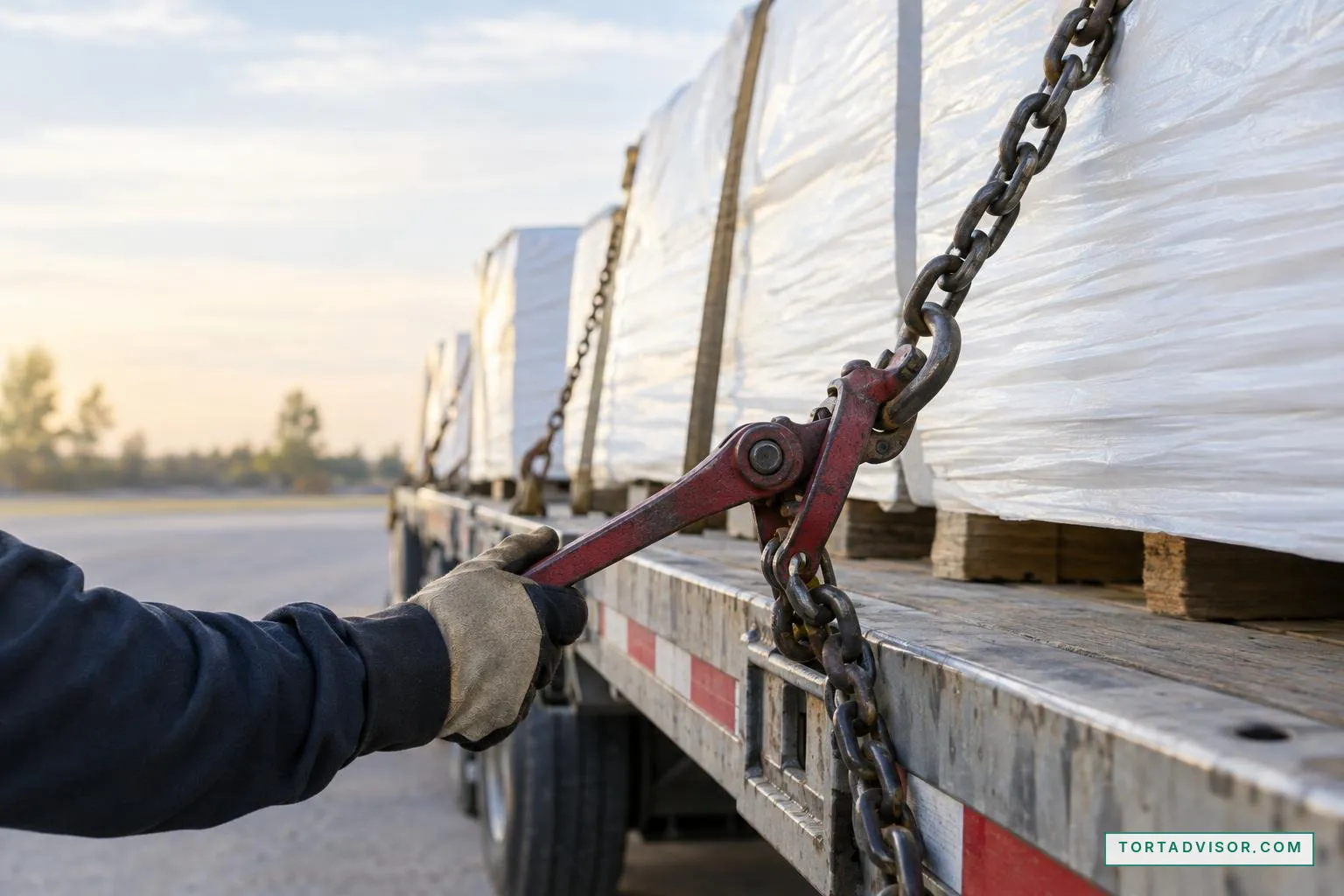
How a cargo securement violation can support negligence per se
If a trucking company or driver broke a federal cargo rule, that violation can help you show they were at fault. It does not, by itself, win the case.
Under the negligence per se doctrine as Cornell’s Legal Information Institute explains it, a defendant who violates a statute or regulation without an excuse is treated as having breached the duty of care. You would not have to separately argue that the driver or carrier acted carelessly. The violation itself can stand in for that showing.
When the doctrine fits
Under the Restatement (Third) of Torts §14, as summarized by Wex, negligence per se applies when two conditions are met:
- The rule was meant to prevent the kind of harm that happened.
- The rule protects the class of people the injured person belongs to.
The federal cargo securement rules in 49 CFR Part 393, Subpart I require cargo to be secured so it does not leak, spill, blow or fall off the vehicle. Rules aimed at keeping cargo off public roads fit that pattern well when a motorist is hit by falling freight. Still, state courts decide how the doctrine applies, and they do not all treat a violation the same way.
What a violation does not prove
Even with a clear violation, you still have to prove two things:
- Cause in fact: the violation actually caused your injury.
- Proximate cause: the violation was a legally recognized cause of the harm.
The defense can also raise excuses recognized under Restatement §15. These include:
- The rule was unclear or confusing.
- The defendant made reasonable efforts to comply.
- Complying would have created a greater risk of harm.
A securement violation is a strong piece of evidence, not a guaranteed result. How much weight it carries depends on your state’s law and the facts of your crash.
Shipper or trucking company: who is responsible for bad loading?
Often both can share the blame, but the trucking company usually carries the heavier duty. In United States v. Savage Truck Line, Inc. (4th Cir. 1953), the court held that the primary duty for safe loading rests with the carrier. The case set out a framework that is still discussed in loading disputes today:
- The carrier comes first. The trucking company holds the main responsibility for making sure a load is safe to haul.
- A shipper that does the loading takes on some risk. When the shipper loads the truck itself, it becomes liable for latent (hidden) defects that the carrier’s people could not have spotted through ordinary observation.
- Obvious problems stay with the carrier. If improper loading is apparent, the carrier remains liable even when the shipper was also careless.
In Savage itself, the court found that both the shipper’s loaders and the carrier’s employees failed to use ordinary care. So when cargo falls on the road, the question is often not shipper or carrier, but how responsibility is split between them.
What about sealed trailers?
Sealed freight can make it harder for a driver to check the load. FMCSA guidance on cargo inspection says the motor carrier and driver are responsible for proper loading and securement. It notes that a padlocked compartment is not treated as sealed. For truly sealed loads, carriers have options such as supervising the loading or getting a notation on the freight bill that the load was properly loaded. Whether the carrier took these steps can matter when fault is being sorted out.
The fact that often decides the case
In practice, the central dispute is usually whether a loading defect was hidden or obvious. Photos of the load, the condition of straps and bracing, and who was present during loading can all bear on that question. Savage is a federal appeals decision, so how a court in your state treats a loading dispute is worth raising with a truck accident lawyer licensed there.
When debris hits you and the truck never touches your car
You may still have a claim even if the truck never touched your vehicle. Federal rules require cargo to be secured so it does not leak, spill, blow or fall off the truck. That duty is about the load staying on the truck. It does not depend on a collision between the truck and your car. A tarp-strap that snaps, a pallet that slides off a flatbed, or gravel blowing from an open trailer can all fall under that rule.
The hardest part: finding the truck
In many no-contact debris strikes, the truck keeps driving. The driver may not know anything fell. That leaves you with the damage but no obvious name to hold responsible. Connecting the debris to a specific truck is often the deciding issue.
Proof that can help includes:
- Witness accounts from other drivers who saw what fell and from which truck
- Dash cam footage from your car or from others nearby, and any traffic or roadside camera video
- The debris itself, kept or photographed before it is cleared from the road
- Markings on the cargo, packaging or straps, such as labels, logos or serial numbers, that point to a carrier or shipper
What federal crash data shows, and what it misses
FMCSA’s 2020 crash table, built from NHTSA data, lists “Cargo/Equipment Loss or Shift” as the first harmful event in 6 fatal crashes and an estimated 3,000 property-damage-only crashes involving large trucks. In that table, a large truck means one over 10,000 pounds gross vehicle weight rating.
Read those numbers carefully. The table counts only crashes where cargo or equipment loss was the first harmful event. It is a narrow measure. It is not a full count of every time debris from a truck hit someone, and it should not be read as one.

Evidence that shows how the load was secured
Falling-cargo claims often depend on records and physical items held by the trucking company, the shipper or the driver. Together, they can show who loaded the cargo, who checked it and what happened during the trip.
- Bills of lading and freight bills. These documents can show who shipped the cargo and who loaded it. For sealed loads the driver cannot inspect, FMCSA guidance on cargo inspection describes options such as supervised loading or a notation on the freight bill. Look for any note about loading, seals or limits on inspection.
- Load plans, dock records and photos. Loading-dock paperwork and pictures taken at pickup may show how the cargo was blocked, braced and tied down before the truck left.
- The driver’s cargo inspection records. Federal rules require the driver to check the cargo and securement devices within the first 50 miles. The driver must check again at each change of duty status, or after 3 hours or 150 miles, whichever comes first. Any inspection notes can be compared with those checkpoints.
- Dash cam and other video. Truck cameras, fuel-stop cameras or nearby traffic cameras may show the load before and during the trip, including the moment it came loose.
- ELD and duty-status data. Electronic logs can show when and where the truck stopped. That helps answer whether the required re-checks could have happened, and whether they did.
- The failed securement devices themselves. Broken straps, chains, binders or torn tarps are physical evidence. They can be measured against the federal cargo securement standards in Subpart I, which require cargo to be secured so it does not leak, spill, blow or fall off the vehicle.
Trucking companies and shippers do not keep records forever. Damaged straps can be thrown away, and video can be recorded over. If you were hurt by falling cargo, ask early how to preserve this evidence. A lawyer can send formal requests to the companies involved.
What compensation questions to explore next
The first question is usually not “how much?” but “who?” Falling-cargo cases can involve more than one party. In one federal appeals case, the court found that both the shipper’s loaders and the carrier’s employees were negligent. When responsibility is shared, each party’s role can affect who may have to pay and how much of the loss each one covers.
Helpful questions to sort out include:
- Who loaded the cargo, and who secured it?
- Was the problem visible to the driver, or hidden inside a sealed load?
- Which companies were involved, such as the carrier, the shipper or a loading contractor?
- What did the injury cost you in medical care, missed work, vehicle repairs and daily life?
There is no average or typical payout for falling-cargo cases. Each outcome depends on the facts, the injuries, the evidence and the law in the state where the claim is brought. If you want to see how real results are recorded, you can browse motor vehicle settlements and jury verdicts by state and read about how settlement amounts are reported. Those pages explain how reported outcomes are documented. They do not predict what any one case is worth.
Before you speak with a lawyer, TortAdvisor’s truck accident settlement calculator can help you organize your injury and loss details in one place. Think of it as a way to prepare your information. It is not a guarantee of value.
Finally, consider talking with a licensed attorney in your state. A lawyer can explain the filing deadlines that apply to you, review your specific facts and help you decide whether a claim makes sense for your situation.
Frequently asked questions
Can I bring a claim if debris from a truck hit my car but the truck never stopped?
Possibly, yes. Federal rules require that cargo be secured so it does not leak, spill, blow or fall off the vehicle. When something falls off and hits you, that duty can matter even though the truck itself never touched your car.
The bigger hurdle is usually figuring out which truck it was and who operated it. Notes about the truck’s markings, dashcam footage, witness names and the debris itself can all help connect the falling cargo to a specific driver and company.
Is the shipper ever responsible instead of the trucking company?
Sometimes. In United States v. Savage Truck Line, a federal appeals court said the carrier has the main duty for safe loading. A shipper that takes on the loading itself can be liable for defects that are hidden, while the carrier stays liable for defects that are obvious.
Responsibility does not always fall on just one side, either. In that case, the court found that both the shipper’s loaders and the carrier’s employees had been negligent.
How often does a truck driver have to check the cargo?
Under 49 CFR 392.9, the driver must inspect the cargo and its securement devices within the first 50 miles of a trip. After that, the driver must re-check whenever their duty status changes, after 3 hours of driving, or after 150 miles, whichever comes first.
The same rule says the driver and the carrier may not operate the truck unless the cargo is properly secured. Tailgates, tarps and equipment on the truck must be secured as well.
Does breaking a cargo securement rule automatically prove the trucking company was at fault?
Not automatically. Under the doctrine of negligence per se, breaking a safety law can establish that someone acted negligently. You still have to show that the violation actually caused your injuries, which means proving both cause in fact and proximate cause.
The defense may also argue that the violation was excused. A rule violation can be strong evidence, but it is only one part of a claim.
What if the trailer was sealed and the driver could not inspect the load?
The inspection rule has an exception for loads that are sealed or are impracticable for the driver to inspect. That exception has limits. FMCSA guidance says a padlocked compartment is not considered sealed, and that the motor carrier and driver remain responsible for proper loading and securement.
The same guidance says drivers do not have to load cargo themselves but must know how it should be secured. For sealed loads, a carrier may supervise the loading or have securement noted on the freight bill. Whether either step happened can matter in a claim.
Sources
- 49 CFR Part 393 Subpart I: Protection Against Shifting and Falling Cargo · Electronic Code of Federal Regulations (eCFR)
- 49 CFR 392.9: Inspection of cargo, cargo securement devices and systems · Electronic Code of Federal Regulations (eCFR)
- Interpretations: § 392.9 Inspection of cargo, cargo securement devices and systems · Federal Motor Carrier Safety Administration
- Crashes Table 2. Crashes Involving Large Trucks by First Harmful Event, Number of Vehicles Involved, and Crash Severity, 2020 · Federal Motor Carrier Safety Administration (data from NHTSA FARS and CRSS) · 2023-02-13
- United States v. Savage Truck Line, Inc., 209 F.2d 442 (4th Cir. 1953) · U.S. Court of Appeals for the Fourth Circuit (opinion text via OpenJurist)
- Negligence per se · Legal Information Institute, Cornell Law School (Wex)
This article is general information, not legal advice. Laws and deadlines vary by state and change over time; check the linked sources or speak with a licensed attorney about your situation.
Understand the difference between rear and side underride crashes, the federal guard standards, and the evidence worth discussing during an injury-claim review.
Who should you look to after a delivery driver hits you? This guide separates the driver, delivery business, contractor and vehicle-maintenance questions, then explains which records to gather for a claim review.
Was the truck driver too tired to drive safely? Understand the federal driving limits, which electronic records help reconstruct the driver's schedule, and the questions that connect those records to an injury claim.