
Truck Accident Settlement Calculator 2026: Estimate Your Claim
Use the truck accident settlement calculator to organize the factors that may affect a commercial truck, tractor-trailer or semi-truck injury claim, including injury severity, medical bills, lost income, liability evidence, trucking-company records, available insurance and long-term damages.
- Organizes medical expenses, lost income, liability evidence and insurance limits.
- Adds commercial-trucking evidence such as ELD/HOS records, maintenance records and carrier information.
- Helps identify additional potentially responsible parties beyond the truck driver.
- Can be updated as treatment, wage-loss and trucking evidence changes.
Get Your Truck Accident Settlement Estimate
Answer the guided questions using your collision facts, injuries, treatment, lost income, insurance information and supporting evidence.
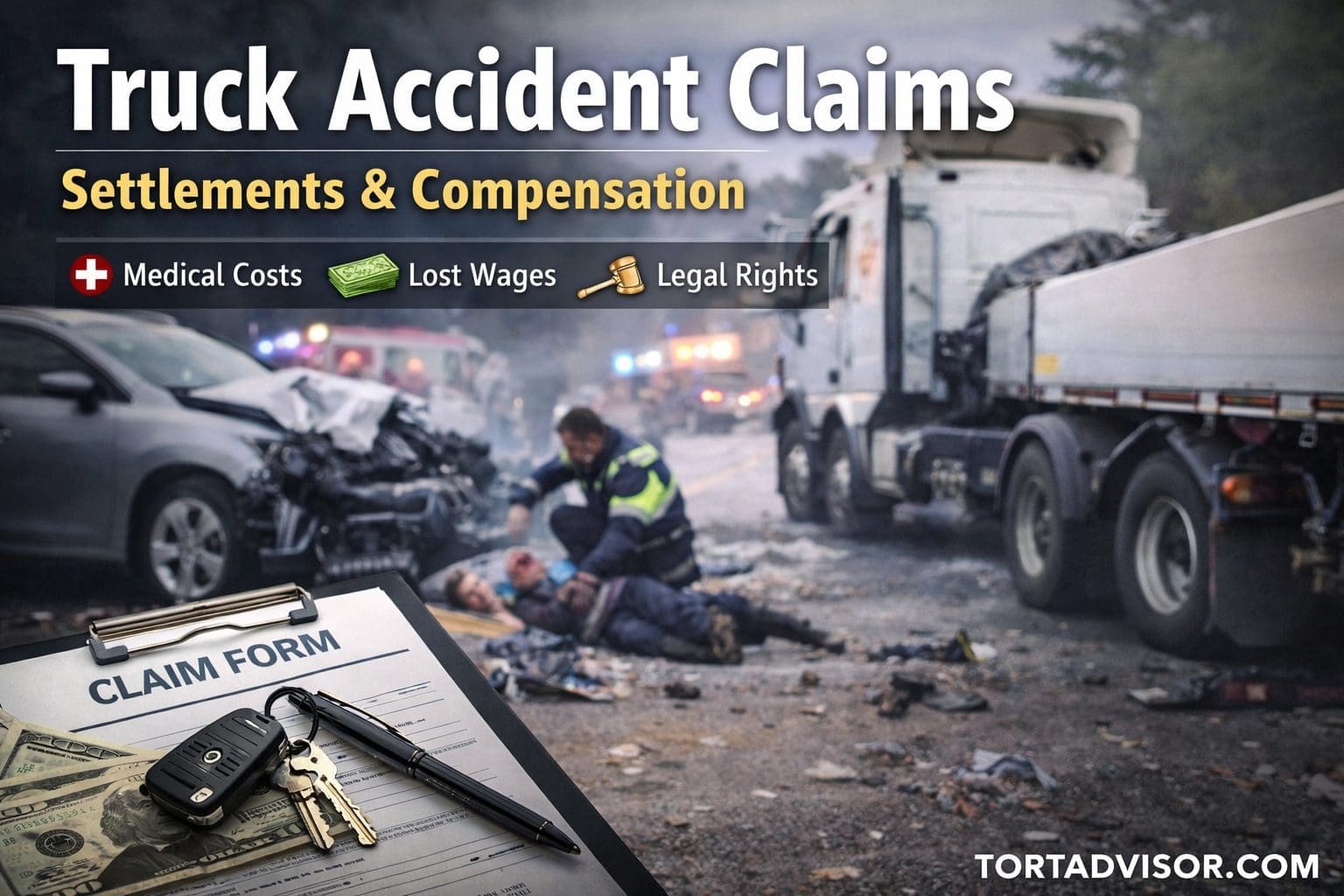
How Much Is a Truck Accident Settlement Worth in 2026?
Truck accident settlement value is highly case-specific. Injury severity, surgery, future care, permanent impairment, wage loss, medical causation, available commercial insurance, comparative fault, the number of responsible parties and the strength of trucking-company evidence can materially change the outcome.
A tractor-trailer case may also involve evidence that does not exist in a routine passenger-car claim, such as driver qualification records, electronic logging device data, hours-of-service records, dispatch communications, maintenance and inspection records, carrier safety data, onboard video or vehicle electronic data.
Current Large-Truck Crash Statistics
FMCSA’s national Crash Statistics dashboard reports 172,880 fatal and nonfatal crashes involving large trucks in 2024, including 4,469 fatal crashes, 4,991 fatalities and 88,611 injuries. The same dashboard currently shows lower preliminary 2025 counts, but FMCSA cautions that MCMIS data are considered preliminary for 22 months.
2024 large-truck crashes
172,880 fatal and nonfatal crashes involving large trucks.
FMCSA national crash statistics →2024 fatalities
4,991 fatalities resulted from crashes involving large trucks.
FMCSA national crash statistics →2024 injuries
88,611 injuries were reported in crashes involving large trucks.
FMCSA Pocket Guide & statistics →What Actually Decides the Value of a Truck Accident Claim
TortAdvisor publishes no dollar range for truck accident claims, because no honest source can produce one. Two people injured in the same collision routinely recover very different amounts, and the reasons are specific and knowable. What follows is what those reasons are, so you can see where your own claim is strong and where it is thin before you speak to anyone.
What the treatment actually shows
The documented course of care — imaging, specialist findings, surgery, therapy, and the gap between the crash and the first visit — is what turns a reported injury into a provable one. A delay in seeking treatment is the single most common way a real injury becomes hard to prove.
Who the evidence shows was at fault
The police report, scene and vehicle evidence, and the state’s rule on shared fault. Most states apply comparative negligence, so a percentage of fault assigned to you reduces recovery by that percentage; in a small number of contributory-negligence jurisdictions, any fault at all can bar recovery entirely.
What coverage exists to pay
A claim cannot recover more than there is available to pay it. The at-fault driver’s policy limits, any umbrella or commercial coverage, the motor carrier’s federally required minimum coverage, and your own underinsured-motorist coverage set the practical ceiling regardless of how serious the injury is.
What the injury has cost and will cost
Medical expenses already incurred, care still required, wages lost, and earning capacity permanently reduced. These are the parts of a claim that can be evidenced. How non-economic loss is valued on top of them varies by state, and several states cap it.
Whether the filing deadline has passed
Every state sets its own limitation period and they differ sharply. Florida, for example, cut its general negligence period from four years to two under HB 837 — and that shorter period applies prospectively, to claims accruing after 24 March 2023, so older claims keep the four-year window. A claim strong on every other factor is worth nothing once its deadline runs.
How the Truck Accident Settlement Calculator Organizes Claim Value
Injury Severity
Surgery, permanent impairment, spinal trauma, traumatic brain injury and long-term disability can materially increase documented damages.
Economic Losses
Past and future medical expenses, wage loss, diminished earning capacity, rehabilitation, transportation and other documented costs may affect value.
Liability & Carrier Evidence
Crash reports, ELD data, hours-of-service records, dispatch information, maintenance evidence and witness or video evidence may affect the liability analysis.
Commercial Coverage
Motor-carrier policies, trailer or broker relationships, multiple defendants and other potentially available insurance can affect practical recovery.
Evidence That Can Strengthen a Truck Accident Claim
Commercial-truck cases may involve evidence beyond the standard police report and medical file. Preservation can matter because some electronic, operational or company records may not remain available indefinitely.
- Police crash report and scene photographs
- Dashcam, traffic-camera and nearby business video
- Electronic logging device and hours-of-service records
- Driver qualification and training records
- Dispatch messages and trip records
- Vehicle inspection, repair and maintenance records
- Electronic control module or other onboard vehicle data
- Cargo, loading and securement records where relevant
- Post-crash drug/alcohol testing records when legally required
- Motor carrier safety history and inspection data
- Medical records, imaging and future-care documentation
- Wage-loss, tax and earning-capacity records
Why FMCSA Records Can Matter After a Commercial Truck Crash
Federal motor-carrier rules can create important sources of evidence in interstate commercial trucking cases. The relevance of any specific rule depends on the carrier, vehicle, route, driver and facts of the collision.
Hours of Service
FMCSA’s current HOS rules generally limit property-carrying drivers to 11 hours of driving after 10 consecutive hours off duty and restrict driving beyond the 14th consecutive on-duty hour, subject to exceptions.
FMCSA hours-of-service summary →Electronic Logging Devices
ELDs are designed to record driving time and support accurate records of duty status. Those records can be relevant when driver fatigue or hours-of-service compliance is disputed.
FMCSA ELD information →Post-Accident Testing
FMCSA requires post-accident drug and alcohol testing in specified circumstances for covered CDL drivers. Whether testing was required depends on the crash and citation conditions.
FMCSA post-accident testing rules →Who Can Be Responsible for a Truck Accident?
Potentially responsible parties can extend beyond the driver. Depending on the facts, a claim may require analysis of the motor carrier, vehicle owner, employer, trailer owner, maintenance contractor, shipper, loader, broker, manufacturer or another road user.
Driver Conduct
Speed, distraction, impairment, fatigue, following distance, lane movement and other driving conduct can affect liability.
Carrier Conduct
Hiring, qualification, supervision, dispatch practices, maintenance, recordkeeping and safety policies may become relevant depending on the legal theory and evidence.
Equipment or Cargo
Brake or tire condition, vehicle maintenance, defective parts, cargo loading or securement may require separate investigation.
Insurance Settlement vs. Filing a Truck Accident Lawsuit
Truck cases may involve commercial insurance policies and more than one potentially responsible entity. A quick offer can arrive before the complete medical, liability or insurance picture is known.
Primary Commercial Coverage
The motor carrier or vehicle owner may have commercial liability coverage that differs substantially from a personal auto policy.
Additional Policies or Parties
Other coverage may exist depending on leases, trailers, employers, contractors, brokers or additional responsible parties.
Your Own Coverage
UM/UIM, medical-payments or other first-party benefits can also matter depending on policy language and state law.
How to Use the Truck Accident Settlement Calculator
Before You Start
- Gather the crash report, scene photos and insurance correspondence.
- Have medical bills, imaging and treatment records nearby.
- Collect wage-loss proof and employer documentation.
- Save repair estimates, rental costs and out-of-pocket expenses.
- Note any trucking-company, trailer, employer or commercial-carrier information you know.
How to Read the Result
- Treat the output as an educational range, not a guaranteed payout.
- Update the estimate as treatment and wage information changes.
- Do not assume one trucking company or one insurance policy is the only possible source of recovery.
- Use the estimate to identify questions and missing records.
- Do not substitute the calculator for state-law, carrier-record or coverage analysis.
Truck Accident Settlement Calculator FAQ
How accurate is the truck accident settlement calculator?
It is an educational estimator. It can organize common value drivers, but it cannot predict an insurer, judge or jury or determine the governing state law.
What is the average truck accident settlement?
No single national average reliably predicts an individual claim. Injury severity, commercial coverage, multiple defendants, fault, venue and damages vary too widely.
How long does a truck accident settlement take?
Timing depends on medical treatment, investigation, preservation of carrier records, liability disputes, insurance, litigation, liens and whether future damages can be evaluated.
Why are truck accident cases different from car accident cases?
Commercial-truck claims can involve motor carriers, federal safety rules, ELD and HOS records, maintenance evidence, commercial insurance and multiple responsible entities.
What if I was partially at fault?
The effect depends on the governing jurisdiction. Fault may reduce or, in some jurisdictions, bar recovery depending on the applicable rule.
What records should be preserved after a truck crash?
Potentially relevant records can include ELD/HOS information, dispatch communications, driver qualification records, vehicle maintenance data, onboard video, vehicle electronic data and insurance information.
Request a Free Truck Accident Case Review
Use the calculator to organize your claim. If you want additional review, you can request a confidential screening before accepting an offer or signing a release.
FMCSA & NHTSA Truck Safety Sources
FMCSA National Crash Statistics
Current national large-truck crash dashboard with 2024 FARS data and preliminary MCMIS information for later periods.
Open FMCSA crash statistics →FMCSA Pocket Guide
FMCSA’s annually updated large-truck and bus statistics reference.
Open FMCSA Pocket Guide →FMCSA Hours of Service
Official federal HOS guidance and rules for covered commercial motor vehicle drivers.
Open FMCSA HOS resources →FMCSA Electronic Logging Devices
Official information about ELDs and records of duty status.
Open FMCSA ELD resources →FMCSA Drug & Alcohol Testing
Official description of when post-accident testing can be required for covered CDL drivers.
Open FMCSA testing rules →NHTSA 2025 Estimates & 2024 Final Data
Official nationwide traffic-fatality context for 2025 estimates and final 2024 counts.
Open NHTSA source →