Short answer: This article explains the key facts, eligibility issues, settlement factors, deadlines, and source-backed updates related to this legal topic. Results vary by case facts, evidence, jurisdiction, and representation.
When a Cosmetic Procedure Goes Wrong: What You Need to Know
📋 Table of Contents
- When a Cosmetic Procedure Goes Wrong: What You Need to Know
- Understanding Cosmetic Surgery Malpractice and Negligence
- Common Procedures and Injuries Handled by Cosmetic Injury Lawyers
- How to Prove Negligence in a Cosmetic Injury Claim
- Liability and Recoverable Damages in Botched Procedures
- Frequently Asked Questions about Cosmetic Malpractice
- Conclusion
Cosmetic injury lawyers help people who have been harmed by botched surgeries, negligent beauty treatments, or unlicensed practitioners — and they can fight to get you the compensation you deserve.
Here is a quick overview of what these lawyers do and when you may need one:
| Question | Quick Answer |
|---|---|
| What do cosmetic injury lawyers handle? | Surgical errors, failed implants, bad Botox, burns, scarring, nerve damage, and more |
| When can you make a claim? | When a practitioner’s negligence — not just a bad result — caused your injury |
| Who can be held liable? | Surgeons, clinics, anesthesiologists, nurses, and product manufacturers |
| What can you recover? | Medical costs, lost wages, corrective surgery, pain and suffering, emotional distress |
| What does it cost to hire one? | Most work on a no win, no fee basis — no upfront costs |
| How long do you have to file? | Typically 2-3 years from the date of injury or discovery (varies by location) |
Nearly 35 million cosmetic procedures were performed worldwide in a recent year — a 40% increase over the prior four years. With that boom comes a rise in injuries, complications, and cases of outright negligence. Some victims suffer permanent scarring or disfigurement. Others face infections, nerve damage, or serious complications from procedures performed by unqualified practitioners. The physical and emotional toll can be devastating — and the legal path forward is rarely simple.
Not every bad outcome is malpractice. But when a practitioner fails to meet the accepted standard of care, skips proper screening, or never gave you a real informed consent conversation — that is where the law steps in.
I’m Mason Arnao, and while my background is in technology, data systems, and digital marketing, I have spent years researching and writing about complex legal topics — including the work of cosmetic injury lawyers — to help everyday people understand their rights in plain language. In the sections below, I’ll walk you through everything you need to know to evaluate your situation and take the right next steps.
Cosmetic injury lawyers terms to know:
Understanding Cosmetic Surgery Malpractice and Negligence
When we go under the knife or even just get a “simple” filler injection, we are trusting a professional with our bodies and our self-esteem. In the eyes of the law, these professionals owe us a “duty of care.” This isn’t just a polite suggestion; it is a legal obligation to provide treatment that meets the standard of care expected of a competent professional in their field.
Cosmetic injury lawyers define malpractice as a breach of that duty. It happens when a surgeon or practitioner makes a preventable mistake that another reasonable professional would not have made. This could be anything from using unsterile equipment to performing a procedure they aren’t actually qualified to do.
To stay safe, we always recommend checking a doctor’s standing with professional associations like the Canadian Society of Plastic Surgeons (if you are across the border) or the American Board of Plastic Surgery here in the States. These organizations set the bar for what “good” looks like. When a doctor falls below that bar and you get hurt, that is negligence.

The Importance of Informed Consent
You might have signed a stack of papers before your procedure that felt like a mortgage application. One of the most important parts of that paperwork is “informed consent.” This means the doctor must explain:
- Exactly what the procedure involves.
- The realistic outcomes (no, you won’t look exactly like a filtered Instagram photo).
- The specific risks and potential complications.
- Alternative treatments.
If a surgeon fails to warn you that a breast implant could rupture or cause systemic illness, and that very thing happens, they may be liable for your injuries—even if the surgery itself was “technically” perfect. If you’re dealing with complications from implants, you can find More info about breast implant lawsuits to see if your experience fits the criteria for a claim.
When a Bad Outcome Becomes Malpractice
We’ve all seen “botched” surgery shows on TV, but in the legal world, there is a big difference between a result you don’t like and a result that is legally actionable. Cosmetic surgery is inherently risky. Sometimes, even with a perfect surgeon, the body doesn’t heal quite right.
However, a bad outcome becomes malpractice when it’s tied to substandard care.
| Expected Surgical Risk | Actionable Negligence |
|---|---|
| Minor, symmetrical scarring | Large, jagged, or unnecessary disfigurement |
| Temporary swelling or bruising | Permanent nerve damage or paralysis |
| Reaction to anesthesia (rare/unforeseeable) | Administering the wrong dosage of anesthesia |
| Dissatisfaction with aesthetic “style” | Operating on the wrong body part or leaving a tool inside |
Common Procedures and Injuries Handled by Cosmetic Injury Lawyers
The world of cosmetic enhancement has moved far beyond the traditional facelift. Today, cosmetic injury lawyers see a wide range of cases involving both surgical and non-surgical treatments.
One of the most dangerous procedures currently trending is the Brazilian Butt Lift (BBL). Statistics show that BBLs carry a higher-than-average fatality rate, often due to fat embolisms. This happens when fat is accidentally injected into a large vein and travels to the heart or lungs. It’s a terrifying risk that requires strict safety protocols—protocols that negligent surgeons sometimes skip to save time.
Other common procedures linked to claims include:
- Breast Augmentation: Issues like capsular contracture (where scar tissue squeezes the implant), asymmetry, or infection.
- Rhinoplasty (Nose Jobs): Breathing difficulties or structural collapse of the nose.
- Liposuction: Organ perforation or severe skin irregularities.
- Botox and Fillers: While “non-invasive,” these can lead to blindness, skin necrosis (tissue death), or “granulomas” if the substance is impure or injected incorrectly.
Why You Need Specialized Cosmetic Injury Lawyers
You wouldn’t ask a plumber to fix your electrical wiring, and you shouldn’t ask a general practice lawyer to handle a complex medical malpractice case. These cases require specialized knowledge.
A skilled cosmetic injury lawyer knows how to navigate the “vanity bias.” Often, insurance companies (and even some juries) try to blame the victim, suggesting that because the surgery was elective, the patient “asked for it.” We know that is nonsense. Everyone deserves safe medical care, regardless of whether the surgery is for a broken leg or a tummy tuck.
Specialized lawyers also have access to medical experts who can testify about exactly where the surgeon went wrong. This is crucial when dealing with unlicensed practitioners. For example, there was a shocking Dangerous cosmetic procedure case study where a woman was arrested for performing procedures in a basement. While that is an extreme case, many “med-spas” use nurses or technicians for procedures that legally require a doctor’s supervision.
Typical Injuries in Botched Cosmetic Claims
The damage from a botched procedure isn’t just skin deep. We see clients suffering from:
- Permanent Scarring: Beyond what was discussed during consent.
- Nerve Damage: Leading to chronic pain, numbness, or loss of facial expression.
- Skin Necrosis: When blood flow is cut off, causing the skin to literally die and turn black.
- Infection: Including life-threatening conditions like MRSA.
Sometimes, the injury isn’t caused by the surgeon’s hand, but by the product itself. If a laser machine malfunctions or an implant is defective, you might have a product liability claim. For more on this, check out More info about defective product liability.
How to Prove Negligence in a Cosmetic Injury Claim
Proving negligence is like putting together a puzzle. To win a case, cosmetic injury lawyers must prove four specific elements:
- Duty: The practitioner owed you a duty of care (you were their patient).
- Breach: They failed to meet the standard of care (they messed up).
- Causation: Their mistake directly caused your injury (not a pre-existing condition).
- Damages: You suffered actual losses (physical, emotional, or financial).
Evidence Required by Cosmetic Injury Lawyers
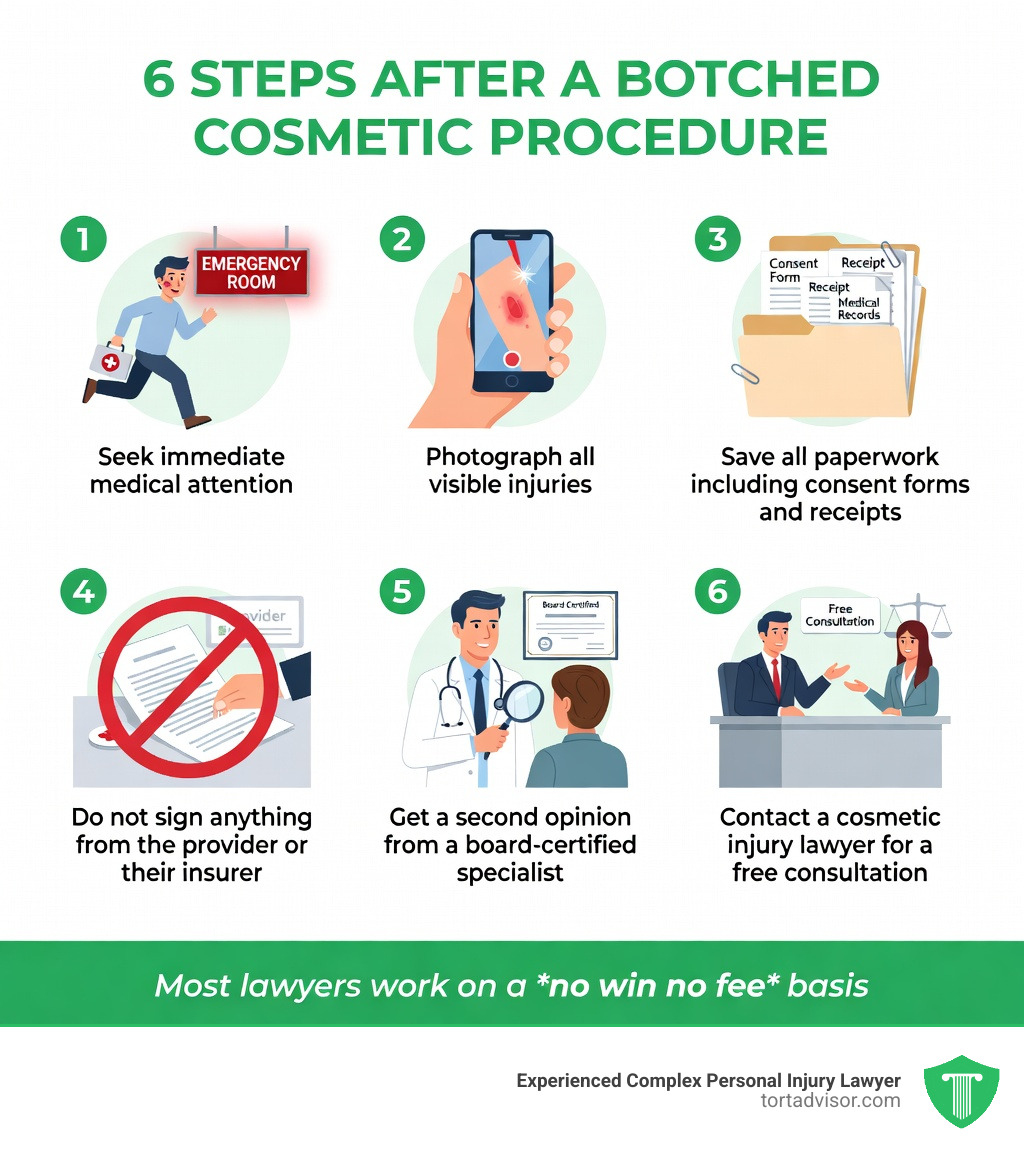
If you think you have a claim, evidence is your best friend. We tell our clients to save everything. This includes:
- Photographs: Take clear, dated photos of the “before,” the immediate “after,” and the progression of the injury.
- Medical Records: All pre-operative assessments and post-operative notes.
- Communication Logs: Save every email, text, or voicemail from the clinic.
- Witness Statements: Did a friend or family member see how much pain you were in?
In cases involving implants, we also look for evidence of More info about breast implant silicone toxicity, which can cause a range of systemic health issues that a negligent surgeon might try to dismiss.
Navigating Waivers and Legal Defenses
A common myth is that if you signed a waiver, you can’t sue. This is false! A waiver typically covers the known risks of a procedure. It does not give a doctor a “get out of jail free” card for gross negligence, recklessness, or unprofessional conduct. If a surgeon shows up to work impaired or uses unapproved industrial-grade silicone, no waiver in the world will protect them.
You also need to keep an eye on the statute of limitations. In many states—from Florida to California—you generally have two years from the date of the injury (or the date you discovered the injury) to file a lawsuit. If you wait too long, you lose your right to sue forever.
Liability and Recoverable Damages in Botched Procedures
In a cosmetic injury case, there might be more than one person at fault. While the lead surgeon is the obvious target, our cosmetic injury lawyers also look at:
- The Clinic or Hospital: For failing to screen their staff or maintain a sterile environment.
- The Anesthesiologist: If you suffered a brain injury or heart issues during the procedure.
- Product Manufacturers: If the tools or implants used were defective.
You can find More info about product liability personal injury if you believe a faulty device was to blame.
Types of Compensation for Victims
When we talk about “damages,” we are talking about making you whole again. This includes:
- Economic Damages: Medical bills, the cost of corrective surgeries (which are often much more expensive than the original surgery), and lost wages if you couldn’t work.
- Non-Economic Damages: Pain and suffering, psychological distress (like depression or anxiety from disfigurement), and loss of enjoyment of life.
- Punitive Damages: In rare cases where the doctor’s behavior was particularly malicious or reckless, a court might award extra money to punish them.
Funding Your Cosmetic Injury Case
We know that after a botched surgery, the last thing you have is extra cash—especially if you’re paying for corrective medical care. That is why most cosmetic injury lawyers work on a contingency fee basis (often called “No Win, No Fee”).
This means:
- You pay $0 upfront.
- The law firm covers the costs of experts and filing fees.
- The lawyer only gets paid if they win your case, taking a percentage of the final settlement.
To get a rough idea of what your case might be worth, you can check out More info about breast implant settlement calculators, though every case is unique.
Frequently Asked Questions about Cosmetic Malpractice
What is the statute of limitations for a cosmetic injury lawsuit?
In most of the states we serve—like Texas, New York, or Illinois—the limit is typically two years. However, the “discovery rule” might apply if the injury wasn’t immediately obvious (like an internal infection that surfaced months later). The best advice? Don’t wait. Consult a lawyer the moment you suspect something is wrong.
Can I sue if I signed a consent form or waiver?
Yes! As we mentioned, consent forms cover foreseeable risks, not negligent mistakes. If the doctor failed to meet the professional standard of care, that waiver won’t stop a lawsuit.
Who can be held liable for my botched procedure?
Liability can fall on the lead surgeon, the anesthesiologist, the nursing staff, the facility where the surgery took place, or even the manufacturer of a defective medical device or pharmaceutical product.
Conclusion
At Tort Advisor, we believe that no one should have to live with the devastating consequences of a medical professional’s negligence. Whether you are in Alabama, Alaska, or anywhere else in our service area, we are here to help. We connect clients with top-rated specialty attorneys who have proven results in complex personal injury and medical malpractice cases.
If you have been injured, don’t suffer in silence. The physical pain is hard enough—let a professional handle the legal stress. Contact our defective product lawyers for a free evaluation today to discuss your case and learn about your options for justice. We are ready to fight for you.
Related Posts

If you developed a serious infection following orthopedic surgery — such as a hip or knee replacement — and a [...]

A global Depo-Provera settlement agreement was announced on June 15, 2026 — the most significant development in this litigation since [...]
If you or a loved one has been diagnosed with mesothelioma after years of using talcum powder products, you may [...]