
The Price of a Mistake: Cancer Misdiagnosis Compensation Guide

What Is the Average Payout for Cancer Misdiagnosis?
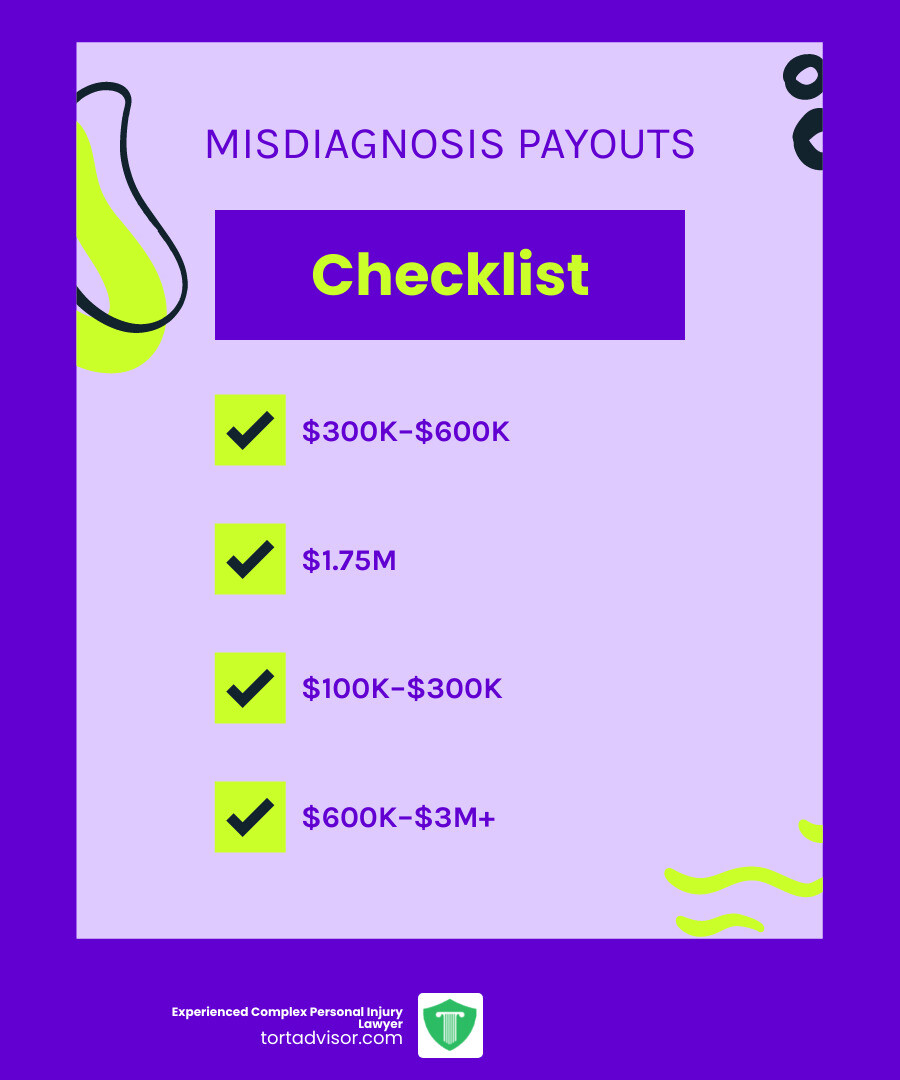
There is no official average payout for cancer misdiagnosis. Most malpractice claims settle confidentially, and the averages quoted online usually come from law firm or insurer summaries rather than complete data. What a claim is worth depends on how much the delay changed the outcome, the treatment and income losses that followed, and state law, including caps on non-economic damages in some states. Serious cases involving wrongful death or late-stage progression can result in verdicts exceeding $1 million.
A cancer misdiagnosis is not just a medical error — it can be the difference between catching a treatable tumor and facing a terminal diagnosis. Nearly 40% of all severe injuries and deaths from diagnostic errors involve cancer, affecting around 100,000 people in the US every year. When a doctor fails to catch cancer in time, the consequences ripple outward: more aggressive treatment, reduced survival odds, lost income, and devastating emotional harm for patients and families alike.
That’s why the legal stakes in these cases are so high. And why understanding what compensation looks like — in real numbers — matters so much before you decide whether to pursue a claim.
Find out if you may have a claim
Answer a few questions and a trained case advisor will review your situation — most people finish in about a minute.
- Free — no cost, no obligation
- About a minute to complete
- Reviewed by a trained case advisor
- Nothing you submit is published
Your details are sent over a secure connection and reviewed confidentially.
I’m Mason Arnao, and while my background is rooted in technology and data systems, my work in internet research and lead generation has given me deep experience analyzing legal settlement data — including the average payout for cancer misdiagnosis — to help people like you cut through the noise and understand what the numbers actually mean. In the sections ahead, I’ll walk you through everything you need to know to make an informed decision.
Understanding the Average Payout for Cancer Misdiagnosis
When we talk about the average payout for cancer misdiagnosis, it is important to distinguish between “settlements” and “verdicts.” A settlement is an agreement reached outside of court, usually with an insurance company. A verdict is a decision made by a jury at the end of a trial.
Jury verdicts tend to be larger than settlements. Why the gap? Trials are risky and expensive for insurance companies. If a case is strong enough to go to a jury, it often involves severe negligence and catastrophic harm, leading to higher awards.
However, most cases settle. According to Johns Hopkins research on diagnostic errors, diagnostic failures are the leading cause of medical malpractice claims in the United States. Cancer misdiagnosis specifically accounts for nearly 38% of these claims. Because these cases are complex, the “average” is just a starting point. Your specific recovery depends on the physical and financial toll the error took on your life.
If the misdiagnosis has left you unable to work, you may also need to explore other avenues of support, such as More info about SSDI for cancer.
How Cancer Type Affects the Average Payout for Cancer Misdiagnosis
Not all cancers are the same, and neither are the legal claims associated with them. Some cancers progress much faster than others. A six-month delay in diagnosing an aggressive lung cancer can be far more damaging than a six-month delay for a slow-growing prostate cancer.
The Latest study on cancer misdiagnosis frequency suggests that cancer is misdiagnosed more than 10% of the time, with certain types like lymphoma and breast cancer topping the list.
Lung cancer settlements can vary wildly. Cases involving non-smokers or very young patients often result in much higher payouts because the “loss of life expectancy” is greater.
The Role of Cancer Staging in Settlement Values
The most critical factor in determining the average payout for cancer misdiagnosis is “stage progression.” If a doctor’s mistake allowed a Stage I cancer (highly treatable) to progress to Stage IV (metastatic/terminal), the settlement value skyrockets.
In these cases, we look at:
- Treatment Intensity: Did the delay mean you had to undergo aggressive chemotherapy and radiation instead of a simple surgical procedure?
- Survival Prognosis: How much did the delay decrease your statistical chance of survival?
- Metastasis: Has the cancer spread to other organs, such as the bones or brain?
For instance, environmental factors can also play a role in certain cancers, which complicates the diagnostic process. You can find More info about PFAS prostate cancer lawsuits to see how specific causes of cancer impact legal strategies.
How Common Serious Diagnostic Harm Actually Is
There is no national register of misdiagnosis payouts, which is why this page will not quote you an average. There is, however, a measured national estimate of how often diagnostic error seriously harms people, and it is the most useful number on this subject. Researchers led by David Newman-Toker at Johns Hopkins estimated that 795,000 adults in the United States each year suffer serious misdiagnosis-related harm, defined as permanent disability or death. The estimate was built from a sample of 21.5 million hospital discharges and published in BMJ Quality & Safety in 2024.
Cancer sits in the small group of conditions that account for most of that harm. The same study cites earlier work by the same research group finding that vascular events, infections and cancers together make up roughly half of all serious misdiagnosis-related harm in the United States. That is the reason cancer misdiagnosis claims exist as a recognisable category of case at all: the harm is concentrated in conditions where a delay changes the outcome, and cancer is the clearest example, because staging moves with time in a way that most conditions do not.
Understand what that figure is and is not. It measures harm, not negligence, and the two are different things. A diagnosis can be missed without anyone having fallen below the standard of care, because some cancers present atypically and some tests return false negatives. The 795,000 estimate tells you that serious diagnostic harm is common enough to be a public health problem; it tells you nothing about whether a particular case is compensable. That question is decided by the standard of care, by causation, and by what the medical records show about when the finding first appeared.
It also explains why payouts in this area vary so widely that an average would mislead you. The cases that resolve for large sums are the ones where the delay is documented, the stage change is demonstrable, and the economic loss is measurable. The cases that resolve for little or nothing usually fail on one of those three, not on sympathy.
Source, checked 17 October 2026: Newman-Toker DE, Nassery N, Schaffer AC, et al., Burden of serious harms from diagnostic error in the USA, BMJ Quality & Safety 2024;33(2):109-120, as summarised by the Agency for Healthcare Research and Quality. TortAdvisor is not a medical provider and this is general information, not medical or legal advice.
Factors That Influence Your Cancer Misdiagnosis Settlement

No two patients are alike, and no two lawsuits are either. When we calculate a potential settlement, we divide the “damages” into two main categories: economic and non-economic.
Economic Damages (The “Receipts”)
These are the quantifiable financial losses you have suffered. They include:
- Medical Expenses: This covers everything from the initial misdiagnosis to the extra treatments required because the cancer progressed.
- Lost Wages: If you had to take time off work for treatment or recovery.
- Future Earning Capacity: If the misdiagnosis resulted in a permanent disability that prevents you from returning to your career.
Non-Economic Damages (The “Human Cost”)
These are subjective and often require an experienced lawyer to quantify:
- Pain and Suffering: The physical pain of advanced cancer and the emotional trauma of knowing a mistake was made.
- Loss of Consortium: The impact the injury has on your relationship with your spouse or family.
- Loss of Quality of Life: The inability to enjoy hobbies, travel, or spend time with loved ones as you did before.
Other Influencing Factors
- Comparative Negligence: Did you contribute to the delay? For example, if a doctor told you to come back in three months for a follow-up and you waited a year, the insurance company will try to reduce your payout.
- Insurance Policy Limits: A settlement is often capped by the doctor’s or hospital’s malpractice insurance policy limits.
- Jurisdiction: Some states have “caps” on non-economic damages, which can limit the total amount you can receive regardless of how much you suffered.
For those dealing with specific medical device-related cancers, there is More info about breast cancer class action lawsuits that may be relevant to your situation.
Proving Negligence in a Medical Malpractice Claim
To secure the average payout for cancer misdiagnosis, we must prove that medical malpractice actually occurred. Simply being misdiagnosed isn’t enough; we have to show the doctor was negligent. This requires proving four specific elements:
- Doctor-Patient Relationship: You must show the doctor owed you a “duty of care.” This is usually the easiest part to prove.
- Breach of the Standard of Care: We must prove the doctor failed to do what a “reasonably competent” doctor in the same specialty would have done. For example, if you had a visible lung mass on an X-ray and the radiologist failed to mention it, that is a breach.
- Causation: We must link the negligence directly to the harm. We have to prove that the delay caused the injury, not just the cancer itself.
- Quantifiable Harm: You must have suffered actual damages (higher medical bills, worse prognosis, or pain).
We rely heavily on expert testimony. We hire independent doctors to review your records and testify that your original physician dropped the ball. For a deeper dive into the legal nuances of this, see Legal research on proving duty of care.
Proving these elements is also vital in cases involving toxic exposure, such as those found in More info about PFAS cancer lawsuits.
What Real Settlements and Verdicts Can Tell You
Looking at real-world outcomes can help, but individual examples are easy to misread. Many malpractice settlements are confidential, large jury verdicts are often reduced after trial or by state damage caps, and a single headline figure says little about a different patient, cancer or state. The most useful comparison is a verified verdict or settlement from your own state involving a similar cancer, a similar delay and similar harm, which an experienced malpractice attorney can research for you.
Frequently Asked Questions About Cancer Misdiagnosis Claims
What is the average payout for cancer misdiagnosis in the US?
As we’ve discussed, there is no official average payout for cancer misdiagnosis, and any “average” can be misleading. If the negligence resulted in the death of a primary breadwinner or a young parent, the values often reach into the millions. Conversely, if the delay was only a few weeks and didn’t change the treatment plan, the payout might be much lower.
It’s also worth noting that symptoms of certain cancers can be confused with other conditions, making the diagnostic process harder. For instance, check More info about PFAS exposure symptoms to see how symptom overlap can lead to errors.
What is the statute of limitations for filing a claim?
This is the most important deadline in your case. In many states, like Florida, you generally have two years from the date you discovered (or should have discovered) the misdiagnosis to file a lawsuit. If you miss this window, you lose your right to sue forever.
You can read the specific Florida Statutes on medical malpractice to understand how the “discovery rule” might extend your deadline if the error was hidden.
What should I do immediately after suspecting a misdiagnosis?
- Get a Second Opinion: Your health is the priority. See a specialist at a different hospital system immediately.
- Gather Records: Request copies of all imaging (CDs of X-rays/CTs), pathology reports, and doctor notes.
- Keep a Daily Diary: Record your pain levels, your emotional state, and the impact on your daily life.
- Do Not Talk to Insurance: If an insurance adjuster calls you, do not give a statement. They are looking for reasons to pay you less.
- Consult a Lawyer: The sooner a legal team can begin investigating, the better your chances of preserving evidence.
If you believe your cancer was caused by environmental toxins, you should also review More info about PFAS lawsuit criteria.
Conclusion
A cancer misdiagnosis is a heavy burden to carry, but you don’t have to carry it alone. While the average payout for cancer misdiagnosis provides a statistical benchmark, your journey is personal. Seeking legal accountability isn’t just about the money — it’s about ensuring that negligent healthcare providers are held responsible so that the same mistake doesn’t happen to someone else.
At Tort Advisor, we connect clients with top-rated specialty attorneys who have a proven track record in complex medical malpractice cases. We work exclusively with highly skilled attorneys to ensure you get the best possible outcome for your case. Whether you are dealing with a delayed diagnosis or a complete failure to treat, we can help you navigate the path to financial recovery.
If your diagnosis involves specific medical complications, such as those related to implants, you can find More info about breast implant cancer lawsuits to see how we handle specialized claims. Contact us today to start your journey toward justice.
Related Posts

How VCF registration works: who should register, the two-year deadline and when it starts, how to register online or by phone, and how it fits with the WTC Health Program.
Paraquat exposure explained from EPA, CDC and court records: how it happens, who is most at risk, drift and vapor, the safety rules since 2016, Parkinson’s research, and the records that help show exposure.

The Supreme Court's June 25, 2026 ruling in Monsanto v. Durnell held that FIFRA can preempt state failure-to-warn claims, unsettling a central theory in paraquat cases. With 6,602 actions pending in MDL 3004 as of 1 October 2026 and a global settlement agreed in principle but no terms disclosed, here is what is verified and what is not.