Why You Need a Defective Product Injury Lawyer After an Accident

When a Product Hurts You, You Need a Defective Product Injury Lawyer
📋 Table of Contents
- When a Product Hurts You, You Need a Defective Product Injury Lawyer
- Understanding Product Liability and Strict Liability
- The Three Main Types of Product Defects
- Who Can Be Held Liable for Your Injuries?
- Proving Your Case with a Defective Product Injury Lawyer
- Compensation and Legal Steps After an Accident
- Frequently Asked Questions about Defective Product Injury Lawyers
- Conclusion
A defective product injury lawyer helps victims hold manufacturers, distributors, and retailers accountable when a faulty product causes harm — and they do it with no upfront cost to you.
Here’s what you need to know right away:
Find out if you may have a claim
Answer a few questions and a trained case advisor will review your situation — most people finish in about a minute.
- Free — no cost, no obligation
- About a minute to complete
- Reviewed by a trained case advisor
- Nothing you submit is published
Your details are sent over a secure connection and reviewed confidentially.
- You may have a legal claim if a product injured you and it was defective by design, manufacturing error, or lack of proper warnings
- Multiple parties can be liable — including the maker, seller, and everyone in between
- You don’t need to prove negligence in many cases — strict liability means the defect itself is enough
- Compensation can include medical bills, lost wages, pain and suffering, and more
- Time limits apply — most states give you 2–3 years to file, so acting quickly matters
- Most lawyers work on contingency — meaning you pay nothing unless you win
Nearly 30 million people are injured every year by dangerous or defective products, according to the U.S. Consumer Product Safety Commission. From faulty car parts and exploding e-cigarettes to contaminated medications and children’s toys with choking hazards — the products we trust daily can cause devastating, life-changing injuries.
The problem? The companies behind those products don’t go down without a fight. They hire aggressive legal teams to protect their bottom line. Going up against them alone is a serious disadvantage.
That’s why having the right legal help matters so much.
Understanding Product Liability and Strict Liability
When we buy a toaster, a car, or a prescription drug, we aren’t just buying an object; we are buying the “implied promise” that the product won’t explode, poison us, or fall apart during normal use. In the legal world, this falls under product liability.
Product liability is the area of law that holds the people who make and sell products responsible if those products hurt someone. It’s not just about a “whoopsie” in the factory; it’s about a legal duty of care that companies owe to us, the consumers. If you want to dive deeper into the basics, check out this more info about product liability personal injury.
In many states, including Texas, the Texas Product Liability Act sets the ground rules. It establishes that a manufacturer can be held liable if a product is “unreasonably dangerous.” We often look at three legal theories in these cases:
- Negligence: The company was careless in designing or making the product.
- Breach of Warranty: The product failed to live up to a specific guarantee (like a car that promises 30 mpg but only gets 10, or a “waterproof” watch that dies in the rain).
- Strict Liability: This is the big one.
Strict Liability vs. Negligence
Strict liability is a consumer’s best friend. In a standard negligence case, you have to prove the company was “sloppy.” You have to show exactly where they messed up. But with strict liability, the focus shifts from the company’s behavior to the product itself.
If a product is defective and that defect caused your injury, the company is often liable regardless of how careful they claim to have been. They could have the cleanest factory in the world and the most polite engineers, but if the product is dangerous, they are on the hook.
Different states have different flavors of this. For instance, New York product liability standards have specific requirements for proving a product was not “reasonably safe.” A defective product injury lawyer knows these local nuances, which is vital because what works in a Manhattan courtroom might be slightly different than the approach in a Dallas or Miami court.
The Role of Consumer Protection Agencies
We aren’t totally alone in the fight against bad products. Several federal agencies act as watchdogs:
- CPSC (Consumer Product Safety Commission): They handle everything from coffee makers to cribs, set mandatory safety standards, and publish the national recall database for consumer products.
- FDA (Food and Drug Administration): They oversee the safety of our food and medications.
- NHTSA (National Highway Traffic Safety Administration): They are the ones who deal with those massive airbag or tire recalls you see on the news.
It is always a good idea to keep an eye on national recall lists and safety alerts. However, just because a product hasn’t been recalled yet doesn’t mean you don’t have a case. Many recalls only happen after a defective product injury lawyer files enough lawsuits to force the company’s hand.
It is worth knowing how much of this actually happens, because the scale explains why a defective product claim is rarely simple. The National Highway Traffic Safety Administration recorded 997 safety recalls in calendar year 2025, covering 31,268,058 vehicles and items of equipment. Vehicles accounted for 891 of those recalls and 29,262,623 of the units, with the remainder split between equipment, child seats and tyres. For consumer products outside the vehicle world, the Consumer Product Safety Commission reported 542 recalls and warnings over roughly the same period, a 32 percent rise on the year before.
The figure that matters most to an injured person is about repairs, not announcements. NHTSA puts the completion rate for 2024 recalls at 73.4 percent, which means roughly a quarter of the vehicles subject to a recall that year were never brought in and fixed. A recall notice is a letter, not a repair. Millions of vehicles carrying a known and formally acknowledged defect stay on the road, and if one of them was involved in your accident, the recall record is already sitting in a federal database with a vehicle identification number attached to it.
That is the practical reason to involve a lawyer early rather than after an insurer has made an offer. The recall record, the manufacturer’s defect report to the agency, warranty claim histories and the product itself are all evidence that exists now and degrades quickly, particularly once a vehicle is repaired, sold or scrapped. Very little of it is hard to obtain while it still exists, and almost none of it can be reconstructed afterwards.
Sources, checked 17 October 2026: NHTSA, 2025 Annual Report on Safety Recalls, published March 2026 · CPSC news release 26-200, 20 January 2026
The Three Main Types of Product Defects
To win a case, we have to categorize how the product failed. Usually, it falls into one of three buckets:
| Defect Type | Definition | Example |
|---|---|---|
| Design Defect | The “blueprint” is wrong. Every single item produced is dangerous. | An SUV designed with a high center of gravity that makes it prone to rollovers. |
| Manufacturing Defect | The design is fine, but something went wrong during assembly. | A bicycle that is missing a crucial bolt on one specific batch. |
| Marketing Defect | The product is fine, but the instructions or warnings are missing. | A powerful cleaning chemical that doesn’t warn users to wear gloves or masks. |
Common Examples of Defective Products
We see these cases across almost every industry. Some of the most common include:
- Dangerous Drugs: Medications that cause heart attacks or strokes that weren’t listed as side effects. You can find more dangerous drug legal information here.
- Medical Devices: Faulty hip implants, pacemakers, or hernia mesh.
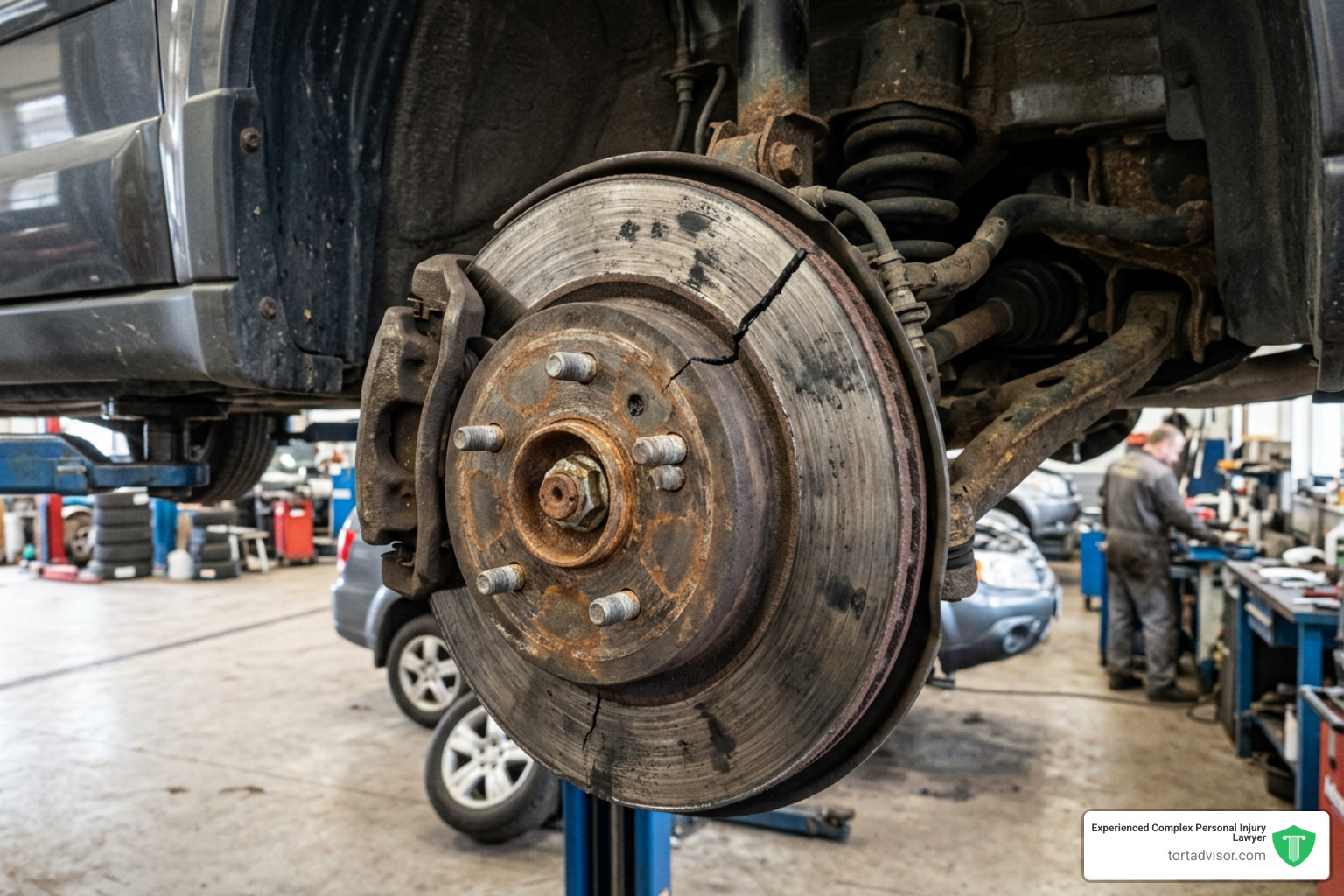
- Auto Defects: Airbags that explode with too much force or brakes that fail.
- Children’s Toys: Small parts that pose choking hazards or electronics that catch fire. If you’re in the Georgia area, an Atlanta Product Liability Attorney can help navigate these specific local claims.
Identifying Warning and Marketing Defects
A product doesn’t have to be “broken” to be defective. If a company knows a drug can cause a specific injury but hides that info to keep sales high, that is a marketing defect. This is often called “failure to warn.”
For example, if a space heater doesn’t have a warning saying “Keep away from curtains,” and it starts a fire, the manufacturer might be liable for the lack of instructions. If you’ve been hurt by a product that didn’t tell you the risks, consulting a New Jersey Defective Product Injury Attorney (or one in your specific state) is the best way to see if you have a “failure to warn” claim.
Who Can Be Held Liable for Your Injuries?
One of the most complex parts of these cases is figuring out who to sue. It’s rarely just the name on the box. The “stream of commerce” is long, and we can often pursue anyone in the supply chain:
- The Manufacturer: The big fish who designed and built the item.
- Component Part Makers: If your car brakes failed because a specific sensor was bad, the sensor maker might be liable.
- Wholesalers and Distributors: The “middlemen” who moved the product.
- The Retailer: The store where you bought it. Even if they didn’t make it, they have a responsibility not to sell dangerous goods.
Whether you need a Product Liability Lawyer New Mexico or one in Florida, the goal is the same: identifying every party that shares the blame to maximize your potential recovery.
Liability for Dangerous Pharmaceuticals and Medical Devices
“Big Pharma” cases are particularly intense. These companies have billions of dollars and will fight tooth and nail. Even if a drug has FDA approval, that doesn’t give the company a “get out of jail free” card. Often, issues only appear during “post-market surveillance”—which is a fancy way of saying “after people start getting hurt in the real world.”
We see this frequently in cases like Bair Hugger Lawsuits (surgical warming blankets) or Hernia Mesh Lawsuit. In these instances, the “defect” might be a design that allows bacteria to grow or materials that the human body rejects.
Retailer and Distributor Responsibility
You might wonder, “Why sue the store? They just put it on the shelf!” Well, in many states, if a retailer knew (or should have known) a product was dangerous, they are responsible. However, some states allow for a “sealed container defense,” which protects a store if they sold a product in a box they couldn’t possibly have opened to inspect.
Timing is also everything. For example, the Maryland statute of limitations generally gives you three years from the date of the injury to file. If you miss that window, it doesn’t matter how defective the product was—you lose your right to sue.
Proving Your Case with a Defective Product Injury Lawyer
Proving a product was defective isn’t as simple as showing a picture of a broken toy. It requires a “trial mindset.” Even if we plan to settle out of court, we prepare every case as if it’s going before a jury. This involves:
- Expert Witnesses: We hire engineers, doctors, and safety experts to testify about why the product failed.
- Engineering Reports: Deep dives into the blueprints and manufacturing logs.
- Evidence Preservation: This is huge. Do not throw the product away! If you throw away the evidence, you might throw away your case.
For a step-by-step breakdown of how this works, our Defective Product Lawyer Guide is a great resource.
Why Hire a Defective Product Injury Lawyer?
You might be a DIY master at home, but you don’t want to DIY a product liability claim. These cases involve:
- Technical Expertise: Understanding the science behind a lithium-ion battery explosion or a pharmaceutical interaction.
- Resource Management: These cases are expensive. We front the costs for experts and testing.
- Litigation Strategy: Knowing how to counter the “army of lawyers” the big corporations will bring.
If you’re still on the fence, read about what can a personal injury lawyer do for you to understand the full scope of our work.
Common Defenses Used by Manufacturers
Companies don’t just write checks; they try to blame you. Common defenses include:
- Product Misuse: “You weren’t using the lawnmower to cut grass; you were using it to trim a hedge!” (Yes, people try this).
- Alteration: Arguing you changed the product after buying it.
- Assumption of Risk: Claiming you knew it was dangerous and used it anyway.
- Comparative Negligence: Arguing that you were partially at fault for your own injury.
Our Attorneys for Defective Products are experts at anticipating these excuses and shutting them down before they gain steam.
Compensation and Legal Steps After an Accident
When we take on a case, we are looking for more than just a refund for the product. We are looking for “make whole” compensation. This includes:
- Medical Expenses: Past surgeries and future physical therapy.
- Lost Wages: Money you lost because you couldn’t work.
- Pain and Suffering: The physical pain and emotional trauma of the accident.
- Punitive Damages: In rare cases, if a company was especially evil (like knowing a car would explode and selling it anyway), a judge might order them to pay extra as punishment.
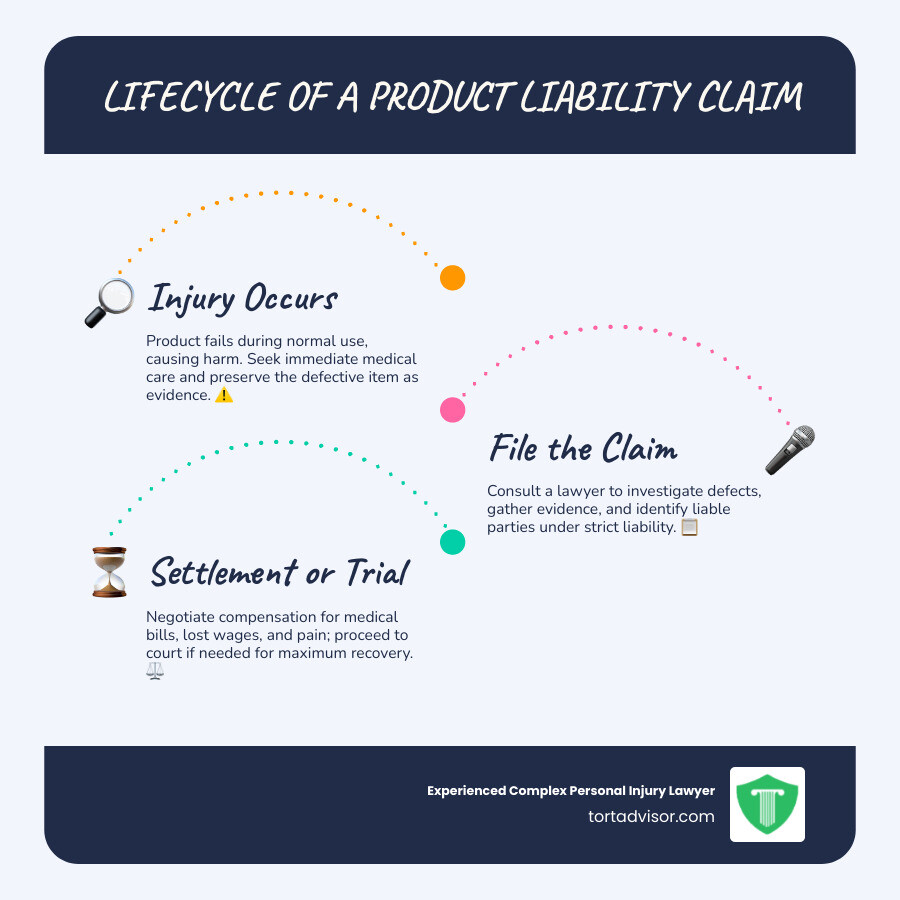
In total, the specialty attorneys we work with have recovered over $750 Million for injury victims. While every case is different, we always fight for the maximum value. You might be worried about the cost of hiring us, but how much does a personal injury lawyer cost is usually a simple answer: we work on contingency.
Immediate Steps to Take After an Injury
If you or a loved one is hurt by a product, do these four things immediately:
- Seek Medical Attention: Your health is #1, and medical records are vital evidence.
- Preserve the Product: Put it in a safe place. Don’t clean it, don’t try to fix it, and don’t send it back to the manufacturer for a “refund.”
- Document Everything: Take photos of the product, your injuries, and the scene. Keep the receipt and the original packaging if you have it.
- Avoid Insurance Statements: The company’s insurance adjuster is not your friend. They want to get you to say something that ruins your case.
For more tips on finding the right person to help, see our finding best injury lawyer guide.
How a Defective Product Injury Lawyer Calculates Damages
We look at both economic damages (things with a receipt, like hospital bills) and non-economic damages (things that don’t have a price tag, like the loss of enjoyment of life). We also calculate “future care costs”—if you need a wheelchair for the next 30 years, that cost needs to be covered today.
If you’re in the tri-state area, our Jersey City Defective Product Injury Guide explains how these calculations often work in local courts.
Frequently Asked Questions about Defective Product Injury Lawyers
How long do I have to file a product liability claim?
This depends on your state’s statute of limitations. Most range from 2 to 4 years. However, many states use the discovery rule, which means the clock doesn’t start until you realize (or should have realized) that the product caused your injury. This is common in medical cases where a defect might not show up for years. You can learn more about the general process of Personal Injury Lawsuits here.
What if the product that injured me was already recalled?
A recall is actually great evidence for your case! It proves the manufacturer admitted something was wrong. However, it doesn’t mean you automatically win. You still have to prove that the specific defect mentioned in the recall is what caused your injury. Always check the CPSC recall database to see if your product is listed.
Can I afford a lawyer for a defective product case?
Yes! We use contingency fee arrangements. The attorney pays for the experts, the filing fees and the research. If the case does not succeed, there is nothing to pay. This allows regular people to take on giant corporations without risking their life savings. It’s why we are known as Trusted Personal Injury Attorneys.
Conclusion
At Tort Advisor, we believe that no one should have to suffer because a corporation decided to cut corners. We connect clients with top-rated specialty attorneys who have proven results in complex product liability cases.
With a 99% success rate in many of the jurisdictions we serve and over $750 Million recovered, our goal is simple: to get you the maximum compensation you deserve so you can focus on healing.
Don’t let a negligent manufacturer get away with hurting you. Contact a Defective Product Lawyer today for a free, no-obligation consultation. experienced attorneys can fight for you.
My name is Mason Arnao — and while my background is in technology, data systems, and digital marketing, I’ve spent years researching and writing about complex legal topics, including defective product injury lawyer cases, to help everyday people understand their rights. I’ll break this down in plain language so you know exactly what to expect and how to protect yourself.
Related Posts

How VCF registration works: who should register, the two-year deadline and when it starts, how to register online or by phone, and how it fits with the WTC Health Program.
Paraquat exposure explained from EPA, CDC and court records: how it happens, who is most at risk, drift and vapor, the safety rules since 2016, Parkinson’s research, and the records that help show exposure.

The Supreme Court's June 25, 2026 ruling in Monsanto v. Durnell held that FIFRA can preempt state failure-to-warn claims, unsettling a central theory in paraquat cases. With 6,602 actions pending in MDL 3004 as of 1 October 2026 and a global settlement agreed in principle but no terms disclosed, here is what is verified and what is not.