
What Alabama Crime Victim Compensation Can Do for You
Alabama crime victim compensation is a state-funded program that helps victims of violent crime pay for real financial losses — things like medical bills, counseling, lost wages, and funeral costs.
Here’s a quick overview of what you need to know:
| Key Detail | What You Need to Know |
|---|---|
| Program | Alabama Crime Victims Compensation Commission (ACVCC) |
| Maximum Award | $15,000 (or $20,000 for crimes on/after Oct. 1, 2014) |
| Who Can Apply | Victims of violent crime (or their family members) who meet eligibility requirements |
| Report Deadline | Within 72 hours of the crime to law enforcement |
| Filing Deadline | Within 1 year of the incident |
| What’s Covered | Medical care, counseling, lost wages, funeral costs, rehabilitation |
| What’s NOT Covered | Stolen property, property damage, pain and suffering, attorney fees |
| How to Apply | By mail, fax, or email to ACVCC |
| Phone | 1-800-541-9388 (victims only) |
If you or someone you love has been the victim of a violent crime in Alabama, the healing process is hard enough without worrying about money. Medical bills pile up. Paychecks stop coming. Funeral expenses can devastate a family overnight.
The good news: you don’t have to face those costs alone.
Alabama has a dedicated program designed specifically to ease that financial burden. But the rules — deadlines, eligibility requirements, covered expenses, and caps — can be confusing. Missing a step can mean losing benefits you’re entitled to.
This guide breaks it all down in plain language so you know exactly what help is available and how to get it.
My name is Mason Arnao, and my background in data systems and internet research has given me a deep understanding of how to navigate complex state programs, including alabama crime victim compensation. I’ll walk you through everything you need to know — from eligibility and deadlines to covered expenses and the appeals process — so you can focus on what matters most: recovery.
Understanding the ACVCC and Its Mission
When a violent crime shatters a life, the ripples go far beyond the initial act. Families are often left “bereft and destitute,” as the Alabama legislature puts it. To address this, the state created the Alabama Crime Victims Compensation Commission (ACVCC).
The ACVCC isn’t just a government office; it is a lifeline funded largely by the people who break the law. Most of its money comes from court costs and assessments paid by convicted offenders, as well as federal Victims of Crime Act (VOCA) funds. Its primary mission is to provide financial assistance to victims of “criminally injurious conduct”—essentially, violent crimes that result in physical injury or death.

You can find more details about their mission and governing rules on the official Alabama Crime Victims Compensation Commission website. The program operates under a strict Administrative Code that ensures funds are distributed fairly to those who truly need them.
The Role of the Commission
The Commission acts as a secondary payer. This means they step in to help when you’ve exhausted other options like health insurance or workers’ compensation. Based in Montgomery, the Commission works closely with the Alabama Law Enforcement Agency Resource Link and local District Attorneys to verify claims.
By covering expenses that insurance won’t touch—like crime scene clean-up or specific types of grief counseling—the ACVCC plays a vital role in the healing process. They help bridge the gap between being a “victim” and becoming a “survivor.”
Eligibility and Deadlines for Alabama Crime Victim Compensation
To keep the program running smoothly, there are several “hoops” you have to jump through. These aren’t meant to be barriers, but rather safeguards to ensure the money goes to legitimate victims who are cooperating with the justice system.
Here are the core requirements for alabama crime victim compensation:
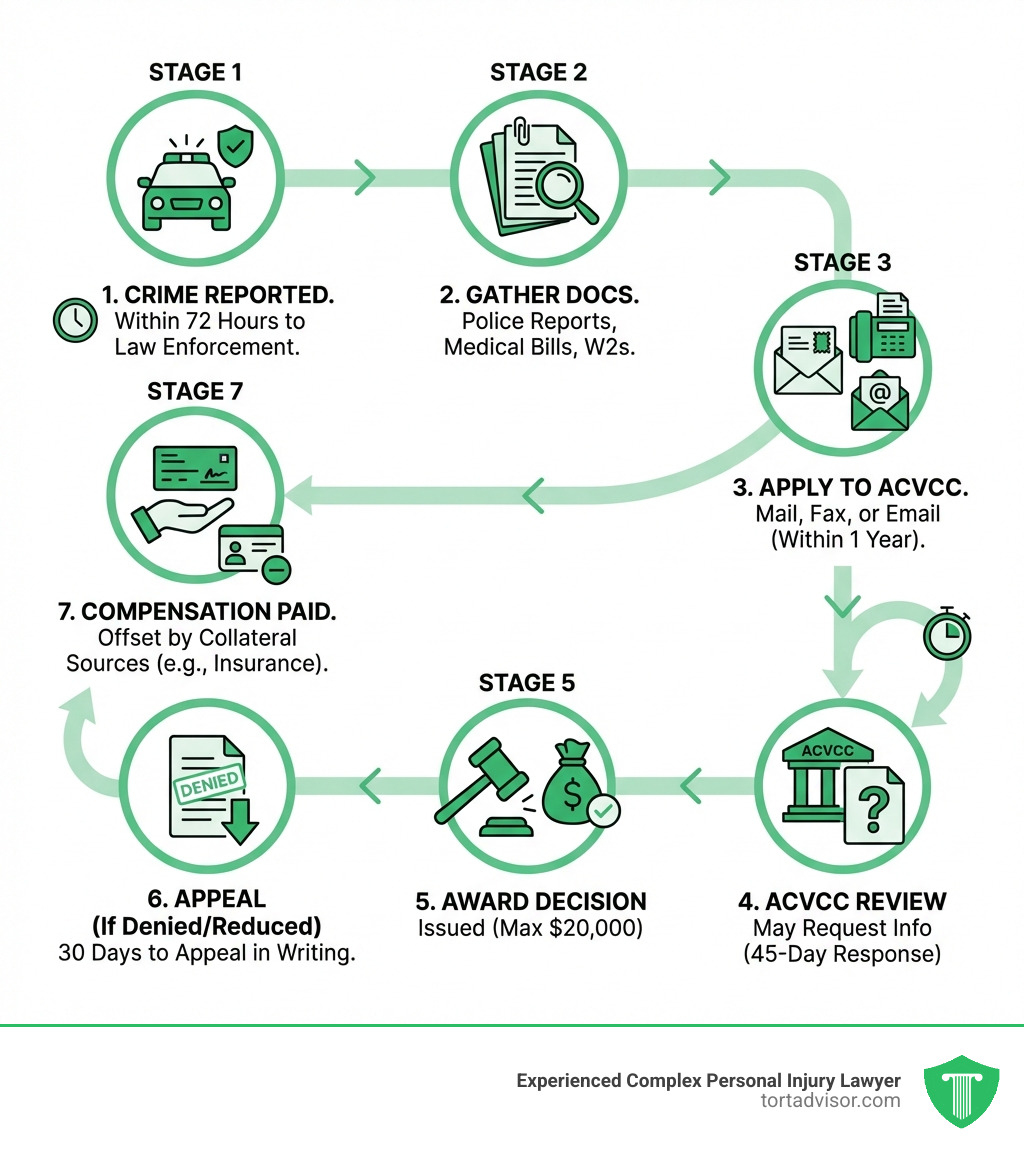
- The 72-Hour Report: You must report the crime to law enforcement within 72 hours of its occurrence.
- The 1-Year Filing Window: You must file your formal claim with the ACVCC within one year of the incident.
- Cooperation: You must cooperate fully with police, prosecutors, and the Commission. If you refuse to testify or stop answering the investigator’s questions, your claim could be denied.
- Innocence: You cannot have been the offender or an accomplice in the crime. Furthermore, your own conduct shouldn’t have contributed to the situation (more on “contributory conduct” later).
- Lawful Presence: Generally, you must be a U.S. citizen or a person lawfully present in the country. However, there are vital exceptions for victims of human trafficking or certain domestic violence situations.
What if I missed a deadline? Don’t panic just yet. The Commission can waive the 72-hour or 1-year rules if you can show “good cause” in writing. This usually applies to minors, people who were physically incapacitated in the hospital, or those with a mental disability that prevented them from acting sooner. For more info about the victim compensation fund and how these exceptions work, it’s often helpful to speak with a victim service officer.
Navigating the Alabama Crime Victim Compensation Application
The application is a multi-page document that requires a lot of “proof.” You can’t just say you lost money; you have to show it.
Required documentation typically includes:
- A complete police report.
- Medical bills and itemized receipts.
- Proof of lost wages (W2 forms, tax transcripts, or a signed statement from your employer).
- Funeral home contracts (if applicable).
- Notarized signatures on the application to verify everything is true.
You can submit an application via mail, fax, or email. Once they receive it, the Commission has the right to request more info. If they ask for a document, you usually have 45 days to provide it, or they might close your file.
Covered Expenses and Maximum Award Limits
The amount of money available depends largely on when the crime happened. Alabama updated its laws in 2014 to increase the help available to victims.
| Expense Type | Limit (Crimes BEFORE Oct 1, 2014) | Limit (Crimes ON/AFTER Oct 1, 2014) |
|---|---|---|
| Total Maximum Award | $15,000 | $20,000 |
| Funeral Expenses | $5,000 | $7,000* |
| Lost Wages (Weekly) | $400 | $600 |
| Lost Wages (Duration) | 26 weeks | 52 weeks |
*Note: For crimes occurring after July 9, 2020, the funeral limit returned to $5,000.
Counseling and Medical Reimbursement
Mental health is just as important as physical health. The ACVCC allows for up to 50 counseling sessions per claim. However, they don’t pay unlimited rates. They follow a strict “cost containment” schedule:
- Psychiatrists: Up to $125 per hour.
- Psychologists: Up to $100 per hour.
- Licensed Counselors/Social Workers: Up to $80 per hour.
- Group Therapy: Up to $60 per hour.
For medical bills (excluding counseling and dental), the Commission often pays a reduced rate—typically 30% of eligible charges up to a $6,000 maximum. This is because the Alabama Crime Victims Compensation Act aims to spread the available funds to as many victims as possible. Other covered costs can include victim rehabilitation, moving expenses (up to $1,000 in extreme safety cases), and even crime scene clean-up (up to $2,500).
Disqualifications, Collateral Sources, and Appeals
Not everyone who applies gets a check. Alabama is one of the strictest states when it comes to “contributory conduct.”
Your claim might be reduced or denied if:
- Contributory Conduct: You were doing something illegal or provocative that led to the crime (e.g., a drug deal gone wrong).
- Offender Benefit: If the money would “unjustly enrich” the offender (for example, if you still live with the person who hurt you and they would have access to the funds).
- Felony Conviction: If you are convicted of a felony after applying, you become ineligible.
- Non-Cooperation: If you stop helping the police or the Commission.
Collateral Source Recovery and Subrogation
The ACVCC is a “payer of last resort.” This means they look at “collateral sources” first. These include:
- Health or dental insurance.
- Workers’ compensation.
- Social Security benefits.
- Life insurance.
- Restitution ordered by a criminal court.
If you receive money from an insurance company for the same medical bills the Commission paid, you must pay the Commission back. This is known as subrogation. Furthermore, if you file a civil lawsuit against the offender, you must notify the Alabama Attorney General’s Office within 15 days.
The Appeals Process
If your claim is denied or the amount is lower than you expected, you have the right to fight back.
- Written Notice: You must notify the Executive Director in writing that you disagree with the decision.
- 30-Day Window: You only have 30 days from the date you received the decision to file this appeal.
- Administrative Hearing: You will be granted a hearing where you can present evidence or testimony to explain why the decision should be changed.
- Judicial Review: If you still disagree after the administrative appeal, you may be able to take the matter to civil court under the Alabama Administrative Procedure Act.
Frequently Asked Questions about Victim Resources
How do I contact the Commission for assistance?
The main office is in Montgomery, but you don’t have to drive there. You can call them at (334) 290-4420 or use the toll-free line at 1-800-541-9388 (reserved for victims only). Every District Attorney’s office in Alabama also has a Victim Service Officer who can help you fill out the paperwork for free.
Does Alabama crime victim compensation cover out-of-state incidents?
Yes, in specific cases. If you are a resident of Alabama but were victimized while traveling in another state (or even internationally in an act of terrorism), you may still be eligible. This usually applies if the state where the crime happened doesn’t have a similar compensation program or if you meet specific residency and travel criteria.
What property is excluded from compensation?
This is a common point of confusion. The ACVCC does not cover:
- Stolen or damaged property (like a broken window or a stolen car).
- Stolen cash or checks.
- Pain and suffering (this isn’t a personal injury lawsuit).
- Attorney fees for filing the claim.
The program is strictly for “economic loss”—real bills and lost paychecks resulting from physical injury or death.
Conclusion
Navigating the aftermath of a violent crime is an exhausting journey. While the alabama crime victim compensation program provides a vital safety net, the legal landscape can be tricky, especially when dealing with insurance companies or potential civil lawsuits against negligent third parties.
At Tort Advisor, we believe that every survivor deserves the best possible legal support. We connect clients with top-rated specialty attorneys who have proven results in complex personal injury and victim rights cases. Our goal is to ensure that while the state helps with your immediate bills, you have the legal muscle to pursue the full justice you deserve.
For more info about victim compensation services and how we can help you find the right legal advocate, reach out to us today. You’ve been through enough; let us help you find the path forward.
Free Confidential Case Evaluation
Complete the short form below to get an immediate FREE case review with an expert in your specific claim. Don't wait, your case could be time sensitive to file a claim.
Related Posts

Discover what to do after a Maryland car accident: immediate steps, insurance laws, claims, and legal help for commuters on I-95.
Discover the average payout for cancer misdiagnosis: $450K median settlements. Learn factors, real cases & how to claim compensation today.
Learn about the recall on gummy bear implants, BIA-ALCL risks, affected models, symptoms, lawsuits & compensation. Get expert legal guidance now!
Hire a defective product injury lawyer to fight for compensation after a defect causes harm. Learn strict liability, defects & claims.
Discover PFAS lawsuit settlement amounts per person kidney cancer: $150K-$500K estimates, eligibility, timelines & claim guide. Get started now!
Hire a top car accident lawyer phoenix az. Guide to claims, laws, steps, damages & choosing the best in Phoenix. Maximize your settlement!