What Is the Right of Way? Yield Rules and Fault After a Crash
If you are wondering what is the right of way, it is a duty to yield, meaning to wait and let another driver, cyclist or pedestrian go first, not a guaranteed right to go. Who had to yield in your crash depends on the signs or signals, who arrived first, whether someone was in a crosswalk, and your state’s traffic laws. Breaking a yield rule can be strong evidence of fault, but it usually does not decide fault on its own.
Even the driver with the right of way is expected to drive carefully. California’s driver’s handbook tells motorists never to assume other drivers will yield and to give up the right of way when doing so could prevent a collision. Some states also give yield rules extra weight after a crash. Texas’s right-of-way statutes, for example, presume that a driver who was required to yield at an intersection and then collided with other traffic there failed to yield.
Below, we explain who goes first at intersections, four-way stops and T-intersections, when pedestrians in a crosswalk have priority, and what federal data shows about crashes at intersections. We then look at how a failure to yield connects to fault and compensation, and close with questions worth writing down while your memory is fresh. Rules differ from state to state, so treat this as general information to help you understand your situation and decide on next steps.
Find out if you may have a claim
Answer a few questions and a trained case advisor will review your situation — most people finish in about a minute.
- Free — no cost, no obligation
- About a minute to complete
- Reviewed by a trained case advisor
- Nothing you submit is published
Your details are sent over a secure connection and reviewed confidentially.
What is the right of way? A duty to yield, not a right to go
The right of way is the set of rules that decides who goes first when drivers, pedestrians and bicyclists meet on the road. The California Driver’s Handbook describes these rules as a way to help traffic move safely by telling road users who goes first and who must wait.
Most of these rules are written as duties to yield. They tell a driver when to slow down, stop or wait for someone else. They do not give anyone permission to force their way through an intersection or crosswalk, even when it is technically their turn.
That is why the same California handbook tells drivers two things that can feel surprising:
- Never assume other people will yield to you. Another driver may not see you, may misjudge your speed or may simply ignore the rules.
- Give up your right of way when it helps prevent a collision. Being “first” matters less than avoiding a crash.
In everyday terms, the right of way is less about who wins and more about who must hold back. Understanding that difference can help you think more clearly about a crash you were involved in, including what each person was expected to do in the moments before it happened.
Rules vary by state. Each state writes its own traffic laws, and the details can differ in ways that matter after a crash. In this article, examples are labeled by state, mainly California and Texas. If your crash happened somewhere else, treat these examples as a starting point for questions, not as the rule that applies to you.
Who goes first at intersections, four-way stops and T-intersections
The short answer depends on the type of intersection and the state you are in. The common situations below are labeled by state because the wording of the rules is not the same everywhere.
California
According to the California Driver’s Handbook section on laws and rules of the road, these rules apply:
- Intersections without STOP or YIELD signs: The first vehicle to arrive goes first. If two vehicles arrive at the same time, you yield to the vehicle on your right.
- All-way (four-way) stops: You must stop first. Then the same first-to-arrive and yield-to-the-right rules apply.
- T-intersections without signs: Traffic on the through road has the right of way over a vehicle coming from the road that ends.
- Entering a highway: Traffic already on the highway has the right of way over vehicles entering it.
Texas
Texas puts its intersection yield duties in Transportation Code Chapter 545, Subchapter D (Right-of-Way):
- §545.151 (intersections without working controls): This section sets yield duties at uncontrolled intersections that are similar to California’s. It also covers a dark signal, meaning a traffic light that is not working. Drivers must treat it as a place to stop and then yield.
- §545.153 (stop signs and yield signs): This section explains what a driver must do when approaching an intersection controlled by a stop sign or a yield sign.
If your crash happened in another state, check that state’s own traffic code or driver handbook. The rules are often similar, but the details can differ.
Pedestrian right of way in a crosswalk
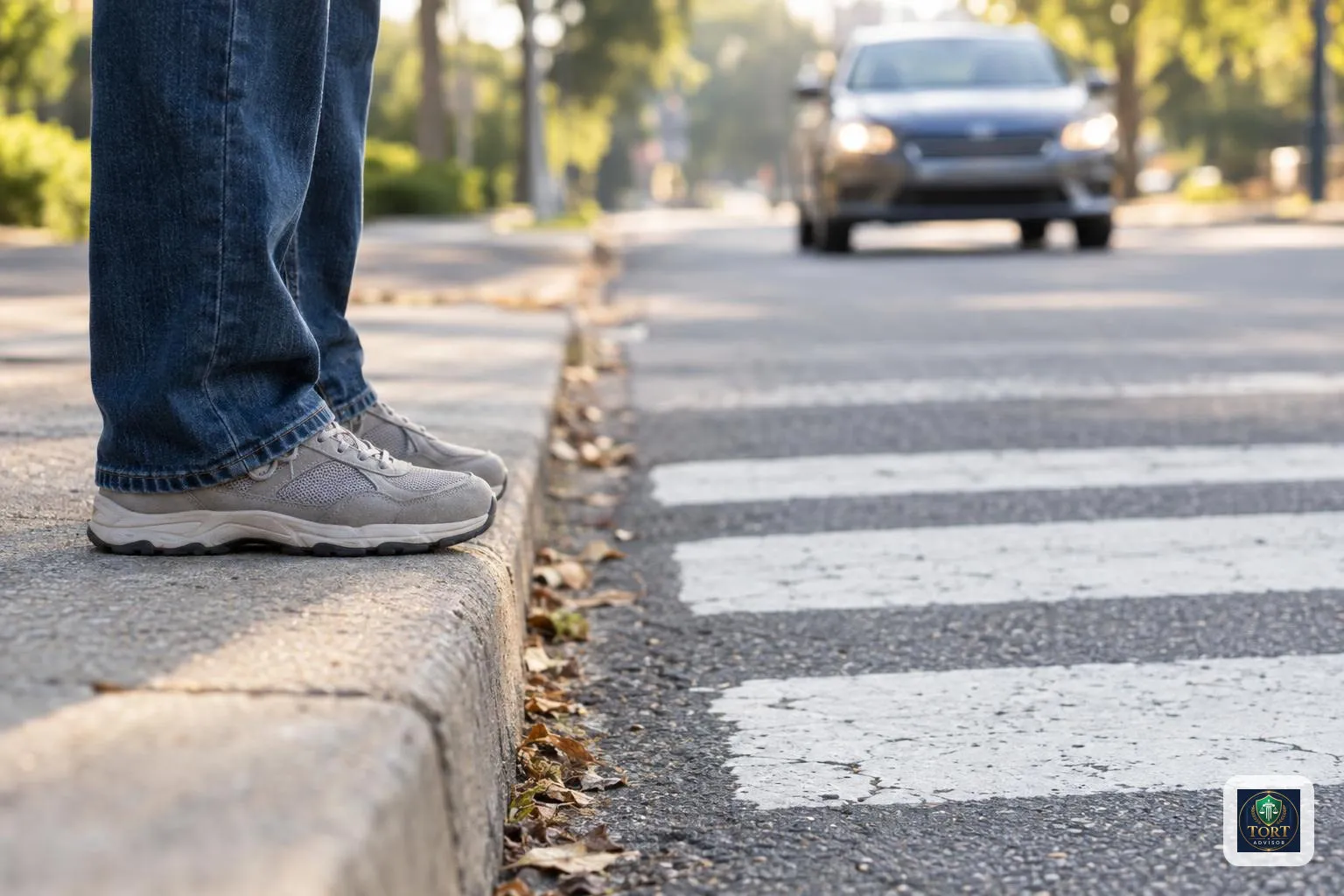
In many situations, drivers must yield to people on foot. That duty is not unlimited, though, and pedestrians can have yield duties of their own. The exact rules depend on the state where the crash happened.
California: pedestrians come first
The California Driver’s Handbook section on laws and rules of the road tells drivers that pedestrians always have the right of way. This is California’s own guidance. Other states may phrase the rule differently, so check the rules for the state where you were hurt.
Crossing mid-block: pedestrians may have to yield
Right of way can shift when someone crosses outside a crosswalk. A National Highway Traffic Safety Administration (NHTSA) guide to pedestrian safety enforcement explains that under the Uniform Vehicle Code, pedestrians may cross mid-block when the two nearest intersections are not signalized. When they do, they must yield to vehicles.
Common driver violations
The same NHTSA guide gives examples of drivers failing to yield to pedestrians, including:
- Failing to yield to a pedestrian crossing on a walk signal
- Failing to yield to a pedestrian while making a right turn on red
The guide also lists violations that pedestrians can commit. A crash may not come down to one simple answer, and both people’s actions can matter.
The right of way is not a shield
NHTSA’s guide also reminds pedestrians that having the right of way will not protect them from a driver who isn’t paying attention. If you were struck while crossing legally, the law may favor you. Still, write down what you remember about the signal, the crosswalk and the driver’s movements while the details are fresh.
Why failure to yield matters: what federal data shows about intersections
Right-of-way mistakes matter most at intersections, and a traffic light does not make a crossing safe on its own. According to the Federal Highway Administration, about one-third of intersection fatalities occur at signalized intersections, the places where signals are supposed to tell everyone when to go.
Intersections are built-in points of conflict
An intersection is where paths are designed to cross. Cars going straight, cars turning, people walking and people on bikes all share the same space, often within seconds of one another. Yield rules exist to sort out who moves first in exactly these moments. When someone ignores or misreads those rules, the result can be a collision that a few seconds of patience would have prevented.
The FHWA figure is a reminder of two things:
- Signals reduce confusion but do not remove risk. A green light or walk signal still depends on every other road user noticing it and responding correctly.
- Every type of intersection deserves attention. Whether a crossing has lights, stop signs or no controls at all, the moment paths cross is when yield duties matter most.
What this means for you after a crash
If your crash happened at an intersection, the question of who was supposed to yield is often central to understanding what went wrong. Note what controlled the intersection, such as a signal, stop signs, a yield sign or nothing at all, and what each driver or pedestrian was doing. Those details help connect the rules described above to the specific events of your crash. That connection is the subject of the next section.
How right of way connects to fault after a crash
Yield rules often become the starting point for deciding who was at fault. When a law says one driver had to yield and a crash followed, that driver’s conduct usually gets a close look. Texas is a useful example because its statutes spell this out. The rules below apply only in Texas.
Texas example: presumptions after a collision
Under Texas Transportation Code Chapter 545, Subchapter D, two provisions tie a collision to the duty to yield:
- §545.151(f): A driver who was required to yield at an intersection and is then involved in a collision there is presumed not to have yielded.
- §545.153(d): If a driver passes a yield sign without stopping and then collides with another vehicle or a pedestrian, the collision is prima facie evidence that the driver failed to yield.
A presumption or prima facie evidence is a starting point, not the final word. The other side can offer evidence about what actually happened, such as speed, visibility, signals or how the other driver behaved. Fault usually depends on what each person did, not just on who was supposed to go first.
Texas example: how shared fault affects recovery
Fault can be split between people. Under Texas Civil Practice and Remedies Code Chapter 33, an injured person found more than 50% responsible cannot recover damages (§33.001). If they are 50% or less responsible, their damages are reduced by their own percentage of responsibility (§33.012). Other states use different rules, so the outcome depends on where the crash happened.
Because these questions turn on evidence and state law, it can help to learn how an injury claim lawyer can help after a crash. If you are wondering what a claim might be worth, our guide to how settlement amounts and payouts are explained covers the factors involved. Every case is different, and no result is guaranteed.

If you were hurt: questions to note about who had to yield
Write down what you remember about who had to yield, while it is still fresh. You do not need to sort out fault yourself. Clear notes can help anyone who later reviews your crash.
- What controlled the spot? Note whether there was a traffic signal, a stop sign, a yield sign, a marked crosswalk or no control at all.
- Who arrived first? California’s handbook explains first-to-arrive, yield-to-the-right and T-intersection rules. The order of arrival can matter, so jot down what you saw.
- Who was turning? Record which direction each vehicle was headed and whether anyone was turning left or right.
- Where were pedestrians? Note whether anyone was in or near a crosswalk and which way they were walking.
Check your own state’s rules
Right-of-way rules and legal presumptions are not the same everywhere. In Texas, for example, the Transportation Code makes a collision after passing a yield sign prima facie evidence of failure to yield. Other states handle this differently. Look up your own state’s vehicle code, or ask a licensed attorney in your state how it applies to your situation.
Optional next steps on TortAdvisor
If you want to understand what can affect a claim, our injury claim settlement calculators walk through common factors. They are a learning tool, not a prediction or a guarantee of any result. If your injuries make it hard to keep working, you can read about what residual functional capacity means if injuries limit your work.
Some readers find that more than one issue applies to them. If a brake, airbag or other part may have failed, see your rights when a vehicle defect may have caused the injury. Our research also covers unrelated areas, such as California detention center sexual abuse claims and filing deadlines, if that is relevant to you or someone you care about.
Keep researching on TortAdvisor
Frequently asked questions
Do pedestrians always have the right of way?
It depends on where you are and how the person was crossing. In California, the state’s California Driver’s Handbook on laws and rules of the road tells drivers that pedestrians always have the right of way. That is California guidance, and other states may word their rules differently.
Under the model Uniform Vehicle Code described in NHTSA’s pedestrian safety enforcement guide, a pedestrian crossing mid-block outside a crosswalk must yield to vehicles. The same guide notes that having the right of way does not protect anyone from being hurt, so both drivers and walkers need to stay alert.
Who goes first at a four-way stop?
Under the California handbook cited above, the driver who arrives first at an all-way stop goes first. If two drivers arrive at about the same time, the driver on the left yields to the vehicle on the right. The handbook also warns drivers never to assume others will yield. Rules can vary by state, so check your own state’s driver manual or vehicle code if your crash happened somewhere else.
If I had the right of way, does that mean I cannot be found at fault?
Not necessarily. The California handbook cited above tells drivers to give up the right of way when doing so would prevent a collision. As a result, how each driver reacted can matter, not only who was supposed to go first. A driver who had the right of way but could have avoided the crash may still share some of the blame.
In Texas, Chapter 33 of the Civil Practice and Remedies Code reduces an injured person’s damages by their own percentage of responsibility. It bars recovery entirely if that person is more than 50% responsible. Other states use different fault rules.
What should drivers do when a traffic light is out?
In Texas, the right-of-way rules in Texas Transportation Code Chapter 545, Subchapter D cover intersections where the traffic signal is dark or not working. Drivers must stop before entering the intersection and yield the right of way, much as they would at a stop sign, before going ahead. Rules for dark signals differ from state to state, so drivers outside Texas should look up their own state’s law.
Is failure to yield presumed when a crash happens?
In Texas, sometimes yes. Under §545.151(f) of the Texas right-of-way subchapter cited above, a driver who was required to stop and yield at an intersection and is then involved in a collision there is presumed not to have yielded. Under §545.153(d), a collision after a driver passes a yield sign is prima facie evidence that the driver failed to yield.
These are Texas rules only. If you were hurt in a crash like this, writing down which signs or signals faced each driver can help when you talk with a lawyer or review your options on TortAdvisor.
Sources
- California Driver's Handbook, Section 7: Laws and Rules of the Road · California Department of Motor Vehicles
- Texas Transportation Code Chapter 545, Subchapter D: Right-of-Way (§§545.151–545.156) · Texas Legislature
- Pedestrian Safety Enforcement Operations: A How-To Guide · National Highway Traffic Safety Administration
- Signalized Intersections · Federal Highway Administration, U.S. DOT
- Texas Civil Practice and Remedies Code Chapter 33: Proportionate Responsibility · Texas Legislature
This article is general information, not legal advice. Laws and deadlines vary by state and change over time; check the linked sources or speak with a licensed attorney about your situation.
Who had the right of way is the starting question—not simply whose vehicle struck the other. Explore intersection scenarios, evidence and clearly labeled state-law examples before researching compensation.
Federal crash data shows a car turning left across a rider's path is one of the most common deadly motorcycle crash patterns. Here is how fault is usually sorted out, which evidence matters, and how shared-fault rules can change a claim.
Start with official sources for San Antonio crash updates, then learn how to interpret their limitations. This guide keeps live incident information separate from the records needed to research an injury claim.